Some videos I’ve watched in the recent month. The ones with Tom Holland are intriguing, at the very least as an illustration of the persuasive power of Christianity on the modern mind short of regeneration. May the Lord grant academics like Holland not just to be “near” the Kingdom or “almost a Christian,” but inside it and altogether Christian!
And as always, “standard caveats.” I read and watch a wide range of things, some of which I do not agree with in whole or in part. I do commend everyone to “test the spirits.” And even the most mature of Christians should ever be vigilant, knowing that our Enemy is ever on the ready to draw us away.
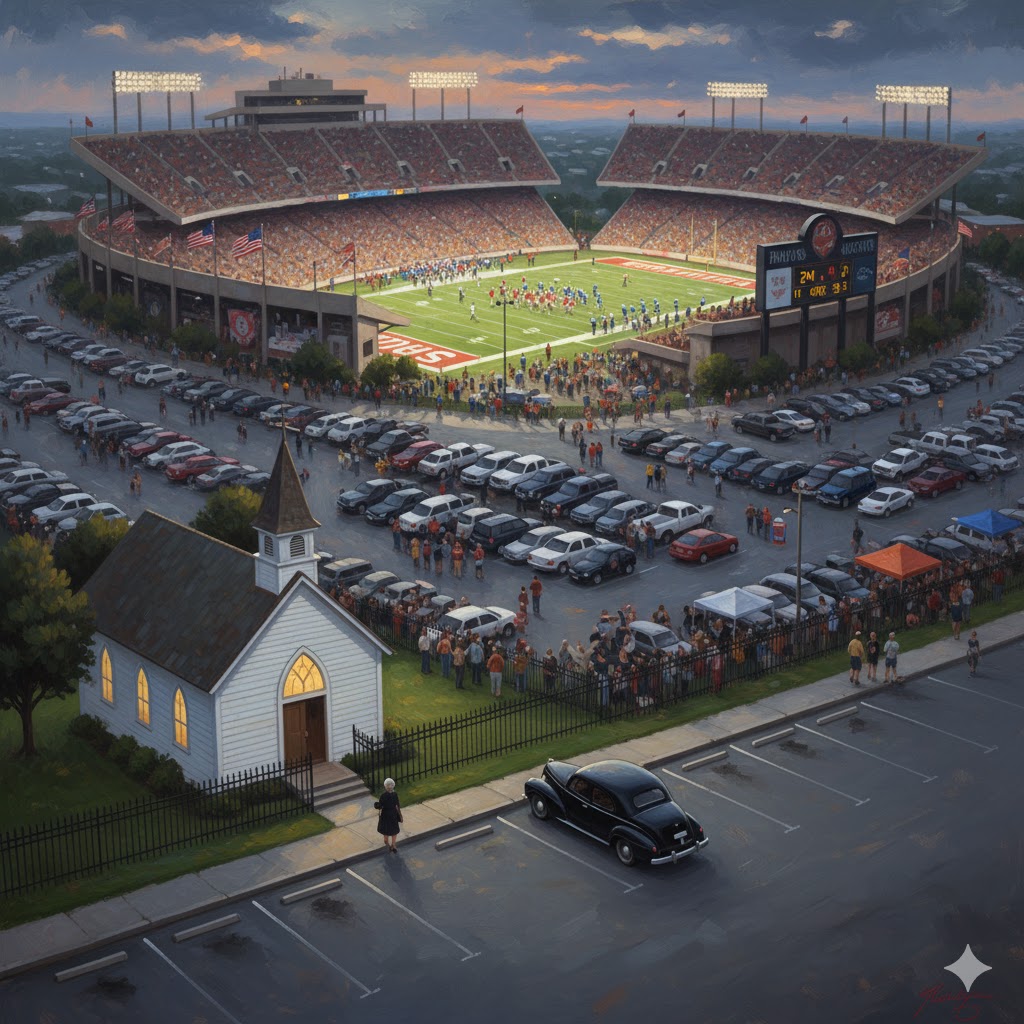
Alas, how far have we fallen from a right honoring of the Lord’s day in a land that was once “a city on a hill!” And how short is our collective memory of far better and holier days. But a simple search will bear witness. Our center of pleasure has shifted from the sacred to the secular, from God to games. The following is the Wikipedia entry for “Sunday sporting events.” Telling.
“Sunday sporting events were not usually played until the early 20th century. In North America, they were prohibited due to blue laws at first, but then cities like Chicago, St. Louis, and Cincinnati later decided to legalize them. Other cities such as New York City and Philadelphia had intense political and court battles to legalize the games. Nowadays, professional sports leagues schedule games on Sundays in the United States, though this practice continues to be opposed by some Christian denominations upholding first-day Sabbatarian doctrine.”
An intriguing thought. I’ve frequently thought of how establishments, while nearly a thing of the past in the secular West, might yet be on the horizon in the East. Stranger things have happened. And, of course, there is that ‘little thing’ (!) of prophecy: “Yea, all kings shall fall down before him: all nations shall serve him” (Psalm 72:11). O, brethren, let us pray for this nation, and for any godly magistrates that He might raise up “for such a time as this!” Mark Noll in his New Shape of World Humanity: How American Experience (2010):
“But third, it is a different story where Christianity spreads in regions of economic strength, as especially in Chᴉna. In this rapidly strengthening Asian power, the systems of belief that once guided society are passing away. Before Maoism imploded, it badly damaged ancestral reliance on Confucian precepts. Christianity seems to be taking off in Chᴉna because more and more Chᴉnese seem to be seeking a new moral compass as Chᴉna itself makes a commanding entrance onto the world stage. David Jeffrey, the provost of Baylor University who for fifteen years has been regularly invited to lecture on Christian subjects at premier universities in Chᴉna, has asked a speculative question that should give foreign analysts pause. Once before, Jeffrey remarks, a great world power passed through tumultuous times as Christian ranks expanded on the margins of society. It was the late 3rd and early 4th centuries. In that turmoil the Emperor Constantine was converted and become, from the top of the imperial system, a supporter of Christianity as a new glue for empire. Is it impossible to imagine that a new Constantine might exist somewhere in the junior ranks of the Chᴉnese communist party?”
Here’s a delightful old volume on Sabbath laws in the United States. As I skim through these, a few short observations. 1. We have collectively forgotten what was once a cultural norm. Hence the fitness of the imperative, “Remember the Sabbath day, to keep it holy.” 2. Freedom of thought, speech, and religion obviously had a big asterisk (at least from our 2024 context). Tolerance was clearly not a free-for-all for every pagan and libertine. 3. This gives the lie to the radical secular-sanitizing narratives of liberals who decry ‘Christian nationalism,’ as well as the hardcore R2K types like Daryl Hart who make strange bedfellows with the same.
“10. He may and ought to remove all false worships, and endure no corrupt preaching, or writing, or meetings for that end, or administrating of corrupted sacraments, or any ordinance other than what is allowed; for, Josiah did cause the people stand to the Covenant that was made, and having removed all idolatrous worship, he made Israel to serve the Lord, that is, he made them abandon corrupt worship, and wait on pure ordinances, as keeping of the sabbaths, offering of sacrifices, etc. and that according to the manner prescribed by the Lord.
“Neither was it a wronging of their liberty, to do so, because:
1. It was the preservation of their liberty, to keep them from the abominable bondage of these evils.
2. It was their duty to abstain from these, and to follow the ordinances purely, and the magistrate may well put people to that.
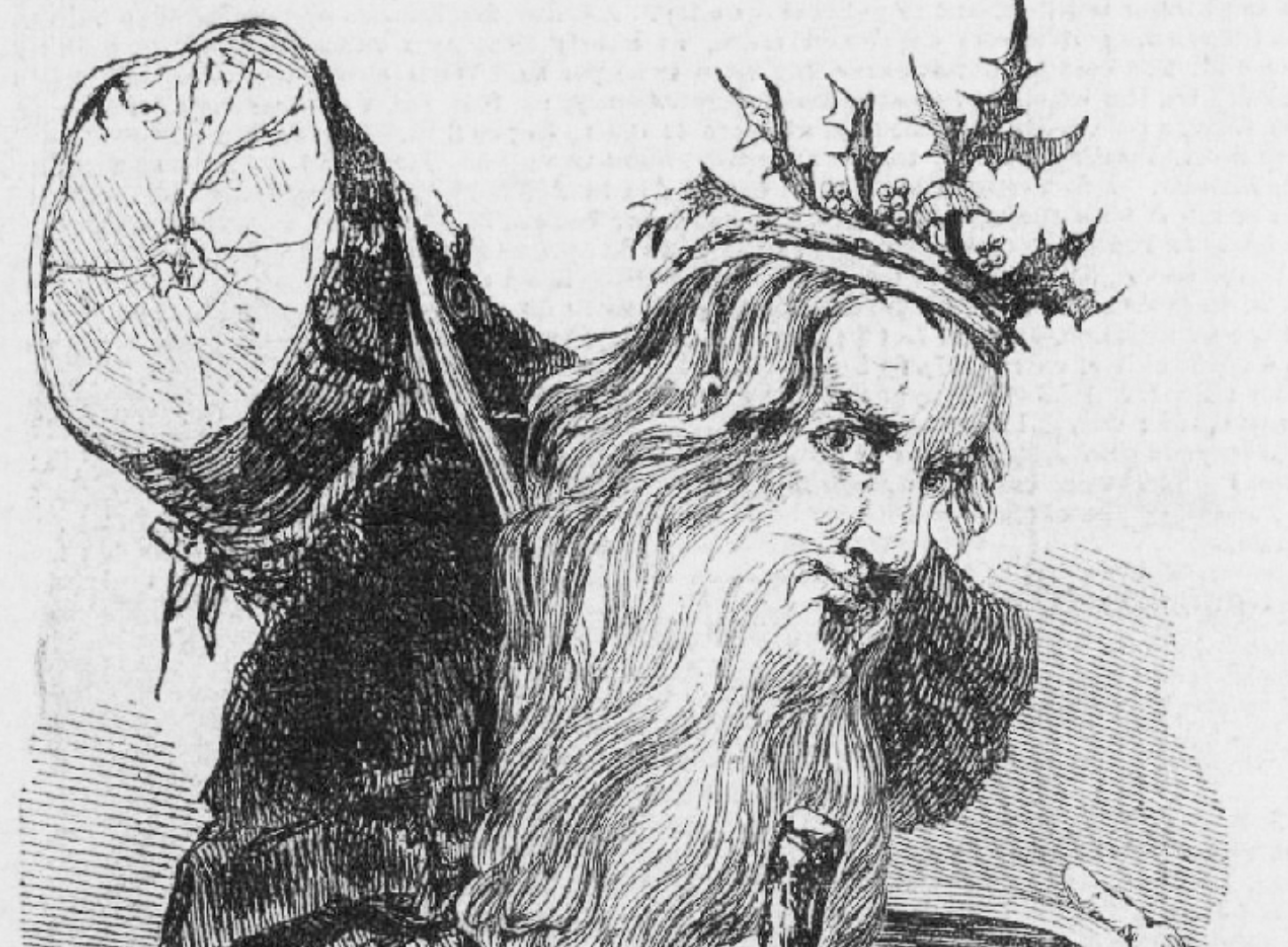
Cancelled services this ‘Christmas’ should be more than enough proof. Proof that Christmas observance and faithfulness to the pure worship of the one true and living God are mutually exclusive. That Christmas will, at least in part, be the death of us. And that, barring an outpouring of the Holy Spirit and a massive reformational purge of all the inventions of men in the worship of God, the West will soon be a paganized, secular wasteland.
Christmas and Christianity have admittedly coexisted for the better part of Christendom, except of course for the great Puritanic ‘pause’ from the 16th to the 18th centuries in much of English-speaking Protestantism. But how can what is fundamentally “not of heaven, but of men” (Luke 20:4), of unarguably ancient heathen and syncretistic Roman Catholic origin, ever live in peace with the Gospel of God? “And what concord [alliance] hath Christ with Belial? . . . And what agreement hath the temple of God with idols” (2 Cor. 6:15-16)?
This message was delivered at the Presbytery Conference of the Presbyterian Reformed Church on June 16, 2022. The audio is available here. Special thanks to Susan Abel for her selfless efforts in transcription!
* * * * *
Isaiah 35:7-10, “And the parched ground shall become a pool, and the thirsty land springs of water: in the habitation of dragons, where each lay, shall be grass with reeds and rushes. And an highway shall be there, and a way, and it shall be called The way of holiness; the unclean shall not pass over it; but it shall be for those: the wayfaring men, though fools, shall not err therein. No lion shall be there, nor any ravenous beast shall go up thereon, it shall not be found there; but the redeemed shall walk there. And the ransomed of the LORD shall return, and come to Zion with songs and everlasting joy upon their heads: they shall obtain joy and gladness, and sorrow and sighing shall flee away.”
Revelation 21:1-3, “And I saw a new heaven and a new earth: for the first heaven and the first earth were passed away; and there was no more sea. And I John saw the holy city, new Jerusalem, coming down from God out of heaven, prepared as a bride adorned for her husband. And I heard a great voice out of heaven saying, Behold, the tabernacle of God is with men, and he will dwell with them, and they shall be his people, and God himself shall be with them, and be their God. Amen, this is the Word of the living God.”
Last month I had the personal privilege of going back to my old stomping grounds—at least, one of them— as a boy. I had not been to Homestead, Florida, just south of Miami, since I was about fourteen years old, not long after my father went to glory. It was a place, notwithstanding the bitterness of the memories of the loss of my father, [that] was overall a time of great delight: many good memories, especially on this particular street. And I am sure my children can tell you, that I would mention the many late nights when we would play a pick-up game of baseball, and take some charcoal and make some bases, and have an awful lot of fun. Well, as we drove up and came into the neighborhood, memories started flooding back—a lot of good memories. And finally I came with my wife to this home, and there it was, largely as I remembered it, although it had a new coat of paint. And much was the same, and much was so very sweet and so very special. I even got to meet the next-door neighbor whom I did remember as a boy (and I got to have a selfie with them!). So it was quite special.
In the following quote, Chalmers explains how a territorial establishment, where parish missions bring the Gospel to every home and hearth, is a double blessing. Even if few souls are saved, the social and moral impact of the Gospel effort leavens the lump:
“And perhaps it will give in your eyes less of a Utopian, and more of an experimental character, to our anticipations of a result so general—if we ask you to consider the just observation of Mr. Wilberforce, on the effect of Christianity even beyond the circle of its own proper and genuine disciples. It elevates the general standard of morals, in every country or neighbourhood which it enters. Even though it should but spiritualize the few, it civilizes the many. Over and above its direct influence on those whom it converts, it has, through the medium of their example and their virtues, a reflex or secondary influence on the families of every little vicinity around them-insomuch that the sanctities and the extraordinary graces of a small number, with the influence of a purifying and preserving salt on the general mass, tell, by a certain overawing power, in restraining the profligacies, and so in raising the character for decency and morals of society at large. This will be remarkably seen in any parish that is under a reclaiming process from the out-fields of heathenism, if the experiment be but well and vigorously conducted. We do not say that the minister will Christianize all; or that he will introduce the worship of God, the voice of psalms, into every family. But the melody that is heard in the habitations of the righteous, will have a certain softening and subduing effect on the inmates of other habitations; and it will be found no romance, but in strict accordance with the realities of human nature, if-by means of his schools and of his other parochial institutes, and (of no small account either) if, by means of his own frequent and various intercourse with the people, and the dignifying effect upon all the householders of their personal acquaintance with the clergyman, and of the personal cognizance which he takes of them and of their families—he mollifies, and to a very great degree, the general aspect of that parochial community over which he presides ; and bequeaths to his successors a far blander and better generation, than he had to encounter himself at the outset of his great undertaking” (Works 14:334-335)
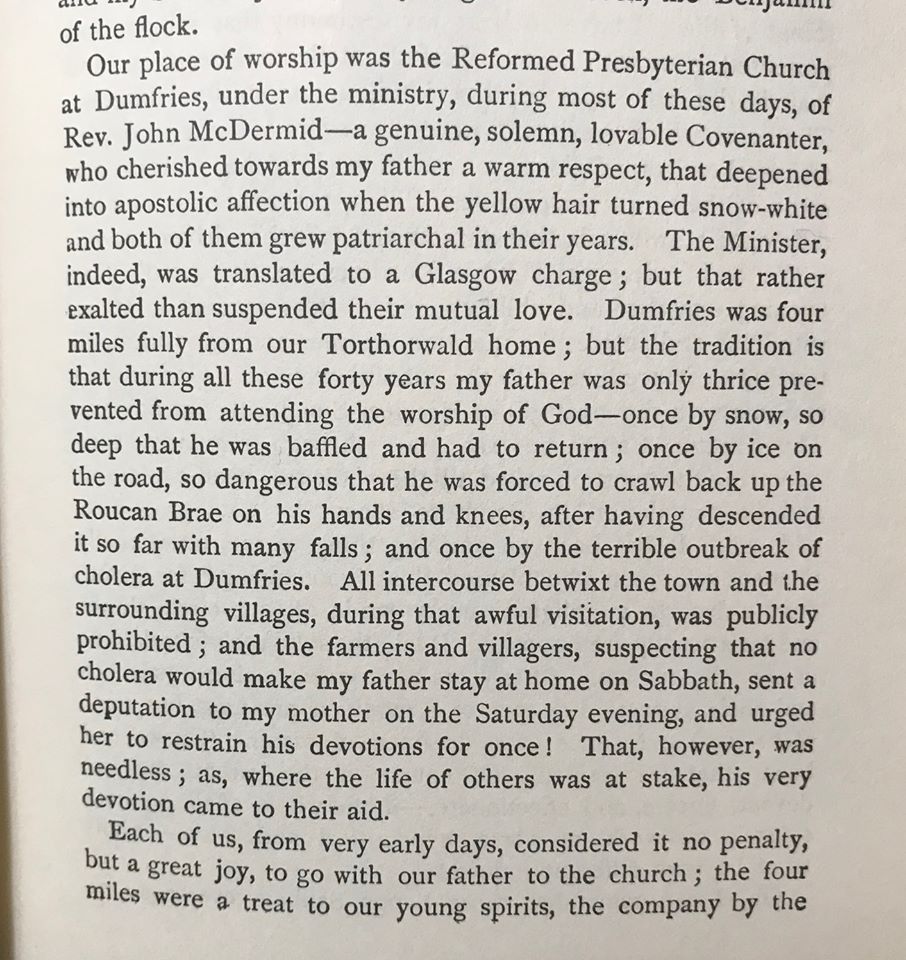
A few striking observations from a favorite anecdote in John G. Paton’s autobiography, below. If I’m not mistaken, this would be referring to a cholera outbreak in 1832 in the U.K.
1. Healthy believers long for the courts of the Lord and don’t let lesser things get in their way. 2. However, it appears that godly Scottish Presbyterians in the early 19th century believed that public health crises could warrant church closures (or at least effectively cause them by population controls). 3. And apparently, the same believed that the state could mandate such closures (or at least effectively, etc.) in the interests of public health.
Not an argument that any of our churches must necessarily close under the present circumstances; just an observation to help put some strong opinions out there in context.
During the recent COVID-19 crisis, many Christian churches have closed their doors, cancelling regular public worships services, though often utilizing telecommunications to facilitate God’s worship in private home contexts. What principles do confessionally Reformed and Presbyterian elders consider when making their decision? These are the ones that factored in to my mind.
1. Worship is priority number one. God’s honor comes before man’s honor, His being before ours. “Thy love is better than life.” We should sooner join the three Hebrew children and lay down our lives than surrender an inch of God’s worship. The First Table comes before the Second, and if there is an apparent conflict, the general rule is to surrender our own interests.





 West Port Experiment