Feeds:
Posts
Comments

Archive for the ‘Sabbatarianism & the Church Calendar’ Category

The following post was written by my friend, Rev. Jerrold Lewis, of the Free Reformed Churches.

* * * *

“They sacrifice upon the tops of the mountains, and burn incense upon the hills, under oaks and poplars and elms, because the shadow thereof is good…” (Hosea 4:13).

What was found in the Qumran caves was nothing new to Israel. In Hosea’s day, heart religion had long become a relic. Over generations, the fire of first love had all but gone out. Historically, slipping happens in stages. Typically, the first generation is passionate, the second grows complacent, and the third rebels. It’s a story as old as time. When the heart of religious man turns from the living God, it will fill that heart with other things. Oh, how each generation needs a fresh outpouring of the Holy Spirit! By the time we meet Israel in Hosea, the covenant people are in the third stage, rebellion.

Yet, this rebellion was not easily spotted. They still brought their sacrifices to the altar. They still offered their tithes and observed the holy days. The priests still performed their duties, just like past generations. To the casual eye, things appeared status quo. Outwardly, at least, Israel’s calendar was full, their altars were hot, the priesthood was sacrificing.

Read the rest here.

Read Full Post »

I could not bring myself to watch all of this, it’s just so idolatrous. But the observation is, if modern pagans take Halloween as their own, should it not raise some serious second thoughts among Christians who participate? “Have no fellowship with the unfruitful works of darkness, but rather reprove them.”

Read Full Post »

Alas, how far have we fallen from a right honoring of the Lord’s day in a land that was once “a city on a hill!” And how short is our collective memory of far better and holier days. But a simple search will bear witness. Our center of pleasure has shifted from the sacred to the secular, from God to games. The following is the Wikipedia entry for “Sunday sporting events.” Telling.

Sunday sporting events were not usually played until the early 20th century. In North America, they were prohibited due to blue laws at first, but then cities like ChicagoSt. Louis, and Cincinnati later decided to legalize them. Other cities such as New York City and Philadelphia had intense political and court battles to legalize the games. Nowadays, professional sports leagues schedule games on Sundays in the United States, though this practice continues to be opposed by some Christian denominations upholding first-day Sabbatarian doctrine.”

Read the rest here.

[Image courtesy of Google Gemini.]

Read Full Post »

“As the Sabbath Day is the most excellent of all the Days in the week; so a Communion Sabbath is the most desireable of all the Sabbaths in the Year; for, that is a Day in God’s Courts, in an eminent Manner, and is truly better than a Thousand. . . . If ordinary Sabbaths do require great Care and Diligence in preparing for, and improving them; then much more do Communion Sabbaths, being solemn and high Days; wherein we make most near Approaches unto God, and he makes near Approaches unto us: They are Days of Heaven upon Earth, and do most eminently represent the Employments and Enjoyments of the Glorified in Heaven.”

John Willison

Read Full Post »

“Time is one of the most precious Things in the World, and what can never be enough valued, nor be carefully improven, seeing the eternal Salvation of our precious and immortal Souls doth wholly depend thereupon. . . . But of all Time, Sabbath Time is the most precious and valuable; since, upon the Improvement ofit, the Salvation of our Souls dependeth in a special Manner. Time is fitly compared to a Ring of Gold, and the Sabbath to the sparkling Diamond in it. So that we ought to have a peculiar Esteem for the Sabbath, and reckon every Moment of Sabbath Time precious, as we do the Fylings of Gold, being careful that none of it be lost.”

John Willison, Treatise Concerning the Sanctification of the Lord’s Day

Read Full Post »

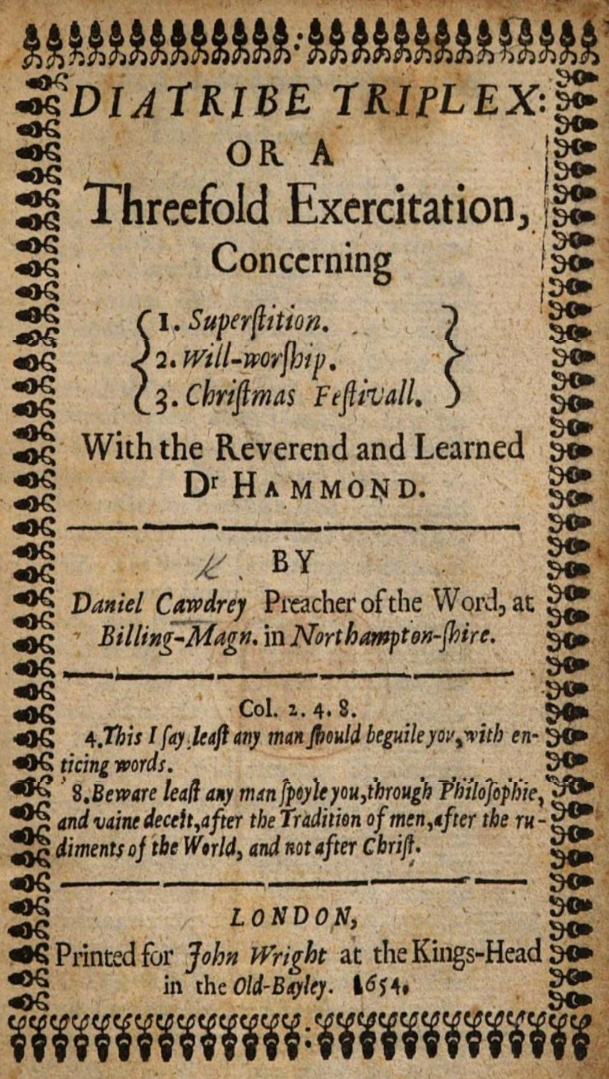
Just finished recording part 2 of 2 of Daniel Cawdrey’s “Of the Festivals of the Church, and Especially Christmas.” Listen to the audio here. This is the third part of a larger work, attached below. The University of Michigan has digitized the text here.

Visit the complete WPE Audio library.

Cawdrey (1588–1664) was a member of the Westminster Assembly, which produced the Westminster Confession of Faith, as well as the Larger and Shorter Catechisms. Like the rest of the Puritans of England and New England, as well as the Presbyterians of Scotland, these godly men rejected all holy days of men’s devising based on what has become called the ‘regulative principle of worship,’ which requires us to have clear and undoubted certainty about the divine, scriptural origin of any worship practice, and that any worship falling short of this standard must be set aside.

The Puritans were not kill-joys or men of bigoted, narrow minds. Anyone who reads their sermons and devotional writings will find them to be the warmest lovers of God, of Christ, and of their fellow men. They were also as a rule generous, catholic-minded men who embraced all those who called upon the Lord in sincerity, even among those who might disagree with them. And above all, they were men who passionately wanted to please God, even if that went against the flow of the opinions of men. I offer these recordings in that spirit.

The following is a sample from Cawdrey, in particular on his contention that the observation of Christmas is ultimately hostile to the proper, apostolic practice of Lord’s day observance:

“[It is said that] The Birth of Christ, is a mercy of such excellent quality, that it can never be overvalued, &c. This is granted; ​But to Institute a day as Holy, without command of Christ, for an Annual commemoration of this, is above the power of any Church, and a Superstitious presumption: and [altogether] needless; considering that the Lord’s day, (which includes the commemoration, not only of his Birth, but his Resurrection, and the whole works of our Redemption by him) was instituted by himself, or his Apostles, by him authorized and inspired, for this very end; & comes [around] once in every week. To limit it therefore to one day in a year, to remember that Mercy, is not an exaltation, but a derogation from it. If this were done, on his own design[ated] Day, wee need not fixe another day.”

Friend, let appeal to you not to brush off this position. You may in the end disagree with it; by all means, search the Scriptures, and be a Berean. But none of us “have attained,” and we should always be willing to bring any of our views or practices to the touchstone of Scripture. Embracing this position would naturally involve sacrifices, hurt feelings, and misunderstandings. But I can assure you from close to 30 years of experience after becoming convinced, and after raising four children in these principles, it is well worth it. “Them that honor me, I will honor.” And you don’t have to be a Grinch! I’m not—and I keep up many, many friendships with dear brothers who aren’t persuaded.

But of course, they’ll understand sooner or later (1 Cor. 13:12)!

Read Full Post »
Read Full Post »

Moses atop the U.S. Supreme Court (source)

Here’s a delightful old volume on Sabbath laws in the United States. As I skim through these, a few short observations. 1. We have collectively forgotten what was once a cultural norm. Hence the fitness of the imperative, “Remember the Sabbath day, to keep it holy.” 2. Freedom of thought, speech, and religion obviously had a big asterisk (at least from our 2024 context). Tolerance was clearly not a free-for-all for every pagan and libertine. 3. This gives the lie to the radical secular-sanitizing narratives of liberals who decry ‘Christian nationalism,’ as well as the hardcore R2K types like Daryl Hart who make strange bedfellows with the same.

A few samples from states in which I’ve lived:

(more…)

Read Full Post »

A fallible, yet sturdy monument to far better times, when men feared God and kept His day. Lord, let your Wind blow once again!

Read Full Post »

Thomas Shepard (1605-1649), on civil magistrates promoting the true religion. “Thesis 20. And if superiors in families are to see their gates preserved unspotted from such provoking evils, can any think but that the same bond lies upon superiors in commonwealths, who are the fathers of those great families, whose subjects also are within their gates, and the power of their jurisdictions? The civil magistrate, though he hath no power to impose new laws upon the consciences of his subjects, yet he is bound to see that the laws of God be kept by all his subjects; provided always, that herein he walk according to the law and rule of God, viz., that, 1, ignorant consciences in clear and momentous matters be first instructed; 2, doubting consciences have sufficient means of being resolved; 3, bold and audacious consciences be first forewarned. Hence it is, that though he hath no power to make holy days, and to impose the observation of them upon the consciences of his subjects, (because these are his own laws,) yet he may and should see that the Sabbath day, (the Lord’s holy day,) that this be observed, because he doth but see to the execution of God’s commandment herein.”

Read Full Post »

Older Posts »