Posted in New England Puritanism, Puritans & Puritanism, Vox Patrum on March 18, 2025| Leave a Comment »
Posted in Audio Resources, Conscience & Casuistry, Experimental Religion & the Cure of Souls, Mental Health, Pastoral Theology, Puritans & Puritanism, Richard Baxter on February 19, 2025| Leave a Comment »
I just completed reading-recording the most helpful, practical, and thorough treatment on the subject of the Christian and his emotions I have ever read. Baxter’s “On the Government of the Passions” (or emotions) is found in Volume 3 of his Practical Works, a part of his massive Christian Directory. If you’ve never read the Puritans before, this would surely be a good place to start. The English is of course dated, but I’d say its much more accessible than you might think. I would personally encourage anyone who has never read this to do so—and you’ll probably feel like me, that this one should be read maybe once per year. And now I’ve recorded if for you, so now you have no excuse! Begin to heal your disordered feelings and cultivate a godly, stable, and enriching emotional life today as you are stuck in traffic or washing dishes. Your next podcast episode will still be there later. Your venerable fathers await!
And on the subject, let me commend a (more) modern theologian, B. B. Warfield, and his absolutely one-of-a-kind article, “On the Emotional Life of our Lord.” As Baxter is a doctor here treating the illness, Warfield presents the Savior who walked in our footsteps with the full range of our emotions, yet without sin. And the complete WPE Audio library can be accessed by the tab up top.
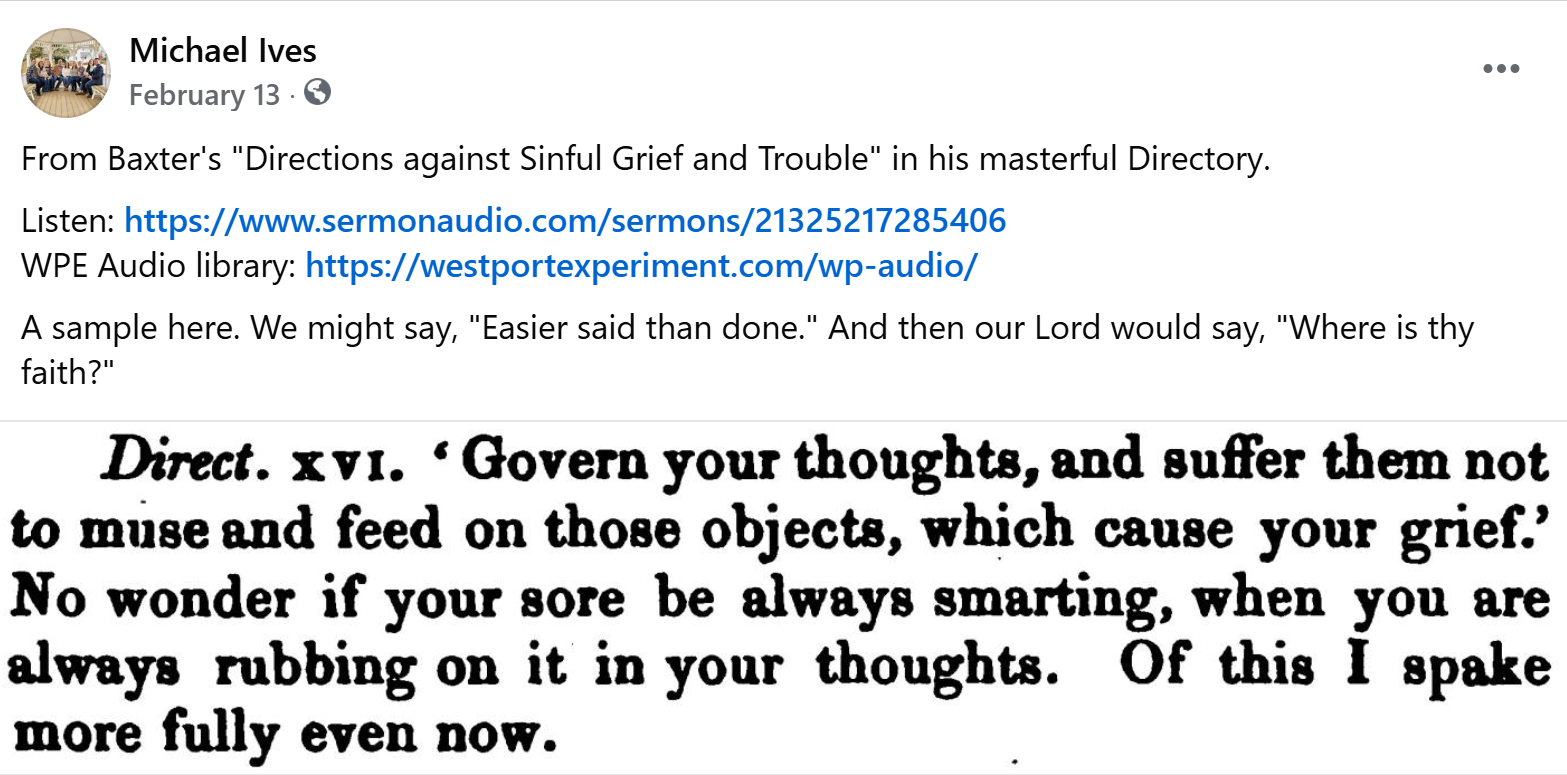
The following is a sample, where Baxter is treating sinful depression and despair. The PDF is below (print p. 256; pdf p. 281)
* * * *
Direction XIV. ‘Abhor all that tendeth to take down the power and government of reason (that is, all feebleness and cowardioe of mind, and a melancholy, a peevish, passionate disposition): and labour to keep up the authority of reason, and to keep all your passions subject to your wills; which must be done by Christian faith and fortitude.’ If you come once to that childish or distracted pass, as to grieve and say, ‘I cannot help it: I know it is sinful and immoderate, but I cannot choose,’ if you say true, you are out of the reach of counsel, advice, or comfort. You are not to be preached to, nor talked to, nor to be written for: we do not write directions to teach men how to touch the stars or explain the asperities or inequalities of the moon, or the opacous [opaque, or hidden] parts of Saturn, or to govern the orbs, or rule the chariot of the sun. If it be become a natural impossibility to you, doctrine can give you no remedy: but if the impossibility be but moral in the weakness of reason, and want of consideration, it may be doctrine, consideration, and resolution be overcome. You can do more if you will than you think you can. How come you to lose the command of your passions? Did not God make you a rational creature that hath an understanding and will to rule all passions? How come you to have lost the ruling power of reason and will? You would take it for a disparagement to be told that you have lost the use of your reason: And is it not a principal use of it to rule the passions, and all other inferior subject powers? You say you cannot choose but grieve! But if one could give you that creature which you want or desire, then you could choose: You could rejoice, if one could restore you that child, that friend, that estate which you have lost. But God, and Christ, and Heaven it seems, are not enough to cure you: if you must have but them you cannot choose but grieve! And what hearts have you then that are thus affected? Should not those hearts be rather grieved for? God will sometime make you see, that you had more power than you used.
Posted in Audio Resources, Conscience & Casuistry, Legalism & Antinomianism, Natural Law, Puritans & Puritanism on December 30, 2024| Leave a Comment »
This small treatise reflects something of the high watermark the Puritans left the Church in Christian ethics & casuistry, written by the Westminster Divine, Thomas Manton. Access the audio here. He does a masterful job of exposing a subtle, legal attitude so often prevalent in the church, that outward, religious observances must always and without qualification supersede concerns of human life and well-being. A colleague of mine shared it with me during the Covid church closure mess of 2020. It was quite relevant then and remains so today. A must-read for every Reformed pastor if not every serious Christian. And visit the complete audio library here.
Posted in Audio Resources, New England Puritanism, Puritans & Puritanism, Sabbatarianism & the Church Calendar, Worship, True & False, tagged bible, christianity, christmas, faith, jesus on December 1, 2024| Leave a Comment »
Just finished recording part 2 of 2 of Daniel Cawdrey’s “Of the Festivals of the Church, and Especially Christmas.” Listen to the audio here. This is the third part of a larger work, attached below. The University of Michigan has digitized the text here.
Visit the complete WPE Audio library.
Cawdrey (1588–1664) was a member of the Westminster Assembly, which produced the Westminster Confession of Faith, as well as the Larger and Shorter Catechisms. Like the rest of the Puritans of England and New England, as well as the Presbyterians of Scotland, these godly men rejected all holy days of men’s devising based on what has become called the ‘regulative principle of worship,’ which requires us to have clear and undoubted certainty about the divine, scriptural origin of any worship practice, and that any worship falling short of this standard must be set aside.
The Puritans were not kill-joys or men of bigoted, narrow minds. Anyone who reads their sermons and devotional writings will find them to be the warmest lovers of God, of Christ, and of their fellow men. They were also as a rule generous, catholic-minded men who embraced all those who called upon the Lord in sincerity, even among those who might disagree with them. And above all, they were men who passionately wanted to please God, even if that went against the flow of the opinions of men. I offer these recordings in that spirit.
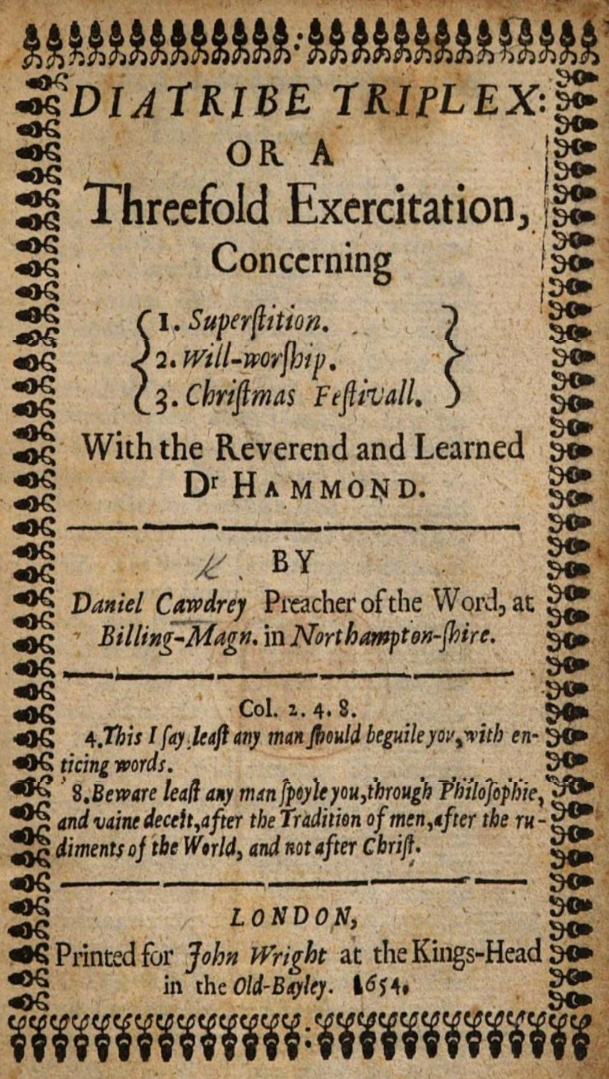
The following is a sample from Cawdrey, in particular on his contention that the observation of Christmas is ultimately hostile to the proper, apostolic practice of Lord’s day observance:
“[It is said that] The Birth of Christ, is a mercy of such excellent quality, that it can never be overvalued, &c. This is granted; But to Institute a day as Holy, without command of Christ, for an Annual commemoration of this, is above the power of any Church, and a Superstitious presumption: and [altogether] needless; considering that the Lord’s day, (which includes the commemoration, not only of his Birth, but his Resurrection, and the whole works of our Redemption by him) was instituted by himself, or his Apostles, by him authorized and inspired, for this very end; & comes [around] once in every week. To limit it therefore to one day in a year, to remember that Mercy, is not an exaltation, but a derogation from it. If this were done, on his own design[ated] Day, wee need not fixe another day.”
Friend, let appeal to you not to brush off this position. You may in the end disagree with it; by all means, search the Scriptures, and be a Berean. But none of us “have attained,” and we should always be willing to bring any of our views or practices to the touchstone of Scripture. Embracing this position would naturally involve sacrifices, hurt feelings, and misunderstandings. But I can assure you from close to 30 years of experience after becoming convinced, and after raising four children in these principles, it is well worth it. “Them that honor me, I will honor.” And you don’t have to be a Grinch! I’m not—and I keep up many, many friendships with dear brothers who aren’t persuaded.
But of course, they’ll understand sooner or later (1 Cor. 13:12)!
Posted in Audio Resources, New England Puritanism, Puritans & Puritanism, The Church in America on November 28, 2024| Leave a Comment »
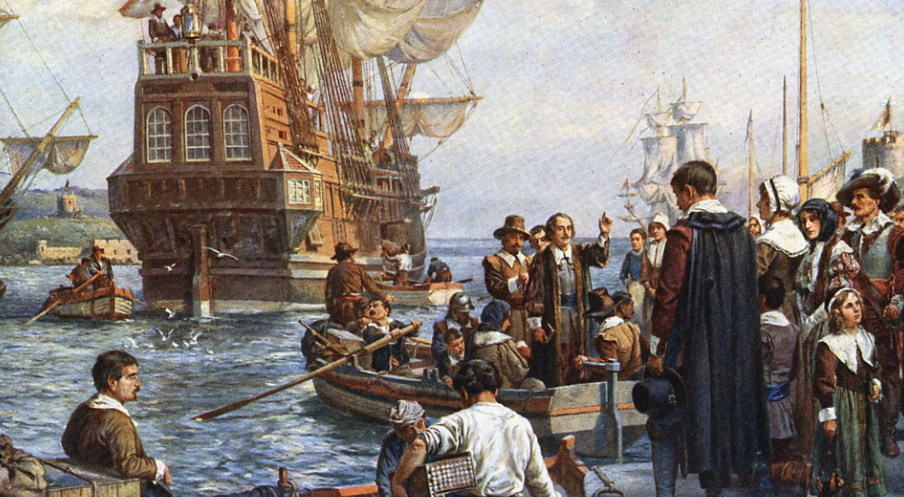
I’ve recorded several chapters of Cotton Mather’s great Magnalia Christi Americana: Or, The Ecclesiastical History of New-England: from Its First Planting, in the Year 1620, Unto the Year of Our Lord 1698. Here are the opening words of the first chapter, “Discoveries of America.”
* * * * *
“It is the opinion of some, though ’tis but an opinion, and but of some learned men, that when the sacred oracles “of Heaven assure us, the things under the earth are some of those, whose knees are to bow in the name of Jesus, by those things are meant the inhabitants of America, who are Antipodes to those of the other hemisphere. I would not quote any words of Lactantius, though there are some to countenance this interpretation, because of their being so ungeographical: nor would I go to strengthen the interpretation by reciting the words of the Indians to the first white invaders of their territories, we hear you are come from under the world to take our world from us. But granting the uncertainty of such an exposition, I shall yet give the Church of God a certain account of those things, which in America have been believing and adoring the glorious name of Jesus; and of that country in America, where those things have been attended with circumstances most remarkable. I can contentedly allow that America (which, as the learned Nicholas Fuller observes, might more justly be called Columbina) was altogether unknown to the penmen of the Holy Scriptures, and in the ages when the Scriptures were penned. I can allow, that those parts of the earth, which do not include America, are, in the inspired writings of Luke and of Paul, stiled all the world. I can allow, that the opinion of Torniellus and of Pagius, about the apostles preaching the gospel in America, has been sufficiently refuted by Basnagius. But I am out of the reach of Pope Zachary’s excommunication. I can assert the existence of the American Antipodes: and I can report unto the European churches great occurrences among these Americans. Yet I will report every one of them with such a Christian and exact veracity, that no man shall have cause to use about any one of them the words which the great Austin (as great as he was) used about the existence of Antipodes; it is a fable, and nulla ratione credendum.
Posted in Audio Resources, Conscience & Casuistry, New England Puritanism, Puritans & Puritanism on November 2, 2024| Leave a Comment »
John Cotton gives an extremely helpful list of biblical considerations for the Christian who is trying to decide whether or not to move. This is taken from “God’s Promise to His Plantations” (1630). I’ve left the archaic formatting in place.
* * * * *
Quest. But how shall I know whether God hath appointed me such a place, if I be well where I am, what may warrant my removeall?
Answ. There be foure or five good things, for procurement of any of which I may remove. Secondly, there be some evill things, for avoiding of any of which wee may transplant our selves. Thirdly, if withall we find some speciall providence of God concurring in either of both concerning our selves, and applying general grounds of removall to our personall estate.
First, wee may remove for the gaining of knowledge. Our Saviour commends it in the Queene of the south, that she came from the utmost parts of the earth to heare the wisdom of Solomon: Matth. 12. 42. And surely with him she might have continued for the same end, if her personall calling had not recalled her home.
Secondly, some remove and travaile for merchandize and gaine-sake; Daily bread may be sought from farre, Prov. 31. 14. Yea our Saviour approveth travaile for Merchants, Matth. 13. 45, 46. when hee compareth a Christian to a Merchantman seeking pearles: For he never fetcheth a comparison from any unlawful thing to illustrate a thing lawfull. The comparison from the unjust Steward, and from the Theefe in the night, is not taken from the injustice of the one, or the theft of the other; but from the wisdome of the one, and the sodainnesse of the other; which in themselves are not unlawfull.
To read further, see below. To access the entire sermon and an audio recording, click here.
Posted in Establishments, Patronage, Puritans & Puritanism, Sacred & Secular, The Godly Prince, Two Kingdoms Theology on March 12, 2024| Leave a Comment »
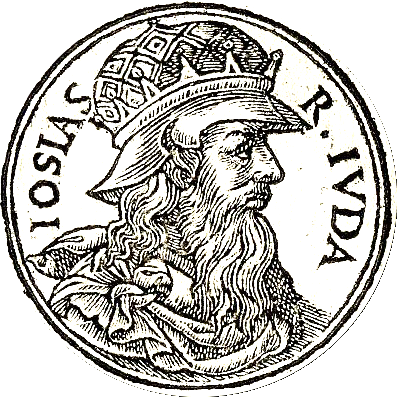
“10. He may and ought to remove all false worships, and endure no corrupt preaching, or writing, or meetings for that end, or administrating of corrupted sacraments, or any ordinance other than what is allowed; for, Josiah did cause the people stand to the Covenant that was made, and having removed all idolatrous worship, he made Israel to serve the Lord, that is, he made them abandon corrupt worship, and wait on pure ordinances, as keeping of the sabbaths, offering of sacrifices, etc. and that according to the manner prescribed by the Lord.
“Neither was it a wronging of their liberty, to do so, because:
1. It was the preservation of their liberty, to keep them from the abominable bondage of these evils.
2. It was their duty to abstain from these, and to follow the ordinances purely, and the magistrate may well put people to that.
(more…)Posted in Heathenism, Puritans & Puritanism, Theology Proper on January 10, 2024| Leave a Comment »
Posted in Establishments, New England Puritanism, Puritans & Puritanism, Sabbatarianism & the Church Calendar, The Godly Prince on December 20, 2023| Leave a Comment »

Thomas Shepard (1605-1649), on civil magistrates promoting the true religion. “Thesis 20. And if superiors in families are to see their gates preserved unspotted from such provoking evils, can any think but that the same bond lies upon superiors in commonwealths, who are the fathers of those great families, whose subjects also are within their gates, and the power of their jurisdictions? The civil magistrate, though he hath no power to impose new laws upon the consciences of his subjects, yet he is bound to see that the laws of God be kept by all his subjects; provided always, that herein he walk according to the law and rule of God, viz., that, 1, ignorant consciences in clear and momentous matters be first instructed; 2, doubting consciences have sufficient means of being resolved; 3, bold and audacious consciences be first forewarned. Hence it is, that though he hath no power to make holy days, and to impose the observation of them upon the consciences of his subjects, (because these are his own laws,) yet he may and should see that the Sabbath day, (the Lord’s holy day,) that this be observed, because he doth but see to the execution of God’s commandment herein.”
Posted in New England Puritanism, Puritans & Puritanism, The Church in America on August 22, 2023| Leave a Comment »
“Englands sinnes have been great, yea and their mercies great. England hath been a mirror of mercy, yet God may leave us, and make us a mirrour of his justice. Looke how he spake to the people in Ier. 7. that bragged of the Temple of the Lord, Sacrifices and offerings: And what may not God which destroyed Shilo, destroy thee O England? Goe to Bohemia, from thence to the Palatinate, and so to Denmarke. Imagine you were there, what shall you see, nothing else but as Travellers say, Churches made heaps of stones, and those Bethels wherin Gods name was called upon, are made defiled Temples for Satan and superstition to raigne in? You cannot goe two or three steps, but you shall see the heads of dead men, goe a little further, and you shall see their hearts picked out by the fowles of the ayre, whereupon you are ready to conclude that Tilly hath been there: Those Churches are become desolate, and why not England? Goe into the Cities and Townes, and there you shall see many compassed about with the chaines of captivity, and every man bemoaning himselfe. Doe but cast your eyes abroad, and there you shall see poore fatherlesse children sending forth their breaches, with feare, crying to their poore helplesse mothers. Step but a little farther, and you shall see the sad wife bemoaning her husband, and that is her misery, that she cannot dye soone enough; and withall she makes funerall Sermons of her children within her selfe, for that the Spaniard may get her little ones, and bring them up in Popery and superstition; and then she weeps and considers with her selfe: If my husband be dead, it is well, happily he is upon the racke, or put to some cruell tortures, and then she makes funerall Sermons, and dyes a hundred times before she can dye. Cast your eyes afar off, set your soules in their soules stead, and imagine it were your owne condition, why may not England be thus, who knowes but it may be my wife, when he heares of some in torments? Ah! Brethren, be not high minded, but feare, as we have this bounty on the one side, so may we have this severity on the other; therefore prancke not up your selves with foolish imaginations, as who dare come to England, the Spaniards have enough, the French are too weake: Be not deceived, who thought Ierusalem the Lady of Kingdomes, whither the Tribes went to worship, should become a heap of stones, a vagabond people, and why not England? Learne therefore to heare and feare, God can be a God without England, doe not say there are many Christians in it, can God be beholding to you for your Religion? No surely, for rather then he will maintaine such as professe his Name and hate him, he will raise up of these stones children unto Abraham; He will rather goe to the Turks, and say you are my people, and I will be your God. But will you let God goe, England? Why are you so content to let him goe? Oh! lay hold on him, yea hang on him, and say thou shalt not goe. Doe you thinke that Rome will part with her religion, and forsake her gods? nay, an hundred would rather lose their lives. Will you let God goe? Oh England plead with your God! and let him not depart. You should onely part with your rebellions, he will not part with you. Leave us not. We see the Church is very importunate to keep God with them still, they lay hold on God with words of argument.”
From Thomas Hooker’s, “The Danger of Desertion” (1641)
 West Port Experiment