Feeds:
Posts
Comments

Archive for the ‘Postwar Consensus, Nationalism’ Category

I came across this excellent piece by Virgil Walker, entitled “The Moment the Mask Slipped: How Christian Nationalism Opened the Door to Ethnic Hostility.” Extremely well-written, poignant, and so needed in the present hour. I also appreciate how he writes from a position of real sympathy for nationalism, patriotism, and acknowledgment of racial diversity—at least, as defined with confessional “guardrails.” This is hardly another tired liberal, globalist harangue, tone-deaf to real fears and grievances of young white Americans. In doing this, I think he meets those ‘halfway’ who find themselves drawn to the more radical online provocateurs out there.

I haven’t fact-checked this. What little I have done lends credibility to this account. But if anyone has evidence to the contrary, send me a note: michael@reformedparish.com.

* * * * *

There are moments in cultural life when an undercurrent becomes undeniable—when quiet tremors surge into a cultural earthquake.

This week was one of those moments.

A friend and brother in Christ, Alex Kocman, posted a simple photo of his adopted son turning thirteen. A family milestone. A request for prayer. A moment Christians should instinctively celebrate.

But the post detonated into more than seven million views.
And what followed wasn’t merely disagreement. It wasn’t a debate about prudence or policy.

It was ethnic hostility.
Open. Public. Unmasked.

Comments attacking the child’s dignity.
Insinuations that a white father “wasted his time” on a black boy.
Suggestions that adoption should be limited to “your own kind.”
Warnings that interracial families “destroy the West.”
Accusations that bringing a child into the home from another ethnicity is “inviting a foreigner into your bloodline.”

And here’s what matters:

Many of those voices weren’t from atheists, leftists, or anonymous trolls.
They came from people who openly identify with Christian Nationalism.

Not the entire movement.
But a growing, vocal, unrestrained wing of it.

And that’s exactly what I warned about long before this week.

Read the rest here.

Read Full Post »

The following is drawn from William Ames’ Marrow of Theology 2.16, “Of Justice and Charity toward our neighbour.” A Reformed orthodox treatment of the ordo amoris or order of love.

* * * * *

13. The order of this charity is this: that God is first and chiefly to be loved by charity, and so he is, as it were, the formal reason for this charity toward our neighbour. Next after God we are bound to love ourselves, namely with that charity which respects true blessedness; for loving God himself with a love of union, we love ourselves immediately with that chief charity which respects our spiritual blessedness. But secondarily, we should love others whom we would have partake of the same good with us. Moreover, others may be deprived of this blessedness without our fault, but we ourselves cannot; and therefore we are more bound to will and to seek this blessedness for ourselves than for others.

14. This is why the love of ourselves has the force of a rule or a measure for the love of others: You shall love your neighbour as yourself.

15. Hence it is never lawful to commit any sin for another’s sake, even though our offence may seem small, and to be a chief good which we should seek for another. For he that wittingly and willingly sins, hates his own soul. Pro 8.36, He that sins against me, offers violence to his own soul. Pro 29.24. He that partakes with a thief, hates himself: he hears cursing and does not declare it.

(more…)

Read Full Post »

Continuing to follow with interest Timon Cline et al over at American Reformer. Still parsing the field of contemporary “Christian nationalism” and trying to discern the good and the not-so-good; so I share this with some tentativeness, yet general appreciation thus far. Classical Protestant ethics and socio-political ethics fascinates me, so anyone participating in a retrieval has my attention.

Have enjoyed reading this article about John Witherspoon and the colonial Presbyterian iteration of establishmentarianism, contra Kevin DeYoung’s pluralistic take of the American revision of the WCF 23. Looks like others there have also written on the same. I still wonder to what degree Witherspoon may have been influenced by Enlightenment liberalism and what bearing that may have had on how he approached Christian magistracy. But that there is more continuity with the original WCF 23 than not just seems to sync with what I’ve understood about public religion in colonial America. Absolute separation just seems laughable on so many counts. I am also reminded how Dr. William Young opined that the American revision of WCF 23 did not technically contradict the original 1646 statement. While my denomination is the only NAPARC body committed to the original edition, I am at least coming to appreciate that we may have more of a genetic connection with colonial Presbyterian than I had first thought.

(more…)

Read Full Post »

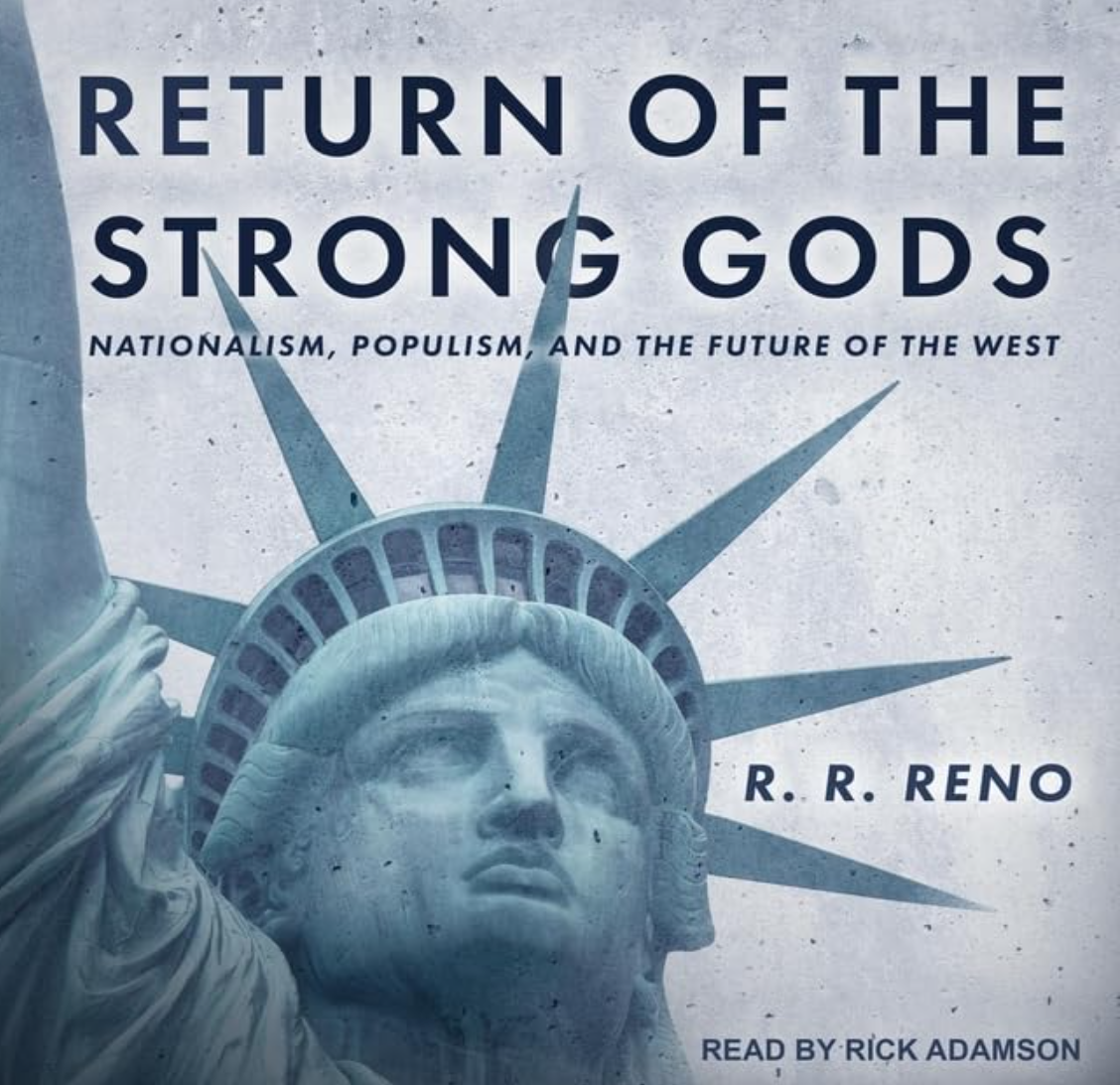
In the last few months, I finished a couple of really insightful non-fiction titles. The first was R. R. Reno’s The Return of the Strong Gods: Nationalism, Populism, and the Future of the West. This was the most helpful overview of what the “post-war consensus” (PWC) actually is and why it is on life support if not in its death pangs. Basically, the PWC was birthed in the aftermath of World War II and the horrors both on the battlefield and in the concentration camps. “Never again!” was the motto in Europe and the U.S., and the modus operandi of the elites was to tamp down on all discourse—religious, political, or social—that could elevate the blood pressure of the nations and so risk a reprise of the world wars. Liberalism in the broader sense of tolerance, acceptance, and openness, was the prevailing doctrine. But what it ended up doing was fueling the populisms and nationalisms we have witnessed in the last decade or so. In the end, we are humans who need “strong loves.” Something to be passionate about—and even die for!

(more…)

Read Full Post »

I found this an able and persuasive rejoinder to Michael Spangler’s extreme kinism. Vogel is responding to a series of articles originally posted here. In my armchair studies of Christian nationalism, kinism, and the postwar consensus critique, there is quite a range of opinion: the good (or at least, acceptable), the bad, and the ugly. One thing is for sure: Spangler doesn’t fall within the first. Mark him, and avoid him.

Read Full Post »