Feeds:
Posts
Comments

Archive for the ‘Paternalism & Patriarchy’ Category

As Reformed people, we are deeply committed to the covenant. We have a solemn responsibility to our children—who after all are not ours, but the Lord’s. We as parents and as pastors have a sacred trust. As pastors, we require solemn vows of parents as they present their covenant children for holy baptism. As parents, we take those public vows in deep, humble gratitude for the manifold grace of God in ‘spreading His skirt over our little ones.’ With faith, we lay hold of the gracious promise, yet with a real trembling for the stewardship that is ours to raise them up in the “fear and admonition of the Lord.”

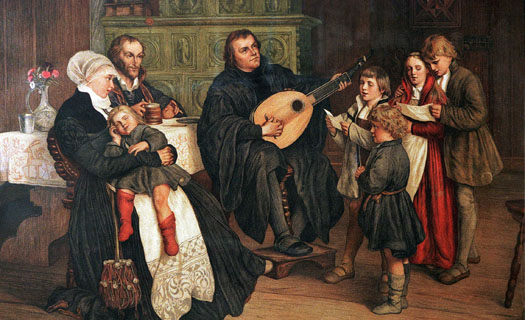
And yet, while our covenant-tradition is clothed with solemnity and gravitas, the lighter side of life shines through (or, it ought to!) as we endeavor to light the flame of faith in our children. There is a place for play; and, in fact, there is great promise in it. I’m increasingly convinced after twenty years of pastoring, twenty-five years of parenting, and now almost two years of grand-parenting, that one major ingredient of parenting and, yes, even pastoring, involves play. And I believe this is all the more vital in small, first- and second-generation Reformed and Presbyterian churches who lack the longevity of larger multi-generational churches. The margins are smaller and the risk of losing our children greater. Especially in our circles, the imperative to do all we lawfully can to create a home and church environment where our covenant children will naturally want to profess faith, commune, marry, bear children, and put down deep roots in our rootless world.

But whether your church is large or small and your subculture more fragile or more robust, these children are still ‘ours to lose.’ Yes, the Holy Spirit must regenerate. Enculturation is a barren womb without free and sovereign grace. But our responsibility, in giving and taking baptismal vows, is not just to catechize and keep good order in home and church. We may and must, if I may put it this way, “win” our children winsomely. And so I say, let us play.

(more…)

Read Full Post »

The following is drawn from William Ames’ Marrow of Theology 2.16, “Of Justice and Charity toward our neighbour.” A Reformed orthodox treatment of the ordo amoris or order of love.

* * * * *

13. The order of this charity is this: that God is first and chiefly to be loved by charity, and so he is, as it were, the formal reason for this charity toward our neighbour. Next after God we are bound to love ourselves, namely with that charity which respects true blessedness; for loving God himself with a love of union, we love ourselves immediately with that chief charity which respects our spiritual blessedness. But secondarily, we should love others whom we would have partake of the same good with us. Moreover, others may be deprived of this blessedness without our fault, but we ourselves cannot; and therefore we are more bound to will and to seek this blessedness for ourselves than for others.

14. This is why the love of ourselves has the force of a rule or a measure for the love of others: You shall love your neighbour as yourself.

15. Hence it is never lawful to commit any sin for another’s sake, even though our offence may seem small, and to be a chief good which we should seek for another. For he that wittingly and willingly sins, hates his own soul. Pro 8.36, He that sins against me, offers violence to his own soul. Pro 29.24. He that partakes with a thief, hates himself: he hears cursing and does not declare it.

(more…)

Read Full Post »

“We presume it to be agreed on both sides, that the outcast millions ought to be reclaimed from the ignorance and irreligion of heathenism. The only difference relates to the party at whose expense this great achievement ought to be perfected —whether by private Christians, under the impulse of a religious benevolence; or by an enlightened government under the impulse of a paternal regard for the highest weal of its subject population. We, the advocates of a National Establishment, hold it the duty and wisdom of every state, thus to undertake for the education of the great family under its charge, and to provide the requisite funds for the fulfilment of the enterprise—and this without prejudice, but the contrary, to the liberality of those individuals, who might choose of their own means to build more churches, and maintain more ministers—thus adding to the amount of Christian instruction in the land. Our antagonists on the other hand hold this to be only the fitting work of individuals, whether acting separately or in associated bodies—to be their concern, and theirs exclusively; and that the government of a country should have nothing to do with it” (Chalmers, Works 17:258-59).

Read Full Post »

The following is an article written in 1919 by Dr. Benjamin B. Warfield. Prof. Warfield was an orthodox theological heavyweight who taught at Princeton Theological Seminary in the early 20th century, until the institution tragically succumbed to theological liberalism in the late 1920s. He here addresses the question of Paul’s words prohibiting women to speak in the assemblies of the church. A digitized version can be accessed here.

Read Full Post »