The following extract comes from Thomas Chalmers: A Biographical Study, by James Dodds (1870). In it, he recounts a lesser known story from the career of Thomas Chalmers. While not an effort on par with his earlier St. John’s and his later West Port Experiments (he was teaching divinity at the University of Edinburgh at this time) the Water of Leith story nonetheless exhibits his ardent commitment to territorial or parochial urban mission. Not to mention his readiness to roll up his sleeves!
* * * *
 HALMERS, in 1833-4, was residing in Forres Street, Edinburgh, not far from the line of the Great North Road by Queensferry. In his walks out to the country in that direction, he would often cross the lofty and spacious Dean Bridge, then newly erected,—the latest wonder in Edinburgh, —spanning the ravine through which, far below, foams the Water of Leith, turbid and brawling, and laden with pollution. From this elevation he would look down upon the village of the Water of Leith, — almost sunk out of sight and sound of the world, though within a few hundred paces of the metropolis, — antiquated and decayed; cooped within steep narrow precipices; with tall gaunt chimneys, untenanted and crumbling granaries, rough dirty streets, miserable hovels into which ‘every element of heaven may enter;’ with scarce any sign of life or action, except two or three lounging figures, the noise and froth of mill-wheels, the grunting of pigs, and the squalling of children without childhood. This abject and neglected place had made itself very notorious, in the late visitation of cholera, by its extreme ignorance and violence. Yet in many ways it had a quaint, old-fashioned, half-savage charm. To the antiquarian, this village was a curious relic of the past, lying close to, yet with a kind of repulsion hiding itself from, the encroaching pomp of the New Town of Edinburgh. To the painter or poet it had strange bits of ancient masonwork; and it had frothing pools, and steep banks clustered all over with wild vegetation, and aspects of a rude primitive life. Chalmers was not insensible to the associations of the past; for, was he not born and brought up amongst the old decayed towns of the East of Fife? He had also the artist’s eye for quaint and out-of-the-way nooks, either of nature or of human habitation. But these lighter moods, though neither scorned nor abjured, were in his mind always subordinated to the sentiment of Christian benevolence. Looking, then, from the height of the Dean Bridge, he might feel,
 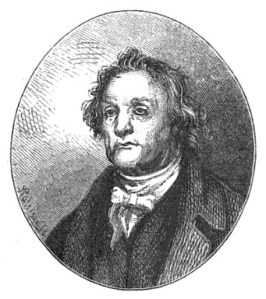 ‘How antique! how it carries one back to the time when Mary Stuart rode her palfrey across that now toppling old bridge in her excursions to the Highlands!’ Or, ‘ How quaint and picturesque these straggling houses, in the deep ravine, with the babbling brook running through the midst!’ But his uppermost feeling would be, ‘What a spot, as if scooped out by nature, and thrown aside by man, to plant a Territorial Church, with all its reclaiming and purifying influences!’
And in the Water of Leith he resolved to show to the world a new model of that Territorial system, which he had begun in St. John’s of Glasgow.
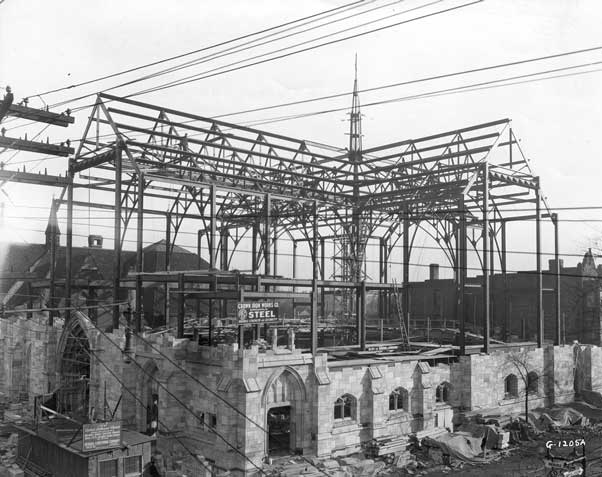
On a survey, it was found that the inhabitants were 1356 in number, but of these only 143 had sittings in any place of worship. There was a meeting-house of some denomination in or near the village, but only five of the inhabitants had sittings; it was attended almost entirely by persons coming from a distance, outside the territory of the Water of Leith. Chalmers, assisted by the liberal friends who never failed him, determined to raise here a territorial church, specially devoted to the inhabitants of the Water of Leith. A missionary began his labours amongst them in 1833. He visited from house to house, made the acquaintance of the people, was courteously received by them, conversed with them, visited the sick, was with them in the hour of affliction and death, was their daily counsellor and friend. He invited them to come to meetings, where he addressed them—in fact, preached to them. His audience became more and more numerous; he had to seek out places of meeting larger and larger; at last he resorted to an old maltgranary, where, with great packing, some 400 people could attend. A church was then erected by subscription, which was opened in May 1836. The sittings were about 1000, and at a moderate charge, and offered in preference to the inhabitants. Soon after the opening, about 700 of the sittings were taken, and almost entirely by inhabitants. It was a true territorial church.
Chalmers officiated at the opening, and dwelt paternally upon the effect of its territorial character.
‘Instead of leaving this church to fill as it may from all parts of the town, we first hold out the seats that we have to dispose of, at such prices as we can afford, to its own parish families. . . . Our fond wish for Edinburgh and its environs is that, district after district, new churches may arise, and old ones be thrown open to their own parish families, till not one house remains which has not within its walls some stated worshipper in one or other of our Christian assemblies; and not one individual can be pointed to, however humble and unknown, who has not some man of God for his personal acquaintance, some Christian minister for his counsellor and friend.’
This new and eminently successful model of Territorialism, coupled with his long teachings, the private exertions at the very same time of his old Glasgow friends, and also the religious darkness and fearful profligacy especially of the large towns, were at length stirring the Church of Scotland from its culpable neglect. . .
Read Full Post »
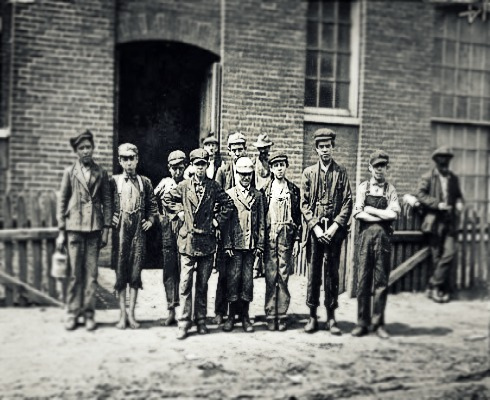 “If a poor child be capable of being thus transformed, how it should move the heart of a city philanthropist, when he thinks of the amazing extent of raw material, for this moral and spiritual manufacture that is on every side of him—when he thinks, that in going forth on some Christian enterprise among a population, he is, in truth, walking among the rudiments of a state that is to be everlasting—that out of the most loathsome and unseemly abodes, a glory can be extracted, which will weather all the storms, and all the vicissitudes of this world’s history—that in the filth and raggedness of a hovel, that is to be found, on which all the worth of heaven, as well as all the endurance of heaven, can be imprinted—that he is, in a word, dealing in embryo with the elements of a great and future empire, which is to rise, indestructible and eternal, on the ruins of all that is earthly, and every member of which shall be a king and a priest for evermore.”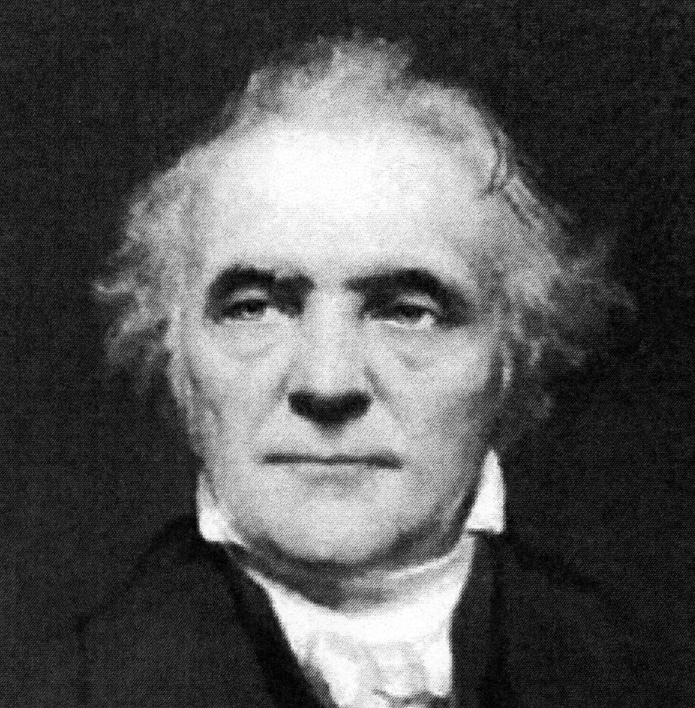
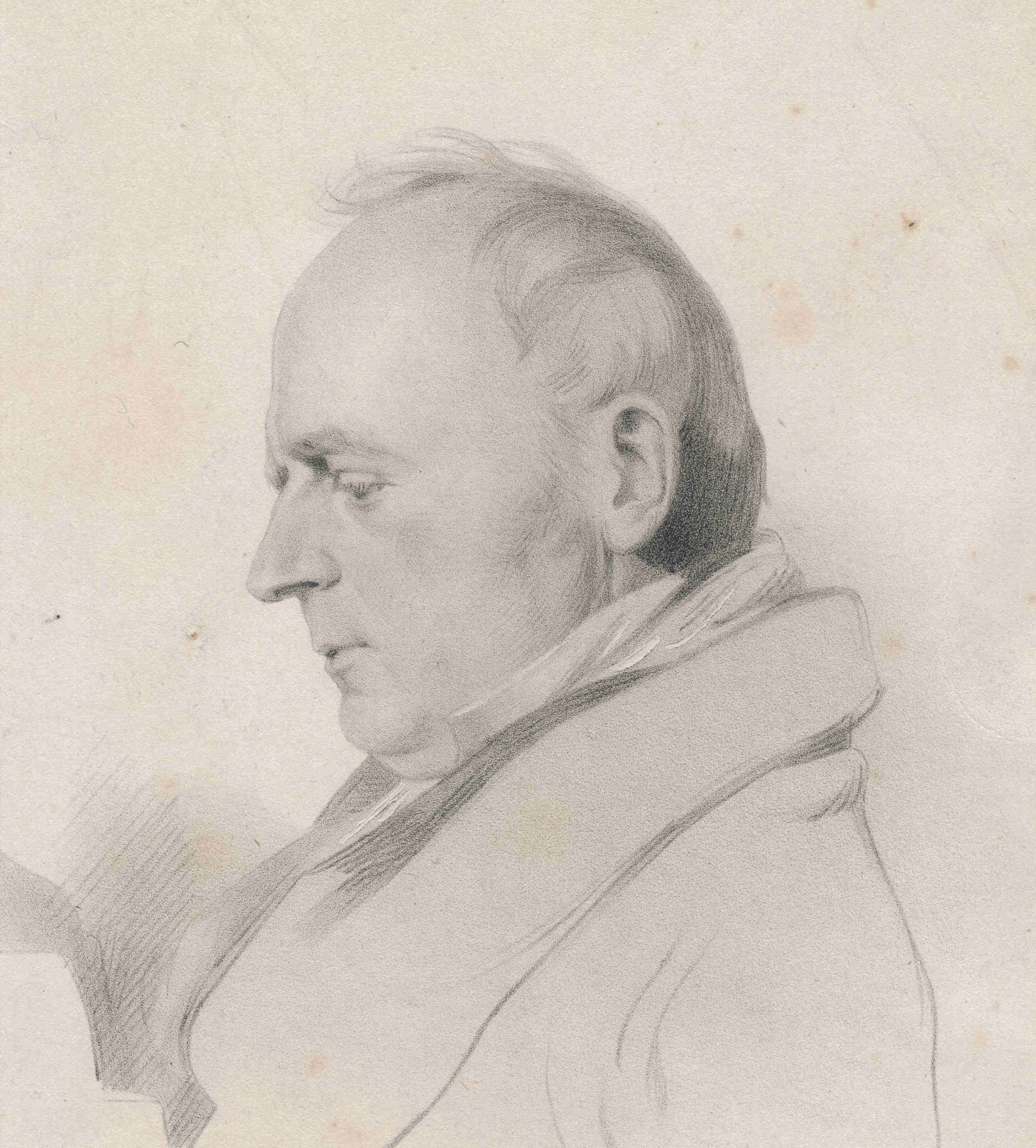



 West Port Experiment