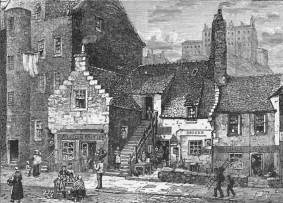
 I recently gave a lecture (sermon?) on the fascinating and inspiring story of Thomas Chalmers’ West Port Experiment in the slums of Industrial Edinburgh, from 1844-1847. You can listen to it here. Ad urbem!
Posted in Benevolence & the Diaconate, Free Church of Scotland, Gregarious (Social) Principle, Locality & the Law of Residence, Missiology, Parish Theory & Practice, The Gospel & the Poor, The Romance of Locality, Thomas Chalmers, Vignettes from 19th Century District Visitation, Vignettes from the Old Parish Way, Visitation Evangelism on July 10, 2016| Leave a Comment »
I recently gave a lecture (sermon?) on the fascinating and inspiring story of Thomas Chalmers’ West Port Experiment in the slums of Industrial Edinburgh, from 1844-1847. You can listen to it here. Ad urbem!
Posted in Church of Scotland, Experimental Religion & the Cure of Souls, Gospel Tactics, Highlands & Islands, Parish Theory & Practice, Parochial Strategy, Preaching, The Romance of Locality, Theology of Community on May 13, 2016| 1 Comment »
 One of my personal heroes is Scottish Presbyterian minster, Aeneas Sage (1694-1774). I’m not quite sure if everything written about him is totally accurate; I get a whiff of the hagiographic if not the legendary in some of the stories. Yet, something in my gut tells me it is too good and so must be true! (Like a historian friend of mine quipped, ‘If it ain’t true, it should be!’) Whatever the case, Aeneas Sage captivates me, for as a pastor he knew how to captivate an audience – in more ways that one.
Posted in Parish Theory & Practice, Thomas Chalmers, Vignettes from 19th Century District Visitation, Visitation Evangelism on September 11, 2015| Leave a Comment »
The following is an article that appeared in the ARBCA Quarterly Update, Feburary 2012, by the Rev. David Campbell, on Thomas Chalmers’ famous West Port Experiment of the mid-1840’s. (British punctuation retained! Proper.)
* * * *
“The Most Joyful Event of My Life”
So Dr. Thomas Chalmers describes it in a letter to his friend, Mr. Lennox, of New York City. Explaining, he says, “I have been intent for thirty years on the completion of a territorial experiment, and I have now to bless God for the consummation of it. Our church was opened on the 19th of February…I presided myself, on Sabbath last, over its first sacrament. There were 132 communicants, and 100 of them from the West Port.”
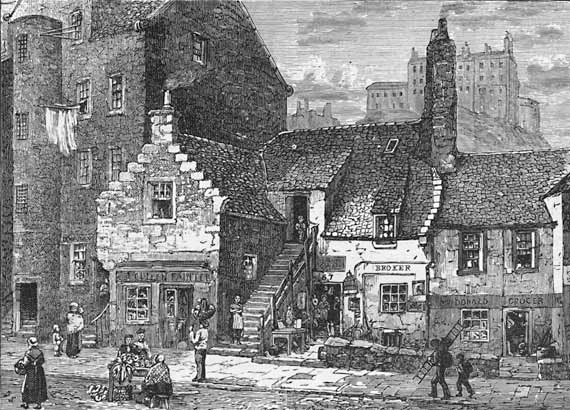 Anyone know where the West Port is? When I was a student in Edinburgh in the mid 1980s I occasionally walked through it as I made my way to the Free Church College. I recollect it as decent enough, just a little run-down and nondescript. It was very different in the early 1840s. Back then it was one of the worst districts in the city, notorious as the scene of the Burke & Hare murders, and infested with beggars, thieves, and prostitutes. The following will give you a sense for just how bad it was:
“When Mr. Tasker, the minister of the West Port, made his first visits to some of the filthiest closes, it was no uncommon thing for him to find twenty to thirty men, women, and children, huddled together in one putrid dwelling, lying indiscriminately on the floor…Upon one occasion he entered a tenement with from twelve to twenty apartments, where every human being, man and woman, were so drunk they could not hear their own squalid infants crying in vain to them for food…He went once to a funeral, and found the assembled company all so drunk around the corpse, that he had to go and beg some sober neighbours to come and carry the coffin to the grave.”
It was this poor and depraved district that Dr. Chalmers selected for his “territorial experiment”. As the term is his so also will be the explanation: “The very essence of our scheme lies in the thorough operation of what we have called the territorial principle. We limit our attention to a single district or locality, itself split into sub-districts, having each a Christian agent attached to it; so that not a home or family which might not be frequently and habitually visited by one having the charge of not more, if possible, than twenty households.”
Chalmers believed this to be the only effective way of evangelising the degraded and over-crowded districts of major towns and cities, and for years he had been eager to demonstrate what, with the divine blessing, could be achieved. With its 411 families and 2000 inhabitants, its poverty and depravity, the West Port of Edinburgh was an ideal place for the attempt. It was a work, he admitted, “greatly too much for my declining strength” (he was then almost 65). But he threw himself into it heart and soul – and with wonderful results.
The first step was the opening of a school. Almost three-quarters of West Port children were growing up without any education at all. So successful, however, were the district visitors in persuading parents to take advantage of the provision (even though it wasn’t free), that when the school opened on 11th November 1844 there were 64 day students and 57 evening students. In the course of the first year the numbers grew to 250. Most of them were from the West Port.
The school was located in an old tanning-loft. In the same place, on Sunday morning the 22nd of December 1844, public worship was held for the first time. It was a far from attractive location: “The interior was bare and dilapidated; the walls coarse and unplastered, pierced her and there with little, dingy, unsightly windows; the roof low and scantily slated, scarcely affording decent shelter; the floor decayed, uneven, and shaking at every tread.”
Dr Chalmers’ son-in-law and future biographer, William Hanna, was present at the evening service. “When we looked round and saw that the whole fruit of the advices, and requests, and entreaties which for many previous weeks had been brought to bear upon all the families by the visitors, was the presence of about a dozen adults, and those mostly old women, we confess to strong misgivings as to the result.” In April 1845, however, Chalmers secured the help of William Tasker, later the West Port minister, and attendance grew under his ministry.
Dr. Chalmers himself, as health permitted, met with the district visitors once a week for discussion, encouragement, counsel, and prayer. He also habitually attended the Sunday services, sometimes as a preacher, often as a hearer. An eyewitness records that “when he was a hearer only, one would see him near the pulpit, in a crowd of deaf old women, who were meanly clothed, but who followed the services with unflagging attention and interest. His eye was upon every one of them, to anticipate their wishes and difficulties. He would help one old woman to find out the text; he would take hold of the Psalm-book of another, hand to hand, and join her in the song of praise. Any one looking at him could see that he was in a state of supreme enjoyment; he could not be happier out of heaven.”
The West Port was deeply upon his heart. In prayers that only came to light after his death we hear requests like this: “Moving fearlessly onward, may I at length obtain such possession of the West Port, as that the gospel of Jesus Christ shall have the moral ascendancy over a goodly number of its families”. “O that I were enabled to pull down the strongholds of sin and of Satan which are there”. “Do thou plentifully endow him [Mr. Tasker] with the graces and gifts of the Apostle Paul. May he have many souls for his hire”. “O may he not only be himself saved, but may he be the instrument of salvation to many.”
On Friday 19th February 1847, the West Port Church was formally opened by Dr. Chalmers. On the 25th of April, as we noted in the opening paragraph, Chalmers presided at the Lord’s Supper. On the following Monday he wrote to William Tasker: “I have got now the desire of my heart – the church is finished, the schools are flourishing, our ecclesiastical machinery is about complete, and all in good working order. God has indeed heard my prayer, and I could now lay down my head in peace and die.” And thirty-five days later that is exactly what he did.
It was feared that that the work would founder with him gone. It did not. Three hundred seats had been let when the church opened and attendance continued to grow steadily. By 1879 the membership was in excess of eleven hundred. By 1896 the number of communicants was upwards of 1300. Also, and almost from the beginning, through the educating of the children, through the efforts of the visitors, and through the public preaching of God’s word, the district itself began to visibly change for the better. It was all a magnificent monument not just to Chalmers’ labours and prayers, but to his faith. He loved the maxim of John Eliot, missionary to native Americans, that “prayer and pains can do anything”. He used to quote it often. And be believed it.
Posted in Missiology, Parish Theory & Practice, Preaching, Thomas Chalmers on July 22, 2015| Leave a Comment »
Recently, I’ve been curious about the historic place of “preaching stations” and their relevance for modern missions. It could just be me, but there seems to be little discussion or usage of the construct in “church planting” efforts. Not sure of the reason for this. Maybe it’s because of the subdued place of preaching as the prime vehicle for conversion—at least within broader evangelicalism. I fear that within Reformed circles, it may reflect church planting that engages more in picking up Calvinist proselytes (at best) or bald sheep-stealing (at worst). That is, church growth that aims not so much at the lost community as an ever-recycling Christian one.
Whatever the case may be, historically and in the contemporary situation, I’m liking what I read from Chalmers on the topic:
“I should not hold it wise to rush precipitately on the formation of a parish church, till a preaching station, upheld by household assiduities, had been tried and found to be successful. Such a preaching station is the germ of the future church, as the missionary is of the future clergyman; but not till the germ had so far germinated, would we venture on a full parochial apparatus for any locality whatever.”
First, preaching stations are forward-moving Gospel efforts, in the direction of full-fledged congregations. They are missionary endeavors. Second, they operate in the right order with respect to sacraments. Word first; then assuming reception, baptism and the Lord’s Supper. Throw the Gospel net far and wide, but keep the sacraments out of the equation until there are “fruits worthy of repentance.” Third, aggressive, territorial household visitation as an indispensable adjunct to the preaching station.
Posted in Parish in Perspective (Qualifications), Parish Theory & Practice, Thomas Chalmers on April 30, 2015| 1 Comment »
Here is a great contemporary summary of Thomas Chalmers’ (1780-1843) ‘district visitation’ or parish model for evangelism and holistic, biblical philanthropy. It was originally published in 2000, in Foundations, the theological journal of the British Evangelical Council (now Affinity).
Ad urbem!
Posted in Church of England, Parish Theory & Practice on January 8, 2015| Leave a Comment »
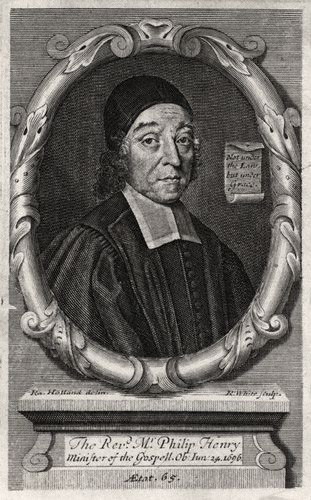 “He was about eight years, from first to last, labouring in the word and doctrine at Worthenbury, and his labour was not altogether in vain. He saw in many of the travail of his own soul to the rejoicing of his heart, but with this particular dispensation, which I have heard him sometimes speak of, that most or all of those in that parish, whom he was, through grace, instrumental of good to, died before he left the parish, or quickly after; so that within a few years after his removal thence, there were very few of the visible fruits of his ministry there; and a new generation sprung up there, who knew not Joseph. Yet the opportunity he found there was of doing the more good, by having those that were his charge near about him, made him all his days bear his testimony to parish order, where it may be had upon good terms, as much more eligible, and more likely to answer the end, than the congregational way of gathering churches from places far distant, which could not ordinarily meet to worship God together.’ From this experience here, though he would say, we must do what we can, when we cannot do what we would, he often wished and prayed for the opening of a door, by which to return to that order again.”
Posted in Church of Scotland, Locality & the Law of Residence, Parish Theory & Practice, Thomas Chalmers on November 12, 2013| Leave a Comment »
Reformations are unsettling. They always involve a critique of the old order, a prophetic protest against wrong. And when those protests give way to action, things change. The Protestant Reformation of the 16th century was no different. So when it reached the shores of Scotland, there was quite a shaking up. [To read further, see full article here – starting at p. 9]
Posted in Establishments, Gathered Church Ecclesiology, Locality & the Law of Residence, Parish Theory & Practice, Thomas Chalmers, Visitation Evangelism on June 4, 2013| Leave a Comment »
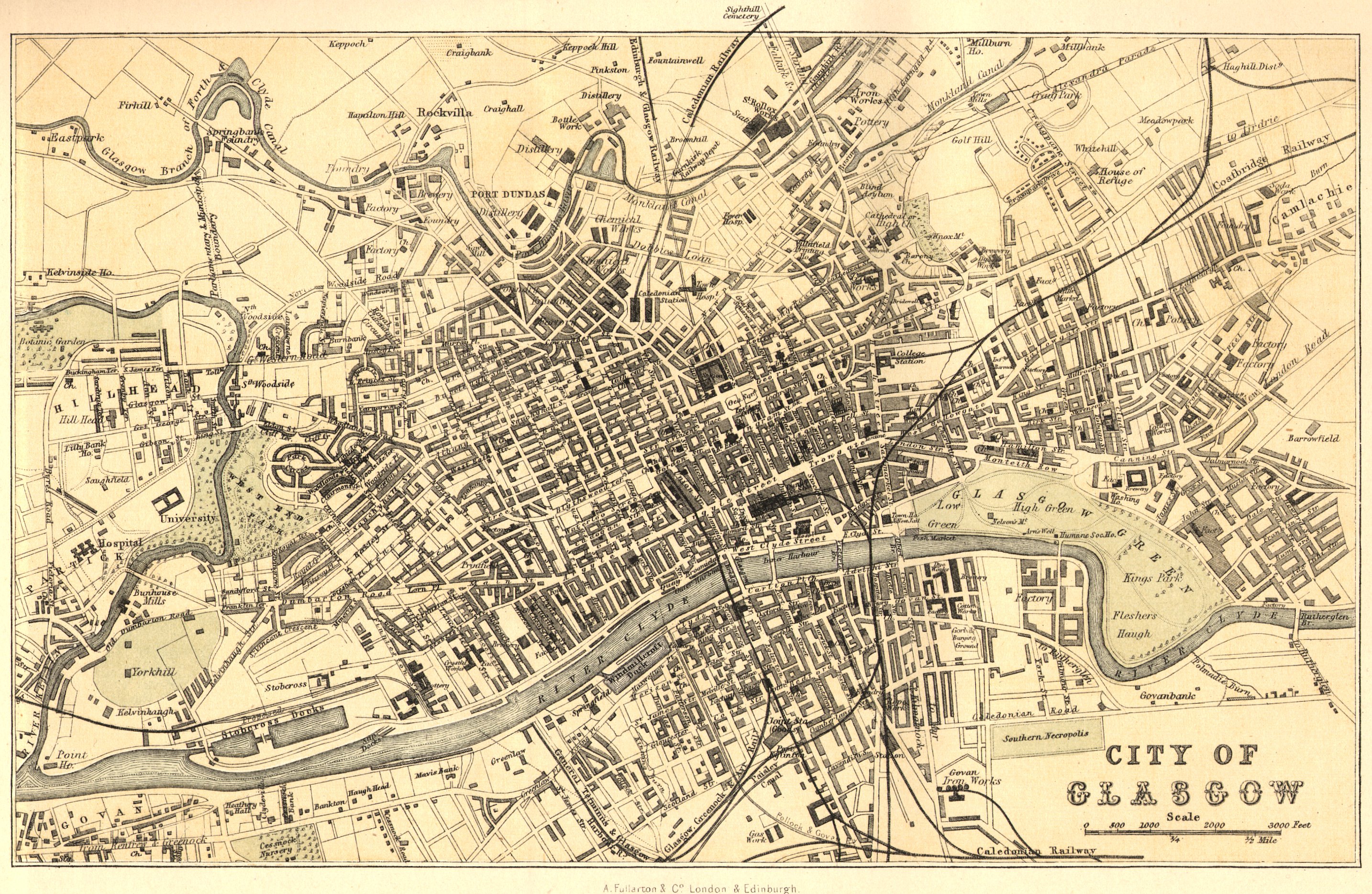 “Now the specific business which we would like to put into the hands of a Christian minister is, not that he should fill his church any how – that he may do by the superior attractiveness of his preaching, at the expense of previous congregations, and without any movement in advance on the practical heathenism of the community: But what we want is, to place his church in the middle of such a territory as we have now specified and to lay upon him a task, for the accomplishment of which we should allow him to the labour and preference of a whole lifetime; not to fill his church any how, but to fill this church out of that district. We should give him the charge over head, of one and all of its families; and tell him, that, instead of seeking hearers from without, he should so shape and regulate his movements, that, as far as possible, his church-room might all be taken up by hearers from within. It is this peculiar relation between his church, and its contiguous households, all placed within certain geographical limits, that distinguishes him from the others as a territorial minister.”
– Thomas Chalmers
Posted in Experimental Religion & the Cure of Souls, Locality & the Law of Residence, Parish Theory & Practice, Thomas Chalmers, Visitation Evangelism on December 19, 2012| Leave a Comment »
 The following are the words of exhortation Dr. Thomas Chalmers gave to his ruling elders upon their induction to office to the newly formed St. John’s parish in Glasgow, in 1819. These men were installed not simply to attend to the communicant and baptized membership, but each was assigned a small district of contiguous households within the parish. They were thus ordained as missionaries to all within the limits of their assignment, visiting each house in turn, seeking lost sheep. The address below highlights the tension frequently stressed by Chalmers – the obligation diligently to use all lawful means to reclaim the unsaved and at the same time to look alone to the Mighty Spirit to bring it all to pass.
* * *
“The whole habit and tendency of my thoughts on the subject of Christian usefulness incline me to attach a far higher importance to your relationship with the parish of St. John’s than to your relationship with the Church, and I do honestly believe, that never till the rights of parishes come to be better respected, never till the attention of ministers and elders be more restricted to the population of a given local territory, never till God put it into the hearts of men to go forth among our heathen at home with the same zeal and enthusiasm which are expected of missionaries who go abroad, will there be any thing like a revival of religion throughout the mass of our city families, or a reclaiming of them from those sad habits of alienation from God and from goodness into which the vast majority of them have fallen.
“There is one circumstance of encouragement which you will soon in the course of your movements through the districts that arc assigned to you be enabled to verify by your own experience. All the householders, with scarcely one exception, and whatever be their character in respect of Christianity, will welcome you with the utmost cordiality and courteousness. There is something in the very presence of one human being when he comes with the feelings and the desires of friendship, which serves to conciliate and to subdue another human being. Bear an honest regard to the people, and the people will, in spite of themselves, bear you an honest regard back again. This is what may be called an open door for you in the first instance, and the effect of frequent intercourse between the higher and lower orders of life in tranquilizing the general spirit of a community, and softening their malignant antipathies which else might ferment and fester and break out into. open violence, and consolidating something like a system of brotherhood through a mighty aggregate of human beings, this I say would confer a civil blessing on the establishment of an eldership that is altogether incalculable.
“But it must be remarked, on the other hand, that so wide and universal a welcome from the families may lead at the outset to a most delusive anticipation. A civil comes more easily and readily than a Christian effect. You are not to infer, because the good will of the people can be so immediately carried, that the conversion of the people will therefore speedily follow in its train. There is much of what is constitutionally attractive among men distinct and apart from any religious tendencies; and there is none who sets himself in good earnest to the working of a Christian effect, that will not soon feel himself engaged in a business where aids and instruments are necessary that are altogether superhuman. You will, in particular, be struck with the obstinate and determinate stand which the manhood of the population will make to all your proofs and all your earnestness. In sad proof of the progressive hardening of conscience will it be seen how arduous if not how impossible it is, with all the arts and resources of Christian philanthropy, to make any sensible advances on those who have been suffered to ascend from boyhood without the Word and without the ordinances.
“It is this which has shut up so many adventurers on the field of Christian usefulness, both at home and abroad, to the melancholy conclusion, that the grown-up generation are to be given up in despair, and that the hope of brighter and better days all lies with the capabilities of the young; and I certainly do recommend, among the foremost objects of your attention, the encouragement of those religious schools which may be situated within the limits of your respective localities, and for the discouragements which you will experience in the obstinacy and immovableness of many parents, you will often meet with a cheering compensation in the
promise and docility of their children.
“At the same time, I would never give up any human being in despair. Forget not the affirmation of the missionary Eliot, that it was in the power of pains and of prayers to do any thing. We are apt to confide in the efficacy and wisdom of our own arrangements—to set up a framework of skillful contrivance, and think that so good an apparatus will surely be productive of something—to please ourselves with parochial constitutions, and be quite sanguine that on the strength of elderships and deaconships, and a machinery of schools and agents, and moralizing processes, some great and immediate effect is to follow. But we may just as well think that a system of aqueducts will irrigate and fertilize the country without rain, as think that any human economy will Christianize a parish without the living water of the Spirit—without the dew df heaven descending upon the human administrators, and following them in their various movements through the houses and families under their superintendence. Still it is right to have a parochial constitution, just as it is right to have aqueducts. But the supply of the essential influence cometh from above. God will put to shame the proud confidence of man in the efficacy of his own wisdom, and He will have all the glory of all the spiritual good that is done in the world, and your piety will, therefore, work a tenfold mightier effect than your talents, in the cause you have undertaken; and your pains without your prayers will positively do nothing in this way, though it must be confessed that prayers without pains are just as unproductive, and that because they must be such prayers of insincerity as can not rise with acceptance to heaven. It is the union of both which best promises an apostolical effect to your truly apostolical office; and with theso few simple remarks do I commend you to Him who alone can bles3 you in this laudable undertaking, and give comfort and efficacy to the various duties that are involved with it.”
Posted in Commerce & Christianity, Gathered Church Ecclesiology, Locality & the Law of Residence, Parish Theory & Practice, Thomas Chalmers on September 19, 2012| Leave a Comment »
In the following quote, Thomas Chalmers (1780-1847) is urging that the Church of Scotland in his day stick to its parish principles, that is, attaching a church to a district, charging its minister to evangelize it, and giving preference to its residents in seating during the services. A church should be a local, or a ‘territorial’ church. It should not operate on the law of supply and demand, thus drawing any and all irrespective of residence. When it does, as Chalmers here points out, it occasions the worst in those who are already religious, fostering a culture of religious fastidiousness – and church-hopping.
Without a territorial arrangement, the “population” of the parish “might still abide in a state of unmoved heathenism; and the chapel congregation, instead of being formed or recruited out of their families, will be drawn very much at the expense of previous congregations, from that class of the community whose habits of church-going are not only already established, but may be said to have been refined into fastidiousness; to whom change is luxury, and who, ever agog on the impulse of novelty, are, in fact, the deadliest adversaries of that territorial system, wherein the great strength of our establishment lies” (Collected Works 16:184).
Again, Chalmers exposes the commercialization of religion that has only grown from embryo to full monster.
 West Port Experiment