Feeds:
Posts
Comments

Archive for the ‘Parish Theory & Practice’ Category

Here are selections from Boston’s personal journal in which he recounts his catechizing efforts throughout his regular, parish ministry.  This installment takes us from Boston’s first labor in the parish of Simprin to his second and last at Ettrick.  Observe the diverse settings and audiences of his catechizing, its bearing on church membership and the sacraments, as well as Boston’s pastoral sensitivity and adaptability to the needs of the people.  Note also how Boston deplored ignorance of Gospel ‘fundamentals’ and so regarded catechizing as a sine qua non in making authentic Christians (that is, in evangelization).

* * * *

 1699

“12th December.—I have had a desire to set up week-day sermons this long time. And since the synod (at which time I had great apprehensions of evil days, which pressed me to be busy in my time) I resolved to try what encouragement I might meet with in prosecuting it. This night I proposed it to two of the members of the meeting for Christian fellowship; who received the motion with all gladness; and I wa3 desired to begin it next Thursday’s night. Upon which immediately I found a great averseness in my own mind to it; thinking withal, that I should have tabled it particularly before the Lord ere I had proposed it. Thus I saw the dreadful deceit of my heart. I pressed my heart with that word, 2 Tim. iv. 2, ” Preach the word, be instant in season, out of season:” but it would not do. As I was going out of doors, it was suggested to me, that the Lord had thus punished me for not seeking light as to that particular expressly. While I wrote this, I thought it indeed a temptation of Satan to divert me from this work. (Nota, It seems both were true.) I was helped earnestly to seek light from the Lord in it. On the morrow I went to God again with this business ; yet could I not be fully satisfied to undertake that work, so long and so much before desired by me; neither had I anything material to object against it. Wherefore I renewed my suit; and thinking about it, got my heart more satisfied and inclined thereto, urging myself with the Lord’s kindness to me in His work, and the necessity of the people’s souls. I went to God again with it; and, in fine, the assiduity of faithful ministers, the apostles, and others, preaching both by day and by night, and no doubt sometimes to a small handful, did overcome me : so that I determine to go on, desiring heartily to comply with it. On Thursday the 14th, at night, I began this exercise, having spent the afternoon in catechising. I went about the examination under a sense of my own emptiness and insufficiency; and was well helped while my heart kept right; but in turning to some one or other of its biasses, my help decayed. In the evening-exercise the Lord’s presence was such, that I was made to say, ” It is good for us to be here.” When alone, the mismanaging of the examination, yea and the sermon too, lay heavy on me; and therefore I went to God for pardon of my weakness. And that exercise I kept up all along after, during my continuance in Simprin ; and had many a sweet and refreshing hour of it. In the winter-season, our meetings for it were in my house, and in the night; in the summer, they were in the kirk, at the time of the day wherein the men rested from their labour: for the people were servants to Langton. And I believe that, for the same reason, it was only the women whom I catechised at any other time of the day ; being solicitous that the master’s business might not suffer by me, nor my good be evil spoken of on that account. On the morrow after, having visited the sick, and found how the Lord had laid His rod on my handful, I was thereby convinced, that, had I slighted the motion for the Thursday’s sermon, I would have had no peace in so doing. Having come home from this visitation, I reflected on it, and saw what secret averseness was in my heart to it, and how poorly I had managed it. I got a clear sight of the freedom and riches of grace, went by myself, and lamented my emptiness and unworthiness; which when I saw, it gave me a check for an inward itching after more work, whereby I might have a little more stipend. That work was, I think, to have been a catechist in Dunse, the encouragement £100 Scots. I had such an offer, and refused it; yet since that time I had such an itch after it. Last night in reading the latter part of John vi. the Lord held His candle before me, helping me to understand it. This night having consulted some books, and my own heart, on the sinfulness of man’s natural state, to see what further of that subject remained to be handled, there occurred only man’s death in sin, to which I was determined accordingly. On the Saturday I studied it, but not with my former assistance: but, after having prayed, and found it to be owing to that I was not so much emptied of myself as before, reckoning the subject more easy, I recovered the divine aid, in meditating afterward on what I had prepared” (109-110).

“17th December. . . That night I began the catechising of the servant; the which part of family duty I continued in my family on the Sabbath nights, till of late years my strength decaying, I almost confined it to the time of the year wherein we have but one sermon.

On the morrow I visited the sick, and spent the afternoon in catechising, and found great ignorance prevailing. On the Tuesday, visiting a sick woman grossly ignorant, after I had laid out before her her wretched state by nature, she told me she had believed all her days. I thereupon sat as astonished for a while, lifted up my eyes to the Lord, and addressed myself to her again for her conviction; howbeit nothing but stupidity appeared. Therefore I saw I had enough ado among my handful. I had another diet of catechising on Wednesday afternoon; and looking to the Lord for help, I got it: and I had some more comfort in them than before. Having inculcated almost on each of them their wretched state by nature, and they frequently attending the means of instruction, there were but few examined that day who did not shew some knowledge of that point. But the discovery I had made of their ignorance of God and of themselves, made me the more satisfied with the smallness of the charge”(111-114).

“Saturday the 23rd… On the morrow, being the Lord’s day, after prayer in the morning I had given way to some worldly thoughts, which were indeed occasioned by something that concerned my conscience; yet my heart soon went without bounds: so that though a desire to be near Christ remained in me, yet I found an averseness to duty even in the very time of duty. Entering on the public work, my prayer was according to my frame, complaining of a body of death, and an ugly heart, and admiring heaven as a place of rest from sin. I preached that day man’s ignorance of his wretched state by nature; and was sure that God called me to preach it, by the voice of the people’s necessity, two of whom had told me expressly that week, they had believed all their days. That night I altered the evening-exercise, from explaining a question sermon-wise, to catechising, as more fit to profit the people: and to this I had been determined after seeking a discovery of the Lord’s mind therein” (114).

1700

“[15th January] I endeavoured on the Monday, not without some success, to keep my heart in a heavenly disposition; spent the morning in my chamber, the forenoon in catechising, the afternoon in business, and visiting a sick man at night, with help from the Lord. Thereafter earnestly plying my books, I found my heart much bettered, my confidence in the Lord more strengthened, the world less valuable in my eyes, and my soul free of the temptations that otherwise I was liable to” (120).

1704

“As for the subject of baptism; after I was settled among the people of Simprin, and had entered closely on my work, finding some of them grossly ignorant, and hardly teachable in the ordinary way, and casting in my mind what course to take with such, I drew up in writing a little form of catechising in the fundamentals, in short questions and answers, on design to teach it them privately in my house. I do not well remember the progress of that affair; nor do I well know where these questions are; but afterward I used the same, in the case of my little children, in the first place, when they became capable of instruction. Among other such grossly ignorant, there was one, who desiring his child to be baptized, I could not have freedom to grant his desire for some time: neither am I clear, whether, when the child was baptized, it was baptized on a satisfying account of the fundamental principles from him or his wife. Whatever had laid the foundation of such scrupling, I was, by means of such straitening in practice, brought closely to consider that point. And having purposely studied the question, Who have right to baptism, and are to be baptized? I wrote my thoughts thereon also. And being one day in conversation on that head with Mr. William Bird, dissenting minister in Barmoor in England, he presented to me Fulwood’s Discourse of the Visible Church, for clearing me. Bringing home the said book with me, I considered it, and wrote also some animadversions on a part of it. From that time I had little fondness for national churches strictly and properly so called, as of equal latitude with the nations, and wished for an amendment of the constitution of our own church, as to the membership thereof” (171-172).

Read Full Post »

I cannot say as I always agree with C. S. Lewis.  He was, after all, not a theologian by profession.  Yet his Screwtape Letters are worthily a spiritual classic and well worth the read.  I am truly amazed by Lewis’ spiritual acuity throughout.

As I was making my way through the Letters recently, one in particular- no. 16 – offered some keen insight into territorialism.  Screwtape favors the gathered church over the parish church – because of the ‘advantages’ of the former and the ‘dangers’ of the latter!  Here is an excerpt.

* * * *

MY DEAR WORMWOOD,

You mentioned casually in your last letter that the patient has continued to attend one church, and one only, since he was converted, and that he is not wholly pleased with it. May I ask what you are about? Why have I no report on the causes of his fidelity to the parish church?  Do you realise that unless it is due to indifference it is a very bad thing? Surely you know that if a man can’t be cured of churchgoing, the next best thing is to send him all over the neighbourhood looking for the church that “suits” him until he becomes a taster or connoisseur of churches.

The reasons are obvious. In the first place the parochial organisation should always be attacked, because, being a unity of place and not of likings, it brings people of different classes and psychology together in the kind of unity the Enemy desires. The congregational principle, on the other hand, makes each church into a kind of club, and finally, if all goes well, into a coterie or faction. In the second place, the search for a “suitable” church makes the man a critic where the Enemy wants him to be a pupil. What He wants of the layman in church is an attitude which may, indeed, be critical in the sense of rejecting what is false or unhelpful, but which is wholly uncritical in the sense that it does not appraise—does not waste time in thinking about what it rejects, but lays itself open in uncommenting, humble receptivity to any nourishment that is going. (You see how grovelling, how unspiritual, how irredeemably vulgar He is!) This attitude, especially during sermons, creates the condition (most hostile to our whole policy) in which platitudes can become really audible to a human soul. There is hardly any sermon, or any book, which may not be dangerous to us if it is received in this temper. So pray bestir yourself and send this fool the round of the neighbouring churches as soon as possible. Your record up to date has not given us much satisfaction. . . .

Your affectionate uncle    
SCREWTAPE

Read Full Post »

“To appropriate his little vicinity—to lay it down in the length and the breadth of it—to measure it off as the manageable field within which he can render an entire and a lasting benefit to all its families—to know and be known amongst them, and thus have his liberality sweetened by the charm of aquaintanceship with those who are the objects of it—instead of dropping as heretofore of his abundance, into an ocean where it was instantly absorbed and became invisible, to pour a deep, and a sensible, and an abiding infusion into his own separate and selected portion of that impracticable mass which has hitherto withstood all the efforts of philanthropy—instead of grasping in vain at the whole territory, to make upon it his own little settlement, and thus to narrow at least the unbroken field which he could not overtake—to beautify one humble spot, and there raise an enduring monument, by which an example is lifted up, and a voice is sent forth to all the spaces which are yet unentered on—this is benevolence reaping a reward at the very outset of its labours; and such a reward, too, as will not only insure the accomplishment of its own task, but as must, from the ease, and the certainty, and the distinct and definite good which are attendant upon its doings, serve both to allure and to guarantee a whole host of imitations.”

-Thomas Chalmers, The Christian & Economic Polity of a Nation, p. 101.

Read Full Post »

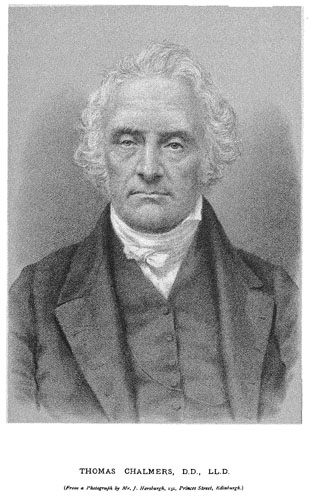
Key to understanding Thomas Chalmers’ advocacy of the locality (or parish) principle for urban missions is what he called ‘the gregarious principle.’  Man by God’s design was made a social creature.  And as a part of God’s moral government, there are certain social laws that men disregard only to their detriment.  The locality principle does not disregard, but presumes the gregarious principle and harnesses its potential.  As a minister adopts a territory for its spiritual cultivation, he removes not only the geographic, but the social distance between himself, his church, and the people he is seeking to reach.  And in the end, heart joins with heart. 

The following quote illustrates Chalmers’ view of the social advantages in a minister doing outreach on the locality principle.  Notice his concern with social ideas such as acquaintance, intimacy, friendliness, welcome, and fellow feeling:

In the first place, then, it is not so likely that a minister will go forth on his share of the population, when spread at random over the whole city, as when they lie within the limits of a space that is overtakable. He feels an incitement to move in the latter way of it, which he does not feel when his attentions are dispersed over a wide and bewildering generality. He, under the one arrangement, may have rare, and rapid, and transient intercourse with the individuals of a diffused multitude; but this can never ripen into solid acquaintanceship with more than a very few.  Under the other arrangement, he may, at a greatly less expense, attain to terms of intimacy with some, and of civility with many. And it would add prodigiously to this operation, were his hearers, on the Sabbath, also his parochial acquaintances through the week. By this simple expedient alone, he would attain such an establishment of himself in his parish, in a single month, as he will not otherwise reach, but by the labour and assiduity of years. The very consciousness that, in a certain quarter of the city, lay the great body of his congregation, would be enough to assure him of a welcome there, and a friendship there, that would ever be inclining his footsteps to his parish, as the fittest scene of promise and of preparation for all his enterprises. And he would find, that the business of the Sabbath and the business of the week, had a most wholesome reciprocal influence the one upon the other. The former business would immediately open a wide and effectual door of intercourse with the people; and the latter business would not only retain the people in attendance upon their minister, but would rapidly extend their demand of attendance upon him, whenever there was room for it. . . .

But the second influence of locality in this matter, is perhaps of greater efficacy still. The first is that by which the minister obtains a more intense feeling of his relationship to his people. The second is that by which the people obtain a more intense feeling of their relationship to their minister. It is incalculable how much this last is promoted by the mere juxtaposition of the people to one another. There is a great deal more than perhaps can be brought out by a mere verbal demonstration, in a number of contiguous families, all related by one tie to the same place of worship, and the same minister. It would go to revive a feeling, which is now nearly obliterated in towns, whereby the house which a man occupies, should be connected, in his mind, with the parish in which it is situated, and an ecclesiastical relationship be recognised with the clergyman of the parish. In these circumstances, where there was no interference of principle, and no personal disapprobation of the clergyman, attendance upon the parish church would at length pass into one of the habitual and established proprieties of every little vicinage. Old families would keep it up, and new families would fall into it; and the demand for seats, instead of slackening under such an arrangement, would become more intense every year, so as to form a distinct call for more churches, whenever they were called for by the exigencies of a growing population (The Christian & Economic Polity of a Nation, pp. 67-68).

Read Full Post »

“However thoroughly we may he convinced of the benefit that would result from the influence of locality, we feel that it is not in easy task didactically to set forth this influence, by any process of argument or explanation. The conviction is far more readily arrived at by the tact of real and living experience, than by the lessons of any expounder. There is a charm in locality, most powerfully felt by every man who tries it; but which, at the same time, it is most difficult so to seize upon as to embody it in language, or to bring it forth in satisfying demonstration to the public eye. We do not know an individual who has personally attached himself to a manageable portion of the civic territory, and has entered with taste and spirit upon its cultivation-and who does not perceive, with something like the force and the clearness of intuition, that, if this way of it were spread over an assembled million of human beings, it would quickly throw a new moral complexion over the teeming expanse that is on every side of him. But what he feels, it is not easy to make others see. For, however substantial the influence of locality is, there is a certain shadowy fineness about it, in virtue of which it eludes the efforts of an observer to lay hold of it, and to analyze it. It is no bad evidence, however, of the experimental soundness of this operation, that the incredulity about it, is all on the side of those who stand without the field of local management; and the confidence about it, on the side of those who stand within-and that, while the former regard it as a mystic and undefinable fancy, the latter find in it as much of sureness and solidity, as if their eyes saw it, and their hands handled it.”

-Thomas Chalmers, The Christian and Economic Polity of a Nation, p. 43.

Read Full Post »

Here is the fourth installment in this series.  To begin at part 1, click here.

* * *

Though intemperance was the main cause of poverty, suffering, misery, and vice in that district of Glasgow, I had also considerable opposition from Romanists and Infidels, many of whom met in clubs, where they drank together and gloried in their wickedness and in leading other young men astray.  Against these I prepared and delivered lectures, at the close of which discussion was allowed; but I fear they did little good. These men embraced the opportunity of airing their absurdities, or sowing the seeds of corruption in those whom otherwise they could never have reached, while their own hearts and minds were fast shut against all conviction or light.

One infidel Lecturer in the district became very ill.  His wife called me in to visit him. I found him possessed of a circulating library of infidel books, by which he sought to pervert unwary minds. Though he had talked and lectured much against the Gospel, he did not at all really understand its message.  He had read the Bible, but only to find food there for ridicule. Now supposed to be dying, he confessed that his mind was full of terror as to the Future. After several visits and frequent conversations and prayers, he became genuinely and deeply interested, drank in God’s message of salvation, and cried aloud with many tears for pardon and peace . He bitterly lamented the evil he had done, and called in all the infidel literature that he had in circulation, with the purpose of destroying it.  He began to speak solemnly to any of his old companions that came to see him, telling them what he had found in the Lord Jesus. At his request I bought and brought to him a Bible, which he received with great joy, saying, ” This is the book for me now ;” and adding, ” Since you were here last, I gathered together all my infidel books; my wife locked the door, till she and my daughter tore them to pieces, and I struck the light that reduced the pile to ashes.”

As long as he lived, this man was unwearied and unflinching in testifying, to all that crossed his path, how much Jesus Christ had been to his heart and soul; and he died in the possession of a full and blessed hope.

Another Infidel, whose wife was a Roman Catholic also became unwell, and gradually sank under great suffering and agony. His blasphemies against God weie known and shuddered at by all the neighbours. His wife pled with me to visit him. She refused, at my suggestion, to call her own priest, so I accompanied her at last.  The man refused to hear one word about spiritual things, and foamed with rage. He even spat at me, when I mentioned the name of Jesus. “The natural man receiveth not the things of the Spirit of God; for they are foolishness unto him!”  There is a wisdom which is at best earthly, and at worst ” sensual and devilish.”  His wife asked me to take care of the little money they had, as she would not entrust it to her own priest.  I visited the poor man daily, but his enmity to God and his sufferings together seemed to drive him mad.  His yells gathered crowds on the streets.  He tore to pieces his very bed-clothes, till they had to bind him on the iron bed where he lay, foaming and blaspheming.  Towards the end I pled with him even then to look to the Lord Jesus, and asked if I might pray with him?  With all his remaining strength, he shouted at me,—

“Pray for me to the devil!”

Reminding him how he had always denied that there was any devil, I suggested that he must surely believe in one now, else he would scarcely make such a request, even in mockery. In great rage he cried,—

“Yes, I believe there is a devil, and a God, and a just God, too; but I have hated Him in life, and I hate Him in death!”

With these awful words, he wriggled into Eternity ; but his shocking death produced a very serious impression for good, especially amongst young men, in the district where his character was known.

How different was the case of that Doctor who also had been an unbeliever as well as a drunkard!  Highly educated, skilful, and gifted above most in his profession, he was taken into consultation for specially dangerous cases, whenever they could find him tolerably sober.  After one of his excessive “bouts,” he had a dreadful attack of delirium tremens.  At one time, wife and watchers had a fierce struggle to dash from his lips a draught of prussic acid; at another, they detected the silver-hafted lancet concealed in the band of his shirt, as he lay down, to bleed himself to death.  His aunt came and pled with me to visit him.  My heart bled for his poor young wife and two beautiful little children.  Visiting him twice daily, and sometimes even more frequently, I found the way somehow into his heart, and he would do almost anything for me and longed for my visits. When again the fit of self-destruction seized him, they sent for me; he held out his hand eagerly, and grasping mine, said,—

“Put all these people out of the room, remain you with me; I will be quiet, I will do everything you ask!”

I got them all to leave, but whispered to one in passing to “keep near the door.”

Alone I sat beside him, my hand in his, aid kept up a quiet conversation for several hours.  After whad talked of everything that I could think of, and it was now far into the morning, I said,—

“If you had a Bible here, we might read a chapter, verse about.”

He said dreamily, “There was once a Bible above yon press ; if you can get up to it, you might find it there yet.”

Getting it, dusting it, and laying it on a small cable which I drew near to the sofa on which we sat, we read there and then a chapter together. After this, I said, ” Now, shall we pray? ”

He replied heartily, “Yes.”

I having removed the little table, we kneeled down together at the sofa; and after a solemn pause, I whispered, “You pray first.”

He replied, “I curse, I cannot pray; would you have me curse God to His face?”

I answered, “You promised to do all that I asked ; you must pray, or try to pray, and let me hear that you cannot.”

He said, “I cannot curse God on my knees ; let me stand, and I will curse Him; I cannot pray.”

I gently held him on his knees, saying, “Just try to pray, and let me hear you cannot”

Instantly he cried out , “O Lord, Thou knowest I cannot pray,” and was going to say something dreadful as he strove to rise up.  But I just took the words he had uttered as if they had been my own, and continued the prayer, pleading for him and his dear ones as we knelt there together, till he showed that he was completely subdued and lying low at the feet of God. On rising from our knees he was manifestly greatly impressed, and I said,—

“Now, as I must be at College by daybreak and must return to my lodging for my books and an hour’s rest, will you do one thing more for me before I go?”

“Yes,” was his reply.

“Then,” said I, “it is long since you had a refreshing sleep; now, will you lie down, and I will sit by you till you fall asleep?”

He lay down, and was soon fast asleep.  After commending him to the care and blessing of the Lord, I quietly slipped out, and his wife returned to watch by his side. When I came back later in the day, after my classes were over, he, on hearing my foot and voice, came running to meet me, and clasping me in his arms, cried,—

“Thank God, I can pray now!  I rose this morning refreshed from sleep, and prayed with my wife and children for the first time in my life; and now I shall do so every day, and serve God while I live, who hath dealt in so great mercy with me!”

After delightful conversation, he promised to go with me to Dr. Symington’s church on Sabbath Day; there he took sittings beside me;  at next half-yearly communion he and his wife were received into membership, and their children were baptized;  and from that day till his death he led a devoted and most useful Christian life.  Henceforth, as a medical man he delighted to attend all poor and destitute cases which we brought under his care; he ministered to them for Jesus’ sake, and spoke to them of their blessed Saviour. When he came across cases that were hopeless, he sent for me to visit them too, being as anxious for their souls as for their bodies. He died, years after this, of consumption, partly at least the fruit of early excesses; but he was serenely prepared for death, and happy in the assured hope of eternal blessedness with Christ He sleeps in Jesus; and I do believe that I shall meet him in Glory as a trophy of redeeming grace and love!

[Go to last post.]

Read Full Post »

One of the reasons Chalmers advocated territorial city missions was to reunite the classes, particularly by the clergy’s concentrated evangelistic efforts in the slums.  It was ultimately a missionary policy, yet it had distinct advantages for the social fabric.  Here’s an interesting quote that helps illumine Chalmers’ rationale for the parish plan in urban context:

In a provincial capital, the great mass of the population are retained in kindly and immediate dependence on the wealthy residenters of the place. . . [which] brings the two extreme orders of society into that sort of relationship, which is highly favourable to the general blandness and tranquillity of the whole population. In a manufacturing town, on the other hand, the poor and the wealthy stand more disjoined from each other.  It is true they often meet, but they meet more on an arena of contest, than on a field where the patronage and custom of the one party are met by the gratitude and goodwill of the other (Thomas Chalmers, Christian and Civic Economy of Large Towns, Glasgow, 1821, p. 51).

As the clergy and benevolent Christian volunteers adopt mission districts in the cities and thoroughly work them, the net effect should be a re-harmonization of the upper- and middle-classes with the working class.

Read Full Post »

The following is an excellent quote from Thomas Chalmers in his Christian and Economic Polity of a Nation (1821).  In it, he demonstrates one particular viture of the locality principle, on which the parish system is built – it facilitates the zeal and perseverance of the Christian missionary:

” He, with a select and appropriate vineyard thus lying before him, will feel himself far more powerfully urged, than when under the common arrangement, to go forth among its families. However subtle an exercise it may require from another, faithfully to analyse the effect upon his mind, he himself has only to try it, and he will soon become sensible of the strong additional interest that he acquires, in virtue of having a small and specific locality assigned to him. When the subject on which he is to operate, thus offers Thomas Chalmers and his family (from flicker.com)itself to his contemplation, in the shape of one unbroken field, or of one entire and continuous body, it acts as a more distinct and imperative call upon him, to go out upon the enterprise. He will feel a kind of property in the families; and the very circumstance of a material limit uround their habitations, serves to strengthen this impression, by furnishing to his mind a sort of association with the hedges and the landmarks of property. At all events, the very visibility of the limit, by constantly leading him to perceive the length and the breadth of his task, holds out an inducement to his energies, which, however difficult to explain, will be powerfully felt and proceeded on. There is a very great difference, in respect of its practical influence, between a task that is indefinite, and a task that is clearly seen to be overtakeable. The one has the effect to paralyze; the other, to quicken exertion. It serves most essential!v to spirit on his undertaking, when, by every new movement, one feels himself to be drawing sensibly nearer to the accomplishmviit of it—when, by every one house that he enters, he can count the lessening number before him, through which he has yet to pass with his proposals for the attendance of their children—and when, by the distinct and definite portion, which is still untravelled, he is constantly reminded of what he has to do, ere that district, which he feels to be his own, is thoroughly pervaded. He can go over his families too, with far less expense of locomotion, than under the common system of sabbath schools ; and, for the same reason, can he more fully and frequently reiterate his attentions; and it will charm him onwards, to find that he is sensibly translating himself into a stricter and kinder relationship with the people of his district; and, if he have a taste for cordial intercourse with the fellows of his own nature, he will be gladdened and encouraged by his growing familiarity with them all; and thus will he turn the vicinity which he has chosen, into a home- walk of many charities ; and recognized as its moral benefactor, will lug kindness, and his judgment, and his Christianity, be put forth, with a well- earned and well-established influence, in behalf of a grateful population.”

Read Full Post »

I recently read an article entitled “Thomas Chalmers and the Communal Ideal in Victorian Scotland” (1992) by Stewart J. Brown, a recognized Chalmers scholar.  In it, he traces the development of the territorial mission program from Chalmers into the Free Church and, even somewhat surprisingly, back in the established Church in the late 1800s.

Brown makes an observation about the waning of the Free Church of Scotland’s vigor for the territorial ideal in the 1870s and on.  According to him, after a renaissance of Chalmersian territorial missions in the Free Church during the 1850s and 60s, the body slowly moved away from the ‘godly commonwealth’ ideal.  Writes Brown, “It began ceasing to perceive itself as a national Church, with responsibility for the spiritual and social welfare of the whole people of Scotland, and increasingly viewed itself as a gathered Church of believers.  In part, this was the result of the passing away of the older Free Church leadership, especially Robert Candlish and Thomas Guthrie (strong supporters of the territorial ideal)” (73).

Now, I’m no expert on the history to judge whether in fact this was the case.  But if it was, then I think it certainly reflects on a connection between ‘gathered church’ ecclesiology and the dangerous tendency to retreatism.  The territorial – or parochial – ideal envisioned the Church as at its core a society of the faithful, but ever reaching out to the perishing community beyond itself.  Its best expression did not confuse believing congregation and unbelieving community.  Yet it heartily embraced the unbelieving community under the obligation of its ‘cure of souls’ mandate (evangelism).  Sadly, when the Church loses that perspective, it will subtly morph into a mere asylum for escapists.  That is both unfaithfulness to Christ and a sure path to spiritual extinction.

Read Full Post »

“A Plea and Plan for a Coöperative Church Parish System in Cities,” by Walter Laidlaw

In this essay, published in the American Journal of Sociology (1898), Walter Laidlaw advocates among the Protestant church a voluntary ‘cooperative parish system’ in the large cities of the United States for the spiritual, moral, and socio-economic benefit of the people. His argument is threefold. First, it is the mandate of Christ to seek the entire well-being of men, both body as well as soul. Secondly, Laidlaw contends that the Church owes it to the taxpayers to seek the ‘moral uplift’ of the working classes. They ought not receive tax exemption for nothing in return. Quite an interesting take on the role of the Church in relation to a non-establishmentarian state! Last, the particular plan he advocates is the surest way to satisfy the mandates both of heaven and of earth.

Map of Lower Manhattan, 1847Positively, I think the article reproduces both the zeal of Thomas Chalmers on the need of Church to evangelize (and that wholistically) the burgeoning modern cities and his level-headed practicality in how the work ought to be done. Energetic, cooperative territorialism is the answer. While Chalmers is not mentioned, his fingerprints are all over it.

Further, Laidlaw certainly continued this legacy by endorsing the elevated philanthrophy that gives intelligently.

My only qualm is the faint note of evangelicalism throughout. It is there, but it is too subdued for my comfort. Presently, I’ve not found out much about Laidlaw’s theology (if anyone can shed some light, I would welcome it). I’m not sure whether he was an advocate of the Social Gospel or whether he retained a distinctive evangelical stance. But the essay is almost altogether devoted to the cooperative parish plan for the relief of outward human misery. I would say ‘Amen and Amen’ to Laidlaw if he unequivocally made the efficient dissemination of the apostolic Gospel the ultimate justification of the system. But right now, I’m at just one ‘Amen.’

Below are some great quotes, with a few comments interspersed.

* * * * * * *

“Originated by the Holy One from one of the largest cities of Judah, commissioned in Palestine’s largest city, her literature christened with the names of the ancient world’s greatest cities and city, her social ideal a city let down from heaven, the church has the opportunity to take the primacy, beyond all question, in altruistic movements, by the institution of a coöperative parish system in cities” (796).

Lamenting over the relative failure of Protestant over Roman Catholic churches to retain their adherents in the large cities, Laidlaw writes,

“Protestantism’s families are not in Protestantism’s church because Protestantism’s church representatives, attending to the people on their communion and pew rolls, scattered all over the 13,000 acres of Manhattan island, have not time or plan to discover and recover the families found on no communion or pew roll.

“It should be a humiliation to Protestantism in New York that three Roman Catholic churches get at more families in the district than do ninety-five Protestant churches, among which are three resident churches. It is idle to ascribe the difference of efficiency in the district to denominational tendency, or national characteristics. It is rather due to the difference between regimentation and somnambulism [sleepwalking]. “Except the Lord keep the city, the watchmen waketh but in vain,’ says Protestantism; and she does on underestimating human wide-awakeness and gumption through her admirable reverence for divine grace. She walketh in a dumb show of saving the city for herself or her Lord” (799-800).

Appreciating the work of the Evangelical Alliance (itself a brainchild of Chalmers) before him in seeking to bring the Gospel wholistically to the cities, Laidlaw critiques the over-idealism of a previous plan that had doomed it to failure. That plan failed in part precisely because of an overemphasis on cooperation:

“It is too ideal … in intermingling denominational visitors. The first step to be taken would [rather] seem to be to induce the churches to regard a geographical area as a special responsibility, and many a church would undertake this if, as a church, it were held responsible for the area, when it might not be willing to share the responsibility with workers from other churches. Spiritual life is systole and diastole indeed, both organization and individual discharging both organic functions at time, but if the church is a divine organization, we must concede her arterialism and assume that individuals are venous” (801).

“Christianity’s warm heart will say to her cool head, when she sees that her alms and uplift must be with both left hand and right hand: ‘Had, you must direct this business for me, or I shall fail in meeting this need. The Master himself did not feed the multitude by Galilee as a mob. He divided the five thousand into companies, and gave each of the twelve his sections to care for. And they did all eat and were filled, no one was overlooked. And they gathered up twelve baskets of fragments, a basket for each disciple, more food than they started with. Head, this need is so great that some hungry one is sure to be underfed, and some greedy one is sure to be overfed, unless there is method.’ And when Christianity talks in this strain, it will not indicate a cooling heart, but a glowing one, one that responds to the Redeemer’s desire, and ‘mind and soul, according well, / will make one music as before’” (803).

Last, Laidlaw gives a number of guidelines for such a cooperative parish system. Cooperation is more than inter-church – it also involves cooperation with civic officials for the ultimate blessing of the community. He gives one interesting instance of such cooperation in New York City during his time:

“For instance, the committee on parks recently circulated a petition, signed by everyone of the pastors in the area, asking the city authorities to locate a small park in the region. When the park is actually opened, it cannot but advertise throughout the whole neighborhood the fact that the church is interested in the people’s well-being” (806-7).

Read Full Post »

« Newer Posts - Older Posts »