Feeds:
Posts
Comments

Archive for the ‘Parish Theory & Practice’ Category

“The sounder part of the Scottish nation know what good their ancestors derived from their Church, and feel how deeply the living generation is indebted to it. . . . Visionary notions have in all ages been afloat upon the subject of best providing for the clergy; notions which have been sincerely entertained by good men, with a view to the improvement of that order, and eagerly caught at and dwelt upon by the designing, for its degradation and disparagement. Some are beguiled by what they call the Voluntary system, not seeing (what stares one in the face at the very threshold) that they who stand in most need of religious instruction are unconscious of the want, and therefore cannot reasonably be expected to make any sacrifices in order to supply it. Will the licentious, the sensual, and the depraved, take from the means of their gratifications and pursuits, to support a discipline that cannot advance without uprooting the trees that bear the fruit which they devour so greedily?  Will they pay the price of that seed whose harvest is to be reaped in an invisible world?  A Voluntary system for the religious exigencies of a people numerous and circumstanced as we are! Not more absurd would it be to expect that a knot of boys should draw upon the pittance of their pocket-money to build schools, or out of the abundance of their discretion be able to select fit masters to teach and keep them in order! Some, who clearly perceive the incompetence and folly of such a scheme for the agricultural part of the people, nevertheless think it feasible in large towns, where the rich might subscribe for the religious instruction of the poor. Alas! they know little of the thick darkness that spreads over the streets and alleys of our large towns. The parish of Lambeth, a few years since, contained not mora than one church, and three or four small proprietary chapels, while Dissenting chapels, of every denomination, were still more scantily found there; yet the inhabitants of the parish amounted at that time to upwards of 50,000. Were the parish church and the chapels of the Establishment existing there an impediment to the spread of the Gospel among that mass of people?  Who shall dare to say so?  But if any one, in the face of the fact which has just been stated, and in opposition to authentic reports to the same effect from various other quarters, should still contend that a Voluntary system is sufficient for the spread and maintenance of religion, we would ask, What kind of religion?  Wherein would it differ, among the many, from deplorable fanaticism?

“For the preservation of the Church Establishment, all men, whether they belong to it or not, could they perceive their own interest, would be strenuous; but how inadequate are its provisions for the needs of the country!  and how much is it to be regretted that, while its zealous friends yield to alarms on account of the hostility of Dissent, they should so much overrate the danger to be apprehended from that quarter, and almost overlook the fact that hundreds of thousands of our fellow-countrymen, though formally and nominally of the Church of England, never enter her places of worship, neither have they communication with her ministers!  This deplorable state of things was partly produced by a decay of zeal among the rich and influential, and partly by a want of due expansive power in the constitution of the Establishment as regulated by law.  Private benefactors in their efforts to build and endow churches have been frustrated, or too much impeded, by legal obstacles; these, where they are unreasonable or unfitted for the times, ought to be removed; and, keeping clear of intolerance and injustice, means should be taken to render the presence and powers of the Church commensurate with the wants of a shifting and still increasing population” (Poetical Works of William Wordsworth, 606, 607).

Read Full Post »

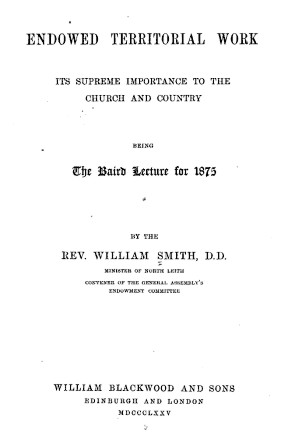
Below are (yet) a few more extracts from William Smith’s Endowed Territorial Work (1875). Smith certainly was on to something in his critique of the so-called American success story, allegedly vindicating religious Voluntaryism. From a confessionally Reformed standpoint, time seems only to have further confirmed his thesis. With Christianity subordinated to the laws of supply and demand, populism has compromised ministerial fidelity and has accelerated the decay of orthodoxy.

As I dwell on it, is there really a twofold problem, traceable to something other than gold standard Reformational thought?  Our spiritual fathers fought for biblical freedoms, not absolute ones. They preached freedom from papal tyranny, freedom from slavery to human traditions, freedom to form a private judgment on the letter of Scripture. But there was a trajectory of freedom that pushed further still – the Enlightenment. That freedom knew no restraints, because it was not ultimately tethered to any authority besides its own.

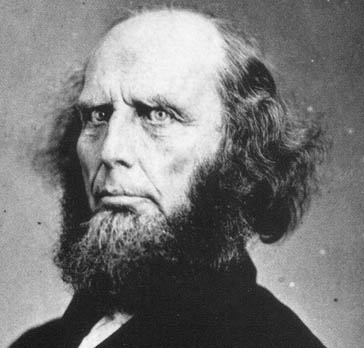
Within the pale of Protestantism, it seems to me that this non-Reformational lust for human autonomy reared its ugly head in the walls of the confessing Church. That was Arminianism. While Dort repressed it for a time, it lived on, and in America it burst into open flame in the ministry of Charles Grandison Finney.

At the same time, a more seemingly innocuous manifestation of Enlightenment freedom was gaining ground in Reformed communions. That was Voluntaryism. What was deceptive about that system was perhaps its frequent affiliation with theological Calvinism. No free will soteriologically, but free choice ecclesiastically. Interestingly, American Presbyterians as early as 1729 embraced Voluntaryism, before it even became a major force in British evangelicalism. Great men, too – some of them my heroes. But Smith’s reflections here, plus more than a century’s worth of all too painful confirmation, draws me to the conclusion that a major fault in American Christianity lies in this twofold concession of ground to the Enlightenment by the sons of the Reformation.

Read this, and see what you think.

* * * * *

“Dr Magee, formerly Rector of Enniskillen, now Bishop of Peterborough, in his trenchant treatise on the Voluntary system, proves with reference to the current fables of its success in the great Western world, that out of a total of 42,359 churches, there were no fewer than 12,829 without any settled pastoral ministry,— that out of a population of twenty-seven millions, more than a third were not even under the influence of pure Christianity, and much less than a sixth were members of any pure Christian Church, — that upwards of five millions either make no profession of any religion whatever, or are open and avowed infidels — that over and above these, another million connected with Mormonism, Spiritualism, or other such monstrous abortions, cannot be regarded as Christians at all—that not less than one hundred different denominations, some of them calling themselves by the most ridiculous names, and glorying in the most absurd peculiarities of faith and practice, are enumerated in the American Census—that the occupants of the pews exert the most degrading and pernicious influence on the occupants of the pulpits, who dare not, as they value their salaries or the place they fill, denounce national sins, and who, as the result of this subserviency, were the great abettors and upholders of slavery so long as it subsisted in the South—that with churches crowded in the cities, hundreds of thousands are living on the territory without Sabbath or sanctuary influences, without a pastor, and without any one to care for their souls—and that in America, as elsewhere, Voluntaryism tends to promote Congregationalism and commercialism, instead of a system of faithful and devoted pastoral superintendence in connection with the ministry of the Gospel” (229-30).

[Quoting a minister in western Canada] “I must pass by the other still greater evil of the Voluntary system; I mean the evil effect which must be the natural consequence of the want of independence in the clergy themselves upon the doctrines of the Gospel. The multitude of sectarian creeds produces a very general indifference to all religion’” (232-33).

“Voluntaryism, therefore, it is very evident, does not change its hue on the other side of the Atlantic. It is fruitful of the same evils there as here. With all the free scope and fair-play it enjoys under the starred and striped Republican banner, it leaves tens and hundreds of thousands uncared for. With a Beecher there, as with a Spurgeon here, planted in a large and populous city, enshrined in a temple where fashion helps to swell the votaries, and sensationalism or genius impregnates the winged words spoken from the pulpit with power to awe, entrance, or excite, Voluntaryism will win for itself such victories as impress the vulgar or unthinking with the idea that it is the system best fitted to succeed” (233).

Read Full Post »

“For thorough and effective endowed territorial work, two requisites are indispensable. In the first place, the whole country must be divided into districts, each containing such an amount of population as shall be manageable by a minister and kirk-session; and provision must be made for easily rearranging these districts from time to time, so as to make them tally with the needs of a fluctuating and increasing population. In the second place, there must be an endowment fund applicable to each district, so as to render the minister so far independent of those among whom he labours, and more especially to make his services available for that portion of the population who care for none of these things, or who cannot pay for religious ordinances” (William Smith, Endowed Territorialism, p. 136).

Read Full Post »

William Smith’s chapter “Endowed Territorial Work as Contrasted with Voluntaryism” in his Endowed Territorial Work (1875) is just so full of really profound, meaty material with surprisingly contemporary relevance that I’m just going to cut and paste a large swath here.  If you’re confessionally Reformed and zealous for mission that doesn’t pander, read this and read on.  You absolutely must cut your teeth on Smith; and if you’re hungry for more, by all means pick up Chalmers! 

A few things I love about this passage.  First, Smith represents the Reformed parish in all its vigorous masculinity.  Unlike the gathered church-model of Voluntaryism (19th century de-establishmentarianism), this construct keeps the church at the center of the community regardless of demographic and socio-economic shifts.  The Reformed parish church stands as a steady bulwark; it holds the standard like an intrepid solider on a contested hill.  Tragically, churches over the last 100-200 years have retreated from the inner-cities.  Not so the Reformed parish church.  And I would think that those who are won over to the ideals of ‘the auld Kirk’ would head unbanward to retrieve long-surrendered ground. 

Not only is the Reformed parish church steadfast, as Smith points out, but it is consciously God- and not man-pleasing.  The tendency of the alternate system yielding to market principles is to fawn and pander.  The latter tends to discharge its duty to men in the sight of God.  True, the Reformed parish church is designed to serve men.  But it serves them as that institution invested with the keys of the Kingdom, assigned to a definite geographic charge, and answerable to its King.

Related to this, Smith makes something clear that I haven’t yet seen in Chalmers.  He points out how territorialism tends to retard the downgrade of confessionalism.  If this model in principle resists the forces of market demand, then at least there is a kind of barrier raised against the inroads of populist latitudinarianism. 

Last – and so much more could be said – I love how Smith shows that the old Reformed parish plan smothers the cult of personality in its infancy.  Being Presbyterian, it takes overseer parity seriously both inside and outside the local context.  And since it respects without worshipping geographic, ecclesiastical boundaries, it promotes diligent attendance on the means of grace on faithful, not necessarily sensational pastors.  Oh, and there is no chapter on sheep-stealing in its playbook.

Alright.  Enough of Ives; enter Smith.

* * * *

Voluntaryism cannot, on its own footing, maintain itself in [poor] districts. Innumerable instances have occurred in which Voluntary chapels, planted originally in districts occupied by industrious and church-attending families, have been removed from these districts to more affluent and attractive neighbourhoods so soon as, from the extension of the town and the concentration of poverty and crime, there occurred an influx into these districts of a poor or vicious population. Parish churches remain permanently in their first position. Though erected originally for the rich, who occupied as their palatial mansions tenements now converted into stores and warehouses, and now surrounded by drunkenness, pauperism, filth, and crime, they maintain their places unchanged, and continue to ring out their Sabbath-bell warning against the sins that prevail around them. Parish ministers, true to their trust, do not abandon the degraded poor whether they will hear or whether they will forbear.”  The fold and the shepherd remain, whatever change the flock may undergo.”  But Voluntaries, more fickle in their affections and less restricted in action, change continually the sites of their chapels, and follow on the skirts of a paying population. Edinburgh exhibits examples of this. Glasgow exhibits still more. But perhaps the most notorious scene of such unworthy and recreant migrations is to be found in Liverpool, where more than fifty such deserted sites may be traced on the map of the town, and where thirty-three chapels have occupied a hundred and thirty different sites— the congregations, in their corporate capacity, remaining the same.  The principle that operates in this way to the abandonment and neglect of the poorer districts, that the wealthier may be courted and cultivated, is surely not a right or commendable principle. It does not harmonise with the spirit of the Gospel, nor can it fulfil the command or do the work of Him who said, “Go out quickly into the streets and lanes of the city, and bring in hither ” (i.e., to the Gospel feast) “the poor, and the maimed, and the halt, and the blind. … Go out into the highways and hedges, and compel them to come in, that my house be filled.”

Dissenters, as a rule, do not systematically visit the poor. It is not part of their system. Their energies are sufficiently tasked otherwise in recruiting their ranks from the multitude of respectable artisans and small shopkeepers who, in our overgrown town parishes, are driven from the national Church by the lack of sufficient accommodation, or by the system of exclusive and proprietary pews that has sprung up, fungus-like, in some quarters. If any Dissenting congregation does adopt the system of local house-to-house visitation, the manner and the meaning of it will soon be detected. The zeal of many of the visitors will be found to expend itself in plying with fulsome flattery, or cajoling with astute misrepresentation, the more respectable adherents of other Churches, if haply they may be seduced to speak the shibboleth and swell the numbers of their congregation. The degraded classes will be lightly passed by. The clamant poor will be silently left, or actually certificated and commended, to the care of the parish minister. The system that countenances, necessitates, or involves such procedure as this, is a selfish, hollow, and rotten system. It cannot cope with the adverse circumstances of society; it cannot overcome the evil of the world.

The system of endowed territorial work, on the contrary, is in strict keeping with Christ’s commission to go and make disciples of all nations. It accords with the plan on which the apostles and first promulgators of the Gospel founded Churches in different places. It conserves the general principles laid down in the New Testament for the guidance of the Church to the end of the world. It approves itself to sound reason as best adapted alike for diffusing generally, and for maintaining permanently, the power of the Gospel in any land. It secures for the pastor a proper sphere, and invests him with the requisite influence, authority, and independence. It places the office-bearers and members of his congregation in a right relationship to him, one to another, and towards such as are without. It marks out for them all a field, the faithful cultivation of which at once exercises the graces and gifts, enhances the joys and rewards, of those that cultivate it, and adds to the trophies of the great Husbandman into whose garners its crops are gathered.  On all these grounds, and on many more which time would fail fully to specify, endowed territorial work approves itself as the system which, most consistent with Christian principle, is in practice found to be most effective and successful.

On the minister it devolves the burden of territorial responsibility, by assigning to each, at his ordination and induction to a parish, a certain amount of well – defined and overtakable, work.  This is its grand underlying principle. Practically, the principle has been departed from in many instances, and especially in our large towns, in consequence partly of the increase of population without a corresponding increase of parishes and parish churches, partly of the rivalry of Dissenters resulting therefrom. But wherever and from whatsoever cause the principle has not been fairly and fully wrought out by the national Church, it has been to the ultimate loss of that Church, and to the detriment of true religion. “Where the principle is strictly acted on—and it ought to be so in every case, both in town and in country parishes—the minister naturally and of necessity feels an interest in his work of a totally different kind from that which is possible in the case of him who acts on the Voluntary principle. The Voluntary minister is bound to the people who are attracted to his ministry by his eloquence and ability in the pulpit. The distance from which these are drawn is limited only by the range of the influence of that attraction. The greater his ability, or popular gifts rather, the wider is the scope of his attractive influence, and consequently the larger the area from which his congregation is drawn, and the vaster and more promiscuous the mass of population among which they are scattered here and there. His relations to his flock are personal only, and change continually with its shifting and fluctuating units. The greater his success and the larger his congregation, the less intimate and the less influential will these relations necessarily become. Whereas, in the case of the minister bound to a territory of manageable extent, his relations not only to the members of his congregation, but to all the inhabitants of that territory, are of a totally different character. They are more solid, intimate, and permanent. He belongs to them. He is officially and solemnly bound to serve them. The consciousness that he is so, and the consequent concentration of his attention and efforts on the scene of their daily avocations, impart to him a feeling of property in them. They belong to him. They are his people. There is thus insensibly created between him and them a link of friendly and familiar correspondence, which leads to the most beneficial effects. Thoroughly acquainted with the dimensions of his field of duty, and aware of the extent of his responsibility, the minister enters upon his labours with alacrity and good hope, and is stimulated and encouraged to steady perseverance in them by the comfortable and enlivening sense of being able to overtake them. Visiting his parish from house to house, he not only ministers on the best footing to those parishioners who by attendance in his church have expressed a desire for his ministrations, but, without any appearance of intrusiveness, without the possibility of offence, and without prejudice to the message he bears, he obtains easy access to home after home, where one circumstanced and accredited as he is can alone preach the Gospel with effect to those so utterly lapsed and careless that no amount of mere pulpit attraction will ever draw them to Christianity.  Besides, what wide and effectual doors are opened for his usefulness by the feeling which pervades the sphere of his activities that in the time of need the poor may apply to him, assured of sympathy and friendly aid—that in the season of sickness he is ready at hand to visit the most abandoned and depraved on their bed of languishing or pain, and to counsel and direct them when conscience at last finds her voice, when their fear cometh as desolation, and when distress and anguish come upon them!  The people know that they can in such cases confidently count upon his succour. Their mutual intercourse and acquaintanceship strengthen this feeling from day to day, till at last, by the cementing force of sympathy, the minister is throned, as Chalmers says, “in a moral ascendancy over his district;” and from his very position there goes forth a commanding influence for the highest ends, that reaches every home and heart within it.

For it is not the good of the poor only which the system of endowed territorial work is calculated to promote. That system is as much required and as well adapted for behoof of the careless and godless among the wealthier classes, who, but for it, would in the great majority of cases be left entirely to themselves, without instruction, counsel, or reproof, in the matter of their spiritual concerns. They are quite as liable as their poorer brethren to fall away altogether from religion. God has formed their hearts alike. By nature they are equally corrupt and depraved. The temptations of wealth and luxury and refinement are not less powerful in seducing men from the paths of piety than the temptations peculiar to a low, crushed, animal condition. The rich, therefore, need the visits and the ministrations of a faithful minister whom they respect, as much as the poor do. But in nine cases out of ten the visit of a minister acting on the Voluntary system would only give offence to the wealthy, create in them additional prejudice against religion, and so issue in doing far more harm than good. Whereas, on the other hand, the minister acting on the territorial system has, in the very nature of his work, a passport to every house in his parish. The reason of his visit being simply the discharge of incumbent duty, will be readily recognised and regarded with respect by the highest in common with the lowest; and, in point of fact, the relations which, on this ground, have been established between the landed aristocracy and gentry on the one hand, and the ministers of the Church of Scotland on the other, have been fruitful in manifold benefits, not only to the rich themselves, but to all classes. They have helped in some measure to neutralise the tendencies of these later revolutionary days towards the disintegration of society, and to keep class united to class by the bonds of mutual sympathy and respect.

The benefits of endowed territorial work have indeed for some generations been obscured by the partial extent to which the system has been maintained in this country.  Even at the period of the Reformation, the statesmanlike idea of Knox in regard to it was never fully realised. Through lack of sufficiently qualified ministers, and more particularly in consequence of the ruthless spoliation of the Church’s patrimony already referred to, the parochial economy of the Church was never, up to the measure of his policy and wish, made sufficiently large and comprehensive for the population of the country. Instead of one thousand only, as he desired, more than three thousand were assigned, on the average, to each parochial charge. In the years that followed, matters grew gradually worse and worse in this respect. In the course of time the population was trebled, and yet no appreciable addition was made to the territorial machinery of the Church. In the towns, where the principal increase of population took place, and where Church extension was chiefly required, the evil arising from neglecting this extension was in particular greatly aggravated by the all but total relinquishment there of all regard to territorial limits in the management of such churches as existed, and in the membership and discipline of their several congregations. These congregations, drawn indiscriminately from all quarters of the town, and from whatsoever parishes formed or environed the town, speedily lapsed into a state of semi-independency. In most instances, their numbers and demands were such as tasked all the energies and took up the whole time and attention of their respective ministers. In consequence of this, the territories assigned to their pastoral care remained untended and unvisited. For all practical intents and purposes, their boundary lines might have been erased from the map. The great mass of their population fell out of all ecclesiastical oversight. And thus the territorial system, sinking into something very like desuetude in many of the most important and conspicuous parts of the country, has not had fair play, and by many is supposed to have proved a failure, simply because it has never been tried.

Another thing which has operated strongly to the damage and disparagement of the territorial system is the overlapping competition of Voluntaryism. By virtue of the tolerant spirit of the times, and because of the liberal character of our civil constitution, Dissenters participate largely in the civil privileges flowing to all that profess religion out of the existence of an endowed territorial Church, although formally they refuse to be parties to any compact between Church and State, such as makes such a Church most easily possible. They derive no trivial advantage from the publicly recognised standard of truth and duty necessarily maintained by the national Church, and to some extent they share also in the benefits arising generally out of its parochial economy and organisation. In point of fact, as I have already indicated, Dissent flourishes only when and where the national Church is strong. Were that Church annihilated to-morrow, and were Voluntaryism thenceforward to become the universal order of the day, the first effect of the change would be a sapping of the chief strength there is in Voluntaryism, which is traceable mainly to the efforts of rivalry.  Gradually, every standard raised by it now, would be lowered further and further. Salaries now forced up by jealous comparison with stipends would become beautifully less. Systems of doctrine, kept pure and unrelaxed because of the continued existence in authority of the Westminster Confession, would, from time to time, be altered in one point after another, to suit the shifting sentiment of the hour. Work now stimulated into general activity by the arbitrary routine of official labours would degenerate into selfish and time-serving efforts.

And yet Dissent, owing her existence and much of her activity to the territorial system, does her very utmost to degrade the character and destroy the benefits of endowed territorial work—like the ivyplant, which, as it climbs, tends to choke the stalwart tree that supports it. Erecting here and there places of worship, maintaining in them ordinances which in most cases are nowise distinguishable from those dispensed by the national Church, and drawing to her, for various reasons, many nurtured in different parishes, she poaches at her capricious pleasure, now in this parish, now in that, and prosecutes, where the work will pay, enterprises that overlap and jar with proper territorial agencies, so as to prevent these from producing the benefit which, left alone to themselves, they would certainly do. What experience is more common at the present day than that of the earnest parish minister who, carefully mapping out his territory into convenient districts, and assigning to each such a staff of labourers as, under the presidency and direction of pious elders and deacons, could sufficiently attend to all the wants, both temporal and spiritual, of the whole population, finds that no sooner is the work thus planned and provided for begun, than it is imitated in its method and machinery by the emissaries of some neighbouring Voluntary congregation, who, previously satisfied with work of a congregational kind, select as a locality for their systematic cultivation not one altogether neglected, which would be good and praiseworthy on their part, but preferentially one which he already is sufficiently caring for? It may seem invidious thus to speak of such labours, by whomsoever and in whatsoever field they may be prosecuted. Those who are only superficially acquainted with such territorial work may imagine that the spiritual wants of any district can never be entirely overtaken, and that therefore no amount of work bestowed on it can ever be superfluous, or any number of workers in excess of its actual requirements. Such persons may consequently be inclined to attribute the remarks now made to jealous or spiteful feeling towards Dissenters.  But, in point of fact, all earnest workers in such fields must know well that there arises no greater hindrance to success in endeavouring to reclaim the outcast and elevate the fallen, than that which is caused by the clashing interference of two or three sets of similar agencies overlapping each other in one locality; and when, as too often happens, Dissenting agencies expend their principal care and strength on fields previously occupied by others, and in attempts to proselytise the children and dependants of those already more or less closely connected with other communions, the ultimate result of their efforts in this way can be only detrimental to the cause of religion in the locality, and tend to damage, not to promote, the success of thorough territorial work.

Read Full Post »

Few in confessional Reformed circles would question the ‘McDonaldization’ of the Church thesis.  So much of evangelical Christianity in America has caved in to consumerism.   But historically, I have to ask whether we’re at the end of a long journey begun by 19th century Voluntaries?  Or was it perhaps commenced inadvertently by the 17th century devotees of “gathered churches?”  The following quote from William Smith (a la Chalmers) at least raises the question, given that his central critique of Voluntaryism is its commericialization of the Church:

“But the radical and fatal defect of the Voluntary system lies in this, that from its very nature it tends to occupy and engross itself with the fat places of the land, leaving the lean neglected and uncared for—that it absorbs and isolates into self-supporting confederations the very portion of the population that ought to be caring for the perishing souls of others less happily conditioned—that the more successful it is in any field, the more neglectful must it be of those persons connected with that field who most require the ministrations of the Gospel —and that its besetting and generally irresistible temptation is to make the grace and ordinances of religion a matter of mere competitive shopkeeping on the one hand, and of ready-money purchase on the other” (William Smith, Endowed Territorial Work, 100-1).

Yet, I fear that Smith’s critique of consumerism cuts both ways.   

Smith wrote at a time when the integrity of evangelicalism had not been radically vitiated.  Many (most?) Voluntaries were Calvinist.  Smith really was criticizing all Voluntaryism, Calvinist or not, because it tended to make the faith once delivered gravitate to where the money is.  Voluntaryism of whatever stripe simply had no internal mechanism to ensure that everyone in the land, including the working classes, were provided the pure ordinances.  The old Kirk, with its principle of endowed territorialism, did. 

Reformed churches in North America are de facto if not de jure gathered churches.  And while many of us have been kept from the abyss of crass McDonaldization (so far), yet we tend to exist only where we can be financed.  Does this explain not only the temptation to dilute our confessionalism, but also why there are so few confessionally Reformed churches in urban America?

Read Full Post »

Recently, I’ve picked up William Smith’s Endowed Territorial Work again.  Truly great stuff.  Robust, Reformed missiology from a disciple of Thomas Chalmers.

The following is a quote in which Smith takes a swipe at 19th century Voluntaryism, which is basically now the status quo most evangelical churches.  Every church is functionally on its own, sink or swim, and is fully subject to the laws of the religious marketplace.  Or, as Smith succinctly puts it, Voluntaryism is the synthesis of “congregationalism and commercialism.”  The net effect is the degradation of the holy ministry.

It also may help orient the reader to mention that Smith has just argued for “necessity of rearranging the whole country into parishes of manageable extent and population, and the likeliest means by which this can be accomplished in present circumstances.”  That’s the parish principle a la Chalmers, also called territorialism.  In this chapter he contends for a coordinate principle with regards to finance, that is, “the provision for each parish of such an endowment or stipend for the minister as shall make him so far independent of those to whom he preaches, and render his services available for the benefit ot such of his parishioners as are either too poor or indisposed to pay for Gospel ordinances” (182).

So, enjoy! – or be challenged, either one.  But at the very least, think.

* * * *

The eminent success of the Free Church of Scotland, not only in the home, but also in the foreign field of evangelistic activity, is frequently quoted as an unanswerable argument in favour of Voluntaryism as against endowment; and on certain platforms it has become customary, for those decrying union with the State, to invite the members of the National Church, to surrender the privileges therein enjoyed, and to imitate the exodus by which their former brethren went forth to enjoy exemption from the burdens connected with permanent endowments. Now, far be it from me, and from every one who has true Scottish blood in his veins, to say one word in disparagement of the sacrifices, exertions, and successes of the Free Church, or to seek to detract from the praise justly due to the skill and statesmanship with which the great founders and leaders of that influential denomination have shaped its policy and guided its career.  But their great success is undoubtedly due in no small degree to the institution by Dr Chalmers of what is called the Sustentation Fund, which, though dependent for its supplies on free contributions from year to year, is in its principle and effects diametrically opposed to Voluntaryism, and does, so far as is possible in the circumstances, embody and carry out the principle of endowment.  It is not so secure as absolute endowment, and therefore the latter is not to be lightly, or except for very much stronger reasons than have yet been advanced, abandoned for it; but the income it provides for Free Church ministers is not dependent merely on the voluntary donations of those that wait upon their ministry. It is drawn in large measure from a source which is really fixed and permanent in its character, and which, though less secure and exempt from the possibility of variableness than that provided by the piety of remote ancestors and invested in substantial property, is yet sufficiently settled and sure to fulfil many of the purposes of endowment. It affects at least the constitution of tha relation between pastor and people, so far as to mitigate in a very considerable degree the evil inherent in mere Voluntaryism, by which the minister is made the minion and the slave of those whom he is bound as the ambassador of Christ to “exhort and rebuke with all authority.”

This mitigation, to whatever it amounts, is, so far as it goes, an immense gain. The evil it abates is most pernicious in its results. As a system, the evil tends to produce mere vapouring orators and popular demagogues and tinkling cymbals, rather than judicious expositors or valiant defenders of the truth and faithful pastors. It renders the exercise of sound and wholesome ecclesiastical discipline next to impossible, and it fills the advertising columns of Saturday newspapers with announcements of sermons and orations couched in clap-trap [absurd or nonsensical] phraseology, the puffery of which is simply disgusting to serious minds, and cannot but be fearfully deteriorating to the spiritual quality of any man, forced to seek by such unworthy expedients to fill his chapel and increase the coppers cast into his treasury.

That this is more frequently the result of Voluntaryism than some may suspect; that  “The pulpit’s laws the pulpit’s patrons give, / And those who live to preach, must preach to live,” is clear from the testimony bome by John Angell James, himself one of the most illustrious of Dissenting ministers.  He says: “In many of our churches the pastor is placed far below his level; he may natter like a sycophant, beg like a servant, or woo like a lover; he is not permitted to enjoin like a ruler.  His opinion is received with no deference; his person is treated with no respect; and, in presence of some of his lay tyrants, he is only permitted to peep and mutter in the dust.”

Read Full Post »

Here’s an interesting piece on the advantages of the parish system from an evangelical in the Church of England.  As Chalmers articulated it, the Church should be a Church for all people and consequently should not be subjected to the laws of the marketplace.  “I am debtor both to the Greeks and to the barbarians, both to the wise and to the unwise.”  The author of this piece argues that principle well.

Read Full Post »

Here’s a great little piece on the contemporary applicability of the parish system, from a friend in the Anglican communion of Australia.  Maybe they can help bring us Presbyterians back to our own parochial inheritance!

Read Full Post »

The following is extracted from Thomas Cochrane’s Home Mission Work (1878).  The chapter, “The Territorial System,” is a nice overview of the urban mission strategy advocated by Thomas Chalmers.

* * * *

In the later years of his eventful life, with all the experience and mellow ripeness of a mind that had given very much of the best of its powers to the advocacy and outworking of the grand old parochial system of Scotland, the illustrious Dr Chalmers, while carrying on with undimmed and undiminished lustre the labours of his distinguished professoriate, worked out, alongside of this theoretical training for the students of theology, the grand practical work of Territorialism. He thus devised and carried out, in a most singularly successful way, a scheme which, because it sought to cope with all the difficulties, and to grapple with all the obstructions that might be encountered, and set itself to the prosecution of true mission work, in a certain selected locality or territory, and to cultivate regularly and thoroughly that district so assumed, has been most fitly termed— “The Territorial System.

In the great metropolis of the West, among her merchant princes, in St John’s parish there, Dr Chalmers had previously developed, and very successfully worked out, under the wing of the State, the system, as strictly parochial; now he was to unfold and develop the same system, minus State support and State influence in any way.

The chosen field in Edinburgh, “The West Port, was the most unlikely, and, seemingly, unpropitious that could have been selected.

The hall opened for public worship was an “old Tan Loft,” near to the spot which had earned an unenviable notoriety, because of revolting murders that had been perpetrated—more revolting than any that had either before or since disgraced the fair escutcheon of that noble city—a locality where purity and outward decency alike blushed for very shame!

Nothing daunted, however, that truly great man, surrounded by a staff of devoted volunteers, went forth into the thick of the conflict, to do battle with the sin and crime that met them, at every corner of the district, and to soothe the sorrows and assuage the trials of human misery and woe.

It was indeed a noble scheme, a grand enterprise; and let that interesting chapter, “The West Port,” in the classic and eloquent biography of Dr Chalmers, written by his son-in-law, the late Dr Hanna, tell in his inimitable style, how, under more than wizard wand, of that Great Moral Conjuror, the wilderness became a fruitful field, and the desert rejoiced and blossomed as the rose, becoming “A Garden of the Lord.

All around now in Edinburgh, from the west to the extreme east, ‘neath the shadow of hoar Holyrood, there have been erected churches and schools upon this territorial system, so that, in addition to “The West Port,” there are more than seven other churches with as many ministers, and fully equipped agencies and congregations, carrying on with greater or less success the operations of the Territorial system.

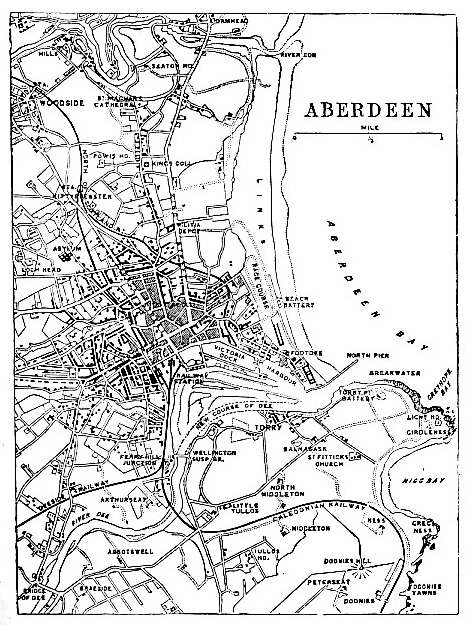
Glasgow, too, has had her full share of the benefits of this scheme. The development of this system, however, is not confined to Edinburgh or Glasgow. Many other large towns in Scotland, such as Aberdeen, Dundee, Perth, &c, have reaped golden harvests from the seed sown, through the carrying out of this important work; while England, too, in measure, has caught the infection and influence, from the spell of the mighty charmer, who though “being dead, yet speaketh,” while his works, all around, follow him; and far hence, away across the broad Atlantic, the winds have wafted on and o’er the story, and there, too, in several instances, the system is being tested and tried.

In the prelude to his lecture on “Transcendentalism, Dr Joseph Cook of Boston, rehearses the story of “The West Port,” and presses upon his readers the importance and moral grandeur of the scheme; while, as Dr Cook himself informed us, when on a visit to this country, the system has been found in America to be the only true system for elevating the community, civilly, socially, and morally.

It may here be stated that the system, both scholastically and ecclesiastically, can be worked out in such a manner as to be self-sustaining; so that the big thoughts, and large desires of the illustrious founder, have not only been proved not to be Utopian, but fruitfully workable; and that too, not only during his distinguished life, under his own eye, and by the cunning of his own right hand; but now, also, a full generation after he has been gathered to his fathers, the work progresses and advances still more and more, and we believe will continue to do so, after its present promoters have gone the way of all the earth.

It may be argued, however, that if so much has been done,—if such harvests have been, or are being ripened and reaped all round, in the town and country districts of Scotland, and elsewhere, is there still need for the advocacy and extension of the practical outworking of this scheme? There is much land yet to be possessed. When we are reminded that in Edinburgh alone, there are perhaps not less than forty thousand, in Glasgow a much larger number, while over broad Scotland, there are about five hundred thousand living in entire neglect of the means of grace; living “without God,” if not dying “without hope,” we cannot fail to perceive that this scheme is of prime importance, and that the necessity for the thorough outworking of it is as great as ever.

THE DISTRICT SELECTED.

The idea of the great founder of the scheme, in regard to the chosen district, was very decided. His firm and unwavering conviction was, that the field selected should be very carefully and deliberately chosen, and that it should be of adequate proportions,—not too large, lest it should not be fully and thoroughly cultivated; not too small, lest there should not be a population sufficiently large to yield material for a good, self-supporting congregation.

Holding these views strongly, Dr Chalmers was in the habit of affirming that a population of about 2000 was quite large enough, in ordinary circumstances, for the purpose in view, and that a district less populous was not adequate for the formation of a Territorial Congregation. Hence a district of about 400 families, or 2000 of a population, according to the system under review, would require about forty visitors in order to cultivate it thoroughl, giving manageable sub-divisions of about ten families to each agent.

THE VISITOR’S DUTIES.

The duties of visitors may be regarded in many aspects (see pages 57-60), but the great, the chief duty is to visit their districts, with a view of promoting the highest good of the families in the district allocated to them. Assuming the visitor to be truly Christian, and devoted to the work, how very much will depend upon the judiciousness manifested in the discharge of duty. What care will be required, lest their visits should hinder, rather than help on the work to be accomplished. How important, all-important, to make the families visited feel that we are really and truly their friend; that we visit, not with a prying over-curious eye to spy into their household affairs, far less in a censorious spirit, ever insinuating our fancied superiority, and finding fault with what, we imagine, may be their little delinquencies; but that, placing ourselves upon the same platform on which they stand, we thus make it clear that we have their highest good at heart, and have love in our heart for them, as well as expressed sympathy upon our lip with them. Hence our aim should be to influence the heart for good.

“They build too low who build beneath the skies.”  They aim too low who aim not at the heart.  The effect of mere gossip in visiting, is always fruitless, if not of evil tendency.  By all means let us be happy, with a gleam of sunshine ever lighting up our countenances.  By all means let our words he happy words, and happy social words.  If time permit there may be talk about the common affairs of life, and the current events of the day; but we should never let our conversation degenerate into flippant talk, idle talk, or jesting which is not convenient; and, if possible, we should never leave any house, without making it clear that our object in visiting was with respect to the highest good of the family.

Even in the distribution of tracts let us have a care of the manner we manifest in so doing. Let us keep in view that, while we are as messengers of mercy bearing the silent message in the tract we give, we are to make it plain that we need the message we bear, as well as those to whom we bear it, as Mr M’Cheyne would have said, in his own tender, touching way, “I need it, my brother, as well as you.”  Or, as we have it from an inspired pen, “We, that we say not you.”

The importance of house-to-house visitation can never be over-estimated. There may be—there are —some who weary in this seemingly slow process, and who would fain “rush into print,” in placards large, fancying that by sleight-of-hand, or speed of foot, or by monster meetings in large halls, and other general schemes, they may speedily evangelise the outlying population in our vast moral wastes.  All success to these, and every good scheme!  It is not so, generally, however, that this work is to be done. The race is not to the swift, nor the battle to the strong.  The patient, laborious, conscientious worker, who realizes what is implied in faithful labour for the Great Master, is the labourer that will here prevail.  If it be true that the time shall come when they shall no more teach every man his neighbour, and every man his brother, saying, “Know the Lord,” does not this imply that, until that time shall have come, this system should be carried on?  And here, again, the conscientious worker must be content to be hidden from the world’s eye, but work ever under the eye of His Lord and Master. He must be willing to be unknown, perhaps unheard of.  Down in the damp, dark cellar;  high, in the lone garret room; concealed in some back court where the sun scarce shines; or in the loathsome land, where fever holds its perpetual sway, and revels, in the luxury of human misery, all prodigal of life,—there must the visitor be prepared to labour, there the missionary be contented to toil, from day to day.

” Go labour on, ’tis not for nought:
Thy earthly loss is heavenly gain;
Men heed thee, love thee, praise thee not;
The Master praises; what are men?”

Prevention is better than cure.“—There are congregations whose membership may not be able to supply agents for carrying out the scheme we have been commending, and where it would be of immense advantage, to such a congregation, to have the scheme thoroughly and earnestly worked out, in connection with their own work, and into their own congregation.  In such a case why should not some healthy and vigorous, if not wealthy and numerous, congregation, come with all its flow of life and love, and work for, at least, if not in connection with the work of such a congregation?   Would not many a struggling congregation thus take heart and begin anew? Would not many a downcast and cheerless minister obtain encouragement, and gird on with fresh ardour the armour of the Gospel of Peace?  Nay, would not this be a true exhibition of the members of the church, looking “not every man on his own things, but every man also on the things of others;” and of manifesting in the clearest sense, how the strong could help the weak, thus showing to the world and the Church alike that “it is more blessed to give than to receive”?

Having, throughout the volume, touched upon the main features of the Territorial system, and having had the privilege, for very many years, of being a humble labourer in the Territorial field, in closing our remarks we may be permitted to say that the longer we have laboured in the outworking of the system, the more thoroughly have we been convinced of the value and effectiveness of it.

One of our greatest and sincerest regrets is, that we should have been so little able to do anything like justice to it. We feel this all the more, that we are not now so agile, as heretofore, in buckling on our armour, and sallying forth at the trumpet’s sound against the common foe.  We must soon retire from the field of action, but, when retiring, we hope to do so by handing down the banner, unfurled and untarnished, with the device thereon, as ever, full, perfect, and undimmed—

For THE LORD

and

Territorialism.


Read Full Post »
Being an armchair philologist, words fascinate me.  I am often allured by the suggestive hints from other cognate languages.  “Hmm. Could this word be related to that?  And if so, how?”   Soon I’m at the dictionary, probing unknown etymologies and discovering family relationships.  New shades of significance of even the most familiar of words give me an inward satisfaction.

But I really sit up and take notice when they are words that tap into domains of personal interest. So after several years of nursing a respect for Reformed parochial mission theory a la Thomas Chalmers, I’ve become really interested in expanding my grasp of related terminology and its significance.

One of the new words under personal review is ward.  I owe this one to Dr. Francis Wayland (1796-1865), the fourth President of Brown University and a strong American admirer of Thomas Chalmers.  In his biographical tribute to the great Scotsman, he mentions the word to explain Chalmers’ advocacy of the parish as a unit of evangelism.  “So far as I understand, the city of Glasgow is divided into parishes, as our cities are divided into wards” (p. 88).  Really, it was just an incidental statement in a larger explanation.  But this attempt to translate a somewhat foreign state of affairs for an American audience made me pause.  “Now if the British parish is analogous to the American ward (or district, precinct, borough), then what is its precise meaning?  And how could it be appropriated ecclesiastically?”

Well, the word as a noun basically means “the act or condition of guarding” or “being in a state of custody.”   Germanic in origin, the word developed through Old and Middle English to the current ward and related variants.  In the same family are beware, wary, guard, and warden.

The following seems to be central to its essence.  The ward is an authoritatively fixed responsibility assigned to some person or persons to regard, protect, and otherwise care for certain ones under their charge.  Usually a ward is not alone, but several wards are distributed throughout a general area, combining for the overall protection and provision of a larger body.  So, then, the ward is an organizational expedient for a broad charge.  In light of all this, we get a clearer insight into the significance both of city and hospital wards.

Turning to the ecclesiastical application, the Lord Jesus Christ has been invested with “all authority in heaven and on earth.”  He, however, chooses to send the Twelve throughout the nations with the keys of the kingdom.  Whatever they “bind on earth shall be bound in heaven,” while “whatever they loose on earth shall be loosed in heaven.”  He that hears them hears the Son, and whoever hears Him hears the Father.

The entirety of the nations are to be taught, baptized, and consequently further taught “in all things whatsoever [Jesus has] commanded them.”  The nations, then, are under the Church’s custody.  No doubt “the heathen rage” and attempt to throw off these “bands” and “cords.”  Yet, none of their mad fury alters in the slightest the dominion of God’s Christ or the authority entrusted to the Church as steward.  The world is Christ’s ward.

Yet the Church under Christ can only fulfill its charge by (in the words of Thomas Chalmers) an intelligent economy. Only by division can the whole be conquered.  So the Church, seeing herself as Christ’s city steward or the spiritual hospital’s administrator, divides and subdivides its sacred charge.  We may call these units any number things.  But given the ancient and contemporary significance of the ward, this offers itself as a great word for the Church’s missionary vocabulary.  And for that matter, it ought to be more than idea – but an abiding mandate.  The Church ought not so much to create wards as to realize and begin to take charge of them!

Perhaps these ideas seem Roman Catholic.  I would contend, however, that the Reformation Church – wearing the mantle of the true catholicism – affirmed them wholeheartedly.  It threw out the vain traditions of men, but not this theology of the Church’s spiritual stewardship over the nations.  And that is why the Reformation Churches kept establishments and the parochial system.  They were viewed as wise expedients to fulfill its sacred responsibility.

Nevermind the blight of secularism, with its contempt of all churchly restraints.  Let us not be browbeaten by the re-paganizing of the West.  It remains, as well as the East – and for that matter, the North and South too! – the territory of the Lord Christ.  It is His domain, as the rightful Heir of all things.  That means the nations are His, the states are His, the cities are His – with all its wards.  Let the Church assume its responsibility over them.  And in so doing, it will one day receive that cheering commendation, “Well done, thou good and faithful servant.”

Read Full Post »

« Newer Posts - Older Posts »