Thomas Shepard (1605-1649), on civil magistrates promoting the true religion. “Thesis 20. And if superiors in families are to see their gates preserved unspotted from such provoking evils, can any think but that the same bond lies upon superiors in commonwealths, who are the fathers of those great families, whose subjects also are within their gates, and the power of their jurisdictions? The civil magistrate, though he hath no power to impose new laws upon the consciences of his subjects, yet he is bound to see that the laws of God be kept by all his subjects; provided always, that herein he walk according to the law and rule of God, viz., that, 1, ignorant consciences in clear and momentous matters be first instructed; 2, doubting consciences have sufficient means of being resolved; 3, bold and audacious consciences be first forewarned. Hence it is, that though he hath no power to make holy days, and to impose the observation of them upon the consciences of his subjects, (because these are his own laws,) yet he may and should see that the Sabbath day, (the Lord’s holy day,) that this be observed, because he doth but see to the execution of God’s commandment herein.”
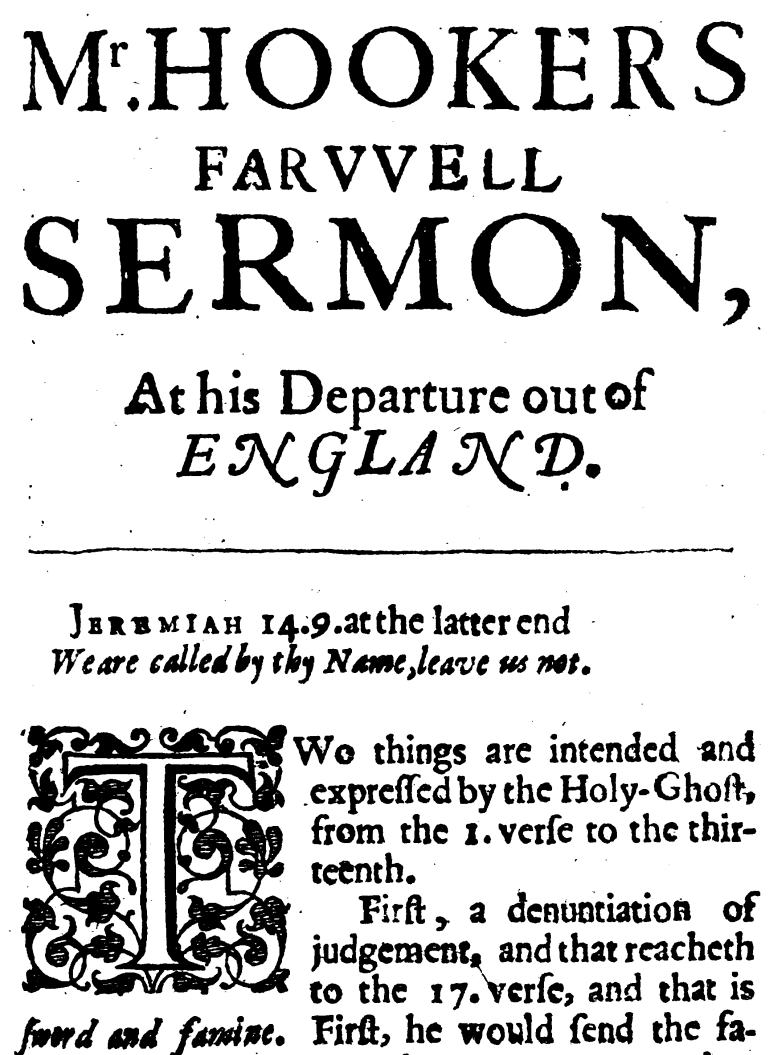
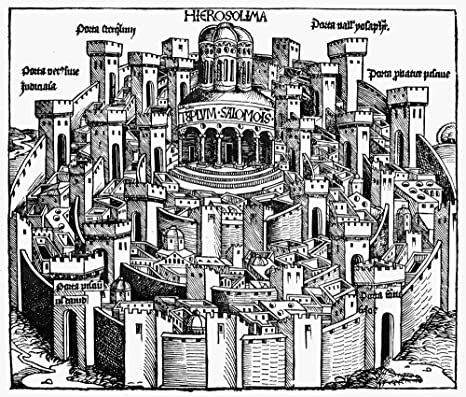
“Englands sinnes have been great, yea and their mercies great. England hath been a mirror of mercy, yet God may leave us, and make us a mirrour of his justice. Looke how he spake to the people in Ier. 7. that bragged of the Temple of the Lord, Sacrifices and offerings: And what may not God which destroyed Shilo, destroy thee O England? Goe to Bohemia, from thence to the Palatinate, and so to Denmarke. Imagine you were there, what shall you see, nothing else but as Travellers say, Churches made heaps of stones, and those Bethels wherin Gods name was called upon, are made defiled Temples for Satan and superstition to raigne in? You cannot goe two or three steps, but you shall see the heads of dead men, goe a little further, and you shall see their hearts picked out by the fowles of the ayre, whereupon you are ready to conclude that Tilly hath been there: Those Churches are become desolate, and why not England? Goe into the Cities and Townes, and there you shall see many compassed about with the chaines of captivity, and every man bemoaning himselfe. Doe but cast your eyes abroad, and there you shall see poore fatherlesse children sending forth their breaches, with feare, crying to their poore helplesse mothers. Step but a little farther, and you shall see the sad wife bemoaning her husband, and that is her misery, that she cannot dye soone enough; and withall she makes funerall Sermons of her children within her selfe, for that the Spaniard may get her little ones, and bring them up in Popery and superstition; and then she weeps and considers with her selfe: If my husband be dead, it is well, happily he is upon the racke, or put to some cruell tortures, and then she makes funerall Sermons, and dyes a hundred times before she can dye. Cast your eyes afar off, set your soules in their soules stead, and imagine it were your owne condition, why may not England be thus, who knowes but it may be my wife, when he heares of some in torments? Ah! Brethren, be not high minded, but feare, as we have this bounty on the one side, so may we have this severity on the other; therefore prancke not up your selves with foolish imaginations, as who dare come to England, the Spaniards have enough, the French are too weake: Be not deceived, who thought Ierusalem the Lady of Kingdomes, whither the Tribes went to worship, should become a heap of stones, a vagabond people, and why not England? Learne therefore to heare and feare, God can be a God without England, doe not say there are many Christians in it, can God be beholding to you for your Religion? No surely, for rather then he will maintaine such as professe his Name and hate him, he will raise up of these stones children unto Abraham; He will rather goe to the Turks, and say you are my people, and I will be your God. But will you let God goe, England? Why are you so content to let him goe? Oh! lay hold on him, yea hang on him, and say thou shalt not goe. Doe you thinke that Rome will part with her religion, and forsake her gods? nay, an hundred would rather lose their lives. Will you let God goe? Oh England plead with your God! and let him not depart. You should onely part with your rebellions, he will not part with you. Leave us not. We see the Church is very importunate to keep God with them still, they lay hold on God with words of argument.”
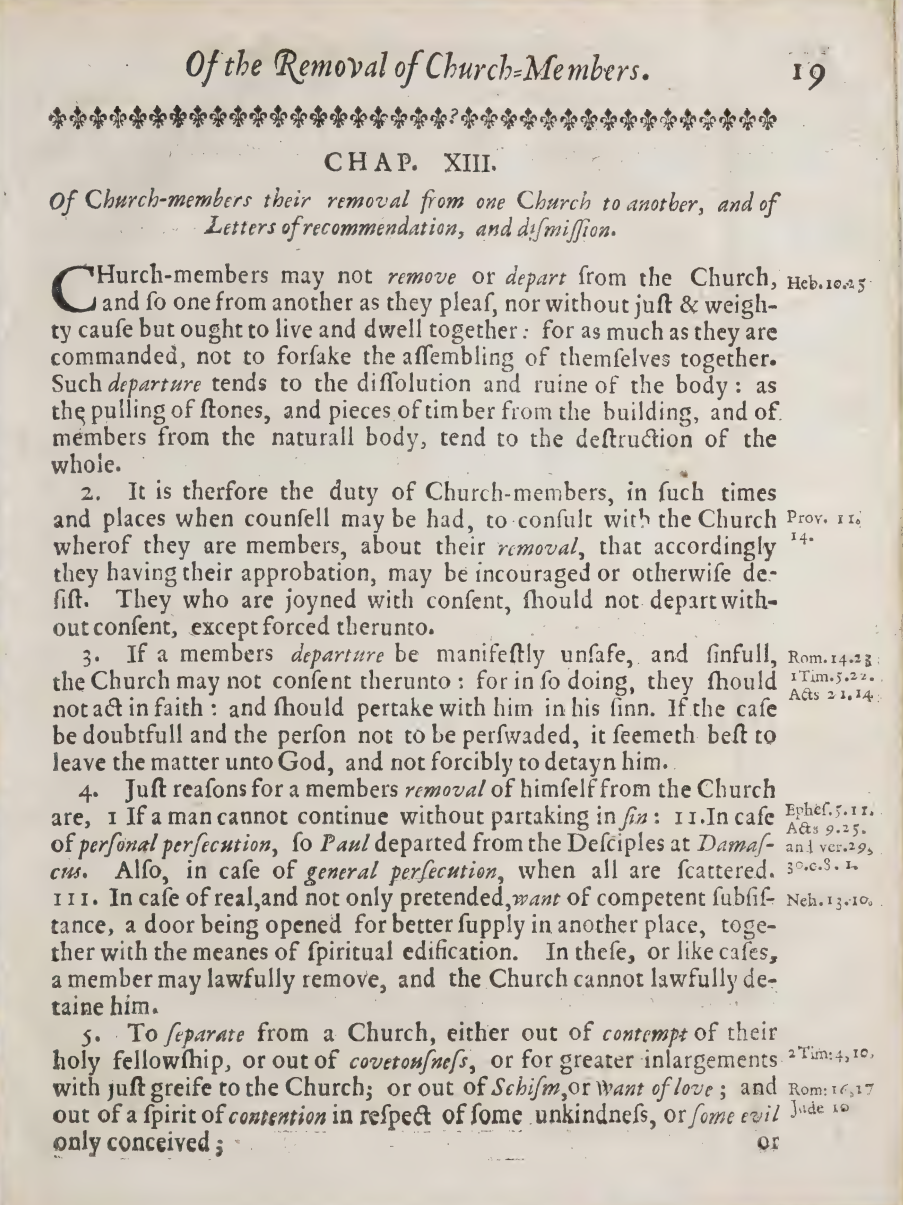
Though I am Presbyterian, I have for years deeply appreciated the great majority of what the New England fathers set forth here in their Cambridge Platform (1649) concerning why, how, and when church members may lawfully leave their local congregation to join another. Would to God we “eat this scroll,” internalizing its biblical principles. And so may we more and more in this individualistic and non-committal age live out the articles of our ancient creed, “I believe an holy catholic church” and “the communion of saints!”
* * * * * * * * *
CHAPTER XIII.
Of church members, their removal from one church to another, and of recommendation and dismission.
1. CHURCH members may not remove or depart from the church, and so one from another as they please, nor without just and weighty cause, but ought to live and dwell together; forasmuch as they are commanded, not to forsake the assembling of themselves together. Such departure tends to the dissolution and ruin of the body, as the pulling of stones and pieces of timber from the building, and of members from the natural body, tend to the destruction of the whole.
Heb. x. 25.
2. It is therefore the duty of church members, in such times and places where counsel may be had, to consult with the church whereof they are members about their removal, that accordingly they having their approbation, may be encouraged, or otherwise desist. They who are joined with consent, should not depart without consent, except forced thereunto.
Prov.xi. 16.
3. If a member’s departure be manifestly unsafe and sinful, the church may not consent thereunto; for in so doing, they should not act in faith, and should partake with him in his sin. If the case be doubtful, and the person not to be persuaded, it seemeth best to leave the matter unto God, and not forcibly to detain him.
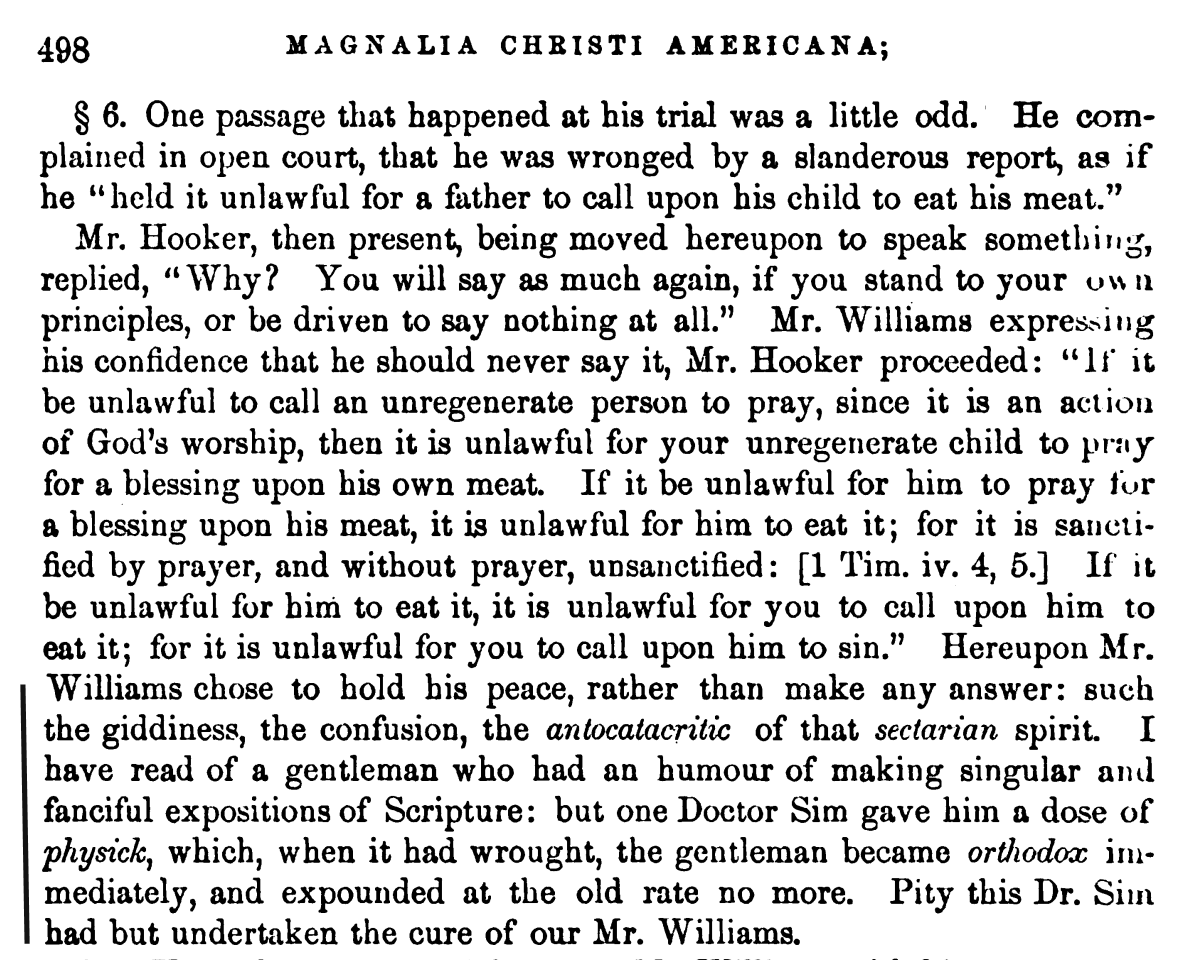
So I was reading Cotton Mather’s narrative of troubled Roger Williams, whom the Boston magistrates exiled because he had made such a nuisance of himself up that way. I found the following humorous—and enlightening! I’m sure Mather hardly meant to suggest that all of Roger William’s problems were mental. But it sure seems like he thinks something was amiss and needed treatment.
“Since in Religion you are not Servants of Men, in true fidelity to Christ you must in your Places peaceably oppose and refuse whatever Innovations, Injunctions, or Traditions of Men. 48 4.1919. Would any change the Lord’s Day for another Day, or command other Feasts to be equally regarded; or forbid you to sanctifie the Lord’s Holy Day, or suppress the Use of his Holy Word; or set up another Rule of Faith and Judge of Controversies? do they devise new Modes of Worship, or mingle their own Fancies with his Institutions? For Conscience sake, receive them not, but obey Christ above all Men, Mic. 6.16 But still preserving the Honour due to the Persons of Superiors, and to their Authority in all all other matters, Rom, 13. 1. Faithful Magistrates will ask no more, and humble Bishops dare no more equal their Canons to His, than Apocryphal Stories to Divine Scripture. When Corruptions grow general, its time for them that are on the Lord’s side, to shew themselves for him, Exod. 32. 26.”
Just finished reading-recording this sermon by the founder of Connecticut, the Puritan Thomas Hooker, entitled, “The Danger of Desertion.” This was Hooker’s farewell sermon to his congregation in England before venturing across the Atlantic. It is one of the most impactful, profound, and weighty sermons I have read in some time. Please, please do yourself a favor and read it. If you are a sincere Christian not in a state of gross backsliding, it will hit you square in the eyes. And if you are, it just may jolt your out of your complacency!
Cling to God. Hard. Until your knuckles are white. And your nailbeds bleed. Do not let Him go! That’s the message. And more, it was a message to England, and so to any Christian nation that has had the privilege of the presence of God.
Here is a truly momentous and historic sermon by John Cotton. Richly theological, eminently practical, and tenderly pastoral. On the occasion of the embarking of John Winthrop and company to the Massachusetts Bay in 1630.
The sermon is especially valuable for its contribution to a “theology of place” and the Christian ethics of travel, relocation, and lawful acquiring of land. Have a listen!
One precious gem: “Ruth dwelt well for outward respects while shee dwelt in Moab, but when shee cometh to dwell in Israel, shee is said to come under the wings of God: Ruth 2. 12 . When God wrappes us in with his Ordinances, and warmes us with the life and power of them as with wings, there is a land of promise.”
And check out my growing audio library, including the Puritan fathers of New England.
I try to avoid promoting my own sermons very often. But after giving a short, three-part series on the doctrine of hell, I continued with a second short series on the subject of biblical, Reformed church growth, something very near my heart. Specifically, I spoke from Matthew 16:18 about building up the church from within by training up, winning over, and thus retaining our baptized, covenant children. We must promote and encourage Christian child-bearing and so helping populate the (visible) Kingdom through these “federally holy” sinners, a mission field in its own right. (More on that subject here.) Then, I laid out in the final messages a call and battleplan for aggressive, local and regional missions. As Prof. Murray said when personally engaging in church-planting in New England, we must “go where the people are, not where you hope they will come.”
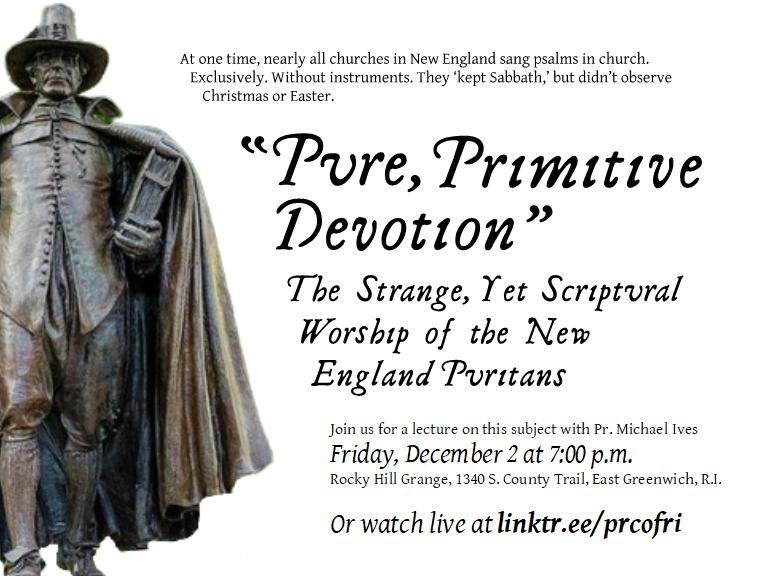
I have been serving in New England and now New Jersey for 18+ years. Let us pray earnestly and labor believingly for the extension of confessional Presbyterianism here in our northeastern “Samaria.” It may be spiritually ‘rocky soil,’ but God can create sons of Abraham from these stones. He did it before! If things go from bad to worse, a strategic retreat is possible. But let us not give up the Messiah’s ground without a fight! And who knows? Perhaps the Lord will make this “desert to blossom as the rose” again, and restore the pure worship of our godly Puritan forbears.
Do you live in the northeast—in New England, New York, or New Jersey? Are you committed to the old paths of the Puritans and Presbyterians? Do you long for a Third Great Awakening today? Would you be interested in hosting special meeting in your area? Please get in touch with me at 515-783-5637 or michael@reformedparish.com. [Note, 7/25/24: we would seek to do so in a collaborative way with area NAPARC and other more faithful churches, where possible.]
And if you don’t live in the northeast, would you pray for us? And maybe even consider joining us, if Providence opens a door?



 West Port Experiment