You who are by office “fishers of men,” have you caught little, or even nothing? Lose not heart. Take it from good Master Boston:

Posted in Free Offer of the Gospel, Gospel Proclamation, Missiology, The Free Offer of the Gospel, The Gospel, Thomas Boston on January 9, 2026| Leave a Comment »
You who are by office “fishers of men,” have you caught little, or even nothing? Lose not heart. Take it from good Master Boston:
Posted in Israel; Calling of & Mission to the Jews, Missiology, New England Puritanism, Puritans & Puritanism on November 4, 2025| Leave a Comment »

This is an academic article from the earlier 20th century on New England Puritan, Cotton Mather, on his zealous concern for the salvation of the Jews. He develops the account from Mather’s notable journal entry in 1696: “This day, from the dust, where I lay prostrate, before the Lord, I lifted up my cries: For the conversion of the Jewish Nation, and for my own having the happiness, at some time or other, to baptize a Jew, that should by my ministry, bee brought home unto the Lord.”
Posted in Missiology, Parish Theory & Practice, Thomas Chalmers on October 21, 2025| Leave a Comment »

“There should be the previous working of a Home Missionary among the families of the locality for which it is destined. . . . We set a parish missionary amongst them, who can give his whole time to the work, and who, by his unwearied ministrations among the sick, and the dying, and the ignorant, and the young, has created such a demand for Sabbath attendance, that his preaching-hall, which holds 300, is filled to an overflow; and we feel encouraged to build a church (to be set about immediately,) in the confident hope that many hundreds, who till now have been living in heathenism, will be reclaimed to the good old habits of their forefathers.”
“But wherever a new parochial economy is meant to be set up, it is in all cases most desirable that a moral preparation should go before the erection of the material apparatus. I do not know a more useful set of labourers than our local missionaries, who ply the families through the week, and congregate them at preaching stations, either on week-nights or on the Sabbath” (Chalmers, Works 18:228-29, 270).
Posted in Missiology, The Church in America, The Kingdom of God, The Sacred Ministry on July 6, 2025| Leave a Comment »
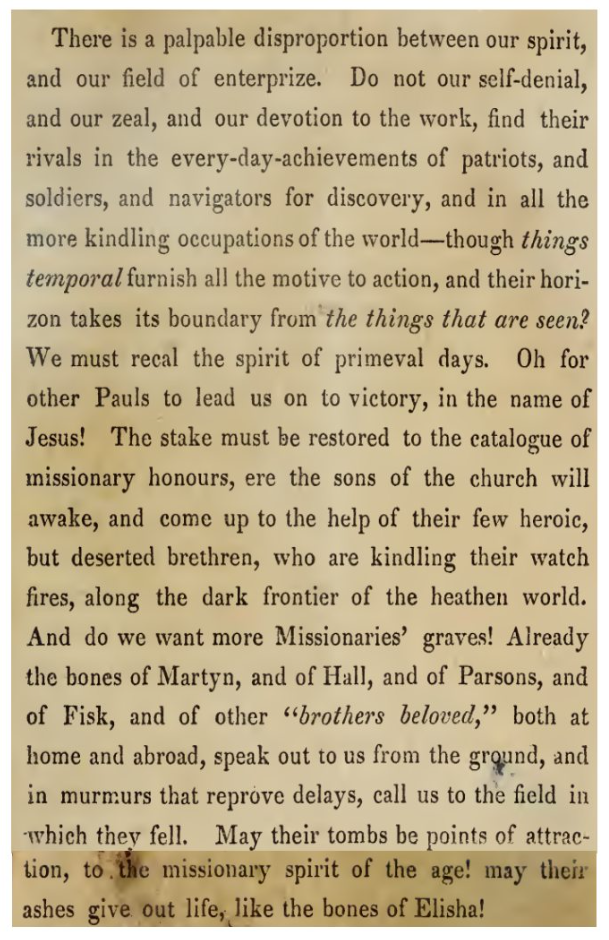
O, that God would stir up the missionary spirit again! Let us humble and abase ourselves, and plead with the Lord for a fresh anointing of the Spirit of God! John Breckinridge (1797-1841):
Posted in Constantine, Establishments, Missiology, Sacred & Secular, Secularization on May 30, 2025| Leave a Comment »

An intriguing thought. I’ve frequently thought of how establishments, while nearly a thing of the past in the secular West, might yet be on the horizon in the East. Stranger things have happened. And, of course, there is that ‘little thing’ (!) of prophecy: “Yea, all kings shall fall down before him: all nations shall serve him” (Psalm 72:11). O, brethren, let us pray for this nation, and for any godly magistrates that He might raise up “for such a time as this!” Mark Noll in his New Shape of World Humanity: How American Experience (2010):
“But third, it is a different story where Christianity spreads in regions of economic strength, as especially in Chᴉna. In this rapidly strengthening Asian power, the systems of belief that once guided society are passing away. Before Maoism imploded, it badly damaged ancestral reliance on Confucian precepts. Christianity seems to be taking off in Chᴉna because more and more Chᴉnese seem to be seeking a new moral compass as Chᴉna itself makes a commanding entrance onto the world stage. David Jeffrey, the provost of Baylor University who for fifteen years has been regularly invited to lecture on Christian subjects at premier universities in Chᴉna, has asked a speculative question that should give foreign analysts pause. Once before, Jeffrey remarks, a great world power passed through tumultuous times as Christian ranks expanded on the margins of society. It was the late 3rd and early 4th centuries. In that turmoil the Emperor Constantine was converted and become, from the top of the imperial system, a supporter of Christianity as a new glue for empire. Is it impossible to imagine that a new Constantine might exist somewhere in the junior ranks of the Chᴉnese communist party?”
Posted in Gathered Church Ecclesiology, Locality & the Law of Residence, Missiology, Parish Theory & Practice, Parochial Strategy, Thomas Chalmers on May 5, 2025| Leave a Comment »

“The Dissenter builds his chapel, and he draws hearers indiscriminately from all the places around; but drawing none save those who have a predisposition for what is sacred, he can only retard the degeneracy of his townsmen, but never, with his present processes, is he able to recall it. The Establishment builds its chapel also; but, besides this, it metes off [measures out] a geographical vineyard to him who officiates therein; and it lies with himself to be in a very few months, a respected and a recognized functionary among all its tenements; and without any romantic sacrifice of his time or of his ease, but just in the quiet and regular discharge of the assiduities of his office, among the ignorant, the sick, and the dying, will he be sure to find good welcome in every heart, and goodwill in every home towards him. Now, it is by these week-day attentions among the people of his local territory, that he, at length, diffuses over the whole of this contiguous space an interest and a desire after his Sabbath ministrations; and gathers new recruits to his congregation from the most worthless of its families” (Thomas Chalmers, Works 16:149).
Posted in Missiology, Parish Theory & Practice, Thomas Chalmers on April 14, 2025| Leave a Comment »

“Why, the circle, whose centre is his meeting-house, and whose radius passes at its further extremity through the tenement of his most distant hearer—such a circle would comprehend, in Edinburgh, a population of fifty thousand, and in London, a population of half a million. There is no other way of addressing ourselves with effect to the moral cultivation of this stupendous domain, but by breaking it up into parishes, and each of its ministers going forth on the territorial principle, charged with the care and the cognizance of all its families—keeping up, by his varied attentions, the spiritual appetite where it exists, and reviving it when it has fallen into dormancy—sustaining, by the external appliance of his household visits and week-day ministrations, that will for religion, and for its services, which, when left to itself, is so miserably apt to wither into extinction—doing, on the large scale of a parish, all that a city missionary does on the smaller scale of a district” (Chalmers, Works 18:90).
Posted in Christendom, Establishments, Missiology, Patristics on March 24, 2025| Leave a Comment »

“Chrysostom soon gained by his eloquent sermons the admiration of the people, of the weak Emperor Arcadius, and, at first, even of his wife Eudoxia, with whom he afterwards waged a deadly war. He extended his pastoral care to the Goths who were becoming numerous in Constantinople, had a part of the Bible translated for them, often preached to them himself through an interpreter, and sent missionaries to the Gothic and Scythian tribes on the Danube. He continued to direct by correspondence those missionary operations even during his exile. For a short time he enjoyed the height of power and popularity” (Schaff, The Life and Work of St. John Chrysostom, Nicene and Post-Nicene Fathers 1.9).
“It was perceived by John [Chrysostom] that the Scythians were involved in the Arian net; he therefore devised counter contrivances and discovered a means of winning them over. Appointing presbyters and deacons and readers of the divine oracles who spoke the Scythian tongue, he assigned a church to them, and by their means won many from their error. He used frequently himself to visit it and preach there, using an interpreter who was skilled in both languages, and he got other good speakers to do the same. This was his constant practice in the city, and many of those who had been deceived he rescued by pointing out to them the truth of the apostolic preaching. On learning that some of the Nomads encamped along the Danube were thirsty for salvation, but had none to bring them the stream, John sought out men who were filled with a love of labor like that which had distinguished the apostles, and gave them charge of the work. I have myself seen a letter written by him to Leontius, bishop of Ancyra, in which he described the conversion of the Scythians, and begged that fit men for their instruction might be sent” (Theodoret, Historia Ecclesiastica 5.30–31).
(more…)Posted in Audio Resources, Church of Scotland, Israel; Calling of & Mission to the Jews, Missiology, Thomas Chalmers on January 27, 2025| Leave a Comment »
A really solid and balanced article by Zach Groff. Sadly necessary these days in some conservative Reformed circles.
Also, Groff mentions a sermon by Robert Murray M’Cheyne, “Our Duty to Israel.” I recorded that in audio not long ago: you can access that here. He also mentions M’Cheyne’s mentor, Thomas Chalmers. Here is a lecture of his on Romans 11, on Paul’s prophecy of the Jews’ future repentance and embrace of their rejected Messiah. And check out the entire WPE Audio library by clicking the tab at the top.
Posted in Church of Scotland, Free Church of Scotland, Missiology, Parish Theory & Practice, Thomas Chalmers on January 8, 2025| Leave a Comment »

“For the accomplishment of this, there must not only be a going forth on the vast and untrodden spaces that are without; there must be a filling up of the numerous and peopled vacancies that are within—a busy, internal locomotion, that might circulate, and disperse, and branch off to the right and to the left, among the many thousand families which are at hand: and thoroughly to pervade these families; to make good a lodgment in the midst of them, for the nearer or the more frequent ministrations of Christianity than before; to have gained welcome for the Gospel testimony into their houses, and, in return, to have drawn any of them forth to attendance on the place of Sabbath and of solemn services—this, also, is to act upon our text, this is to do the part, and to render one of the best achievements of a missionary.”
-Thomas Chalmers, Works, 6:270.
 West Port Experiment