Feeds:
Posts
Comments

Archive for the ‘Mental Health’ Category

The following are extracts of David Dickson’s (1583–1663) Therapeutica Sacra, Book 1, Chapter 4, “The Divine Covenants about the Eternal Salvation of Men; and in Special, Of the Covenant of Redemption,” etc. This chapter is both a high-water mark of Scottish federal theology and at the same time a tremendous glimpse into the high mystery of the psychological ordeal through which our Lord’s sinless soul had to pass. Behold, was there any sorrow like unto his sorrow? And truly, those vexed in their minds and even the psychologically tormented may take solace with the lengths to which God came down to “taste death for every man.”

I have also recorded the chapter here. Read or listen; then prostrate yourself before the “man of sorrows.”

* * * *

Objection. But did not this astonishing amazement of Christ’s soul, speak some imperfection of the human nature? Answer. It did no ways argue any imperfection, or lack of sanctity in him; but only a sinless and kindly infirmity, in regard of natural strength, in the days of his flesh. For the mind of a man, by any sudden and vehement commotion arising from a terrible object, may, without sinning, be so taken up, that the swift progress of his mind in discourse may for a while be stopped, and the act of reasoning suspended a while ; all the cogitations of the mind fleeing together to consult, and not being able to extricate themselves in an instant, may stand amazed, and sit down awhile, like Job’s friends astonished. Now our Lord, taking on our nature and our common sinless infirmities, became like unto us in all things except sin. Daniel’s infirmity at the sight of an angel, was not sin, (Dan. x).

Objection. But doth not this astonishing admiration, suddenly lighting upon Christ’s soul, prove that something unforeseen of him did befall him? Not at all; for he knew all things that should befall him, and told his disciples thereof, and \ras at a point, and resolved in every thing which was to come, before it came. But this astonishing amazement did only shew forth the natural difference between things preconceived in the mind, and these same things presented to sense: for there is in the mind a different impression of the preconceived heat of a burning iron, before it do touch the skin, from that powerful impression which a hot iron thrust into the flesh doth put upon the sense. In regard of which natural difference between foresight and feeling, between resolution and experience, this astonishment befell our Lord ; and in this regard, Christ is said to learn experimental obedience by these things which he suffered, (Heb. v. 8). . . .

(more…)


Read Full Post »

B. B. Warfield’s “On the Emotional Life of our Lord” is simply a masterpiece of exegesis, theology, and psychology on the high mystery of the God-man’s emotions as the Gospels depict them. Especially profound are his insights on His holy anger and fear, where the “holy, harmless, undefiled” Savior gives full play to this side of His sanctified humanity without the slightest breach of God’s law. “Behold, and see if there be any sorrow like unto my sorrow!” And so we may appreciate all the more deeply the sympathy of our High Priest who can be “touched with the feeling of our infirmities, yet without sin.” This is an absolute must-read—I know of nothing else like it on the subject. You can read it below or listen to my recording here. Let me also suggest my recording of Richard Baxter’s “On the Government of the Passions;” and visit full WPE Audio library for more titles.

Read Full Post »

I just completed reading-recording the most helpful, practical, and thorough treatment on the subject of the Christian and his emotions I have ever read. Baxter’s “On the Government of the Passions” (or emotions) is found in Volume 3 of his Practical Works, a part of his massive Christian Directory. If you’ve never read the Puritans before, this would surely be a good place to start. The English is of course dated, but I’d say its much more accessible than you might think. I would personally encourage anyone who has never read this to do so—and you’ll probably feel like me, that this one should be read maybe once per year. And now I’ve recorded if for you, so now you have no excuse! Begin to heal your disordered feelings and cultivate a godly, stable, and enriching emotional life today as you are stuck in traffic or washing dishes. Your next podcast episode will still be there later. Your venerable fathers await!

And on the subject, let me commend a (more) modern theologian, B. B. Warfield, and his absolutely one-of-a-kind article, “On the Emotional Life of our Lord.” As Baxter is a doctor here treating the illness, Warfield presents the Savior who walked in our footsteps with the full range of our emotions, yet without sin. And the complete WPE Audio library can be accessed by the tab up top.

The following is a sample, where Baxter is treating sinful depression and despair. The PDF is below (print p. 256; pdf p. 281)

* * * *

Direction XIV. ‘Abhor all that tendeth to take down the power and government of reason (that is, all feebleness and cowardioe of mind, and a melancholy, a peevish, passionate disposition): and labour to keep up the authority of reason, and to keep all your passions subject to your wills; which must be done by Christian faith and fortitude.’ If you come once to that childish or distracted pass, as to grieve and say, ‘I cannot help it: I know it is sinful and immoderate, but I cannot choose,’ if you say true, you are out of the reach of counsel, advice, or comfort. You are not to be preached to, nor talked to, nor to be written for: we do not write directions to teach men how to touch the stars or explain the asperities or inequalities of the moon, or the opacous [opaque, or hidden] parts of Saturn, or to govern the orbs, or rule the chariot of the sun. If it be become a natural impossibility to you, doctrine can give you no remedy: but if the impossibility be but moral in the weakness of reason, and want of consideration, it may be doctrine, consideration, and resolution be overcome. You can do more if you will than you think you can. How come you to lose the command of your passions? Did not God make you a rational creature that hath an understanding and will to rule all passions? How come you to have lost the ruling power of reason and will? You would take it for a disparagement to be told that you have lost the use of your reason: And is it not a principal use of it to rule the passions, and all other inferior subject powers? You say you cannot choose but grieve! But if one could give you that creature which you want or desire, then you could choose: You could rejoice, if one could restore you that child, that friend, that estate which you have lost. But God, and Christ, and Heaven it seems, are not enough to cure you: if you must have but them you cannot choose but grieve! And what hearts have you then that are thus affected? Should not those hearts be rather grieved for? God will sometime make you see, that you had more power than you used.

[image source]

Read Full Post »

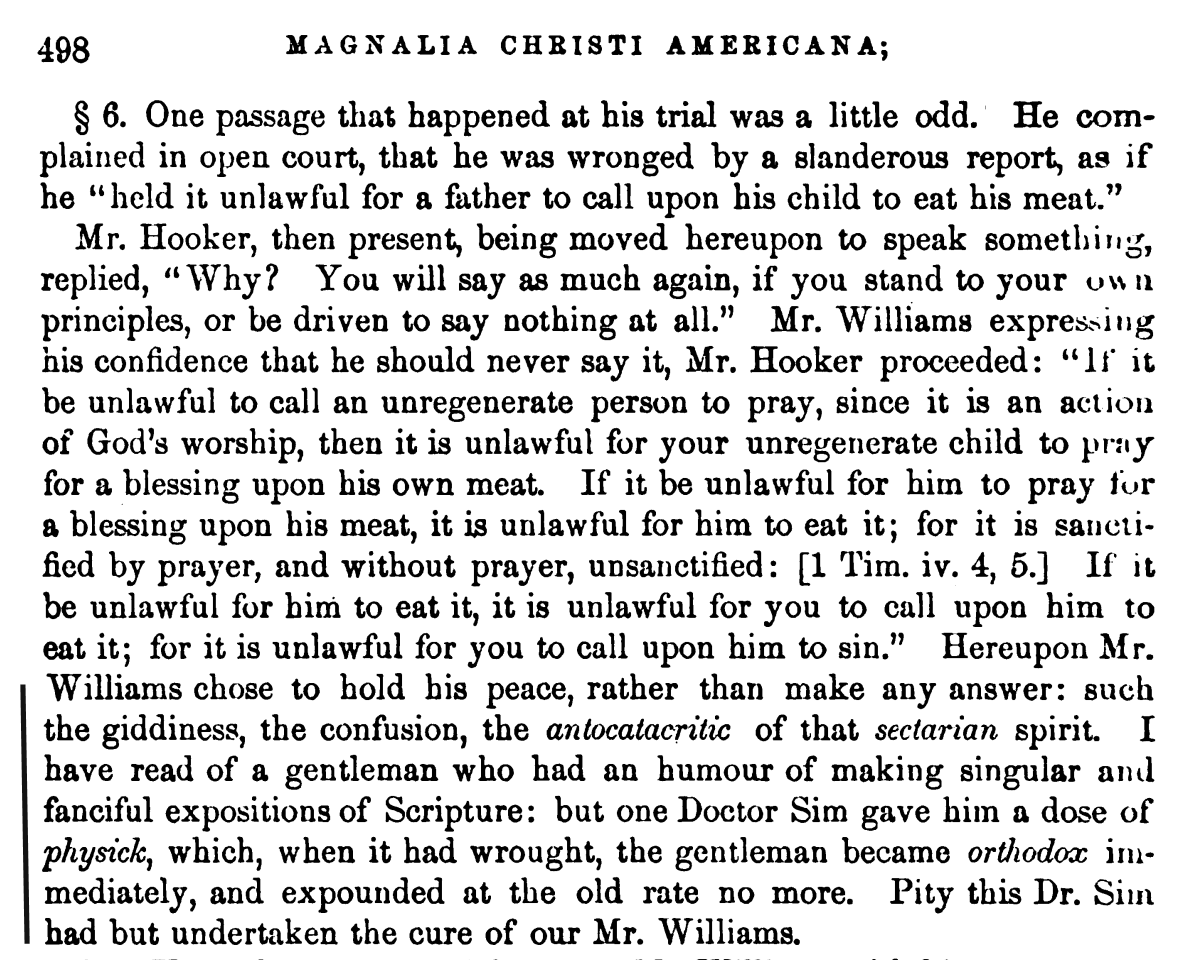
So I was reading Cotton Mather’s narrative of troubled Roger Williams, whom the Boston magistrates exiled because he had made such a nuisance of himself up that way. I found the following humorous—and enlightening! I’m sure Mather hardly meant to suggest that all of Roger William’s problems were mental. But it sure seems like he thinks something was amiss and needed treatment.

Read Full Post »