Feeds:
Posts
Comments

Archive for the ‘Locality & the Law of Residence’ Category

“The Dissenter builds his chapel, and he draws hearers indiscriminately from all the places around; but drawing none save those who have a predisposition for what is sacred, he can only retard the degeneracy of his townsmen, but never, with his present processes, is he able to recall it. The Establishment builds its chapel also; but, besides this, it metes off [measures out] a geographical vineyard to him who officiates therein; and it lies with himself to be in a very few months, a respected and a recognized functionary among all its tenements; and without any romantic sacrifice of his time or of his ease, but just in the quiet and regular discharge of the assiduities of his office, among the ignorant, the sick, and the dying, will he be sure to find good welcome in every heart, and goodwill in every home towards him. Now, it is by these week-day attentions among the people of his local territory, that he, at length, diffuses over the whole of this contiguous space an interest and a desire after his Sabbath ministrations; and gathers new recruits to his congregation from the most worthless of its families” (Thomas Chalmers, Works 16:149).
Read Full Post »

The article below on Andrew Bonar at Finnieston, Glasgow, was written by my friend Matthew Vogan and published in the Bulwark Magazine of the Scottish Reformation Society. The author relates the compelling story of Bonar’s evangelistic labor on the parish principle as taught and modeled by Thomas Chalmers.

Here are some sample extracts from the article:

Every afternoon from one o’clock till nearly five he would be found walking about his parish, visiting his people. He was well known on the streets of the district. He became a well-known figure in the area, and his friendly way of speaking and behaving endeared him to all, including children. Little children would run up to him as he walked and put their hand in his and receive a smile and gentle hand laid on the heard. One child called him “the minister with the laughing face.” Soon after arriving in the city, he spoke to a little girl in the street, addressing her by name. The child ran home to her mother with the delighted cry, “Mither, mither, he kens me.” [“Mother, mother, he knows me!”]

(more…)

Read Full Post »

The following three articles by Frank DeVito at the Witherspoon Institute resonate with me rather deeply. He challenges conventional thinking in order to promote the rejuvenation not just of the nuclear family, but the extended family, and that inter-generationally in the localities where God has planted us. Well said, sir!

Read Full Post »

Apologies to everyone who tried to watch the livestream—technical issues. Here is the audio:

Read Full Post »

Go local, grow local!

Read Full Post »

Unless otherwise noted here prior to the event, the lecture will be livestreamed here:

https://linktr.ee/prcofri

Read Full Post »

“This arrangement ought, as far as possible, to be commonly observed, that every one, content with his own limits, may not encroach on another’s province. Nor is this a human invention. It is an ordinance of God. For we read that Paul and Barnabas appointed presbyters over each of the churches of Lystra, Antioch, and Iconium (Acts 14:23); and Paul himself enjoins Titus to ordain presbyters in every town (Titus 1:5). In like manner, he mentions the bishops of the Philippians, and Archippus, the bishop of the Colossians (Phil 1:1; Col 4:17). And in the Acts we have his celebrated address to the presbyters of the Church of Ephesus (Acts 20:28). Let every one, then, who undertakes the government and care of one church, know that he is bound by this law of divine vocation, not that he is astricted to the soil (as lawyers speak), that is, enslaved, and, as it were, fixed, as to be unable to move a foot if public utility so require, and the thing is done duly and in order; but he who has been called to one place ought not to think of removing, nor seek to be set free when he deems it for his own advantage. Again, if it is expedient for any one to be transferred to another place, he ought not to attempt it of his own private motive, but to wait for public authority.”

John Calvin, Institutes of the Christian Religion, Vol. II, pp. 321

Read Full Post »

Years back, my heart got large for missions — especially urban missions to those on the ‘other side of the tracks.’ At about the same time, I became Reformed (a high octane, old school Presbyterian no less!), putting me in a a sub-subset of a subset. My life and ministry has ever since lived somewhat in the frontiers the unlikely and the implausible. A straightlaced, tall gringo Presbyterian goes out among immigrants, trying to evangelize in broken Spanish and recruit sinners to the “outward and ordinary means” in a humble, little Reformed church 15 minutes to the south. And to sing Psalms. Without musical accompaniment. In English.

I admit that there are all kinds of problems with this model, from a human perspective. But it is actually more plausible than one might think. Yet before I deal with the plausibles, let me first set forth some principles.

The first principle is principle! Principle precedes the practical. We must first determine whether something should be done before we decide whether or not we think it is practical. We ought to go out and bring the Gospel to all. None excluded. Politics quite aside, we may and must not discriminate based on sex, ethnicity, gender, or for that matter even sexual ‘preference.’ By the mandate of our King, we must go and tell them. Yes, as Calvinists, we know that not every “all” means “all.” But “every creature” does in fact mean “every creature.” Even if they don’t look like us, eat like us, or even use our language. It doesn’t matter whether they ‘have papers’ or not, vote Democrat or not. How they got here and whether they should by law be here, is a separate issue for a different discussion (and full disclosure: I lean quite “red” when it comes to immigration policy!). But that they are here means they are here for us to evangelize. And not just gripe about and avoid them as much as possible.

(more…)

Read Full Post »

The following quote from Thomas Chalmers in his Lectures on the Establishment and Extension of National Churches (1838) captures his ideal for domestic missions. The ‘parish’ is not a synonym for ‘congregation.’ Rather, it is the defined sphere of pastoral and even missionary activity by a minister and his elders. This is the local or territorial principle.

* * * *

“Now the specific business which we should like to put into the hands of a Christian minister is, not that he should fill his church any how—that he may do by the superior attractiveness of his preaching, at the expense of previous congregations, and without any movement in advance on the practical heathenism of the community: But what we want is, to place his church in the middle of such a territory as we have now specified, and to lay upon him a task, for the accomplishment of which we should allow him the labour and perseverance of a whole lifetime; not to fill his church any how, but to fill this church out of that district. We should give him the charge over head, of one and all of its families; and tell him, that, instead of seeking hearers from without, he should so shape and regulate his movements, that, as far as possible, his church-room might all be taken up by hearers from within. It is this peculiar relation between his church, and its contiguous households, all placed within certain geographical limits, that distinguishes him from the others as a territorial minister. And let the whole country be parcelled out into such districts and parishes, with an endowed clergyman so assigned to each, and each small enough to be overtaken by the attentions of one clergyman—we should thus, as far as its machinery is concerned, have the perfect example of a territorial establishment.”

[image source]

Read Full Post »

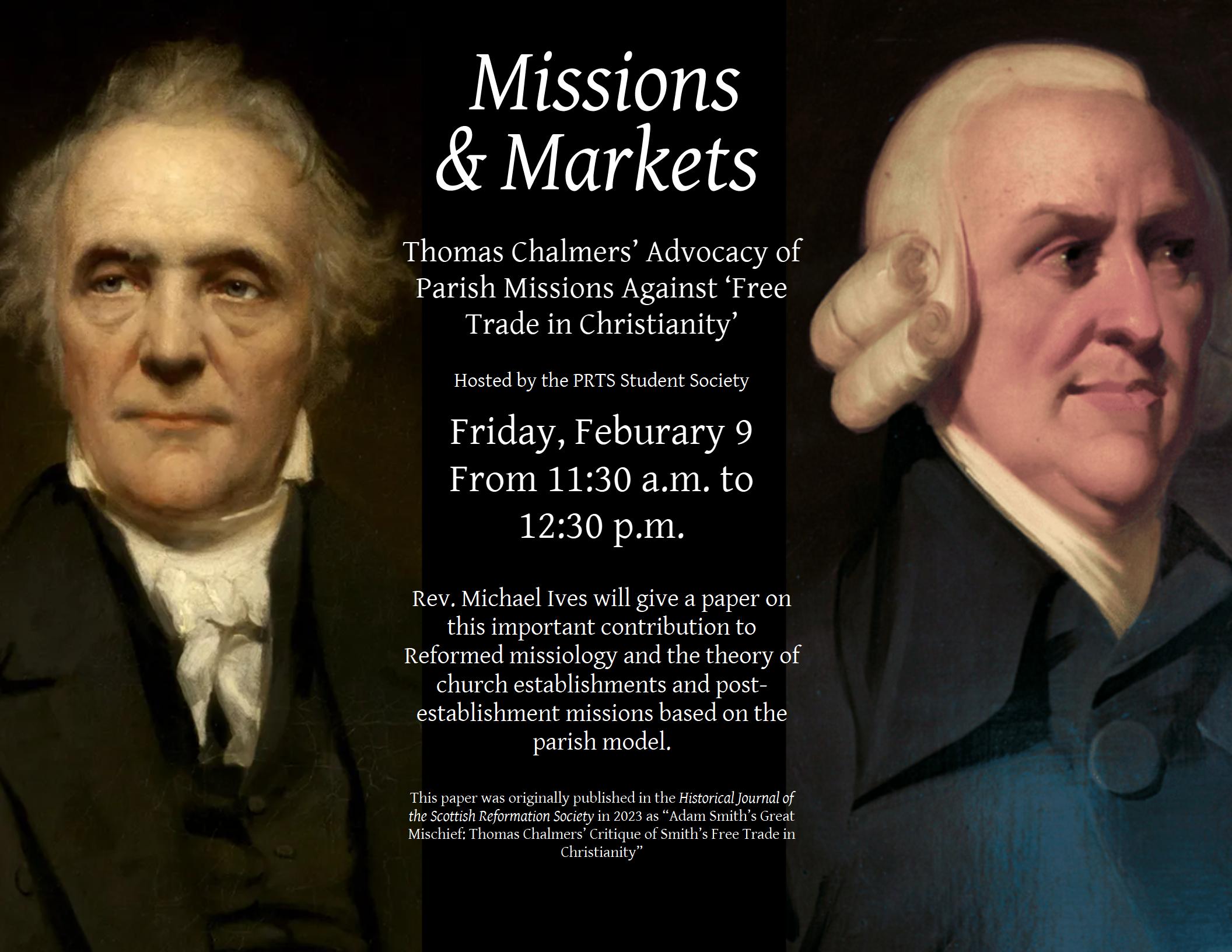
Would you like to get a basic introduction to Thomas Chalmers’ parish mission theory? And are you up to learning about how I’ve been applying these principles in South Providence, a multi-racial working class area?

I’m offering another live video presentation tomorrow (Saturday), at 1:00 p.m. Eastern lasting about 25-30 minutes, followed by questions and answers. Because I will be showing photos of a number of personal outreach contacts from over the years, I’ll be doing this by invitation-only via Zoom. So if you’d like to be invited and participate, please drop me a note at mjives dot refparish at gmail dot com. Or reply in the comments below with your e-mail address.

Read Full Post »

Older Posts »