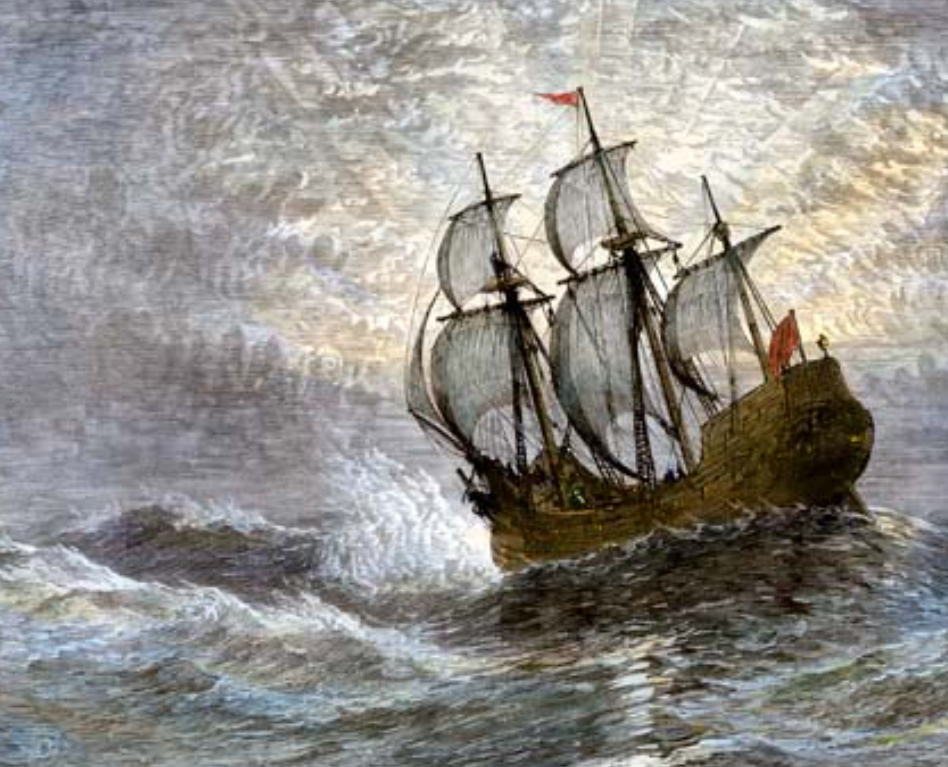
As we turn in deep gratitude to the Most High for all His blessings towards us, let us remember especially the unique favor He has shown to our fathers and mothers of the faith who first came to these shores on a holy “errand into the wilderness.” In the words of the Mayflower Compact (1620), their cause was “undertaken for the Glory of God, and Advancement of the Christian Faith, and the Honour of our King and Country.”
Let me encourage you to listen to our Pilgrim and Puritan fathers. In addition to other amateur recordings, I’ve been steadily adding to this collection of sermons, treatises, and narratives from the pen of these giants of the faith, who helped found this “City on a Hill.” And if you’d like to hear an early account of the Pilgrim colony, check out Cotton Mather’s, “Magnalia Christi Americana 1.1: Discoveries of America.” Also, John Winthrop’s original sermon where he speaks of the “city on an hill,” is available under “A Modell of Christian Charity.”
And as we thank the Lord today, lest us with humility and earnestness implore Him to restore the former glory through national repentance. He did it before, and He can do it again! “Wilt thou not revive us again: that thy people may rejoice in thee” (Psalm 85:6)?
The following comes from the pen of Thomas Boston. Though nestled away in country parishes, this man was an eminent theologian indeed. Here he demonstrates his command of Nicene orthodoxy:
“And as to the nature of this generation, our blessed Lord himself doth in some measure explain it to us, so far as we arc capable to apprehend this great mystery, when he tells us, John. v. 26. ‘As the Father hath life in himself, so hath he given to the Son to have life in himself.’ So that to beget the Son, is to give to the Son to have life in himself, as the Father hath life in himself; which doth necessarily import a communication [sharing] of the same individual essence. For to have life in himself was an essential attribute of God; i.e. to have life independently, of and from himself; and to be the source and fountain of life to all the creatures, is a perfection proper to God, inseparable from his nature, yea, the very same with his essence. And therefore the Father cannot give it, unless he give the essence itself: and he cannot give the essence by way of alienation, for then he himself would cease to be God; nor by way of participation, seeing the divine nature is one, and cannot be divided. Therefore it must be by way of communication [sharing]. So that the generation of the Son is that eternal action of the Father, whereby he did communicate to the Son the same individual essence which he himself hath, that the Son might have it equal with himself. But as to the manner of this generation, or communication of the divine essence of the Son, it is altogether ineffable and inconceivable to us. It is simply impossible for poor weak worms, such as we are, to understand or explain wherein it consists. It is not natural, but supernatural, and wholly divine, and therefore incomprehensible by us. Yea, it is incomprehensible even by the angels themselves, who far exceed men in intellectual abilities. We may justly hereunto apply what we have, Isa. liii. 8. ‘ Who shall declare his generation?’ This whole mystery is incomprehensible by us: We ought humbly and reverently to adore what we cannot comprehend. There is a coummunication of the whole essence or Godhead from the Father to the Son, in receiving whereof the Son doth no more lessen or diminish the majesty or Godhead of the Father, than the light of one candle doth the light of another from which it is taken. Whereupon the council of Nice said well, that Christ is God of God, light of light, very God of very God, not proceeding but begotten. Hence it is clear, that he had a being before he was born of a virgin, yea from eternity; and that he is the true God, and the most high God, equal with the Father, Phil. ii. 6. John i.1.; for no being can be eternal but God.”
Below are a number of documentaries and educational videos about Scottish Presbyterian history, with special focus on the history of the Covenants and the Covenanters.
The following short documentary series by my friend, Matthew Vogan, definitely the best out there from a confessionally sympathetic perspective. Well produced, informative, and challenging to the mind and heart. The trailer is immediately below; watch the entire series here.
Check out also a great series for children, “Stories of the Covenant” by the same. Watch a sample below; view the entire series here.
This was a particularly good episode. It just so happened that I had picked up Anselm’s masterpiece on penal substitutionary atonement, Cur Deus Homo? (Why the God-man?) There is definitely more light from the “Dark Ages” than is often supposed. Protestantism rejected a lot from the Medieval Church; but it retained a lot both from it and the Patristic era.

 West Port Experiment