Feeds:
Posts
Comments

Archive for the ‘Experimental Religion & the Cure of Souls’ Category

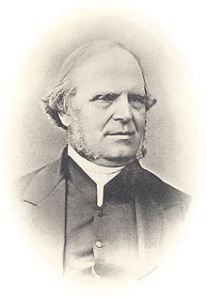
patrick-fairbairnI’ve recently been picking away at a great 19th century treatise on pastoral theology by Free Church of Scotland minister and professor, Patrick Fairbairn.  A must read!  In the introductory chapter, he deals with foundational issues of ecclesiology that shape and mold the practice of shepherding souls.  Without the foundation, the house is shaky at best.  Here’s a very insightful quote on the bearing of right views of the Church as visible and invisible on the pastoral office:

“To the visible Church, then, belongs the public administration of the means of grace; and as it is by the instrumentality of these means that the true Church is gathered in, it is obvious that it is no more possible to sever the one from the other, than it is to sever the inward grace of the sacraments from the outward sign; and that, in fact, as in the sacraments the outward sign and the inward grace are not two sacraments, but the two aspects, the inward and the outward, of one and the same ordinance, so the visible and the true Church are not distinct communities, but one and the same, regarded from different points of view. The true Church depends for the maintenance of its existence on the visible Church; and, in turn, the visible Church is supported by the true. Thus a reciprocal action is ever going on : the visible Church, as such, dispensing the means of grace by which Christ works to the gathering in of His elect; and the true Church, as such, upholding and perpetuating the visible use of those means by furnishing faithful recipients of them.”

Sadly, it’s out of print.  But there appear to be several used copies on Amazon, and you can access it on GoogleBooks.

Read Full Post »

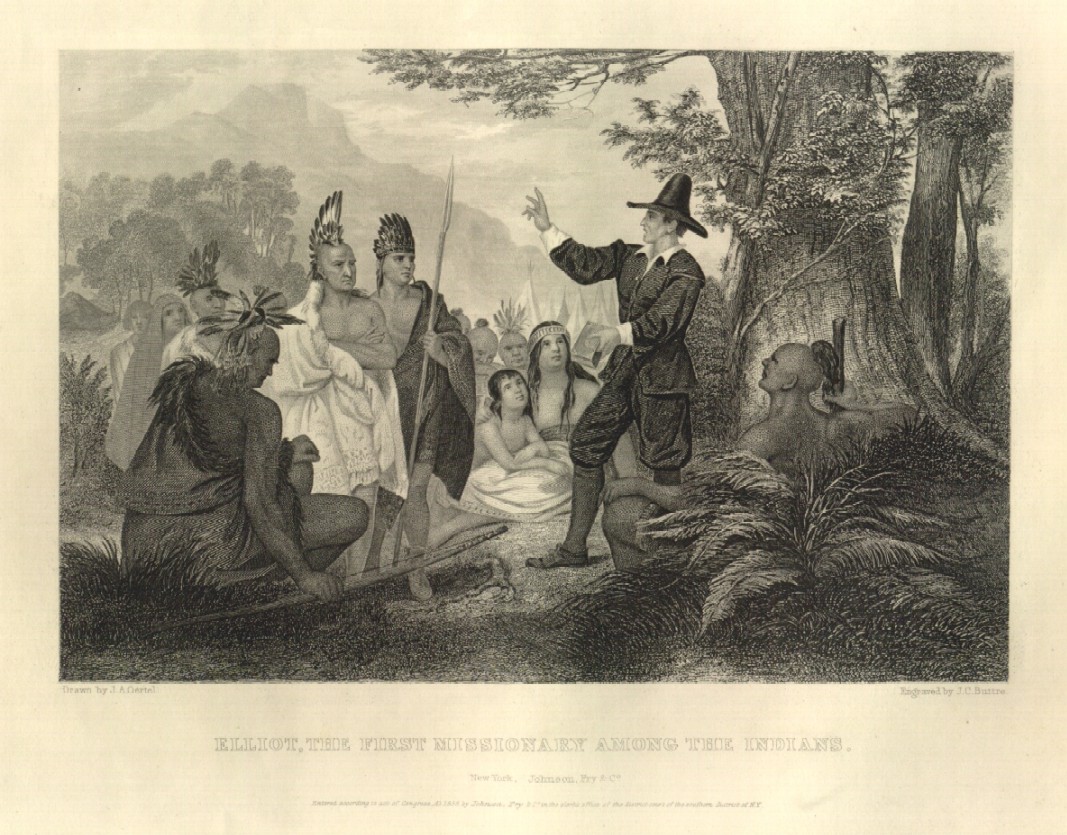
The following are anecdotes from the labors of Puritan missionary John Eliot (1604-1690) among the Native Americans of early Massachusetts.  The extract is drawn from The Life of John Eliot by Nehemiah Adams (1847).

Specifically, we witness Eliot and company catechizing the heathen, ushering them into the holy knowledge of the faith and so into the bosom of the Church.  Obviously, our Puritan forbears entertained a broad view of this discipline.  It was not simply for those in the Church seeking to deepen their understanding of  but also for those laying hold of the skirt of a Jew and begging for guidance to Zion’s God.

After one or two more posts, I’ll conclude with some reflections on Eliot’s evangelistic catechesis.

* * * *

An hour and a quarter was occupied in the discourse. Mr. Eliot gave the Indians first a brief exposition of the ten commandments, showing the wrath and curse of God against those who break the least one of them. The subject was then applied, and the law having been brought to do its work in their hearts, and their sins being pointed out to them, as Mr. Eliot says, with much sweet affection, Jesus Christ was preached to them as the only Saviour. He told them who Christ was, and what he did, and whither he had gone, and how he will come again to judge the wicked and burn the world. The creation and fall of man, the greatness of God, heaven and hell, the pleasures of religion and the miseries of sin were then explained in language and with illustrations suited to their capacity.

The sermon being finished, Mr. Eliot proposed some questions to them, and first inquired whether they understood what had been said, and whether all or only some of them understood it ? A multitude of voices exclaimed that they all understood every thing which had been spoken. Leave was then granted them to put questions, and it is interesting to notice the first questions which these children of the wilderness proposed. The first questions were, “What is the cause of thunder?” “What makes the sea ebb and flow?” “What makes the wind blow?”

But there were some questions proposed by them which Mr. Eliot says some special wisdom of God directed them to ask, as, for example, How may we come to know Jesus Christ?

Mr. Eliot told them that if they could read the Bible they would see clearly who Jesus Christ is, but inasmuch as they could not then read, he desired them to remember what he had told them out of the Bible, and to think much and often upon it, when they lay down on their mats in their wigwams and when they rose up, and to go alone in the fields, and woods, and muse on it, and so God would teach them.

He told them that if they would have help from God in this thing, they must begin to pray, and though they could not make long prayers as the English did, yet if they did but sigh and groan, saying, “Lord, make me to know Jesus Christ for I know him not,” and if with all their hearts they persisted in such prayers, they might hope that God would help them. But they were especially to remember that they must confess their sins and ignorance to God and mourn over them and acknowledge how just it would be in God to withhold from them any knowledge of Christ, on account of their sins.

This instruction was communicated to them by Mr. Eliot through the Indian interpreter whom he had brought with him, but he says he was struck with the fact that a few words from the Preacher had much greater effect than many from the interpreter.

One of them asked, whether Englishmen were ever at any time so ignorant of God and Jesus Christ as they themselves?

Another put this question: Whether if the father be naughty and the child good, will God be offended with that child ? because in the second commandment it is said that he visits the sins of the fathers upon the children.  They were told in reply to this that every child who is good will not be punished for the sins of his father, but if the child be bad, God would then visit his father’s sins upon him, and they were bid to notice that part of the second commandment which contains a promise to the thousands of them that love God and keep his commandments.

One of them asked, How is all the world now become so full of people, if they were all once drowned in the flood? This led to the story of the ark and the preservation of Noah.

Mr. Eliot then proposed some questions to them, for example, Whether they did not desire to see God, and were not tempted to think there is no God because they could not see him?  Some of them answered, They did desire to see Him if it could be, but they had heard from Mr. Eliot that he could not be seen, and they did believe that though their eyes could not see him, he was to be seen with their soul within. Mr. Eliot endeavored to confirm them in this impression, and asked them if they saw a great wigwam or a great house, would they think that raccoons or foxes built it? or would they think that it made itself? or that no wise builder made it, because they could not see him who made it?

Knowing that the doctrine of one God was a great stumbling block to them, Mr. Eliot asked them if they did not think it strange that there should be but one God, and yet this God be in Massachusetts, and in Connecticut, in Old England, in this wigwam, and the next, and every where at the same time?  One of the most sober of them replied that it was indeed strange, as every thing else they had heard preached was strange, and they were wonderful things which they never heard of before, but yet they thought “It might be true, and that God was so big every where.” Mr. Eliot illustrated the truth by the light of the sun, which, though it was but a creature of God, shed its light into that wigwam, and the next, in Massachusetts and Old England, at once.

He inquired of them if they did not find something troubling them within after the commission of murder, theft, adultery, lying; and what would comfort them, and remove that trouble of conscience when they should die and appear before God?  They replied that they were thus troubled, but they could not tell what they should say about it, or what would remove this trouble of mind, whereupon Mr. Eliot enlarged upon the evil of sin and the condition of the soul which is cast out of the favor of God.

Having spent three hours in this interview, Mr. Eliot asked them if they were not weary, and they said, no. But thinking it best to leave them with an appetite, Mr. Eliot concluded the meeting with prayer.


Read Full Post »
When Thomas Chalmers began the West Port Experiment in 1844, he delivered a series of four public lectures on the principles of the territorial or parochial method of evangelism.  In it, he told his hearers how he had decided many years ago to disassociate all his parish labors from matters of public charity.  To have combined them would compromise the great errand on which he labored.  “I fairly cut my connexion with them all [the public charities]; I let the people understand that I dealt only in one article, and that, if they valued the advantages of Christian instruction, they were welcome to any approximation which I could make to them” (Memoirs 2:684).  In short, Chalmers would distribute not the “bread that perishes,” but that which bread “endures to everlasting life.”

The Church must not get sidetracked from her calling.  Christ gave the Church “one article” to distribute to the nations.  She is given the keys, not to an earthly storehouse of perishables, but to the very kingdom of heaven.

Read Full Post »

index“It is our fault, that we look upon God’s ways and works by halves and pieces; and so, we see often nothing but the black side, and the dark part of the moon. We mistake all, when we look upon men’s works by parts; a house in the building, lying in an hundred pieces; here timber, here a rafter, there a spar, there a stone; in another place, half a window, in another place, the side of a door: there is no beauty, no face of a house here. Have patience a little, and see them all by art compacted together in order, and you will see a fair building. When a painter draweth the half of a man; the one side of his head, one eye, the left arm, shoulder, and leg, and hath not drawn the other side, nor filled up with colours all the members, parts, limbs, in its full proportion, it is not like a man. So do we look on God’s works by halves or parts . . .  yet do we not see, that in this dispensation, the other half of God’s work makes it a fair piece.”

-Samuel Rutherford, The Trial and Triumph of Faith (1645)

Read Full Post »

withered hand“Say not you cannot believe, the great defect is in your will. ‘Ye will not come to me,’ says Jesus, ‘that you may have life.’ Stretch out the withered hand to Christ; protest you shall never be satisfied till he put forth mighty power to make you believe, and never quit the throne till you get it, if you should dig your grave at it, Luke 16:39-43.”

-Thomas Boston

Read Full Post »

Some choice counsel from Thomas Chalmers to a Christian lady struggling with doubts (1826).  His distinction between having a concern about what and not how to believe is especially choice.

* * *

2318058434_433229b519_o

But, generally, you complain that you are ignorant of how to go—how to believe. Now this has long been a stumbling-block to many; their thoughts are how they are to believe, when their thoughts should be what they should believe. They look inwardly for the work of faith, when they should look outwardly for the object of faith. “For every one thought,” says Richard Baxter, “that he casts downwardly upon himself, he should cast ten upwardly and outwardly upon Jesus, and upon the glorious truths of the Gospel.” You say that you have no doubts of the freeness of Christ’s salvation, and of His willingness to save you. Dwell upon this; persist in this; stand in the Gospel attitude of looking upon Jesus, and light will at length arise within you. In the act of looking, you may have to wait a longer or a shorter time for your coming enlargement; but surely it is worth the waiting for. Meanwhile your business is prayer; a diligent attention in the ordinances of religion; reading of God’s word; and, above all, a keeping of the sayings of Christ: “He that keepeth my sayings, to him will I manifest myself.” Be assured you are in good hands, even in the hands of Him who will not break the bruised reed nor quench the smoking flax.

Read Full Post »

sunbehind-300x225I’m a dyed-in-the-wool psalm singer.  But like my predecessor, Dr. William Young, I can still appreciate as poetry the rich, experimental hymns of the past.  Here’s one from Joseph Hart (1712-1768) on the child of God struggling with assurance.  It’s titled, “The Doubting Christian.”

 
1    If unbelief’s that sin accursed,
Abhorred by God above,
Because, of all opposers worst,
It fights against his love,

2    How shall a heart that doubts like mine,
Dismayed at every breath,
Pretend to live the life divine,
Or fight the fight of faith?

3    Conscience accuses from within,
And others from without;
I feel my soul the sink of sin,
And this produces doubt.

4    When thousand sins, of various dyes,
Corruptions dark and foul,
Daily within my bosom rise,
And blacken all my soul,

5    I groan, and grieve, and cry, and call
On Jesus for relief;
But, that delayed, to doubting fall,
Of all my sins the chief.

6    Such dire disorders vex my soul,
That ill engenders ill;
And when my heart I feel so foul,
I make it fouler still.

7    In this distress, the course I take
Is still to call and pray,
And wait the time when Christ shall speak,
And drive my foes away.

8    For that blest hour I sigh and pant,
With wishes warm and strong;
But dearest Lord, lest these should faint,
O do not tarry long.

Read Full Post »

edwardsJonathan Edwards wrote of his future wife, Sarah Pierrepont, “They say there is a young lady in (New Haven) who is loved of that Great Being, who made and rules the world, and that there are certain seasons in which this Great Being, in some way or other invisible, comes to her and fills her mind with exceeding sweet delight; and she hardly cares for anything, except to meditate on him… she has a strange sweetness in her mind, and singular purity in their affection… you could not persuade her to do anything wrong or sinful….  She is of a wonderful sweetness, calmness and universal benevolence of mind…. She will sometimes go about from place to place, singing sweetly; and seems to be always full of joy and pleasure; and no one knows for what.  She loves to be alone, walking in the fields and groves, and seems to have someone invisible always conversing with her.”  Here is a higher romance.  Attraction to one who is hopelessly enamored with God.

May God make all our wives and our daughters such “daughters of Sarah” and make us worthy of those of whom the world is not.

Read Full Post »

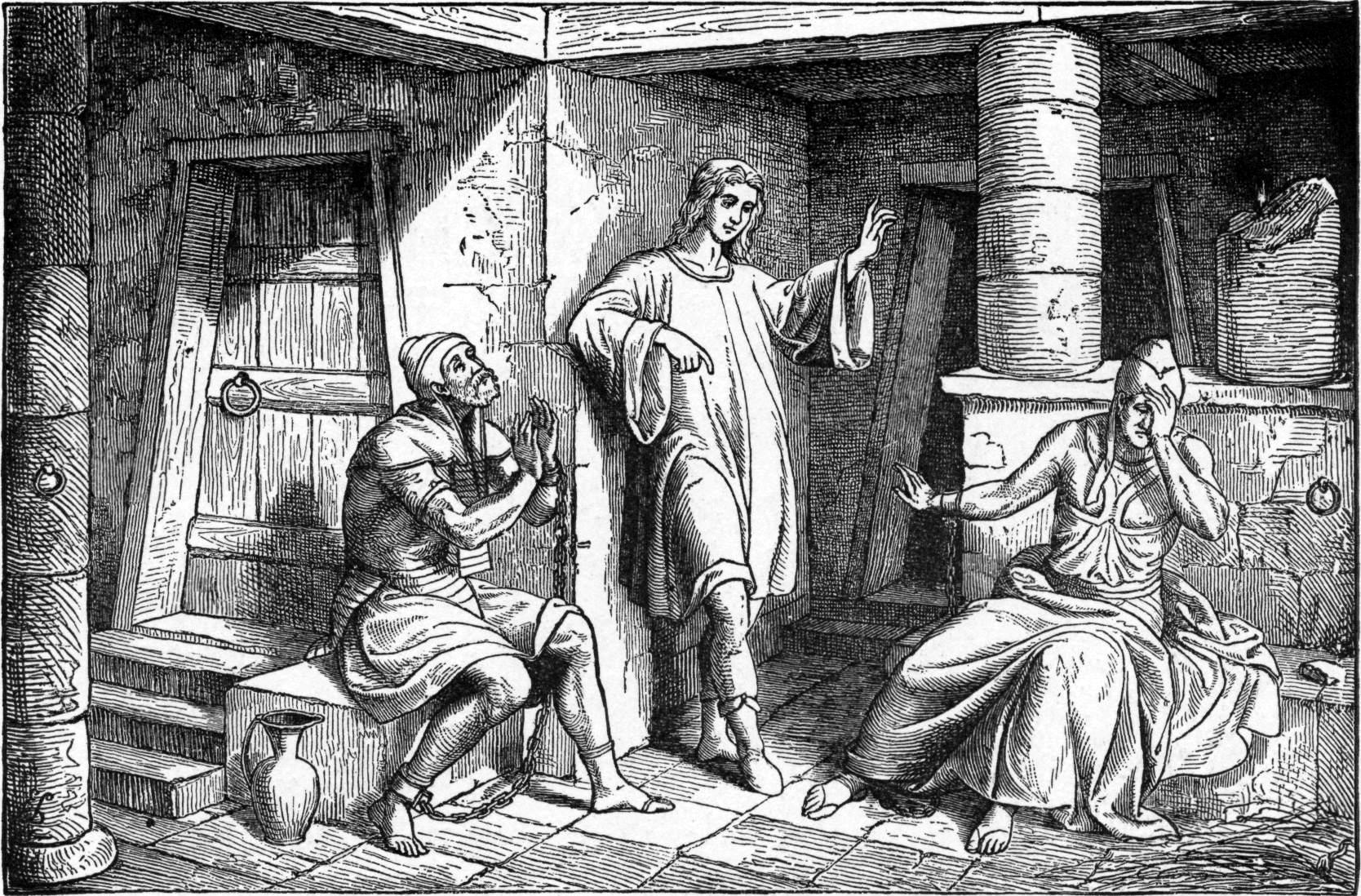
Foster_Bible_Pictures_0051-1_Joseph_Interprets_the_Prisoners'_Dreams“There is sometimes a very great similitude between true and false experiences, in their appearance, and in what is expressed and related by the subjects of them: and the difference between them is much like the difference between the dreams of Pharaoh’s chief butler and baker; they seemed to be much alike; insomuch that when Joseph interpreted the chief butler’s dream, that he should be delivered from his imprisonment, and restored to the king’s favor, and his honorable office in the palace, the chief baker had raised hopes and expectations, and told his dream also; but he was woefully disappointed; and though his dream was so much like the happy and well-boding dream of his companion, yet it was quite contrary in its issue.”

-Jonathan Edwards

Read Full Post »

rainy_day_wallpaper_series_5_out_of_7_by_moggget-d5ddcjf“I find that principle and reflection afford a feeble support against the visitations of melancholy. It is a physical distemper, and must be counteracted by physical means. It is not the direct application of reason that will school it down, any more that it can cure the discomfort of your physical sensations when placed in an overheated room, for example. But it is our duty to apply whatever experience tells us is a corrective against those unpleasant feelings which agitate, and enfeeble, and render unfit for any useful exertion. It is not my duty to feel cool and comfortable when placed in a confined room; but it is my duty to rise and open the window if this can restore me to my wonted capacity of exertion. It is perhaps not my duty to summon up a cheerfulness of mind in the hour of unaccountable despondency, for perhaps this is an affair as completely beyond the control of reason as any other of our physical sensations; but it is my duty to study, and, if possible, to devise expedients for restoring me from this useless and melancholy state. Now, all experience assures me that regular occupation is that expedient; and it is my duty, if I find myself unequal to the severity of my usual exercises, to devise slighter subjects of employment which can be resorted to in the time of necessity. This I esteem to be an important part of moral discipline. Writing a fair copy of an old production which you wish to preserve, setting your books and papers into a state of greater arrangement, writing letters, looking over your accounts, and making slight but interesting calculations about your future gains and future expenditure,—these, and a number of other subjects of occupation, should occur to be ever ready to offer themselves as correctives to melancholy. Let me cultivate, then, that habit of exertion which will not shrink from a remedy which I find so effectual.”

-Thomas Chalmers (1780-1847)

Read Full Post »

« Newer Posts - Older Posts »