Feeds:
Posts
Comments

Archive for the ‘Establishments’ Category

James Bannerman (1807-1868), one of the “Disruption Worthies,” wrote a comprehensive two-volume work on the Presbyterian doctrine of the Church, The Church of Christ.  It is a definitive treatment of the subject and really ought to be on the shelf of every Reformed minister, if not of every Reformed head of household.

The following quote comes from a selection in the first volume on the subject of the necessity of a friendly connection between the Church and State.  One of the reasons is that the State cannot be altogether neutral to the universal claims of the of the Kingdom of God within its boundaries.  While the Church does not have a right to interfere in the sphere of civil government, yet it demands audience from king and people of all lands.  Her warrant comes from none less than the Most High:

[The Church’s] first principle and first duty is that of aggression. The ministers of the Gospel claim it as a right to go into every nation, however fenced around and guarded from intrusion, and to demand an entrance in the name of Him who sent them, even although the magistrate should bid them depart from his coasts. Further still, the messengers of the Cross arrogate to themselves thee title to enter into every human dwelling where a sinner is to be found, – seeking admittance in the name of the Saviour of sinners, that they may negotiate with the inhabitant in behalf of their Master, however sternly the door may be closed against them by jealousy of their errand, or hatred to their cause.

It has been the eloquent boast of freedom in our country, that every man’s house is his castle; and that, be it but a straw-built shed, open to every breath of heaven, yet fenced about by the protection and the sanction of law, there even ‘the king cannot and dare not enter.’  But where the king cannot enter, there the missionary of Christ claims to be admitted; and, with a higher warrant in his hand than that of human law, bids the gates be lifted up, that with the Gospel he may enter in” (The Church of Christ, 1:142).

Too often we fail to appreciate this authoritative dimension to missions.  While the servant of the Lord must not strive, but be patient with all men, yet he is not go to into the world hat-in-hand.  Mission forbids timidity, for we have been sent by the King of kings.   No, we should not force entry, for the weapons of our warfare are not carnal.  Yet alternately, we should not so ‘respect’ the boundaries of men when our Lord counts it no trespass.  It is His claim after all, the deed and grant of His Father.  And the warrant is in our hand.

So let us go.  Aggressively.

Read Full Post »

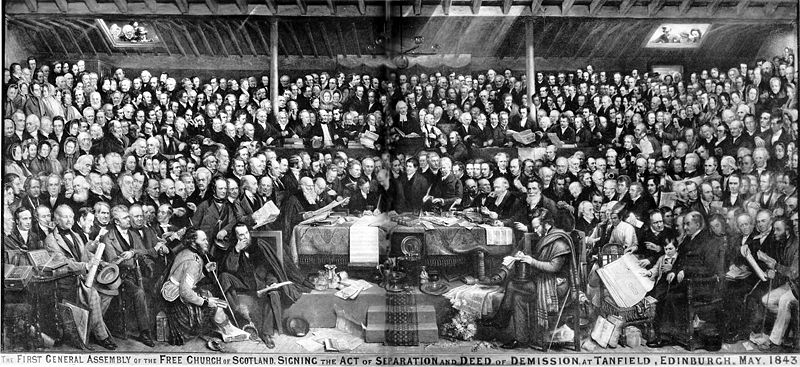
By the 1830s, the Church of Scotland was in the midst of a true evangelical revival.  Yet with the revival came conflict.  Increasingly, the State transgressed into the sphere of the established Church.  Its interference called into question the very spiritual independence of the institution that John Knox and others had helped consolidate under Christ’s ultimate authority. 

Thomas Chalmers, the premier Scottish preacher of the day, threw his full weight on the side of the evangelicals.  In temporal matters, the Church was to be subject to the State.  But not one inch of ground should be given on matters spiritual.  Christ is Head of the Church, and His law is higher than the law of the land.  His servants must at the end of the day obey God rather than man.

In Chalmers’ Memoirs, we read the following words about the dire consequences for compromise.  Speaking of the State’s intrusion in spiritual things, he writes, “Why, this would be lording it over us with a vengeance!  It would be making us swallow the whole principle; and the Church of Scotland, bereft of all moral weight, might henceforth be cast a useless and degraded thing into the bottom of the sea” (Memoirs 4:139).  In short, pragmatism leads to cultural irrelevance.

Though writing in a very different context, his words ring true today.  If the Church should indulge in pragmatism, then it not only breaks allegiance to Christ, but so debases itself as to be contemptible even to the wicked.   “If the salt loses its saltiness, how shall it be made flavorful?  Is it then good for nothing, but to be cast out and trampled under men’s feet.”

Read Full Post »

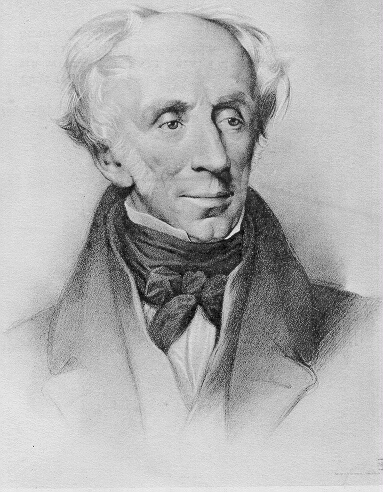
“The sounder part of the Scottish nation know what good their ancestors derived from their Church, and feel how deeply the living generation is indebted to it. . . . Visionary notions have in all ages been afloat upon the subject of best providing for the clergy; notions which have been sincerely entertained by good men, with a view to the improvement of that order, and eagerly caught at and dwelt upon by the designing, for its degradation and disparagement. Some are beguiled by what they call the Voluntary system, not seeing (what stares one in the face at the very threshold) that they who stand in most need of religious instruction are unconscious of the want, and therefore cannot reasonably be expected to make any sacrifices in order to supply it. Will the licentious, the sensual, and the depraved, take from the means of their gratifications and pursuits, to support a discipline that cannot advance without uprooting the trees that bear the fruit which they devour so greedily?  Will they pay the price of that seed whose harvest is to be reaped in an invisible world?  A Voluntary system for the religious exigencies of a people numerous and circumstanced as we are! Not more absurd would it be to expect that a knot of boys should draw upon the pittance of their pocket-money to build schools, or out of the abundance of their discretion be able to select fit masters to teach and keep them in order! Some, who clearly perceive the incompetence and folly of such a scheme for the agricultural part of the people, nevertheless think it feasible in large towns, where the rich might subscribe for the religious instruction of the poor. Alas! they know little of the thick darkness that spreads over the streets and alleys of our large towns. The parish of Lambeth, a few years since, contained not mora than one church, and three or four small proprietary chapels, while Dissenting chapels, of every denomination, were still more scantily found there; yet the inhabitants of the parish amounted at that time to upwards of 50,000. Were the parish church and the chapels of the Establishment existing there an impediment to the spread of the Gospel among that mass of people?  Who shall dare to say so?  But if any one, in the face of the fact which has just been stated, and in opposition to authentic reports to the same effect from various other quarters, should still contend that a Voluntary system is sufficient for the spread and maintenance of religion, we would ask, What kind of religion?  Wherein would it differ, among the many, from deplorable fanaticism?

“For the preservation of the Church Establishment, all men, whether they belong to it or not, could they perceive their own interest, would be strenuous; but how inadequate are its provisions for the needs of the country!  and how much is it to be regretted that, while its zealous friends yield to alarms on account of the hostility of Dissent, they should so much overrate the danger to be apprehended from that quarter, and almost overlook the fact that hundreds of thousands of our fellow-countrymen, though formally and nominally of the Church of England, never enter her places of worship, neither have they communication with her ministers!  This deplorable state of things was partly produced by a decay of zeal among the rich and influential, and partly by a want of due expansive power in the constitution of the Establishment as regulated by law.  Private benefactors in their efforts to build and endow churches have been frustrated, or too much impeded, by legal obstacles; these, where they are unreasonable or unfitted for the times, ought to be removed; and, keeping clear of intolerance and injustice, means should be taken to render the presence and powers of the Church commensurate with the wants of a shifting and still increasing population” (Poetical Works of William Wordsworth, 606, 607).

Read Full Post »

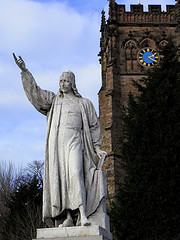
Richard Baxter of Kidderminster (from flickr.com)Baxter was an establishmentarian.  It is good that kings and queens should be nursing fathers and mothers to the Church.  He lamented in his Reformed Pastor that magistrates did not make adequate provision of Reformed pastors throughout the England of his day. 

Yet, he did not lay the main blame at the feet of civic leaders.  The fault was with the laziness of the ministry.  “It is we who are to blame, even we, the ministers of the gospel, whom they should thus maintain.  For those ministers that have small parishes, and might do all this private part of the work [pastoral care, mainly through catechizing], yet do it not, or at least few of them.  And those in great towns and cities, that might do somewhat, though they cannot do dall, will do just nothing but what accidentally falls in their way, or next to nothing; so that the magistrate is not awakened to the observance or consideration of the weight of our work” (Reformed Pastor, pp. 184-85, emphasis mine).  Like Chalmers some 150 years after him, his establishmentarianism was no fawning dependence of the Church on the State.  Rather, the Church ought to rise to the calling of its own Master, with or without the aid of the magistrate.  Yet, both Baxter and Chalmers believed that the diligence of the ministry could induce the State to its duty of patronizing the heavenly Kingdom.

Read Full Post »

Today, I was reading an article comparing Adam Smith’s argument in favor (!) of establishments furnishing religious instruction with that of Thomas Chalmers.  The essay concluded that, in light of their views, contemporary tax policies are warranted in exempting religious organizations from such standard civil obligations and in allowing deductions for contributions made to them.  This statement reminded me of a recent post in which the author I was treating  contended that such tax policies were not just warranted, but that they placed distinct obligations upon churches actively to work for the common good.  They are, in a way, post-establishmentarian state subsidies of religious organizations to improve the social order.  If that is the case, then ought we as Church to consider our tax benefits as advance payments from Caesar to perform our Christian mandate (Mat. 28:18)?

Read Full Post »

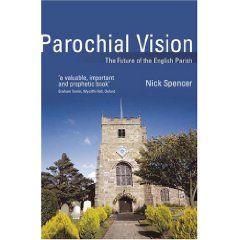
Parochial VisionIn Parochial Vision: The Future of the English Parish System (2004), Nick Spenser offers a very intriguing argument for the reimplementation of the ‘minster’ church model of England’s early medieval period. His main argument is that parish system of the Church of England is in major decline due to demographic shifts, the disappearing of traditional communities, and especially the spiritual declension of the British people. Spenser doesn’t reject the parish system, yet he contends that it needs recasting into a more flexible, regional, and collegial (cooperative) pattern. This pattern is the old ‘minster’ model.

Regrettably, this valuable book won’t find a wide readership this side of the pond, since the entirety of the book pertains to the U.K. situation and to the Anglican Church in particular. This is too bad, since Spenser gives a very compelling example of strategic, ecclesiastical proactivity within the tumult of social change. And he does this without giving up on the age-old principles of territorialism and locality. Like Thomas Chalmers, he analyses the human and brick-and-mortar realities, harvests strategic principles from the Church’s past that are relevant, and suggests the how an old model can successfully be redeployed.

My own criticisms of the book are from an evangelical perspective. Spenser is too theologically inclusive. He advocates this model for both ends of the doctrinal spectrum, conservative and liberal. Certainly, he reflects the via media ethos of the Church of England. Yet there can be no middle way when the alternates today are light and darkness (2 Cor. 6:14). I am stimulated by his overall suggestion, but add a strong qualifier that unity must be in truth.
Second – and in light of the first, this should come as no surprise – there is little if any place dedicated to preaching as the means of renewing the Church in Britain. The whole book suggests a fix by changing administrative models. Now, I’m all for improving efficiency and open to strategy changes consistent with the Word of God and common sense. But if rigorous, expository and applicatory preaching is not central, changing forms will yield a formal change at best.

These reservations notwithstanding, Spenser’s book is a fascinating read.

Read Full Post »

Picture of a Celtic Cross, Lindisfarne, Northumberland (www.freefoto.com)

This is a third installment of my review of the fascinating work, P. D. Thompson’s Parish & Parish Church. If you’re interested in the history of Christian missions and of the parish plan and are just joining us, click here to read the first.

* * * * *

In chapters 5 & 6, Thompson moves from Gaul to Britain. It is here that we are introduced to the parish systems most familiar to us in the English-speaking world.

Chapter 6, “The English Parish”

Six features marked the rise of the English parish system. First, it was patterned after previous work on the continent, and especially Gaul. The ‘Mother-Church’ models of Jerusalem and Antioch were thus transplanted indirectly. “When Augustine with his forty missionary monks landed in England in 596, effected their settlement around the Mother-Church at Canterbury and stared from that point to evangelize the whole land, he was of course familiar with the organization of the Church on the Continent, and set about shaping the Anglo-Saxon Church on the same lines” (56).

Second, the movement was from the greater to the smaller. Ecclesiastical units at first were more like ‘dioceses,’ broad unsubdued territories; yet with time, these territories were subdivided into smaller units as the Gospel prospered. They became more defined and emerged as parishes in the popular sense. In Venerable Bede’s time (c. 672–735), says Thompson, “the Church was organized only on the broadest and simplest lines, and nothing in the nature of parish or parish church had begun even tentatively to emerge” (63).

Third, as on the continent, management was carried on by hierarchical superintendence. Thompson writes:

The plan was that Augustine himself should be the primate of the whole country; that there should be two provinces, a southern and a northern; that he should ordain for his own province twelve bishops, with London as the metropolitan see; that he should consecrate another bishop and station him at York, who, when he had evangelized York and the surrounding territory, should thereupon ordain twelve bishops for this northern province with himself as metropolitan (56).

It is lamentable, I think, that the early Medieval Church did not distinguish the things that differ. The first Mother-Churches in Acts may have taken over patterns of civil organization for administration and witness, as we’ve seen in the first installment. The parish system, I contend, is a natural development of that. They also clearly furnished the early Church with directions for the selection of the orders of presbyter and deacon. But they left neither precedent nor precept for the selection of new apostles and sub-apostolic deputies. This is more than suggestive that the hierarchical model of the apostolic times was discontinued. Augustine surely couldn’t furnish the authenticating “signs of an apostle.”

That being said, I don’t think that there is anything wrong with a temporary superintendence in mission strategy. The Mother-Church model is a good one. But once the daughter churches become fully mature and self-sustaining, they should be raised to parity with the Mother-Church – her officers included. Really, the embassies sent from the Mother-Church should be fellow presbyters. If the missionaries begin collegially with the presbyters of the sending church, they will remain collegial.

Yet, there are two things in Augustine’s policy that I really like. First is his territorialism. England is the claim of the Heir of all things. Really, we’ve got to remember that the parish system is simply a version, or perhaps more properly, a later stage of territorialism. With Augustine, the broad lines were drawn; subdivisions would come with time. Second, one cannot help but admire his aggressiveness. Dividing is merely preparative for efficient conquering. And this faithful army of Christ left Canterbury with the sword of the Spirit, subduing unruly hearts by the preached Word. While I demur at his episcopacy, I praise his ferocity.

The fourth feature was itinerant preaching a key strategy. The matrices were the headquarters from which the preachers were deployed. Bede wrote to Egbert, the newly appointed Archbishop of York (735) and possibly a former student of his, suggesting

that he should follow the example of Paul and Barnabas, who, wherever they went, as soon as they entered cities or synagogues, preached the word of God. ‘This is the work, he went on, ‘to which you are called and for which you were consecrated. And this you will do if, wherever you go, you collect around you the inhabitants of the place and deliver to them the word of exhortation, and also, as a leader in the heavenly warfare, with all who come with you, set them an example of good living. And since the places which belong to the government of your diocese occupy too wide a space to enable you alone to go through them all and preach the Word of God in the smaller villages and hamlets, even in the course of the whole year, it is necessary that you should associate with yourself many helpers in this holy work, by appointing priests and teachers to go through all the villages, constantly preaching the Word of God and consecrating the heavenly mysteries, and especially administering the office of holy baptism, as opportunity may be found’ (61-62).

Venerabe BedeIncidentally, I do think that while gathering the village for preaching is a standard approach in itinerant ministry, it is not inapplicable in the ‘settled’ phase. Gathering in a narrowly defined ‘parish’ in the standard sense is the continual obligation of the ministry. That is why there is visitation. Visitation is for gathering, and gathering is for preaching. Robert Murray M’Cheyne, a devout parish minister in the 19th century, would make his rounds in house-to-house visitation and call on the people to attend some preaching in the open air.

Fifth, just as in Gaul, godly kings and wealthy lay patrons facilitated the progress. Once Constantine adopted and patronized Christianity, the Mother-Church model in Europe was conjoined with establishmentarianism. Medieval England boasted of many large-hearted, royal patrons of the Church: Ethelbert, King of Kent (c. 560 – 616), Alcuin of York (c. 735 – 804), the friend of Charlemagne, Alfred (c. 849 –  c. 899), Athelstan (c. 895 – 939), Edgar (959-75), and Cnut the Dane (1018-35). Among the many initiatives were – like Charlemagne in Gaul – the admonition and later the legal imposition of tithes for the maintenance of the ministry. Thompson comments on the last mentioned of these rulers:

Cnut in particular, who in his later years was a wise and devout ruler, and whose code of laws was even more elaborate than that of Alfred the Great, did much to strengthen and extend the Church both by legislation and by personal example. Among other enactments he restored the law of Edgar in favour of local churches with burial-grounds, and gave notice that if plough-alms, tithes, and other statutory dues payable to the Church were in arrears, the laws concerning them would be strictly enforced by him against defaulters (66).

Once again, we see kings greatly advancing the work of Christ. One is reminded of Rev. 12:16, a text that Thomas Chalmers quoted to defend establishments of Christianity, “And the earth helped the woman, and the earth opened her mouth, and swallowed up the flood which the dragon cast out of his mouth.” Praise God for those noble ones whom He calls to Himself and whose authority and resources are employed to Christ’s honor. And for those separation-of-church-and-staters out there, aren’t these men to be praised for their willing patronage of the Church? Won’t Christ honor their cup of cold water at the last day?

Further, since the very genesis of Christianity, God used wealthy landowners. So too in Medieval England:

The greater landowners in particular would feel it to be due to their position, as well as necessary for the religious welfare of their people, to have a church and resident chaplain of their own. The district assigned to such a church would naturally coincide with the boundaries of the estate whose people it was intended to serve. That many such districts, each with its church and chaplain, came into existence, is to be inferred from the fact that they were given a name of their own. This name was the ‘priestshire,’ to distinguish it from the ‘bishopshire’ or diocese of the bishop. ‘The priestshire’ was the Anglo-Saxon counterpart, at least in embryo, of the parish already widely established on the Continent (66).

In time, these wealthy landowners helped tip the scales away from Mother-Church dominance, so facilitating decentralization (the sixth feature, below). It is interesting in this connection to observe that the English parish system is at least in part a byproduct of the feudal structure of medieval society.

This also helps shed some light on the controversial issue patronage in the Church of Scotland from the Revolution Settlement on. The early and medieval Church grew in part because of wealthy, benevolent patrons, and this system remained in place through the Reformation. The controversy largely arose when the happy arrangement degenerated through corruption.

Last, hardships temporarily slowed the progress of the Gospel and consequently the development of the parish system. These were largely on account of the Norman invasions, beginning in 792. Alfred arose to stave off the invaders, becoming a national hero, and established a peace in which “the organization of the Church proceeded apace” (64). Yet before Alfred’s success, the hardships actually served to scatter the Gospel seed more broadly, and the blood of the martyrs enriched the soil. So really, these struggles actually hastened the establishment of the parish system. Its progress is, as we have seen previously, retarded when the Mother-Churches hold the reins too close. It is furthered when healthy decentralization occurs.

This, then, is the sixth feature of the rise of the English parish system – a decentralizing phase after the settlement of Christianity. Actually we might say, the parish system was not simply the result of decentralization, but of recentralization. Or, if you like, a movement from mono- to multi-centrism. A center of evangelism produces several centers of evangelism, and so on.

Two observations on this last point. I wonder if this fact may partially explain why modern society is not conducive to the parish system – in addition to Enlightenment freethinking and plain ol’ original sin, that is! During the Medieval time period, society was heavily agricultural. There were many more geographic centers in society, because you had feudal lords dotting the map of Christian Europe. The peasants became vassals to these lords, and so were geographically oriented to these many centers. They were near their benefactors. Because they could not finance the ministry, the wealthy lords would. And obviously, they viewed their sphere of responsibility delimited by the boundaries of their lands. The feudal system, however, began to break down as the medieval period shifted to the Modern. Cities grew. And of course the Industrial Revolution only accelerated that shift away from the field. Consequently, the wealthy patrons were disconnected geographically from the lower orders of society. We still see that geographical divide between the haves and the have-nots in our modern urban contexts. There is no geographic center of philanthropy, physical or spiritual. I’m sure the rise of the middle class also had something to do with this, in addition to a myriad of other factors. But I’m just (possibly) catching hold of this one!

It also seems that the Reformation perfected the parish system. By leaving the parish system intact, the Reformers merely recognized and confirmed the preexisting multi-central character of the catholic Church. What it threw off was the ghastly monocentrism of Rome.

Chapter 7, “The Scottish Parish”

While the rise of the parish system in Scotland bears analogies to its predecessors, it significantly differed from them in several ways.

First, though the introduction of the Gospel in Scotland was more or less coeval with that of England, yet the parish system emerged significantly later there than in England. A major factor is that the Celtic missionaries, Columba and his associates, were uninfluenced by Roman preeminence.

The Celtic Church instead had a somewhat different missionary plan. They did operate out of ‘Mother-Churches,’ Iona and Lindisfarne, but they were monastic. They also sent out itinerant missionaries, yet, “their missions were directed not along diocesan or parochial, but along tribal, lines, and resulted not in the formation of congregations or organized Christian communities but rather in ‘cells’ or ‘colonies,’ which were centers of evangelizing and educational influence within the tribal areas to which they ministered” (70-71).

Though it was profoundly successful, the Columban mission was “weak in organization, and did not always succeed in consolidating the ground it had so gallantly won” (75). The Anglo-Roman mission from Canterbury in time supplanted it, that model becoming ascendant in Scotland by the mid-12th century. It was really at that point that the emergence of a full-fledged parochial system began.

Another distinct feature in Scotland was its development towards a national Church. Under Kenneth McAlpin, who reigned from 844-860, the Church emerged as the Ecclesia Scoticana. It was “coterminous with the nation, and was intended to embody and express the national life on its religious side” (78). Further, it was free and independent. “Like its predecessor, the Columban Church, Ecclesia Scoticana was willing to be on friendly terms with Rome or Canterbury or any other Christian communion; but it acknowledged allegiance or subjection to none” (78).

Queen Margaret and her son King David in the 12th century furthered the process of Romanizing the Scottish Church. Margaret gave grants of land in Scotland to Norman and Saxon courtiers, moving the nation towards feudalism. Writing of these expatriates, Thompson indicates that

Among their other southern ideas and customs they brought with them, both from France and England, the parochial idea which had already taken root and become widespread in these two lands. It was an integral part of their feudal organization, and as such they set about planting it on Scottish soil. As feudal lords they recognized the obligation of providing religious ordinances for their retainers, and dedicated a portion of their lands for this purpose. Practically every such local religious foundation became in course of time a parish church, with its parish co-extensive with the boundaries of the estate, so that with the appearance of these pious donors parishes in embryo began to spring up all over the land (88).

Interestingly enough, the subsequent Scottish royalty that sought to complete the process of Romanization themselves slowed the development of the parish system. By their erecting and enriching a broad network of monasteries, “episcopal and parochial development” suffered (90). Bishops gradually lost immediate oversight in their “own sees,” and local endowments were handed over to enrich monastic orders, which proliferated throughout the land.

It is true that this centralizing, or ‘hoarding,’ tendency was offset by private activity. “Partly by private donations as in the case of Ednam, and partly by the energy of individual bishops, local churches were built and endowed with the usual ploughgate of land. In addition tithes of all produce (Scottice teinds) were enforced by successive kings; and tithes upon personal earning were also exacted and paid, not without resistance in either case” (91-92). Yet, during the 14th and 15th centuries, various factors contributed to the entire breakdown of the ecclesiastical system in Scotland, with the common people suffering the worst for it. Corruption and self-aggrandizement were the rule of the day. The ministry in rural areas was meager, only to be provided sporadically by itinerant friars. Yes, the parish structure just prior to the Reformation owes debt to the Anglo-Romanizing of the Scottish Church. Yet, paradoxically, its top-heavy self-interestedness trampled upon its vitality and potential for good. “The parish with its church was the Cinderella of the Scottish ecclesiastical household” (96). It was, says Thompson, left to the Reformers to “revive and develop the parochial idea, and to make the parish church a power in the land” (97).

Read Full Post »

It has been some time since I put this one on the shelf.  Just getting back to it.  It you’d like to head back and read the first post, click here.

* * * * *

A Review with Observations on Parish and Parish Church: Their Place and Influence in History, by P. D. Thompson

Part 2

The Shield of CharlemagneIn the previous installment of Parish and Parish Church, we discussed P. D. Thompson’s helpful treatment of the birth and early development of the ecclesiastical parish as a geographical unit for the Church’s administration and witness. This system, so familiar to us in its finished, Medieval and Reformation forms, was embryonically there in the apostolic Church, ‘beginning at Jerusalem.’

In chapter 4, ‘Baptismal- or Mother-Churches,’ Thompson traces this emergence further. Those churches planted throughout the Mediterranean world that reached a level of success and strategic prominence carried the next phase on. These were called matrices or ‘Mother-Churches.’ They served as bases for the centripetal push of the gospel into the regions surrounding them. Jerusalem and Antioch of the first generation became the models for further church administration and outreach in the second. “Each parish was administered by a bishop, with the original Mother-Church as centre, and with a staff of presbyters and deacons to assist him in his central ministry and to prosecute the Christian ministry further afield” (36). That being said, “the mode of administration . . . and the scope of the bishop’s authority and rule, differed in different countries and provinces. In some, as outlying daughter churches came to be planted, rural or itinerant bishops were appointed to minister in them, not, however, with full episcopal powers, but to some extent under the jurisdiction of the bishop of the Mother-Church.” The ‘daughter’ churches spawned by the evangelistic efforts of the ‘mothers’ slowly attained their autonomy. Until that time, the center of gravity was ‘back home.’ There the Lord’s Supper and baptism would be celebrated. Hence, the synonym ‘Baptismal Churches.’

This centralized feature of ‘Mother-Churches’ was in many ways natural and necessary, Thompson observes. “Up to a point it was fitted to promote the interests and welfare of the Church as a whole. At this early stage it was all to the good that there should be one strong central authority, that local congregations should be regarded as simply outposts and extensions of the mission of the Mother-Church, and that their ministers and members alike should be subject to a recognized and uniform discipline.” One can’t help but see here the dynamic of the Jerusalem Church in Acts. The church was one, with a central board of elders (presbyteroi). The collections for the poor were centralized, and the deaconate administered it throughout the house assemblies.

Thompson continues to point out that what eventually occurred – very naturally – was a gradual process of decentralization. As the smaller outposts were formed, they gradually became self-sufficient and self-sustaining. The daughters were growing up, and the mothers let that happen. Here we see three defining features of the parish plan, nascent before, yet coming to maturity here. That is, we observe ecclesiastical reproduction, supervision, and eventual parity. Churches, like mothers, exist to reproduce their kind. Supervision and care is required for a time until their offspring may reach self-sustaining maturity. The end result is two mothers – in total parity. And what is the overarching goal of this ‘being fruitful and multiplying?’ Filling the earth and subduing it, of course!

It seems to me, then, that the Episcopal system of Rome embodies this dynamic, frozen and exaggerated. It is frozen at the point of centralization, failing to proceed to the next phase – healthy decentralization, independence, and a parity of equals. And further, it exaggerates that development to gargantuan proportions.

At the same time, I can easily fit this ‘Mother-Church’ paradigm with my Presbyterianism. There is nothing wrong with centralization and supervision, provided that is but a phase in an ever-recurring missionary impulse towards decentralization, independence, and parity of equals. And, of course, towards Christianization! I am sure this is part of the reason why the Reformers didn’t scrap the parish plan when pursing their agenda.

In short, however, not every second generation ‘Antioch’ followed this healthy pattern. Some went in the Episcopal direction partly by the fault of men. Some bishops exchanged the older “personal and patriarchal” preeminence – the primus inter pares model – for a more “magisterial and princely” one (38). But some of it was much more innocent. “This power came into [the] hands [of the bishop] through the Mother-Church, whose very name explains the reverence and affection in which it was held” (39). Who can fault filial affection (1 Cor. 4:15)? Thompson further explains,

In addition to being the seat of the bishop and the first church to be erected in the episcopal parish, in course of time it became the shrine of hallowed associations. There the first converts to the faith were baptized, and after them their children and children’s children in growing numbers, until family after family both gentle and simple for leagues around had been thus received into the family and household of God. There they presented themselves in due season as candidates for full membership in the Church, received instruction as catechumens, and were admitted to the sacred rite of the Lord’s Supper. And there, in the God’s-acre surrounding the sacred edifice and making it still more sacred, succeeding generations of their dead were laid to rest (39).

Consequently, believers connected with these sacred Bethels freely gave abundant thank-offerings, even leaving legacies of property to them, including “lands and houses” (39). However, while the revenue was dedicated both “by canon law and by bequest” not only to the Mother-Church but also to the daughter churches planted by them, it is not at all surprising that the bishops who presided over such funds should “jealously and tenaciously” preserve such a privilege (40).

Further, that was not the only privilege they enjoyed. By restricting the rite of baptism to the Mother-Church, for instance, they retained privileges touching not only “on the life of the individual,” but also “the family, and the community at every point” (41). And then the Mother-Churches had the privilege holding the festivals such as Christmas and Easter, occasions for further offerings, as well as the exclusive right of burial within its grounds. Obviously, decentralization ran counter to old privilege. One doesn’t decentralize and devolve privileges upon others, unless he is guided by the highest principle and has the true interest of the Kingdom at heart.

But while the structure of temporal and spiritual preeminence was in the building, a counter-movement made alternating progress also. It became known as the parish system. It was a force prior to the fixed and self-aggrandizing system of preeminence and destined to be its reforming counterpart.

In chapter 5, entitled ‘Parishes in the Making,’ Thompson follows the growing parish system under Charlemagne (742-814) in the early Medieval era. It was during this period that particularly in Gaul – modern day France – the features of territorial division and the parity of churches crystallized, a pattern “with which the world has been so familiar” (45).

He begins by explaining that during Charlemagne’s time, three religious foundations existed – the Baptismal-Church, or what then became to be the “cathedral in each principal town” (45), the monastery, which was quite a distinct animal all its own, and a tertium quid. It is with this third kind that Thompson devotes the rest of the chapter, for this is the soil out of which the Medieval parish system grew.

Into this category would fall the many outposts daughter churches of the matrices, the ‘cells’ of the itinerant preaching monks, the chapels erected by wealthy landowners on their properties for the spiritual well being of their peasantry, and the churches built by prosperous townships. “These all differed in origin, but they had one thing in common; they were all subordinate to and almost completely dependent upon the over-ruling religious authorities to which they were attached” (46).

As the churches in this third category multiplied and came to stand on their own two feet, they pressed for greater autonomy and more privilege. And, “as might be expected, this movement … was started and sustained mainly by private and public donors, landowners, and townships, who not only erected chapels or churches at their own expense, but provided endowments for their ministry and maintenance” (46).

This slow process of decentralization and local empowerment, says Thompson, was marked by three stages. First, the ministries in these churches sought official recognition and benefit. One must remember from the review above that “local churches were little more than mission stations, preaching and teaching centers with an itinerant or at best a restricted resident ministry” (47). And as it was with the Word, so it was with the Sacraments. The keys are at the Mother-Church.

The second step was the “delimitation of an area within which this ministry could be exercised, and whose population was placed under the spiritual care and discipline of the priest or chaplain in charge.” That was simply a recognition that the private, landowner-underwritten chaplains, already independent of the Mother-Churches and her bishops, ought to have properly designated spheres of their own.

The third step was to secure the privilege of the purse. The Mother-Churches had all local revenues vested in them. Gifts and legacies might be earmarked for a certain daughter church, but this was not always strictly observed. The bishops, in charge of purse strings, would often “reserve the lion’s share for their own Baptismal-churches or for ecclesiastical purposes in general” (49). Not surprisingly, dependent churches suffered, a sense of injustice on the local scene was felt, and “donors and people alike” sought greater control over their own endowments. At the same time, Medieval townships were growing and becoming more prosperous. They too sought a greater privilege and control of their own resources.

To these factors must be added the capstone effort of Charlemagne to the establishment of the parish system. He was, says Thompson, “deeply concerned to strengthen and extend the influence of the Church, and he set about doing this in a systematic and thorough-going way” (50). His policy was to provide godly, educated ecclesiastical and civil servants throughout his dominions. Consequently, he “started schools in every bishopric and monastery, himself leading the way by establishing a royal school at his own court” (51). And last, he imposed statutory tithes, which had hitherto been voluntary. He decreed that “whether noble or gentle or of lower degree all must give, according to God’s commandment, of their substance and labour to the churches and priests.” This last ordinance greatly improved the collections; but there was much more.

At the Council of Aix-la-Chapelle in 816, the local churches were able to lay claim to greater rights in part by their payment of the statutory tithe. At the Council, laws were enacted to secure for the local churches “a settled ministry, an assured and adequate stipend, an ‘entire manse’ (with garden, glebe, and other appurtenances), a delimited area, and the crowning right of applying local tithes to local religious purposes” (53). Consequently, this Council “went far to lay the foundations of the future parochial system, and to erect the framework of the parish church and parish that were to be.”

A few observations here. First, I am struck by the influence of the laity in the emergence of the parish system. Wealthy, lay patrons were able to counteract the preservers of privilege in the Church and so promoted the Church’s best interests. Sometimes those in office can lose sight of why they are there. And the people – particularly influential and moneyed people – can rein them in. Lay movements are often salutary for the church, and the story of the parish system is in many ways a lay movement within the Church for the Church.

Related to this, I see once again how God can use the prosperous to further the Kingdom of God. I once read that the Countess of Huntington, a wealthy 18th century believer who financed large segments of British evangelicalism, thanked God that the Bible didn’t say “not any,” but “not many noble are called” (1 Cor. 1:26). God calls some privileged individuals and summons them to employ their resources for the Gospel. While the privileged bishops hoarded, many wealthy patrons gave away. And yet they increased (Prov. 11:24)!

And I can also see how reformation can be spurred on by the frustrations of the disenfranchised. Wasn’t that the catalyst for the great Protestant Reformation? Luther was indignant that the money of the hard-working German Church was going to gild St. Peter’s.

Also a few questions on successive history – for anyone who has some light. I notice that Gaul, according to Thompson, was the first to establish the parish system, strengthening local rights and promoting parity among churches. Does this at all, at least in part, explain the tendency of the French Church to advocate Conciliarism and reject the ultramontane claims of Rome?

Also, this chapter sheds some helpful light on the origins of ‘chapels.’ Really, they were from the beginning churches of the people. Now, are chapels, both in their origin and in their successive manifestations, extra-ecclesiastical bodies devised in response to the failure of the institutional Church? And in that sense, are chapels – to use an anachronism – para-church organizations?

Last, it is not surprising that one of Thompson’s main theses in the book is that the parish system is the mother of democracy. I might just ask whether or not the parish system is in a sense its daughter as well, given this particular history.

Read Full Post »

From flickr.comThomas Chalmers has been widely acclaimed for his views and particularly his applications of social concern. And within the current Reformed world, he is pointed to as an example for modern day ‘mercy ministries.’ Consequently, I’d like in this final commentary on Cheyne’s The Practical and the Pious to turn to the principles of Christian benevolence that Thomas Chalmers advocated – principles that the contributors to this collection of essays have helped me grasp a bit better.

(1) The priority of spiritual benevolence

First, I think Mary Furgol was the most helpful in bringing to the fore the evangelical cast of Chalmers the philanthropist. She demonstrates that Chalmers’ view of social concern meant that one should redress the spiritual needs of the poor ultimately. That is the priority. And so she cites Chalmers, “The main impulse of his [the Christian’s] benevolence, lies in furnishing the poor with the means of enjoying the bread of life which came down from heaven, and in introducing them to the knowledge of these Scriptures which are the power of God unto salvation to every one who believeth” (121).

Chalmers felt obliged to deal with the issues of the body because this was the only effective way to deal with the issues of the soul. And so Furgol observes,

His often clinical approach to poverty and its relief must be seen in the light of his growing conviction that the most important thing was to safeguard the eternal welfare of men’s souls. Having realized that he would not be free to concentrate on this until he had dealt with the problem of poor relief and its interference with a minister’s valuable time, as well as its detrimental effects on the morals and the Christian education of the people, he therefore turned to the task of evolving a specific plan to combat the evil. The main purpose behind the plan, however, was still the religious one of bringing the Good News to the poor, and it is vital to understand this when examining his later solution of the problem of poor relief and assessing its impact and success (128).

I wonder, in this connection, if Chalmers is so neglected in the present day precisely because he was too evangelical for the sociologists and too sociological for the evangelicals. It is a delicate balance to retain an evangelical priority in ministry and yet cultivate a meaningful, active humanitarianism.

At the same time, some within the Reformed world hold Chalmers up as an example for mercy ministries.  Yet some seem to coordinate ‘word’ with ‘deed,’ shifting the center of gravity from the preaching of the cross to a middle position.  From my reading, I don’t think Chalmers would have gone there.

That being said, perhaps the ‘mercy ministry’ movement in Reformed Christianity is only seeking to correct the excessive other-worldliness of 20th century fundamentalism that retreated from social action, scared silly by the Social Gospel. That is laudable. I only hope that the pendulum is not rushing past the golden mean.

(2) The focus on locality

If you have read this blog with any frequency, you will certainly recognize the following theme resurfacing here – locality. As any realtors worth their salt (if there are any left) will tell you, the three things that make a property desirable are: location, location and … location. Well, Chalmers never wearied of beating this same drum as well. Locality is vital to the enterprise of Christian benevolence.

For Chalmers, this simply meant that those who would bring the Gospel in word and deed to the poor must to be brought into regular contact with them. Locally. If they do not live in the area, they must regularly visit the area. But even prior to this, that area must first be defined and then assigned to certain benefactors. Without definition, there is no clear locus for intelligent compassion. The vastness of the problem will be daunting without a manageable, delineated territory. But once the areas are defined and parceled up, they must be allocated. An unassigned locality is just an abstraction. Its plight will have no real pull. But once it is assigned – or adopted, if you will – then the spiritually and economically privileged will have a tie to it, a workable plot of their own to cultivate. The rich and poor will be brought together in the locality of the poor, and the results should be evident in time. Multiply this thousands of times over across a nation, and you have Chalmers’ model for dealing with poverty. It is a grassroots solution.

McCaffrey comments on this, as well as on the influence of Chalmers’ locality principle:

Chalmers’ insistence on the need to reform the individual first in the locality, as the means to reforming society in general, continued to be remarkably vibrant in its appeal in both Britain and the United States. In both countries he found a ready audience in those reformers who sought the good society and who were increasingly chary of leaving its realization to the chance workings of unrestrained lasseiz-faire capitalism on the one hand or too extensive a state-imposed regulation on the other (53).

As I reflect on it, there is no question that the locality principle, bringing the benefactors into regular contact with the beneficiaries, goes against the grain of the urban situation. Cities are notorious for the evil of anonymity. Sin likes darkness; it retreats from community especially if community is viewed as an old socio-religious ball and chain that holds people accountable. Now, that is not to suggest that people always migrate to cities for sin. (Though I don’t think that 1 in 3 San Franciscans are gay because their gene pool is different.) Frequently, there are economic pressures that call individuals from field to factory. That is the way it was in Industrial Age Scotland; that is the way it is in 21st century China. But the reality is that cities not only afford more economic opportunity: they also facilitate sin. Sin loves options and hates the Sartre stare.

That’s not the only reason why the locality principle doesn’t easily fit with the urban context. There is also the socio-economic stratification of cities. Today, we call this ‘white flight.’ I’m not sure all of that is bad. People want to raise their children in peace and safety. Many who live in the slums aspire to get out. But it is a reality – almost a law. Distance between the privileged and the underprivileged just happens. Government has tried to change that, as with busing; but it never sticks. I would suggest that North American inner cities have become a kind of de facto social waste confinement area. We retreat from the problem and thus the Welfare State cannot but step in. Otherwise, there will be social unrest.

Yet, while the locality principle is like the syrup of ipecac to the city’s culture, it is medicine that must be swallowed. The spiritually and outwardly privileged must be brought into contact with the spiritually and outwardly underprivileged. And it won’t happen by some government program. It must happen through an army of volunteers. Volunteers who will bridge the geographic divide into needy localities.

Incidentally, the old scheme of parish visitation was built on the locality principle. One cannot care some someone that he doesn’t see, with whom he does not come into contact. And that visitation must be regular if it is to be meaningful.

(3) Voluntary relief

For Chalmers, the cure of ‘pauperism’ – the 19th century term for dependency on the state – lies in a voluntary program. He firmly believed that involuntary schemes (state programs) are doomed to failure for four reasons, according to Checkland:

First, people become systematically trained to expect relief as a right, thereby destroying the connection which nature has established between economy and independence and between improvidence and want. Second, neighbours and kindred of the poor lose their private sympathies and abstain from providing relief. Third, as the number of poor increases they will be less comfortably relieved, since the allowance per pauper tends to decrease. Fourth, an artificial system tends to be wasteful, both in terms of increased expenditure on paupers caused by their demands for relief as a legal right and by the increase in the number of individuals needed to administer relief. It was Chalmers’ belief that every extension of the poor’s fund is followed by a more than proportional increase of pauperism, and he contended that there should be no compulsory assessment, no certainty on the part of the poor that they would obtain relief, and no possibility of the numbers in receipt of relief being infinitely augmented (131).

And Hilton supplements this evaluation of Chalmers’ thought here, explaining, “State poor laws and organized charity transformed beneficence from a thing of ‘love’ and ‘gratulation’ to a subject of resentment on the part of the rich, dependence on the part of the poor, and ‘angry litigation’ between the two” (146). Leaving the old voluntary model is a recipe for class wars.

(4) Education

Next, education is absolutely vital. Writes Checkland, “He believed that education was the fundamental need of the lower orders, transcending in importance and, indeed, canceling out the need for most poor relief” (131). Since the Reformation under John Knox, education had been of paramount importance in Scotland. It was no different for Chalmers. Education furnishes the key for the self-improvement of the poor. Time and money are better spent in providing this form of benevolence.

This is why Chalmers was such an advocate of ‘Sabbath’ or ‘Sunday Schools.’ In their origin, they were not Bible classes for the young of middle-class churches as they are today. They were the only forms of education that many poor people had at all in those days. Sunday Schools were very much agencies of benevolence.

(5) Intelligent benevolence

Which leads us to the distribution of monetary benevolence. Obviously, education is a long-term investment, and some people require immediate help. Chalmers’ response was to lay down certain guidelines, which he both followed and instilled within his diaconate at St. John’s.

Furgol enumerates these guidelines in a survey of his diary entries:

These entries reveal how Chalmers was striving to put into practice his convictions that people should be encouraged to be as independent as possible, that if relief were given it should be minimal, and that is must at all costs be made obvious that no regular official relief system could be automatically depended on in the event of a simple plea for help. Moreover, a letter written to William Johnson of Lathisk at this time reveals two more aspects of his ideas being put into practice: that friends and relatives should be called upon to respond in a spirit of Christian charity, and that any relief given should only be in cases of extreme and deserving want (124).

Dare we call this ‘compassionate conservatism?’

On this basis, some have strongly criticized Chalmers for idealizing a cold, clinical brand of philanthropy. Cheyne writes in his introduction that the strongest criticism that has been made was “a strange heartlessness [that] underlay the treatment of poverty worked out by Chalmers and his supporters” (20). Nor was Chalmers without his critics during his own lifetime. William Pulteney Alison opposed Chalmers’ dogged adherence to strict voluntary relief. He even critiqued the St. John’s model as dealing harshly with the poor under the guise of Christian stewardship. And so Checkland quotes Alison, “The grand object kept in view by almost every parish is the possibility of evading the duty of relieving the poor” (133). Ouch!

Now, it is hard for me to evaluate the degree of truthfulness in these criticisms. Was there a knee-jerk reaction to open-handed benevolence in extreme fears of giving to the ‘undeserving?’ Did they err on the side of thrift and not on the side of liberality? I wouldn’t be surprised if it was the case. And if so, was there some degree of discontinuity between the proverbial Scottish benevolence before Chalmers and that of Chalmers’ more business-like social experiments? And was it called for, given the great demographic shifts from the rural areas to bustling cities?

Concluding thoughts

Having been reared in evangelicalism, I often heard that the concern for our nation’s poor is the responsibility of the Church. The Welfare State exists because we won’t feed the poor. And prior to my own study of Chalmers, I was under the impression that the St. John’s experiment – what little I knew of it – was proof that Chalmers thought it was. But now I’m not so sure.

The following is a thesis that needs confirmation, so I put if forth tentatively. But certain things seem to be emerging as I read him for myself.

I think Chalmers thought that it was the concern of the state to make sure that all its citizens were cared for, physically and spiritually. Those in government are fathers. Citizens are children. The state ought to seek out a Church and finance it for the spiritual instruction of its people, much as a wealthy aristocrat would hire a tutor for his son [see my essay on Chalmers and establishments].

Being a believer in liberal economics, the best way to care for the people, generally speaking, is to avoid interference in the marketplace. But what of the poor, the victims of the unfeeling free market? The state has a duty to care for them as well. Only, this is not to be done by legal assessments (i.e., legislated ‘wealth reallocation’). It should be left voluntary, on the lines of the old Scottish model.

But the state should support the poor by supporting the Church of the poor – the establishment, which is first of all the spiritual instructor of the people. By subsidizing a religious establishment, lives are changed. Drunkards are sobered, prostitutes are made chaste, thieves go to work, and spendthrifts turn frugal. That is how the state may and ought to care for the poor, Chalmers contends.

But further, the state ought to aid the poor by providing for universal education. The spiritual education of the established Kirk is the first and most important prong of that agenda. But the second is not far behind. Education is the key to self-improvement, and consequently, the improvement of the nation. ‘Give a man a fish, and you have fed him for a day: teach a man to fish, and you have fed him for a lifetime.’

Yet, Chalmers wasn’t blind to the fact that the state has to do more for the poor than providing spiritual and secular education. The state cannot say, ‘be ye warmed and filled,’ yet do nothing immediately for the hungry. It should not leave the poor altogether to the whim of, well, whoever. Rather, it should take an active role in encouraging and facilitating neighborly benevolence, particularly the benevolence of the wealthy.

This is best and most efficiently done through the mechanism of the established Kirk. The Kirk, after all, operates territorially and already competently cares for the poor of its own number. The Kirk performs this care best because it operates on the soberest principles. “If a man will not work, let him not eat.” The Kirk already has assumed the spiritual care, the cura animarum, of the people, and the state only acknowledges that reality, honoring it in a pecuniary way. She also cares for the body of the unchurched throughout its parishes since love comprehends the whole man, body as well as soul. Why not, then, outsource ‘welfare’ to her? If I am not mistaken, that is exactly how Chalmers sought municipal cooperation in the St. John’s experiment of Glasgow.

If this is Chalmers’ view of the role of the Church and the care of the poor, then he obviously thinks it is a responsibility of the Church when and only when the state explicitly contracts with her. It happens when she enters into a partnership with the state as a religious establishment. Before that, the state does not recognize the Church. She is not chosen to care for the souls of a nation’s citizens or their bodies, for that matter. She has no special obligation to the poor, other than the law of love to one’s neighbor.

If I am right on my assessment of Chalmers, and if Chalmers is right (and, surprise of surprises, I lean that direction), then we as an organized Church have no special responsibility for the poor. We have no formal authorization, because the state wishes to retain management of this beast directly.

Yet, I am hardly suggesting that the Church has no responsibility for the nation’s poor, or that Chalmers thought that unestablished Churches may wash their hands of this great civic duty.

Generally speaking, I wonder if it is not so much the obligation of the Church qua Church to care for the nation’s poor as it is the duty of the nation, which comprises also the Church. The care for the poor is our duty not as the Church, but as citizens. And, of course, our Christian principles all the more compel us to our neighborly duties. It is not the Church’s problem per se. But it is the Christian citizens’ problem, collectively with the rest of the nation.

This is a collective problem. We as Christians are called to “seek the peace of the city” where He has placed us in our earthly exile, and to “pray unto the LORD for it: for in the peace thereof shall [we] have peace” (Jer. 29:7). We are Christians first, yes. But we are also citizens of an earthly order. I am a citizen of Rhode Island. Our prison system has swelled to an overflow. Our unemployment rate is the highest of any state in the nation. This is not someone else’s problem. This is my problem, because I am a citizen of Rhode Island. It is not the Church’s problem, directly. Yet it is the Church’s problem, insofar as the Church in secular matters holds it citizenship on earth.

Very practically, I think that what we have before us is an opportunity for volunteers. The state will not ask us to educate its people in the truths of Christianity. Nor will it ask us to care for their bodies (except on April 14). Yet it presently will not interfere with us if we choose to volunteer.

That we volunteer to care for souls is just another way of describing evangelism. But volunteering for social improvement beyond the community of faith can be sticky. The ministry of the Church should not “leave the word of God, and serve tables” (Acts 6:2). And while we must “do good unto all men,” we are “especially” to do so for “the household of faith” (Gal. 6:10). Let us not forget that one great apologetic argument for the authenticity of our faith is the love that Christians have for each other (Jn. 13:35).

Yet to some degree and in a very tangible way there must be concern for our neighbor. He has a body, and not just a soul. So let us follow Chalmers as he followed our Lord, “who went about doing good” (Acts 10:38).

Read Full Post »
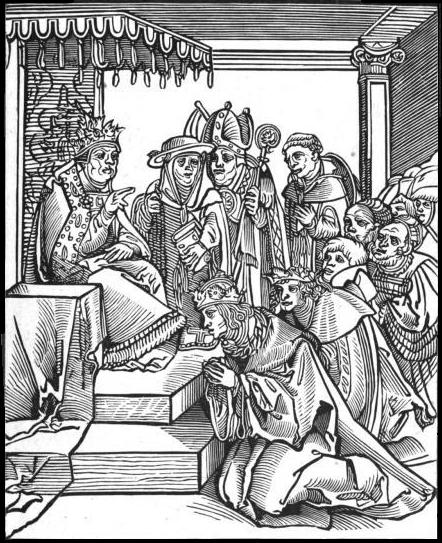
Bust of Thomas ChalmersThe Practical and the Pious – 2
Chalmers the Manager: Lessons in Christian Leadership

In the first part of my review of A. C. Cheyne’s collected essays, The Practical and the Pious: Essays on Thomas Chalmers (1780-1847), we observed the way in which Thomas Chalmers was great Christian bridge builder in his day. He sought to connect the teaching of Scripture and the best traditions of the Christian past to the then-present issues. He sought to obey the Kingdom mandate to the best of his abilities and leaves us to follow the path he pioneered for His and our Lord.

In this second installment, I would like to turn to another theme that emerged for me as I read these essays. Chalmers, in addition to being – or at least striving to be – a bridge builder, was a great administrator. Our ‘practical pietist’ was a churchman, and as a churchman he managed – impressively.

First, Chalmers was a great administrator because he was a man of vision. As a manager, one must have a clear, well-defined purpose. Otherwise, both the manager and the managed will be directionless. And if you aim at nothing, you are sure to hit it, as they say.

His great ambition was the ‘Christian good of Scotland.’ The land must be Christianized.  Everything else was subordinate to this – even the established Kirk. Sefton quotes Chalmers,

I have no veneration for the Church of Scotland merely quasi an Establishment, but I have the utmost veneration for it quasi an instrument of Christian good; and I do think, that with the means and resources of an Establishment she can do more, and does more, for the religious interests of Scotland than is done by the activity of all the Dissenters put together. I think it a high object to uphold the Church of Scotland, but only because of its subserviency to the still higher object of upholding the Christianity of our land (169).

Chalmers inspired others with this vision of a Scotland thoroughly leavened with the Gospel.

But he wasn’t a great administrator because he had vision. One can be a visionary and yet very impractical. Chalmers embodied both vision and practicality – a potent combination. Everything Chalmers said and did was really a strategy to reach the great end of Christianizing Scotland.

The locality principle that he tirelessly advocated was but a strategy, a means to an end. This principle, as I have explained elsewhere, is that the church should spearhead evangelistic efforts geographically, focusing on defined territories with regular district visitations. Only through habitual cultivation of these areas by ‘territorial ministers’ would true Christian communities reemerge in the new urban context; only through this method – wrought in the aggregate – would the land be permeated with the Gospel.

The Church Extension campaign of the 1830s was yet another strategy. The Church of Scotland, in order to Christianize the burgeoning, unchurched population of the major cities, desperately needed to finance new church buildings and ministers. Chalmers took over the convenorship of the committee and, through his fundraising efforts, was able to witness the erection of more than 200 new church buildings. And all for the Christianizing of Scotland.

Interestingly, this strategy was complementary of the territorial principle. Sefton writes, “The enterprise was concerned not only with the building of new churches but also with the vicinity for whose good the new church was intended. The object was to provide a church near enough and with seat rents low enough to benefit the families by whom it was surrounded” (169, emphasis mine). Chalmers made sure that the program was efficient by making it conform to the territorial principle. The strategies were synergistic. Not a territory without a meeting place, or a meeting place without a territory.

Church establishments comprised another prong of Chalmers’ strategy. We’ve already seen in the quote above that he only viewed them as efficient instruments for the promotion of Christian good. They exist to facilitate territorial church extension (see my essay on Chalmers on establishments). Since the days of Constantine, the goal of establishments is “not to extend Christianity into ulterior spaces but thoroughly to fill up the space that had been already occupied” (168). Specifically, then, an establishment is a “universal home mission.” That is, it is a structure that exists for the further Christianization of a land where the Gospel has already gained a footing. It is phase 2 in the mission program. It is what the army does after taking Normandy.

These profound quotes further nuance my concept of establishments and the territorial principle. The latter is always a strategy that the church can and should employ. The Gospel has always come to districts and territories, and it always comes to put the standard up for Jesus, who speaks for every land, saying, ‘Mine!’ Yet, the principle is applied with lesser openness and focus during times of persecution and more breadth when the church hasn’t taken firm footing in a region.

One cannot implement the parish principle in Muslim countries, with a territorial minister going door to door as M’Cheyne in Dundee or Bonar in Finnieston. Yet, cells of believers can and do still influence their communities. True, they cannot be as open and must even pay for their successes with their blood. Omaha Beach was taken, yet at a high price. But it is worth it. And the territorial principle can be applied when missionaries are first introducing the Gospel into a region; only, the strategy is usually to work more broadly without narrowed reference to fixed districts until nuclei of converts develop. Churches are then formed, which become centers for saturating communities.

And establishments, as I am beginning to see, are a strategic step in the typical process of Christianization. Christianization begins before establishments arise and continue after they are formed. Paul preaches the Gospel throughout the Empire until at last the movement overtakes the Emperor – several generations later. But at the time of Constantine, while Christianity was on the rise, there was much work yet to be done. And so the magistrates became promoters and patrons of the true Gospel. They became, in the words of Isaiah “nursing fathers” and “nursing mothers” (Isa. 49:23). We in the United States are not at the establishment stage, yet thankfully, we are not at the persecution stage. We can therefore apply the territorial principle more consistently and with greater focus, since Christianity is settled. But Congress does not yet subsidize us. Yet.

Chalmers was also a great manager because he was cognizant of realities on the ground as he developed strategies. We’ve essentially addressed that in the previous essay. But a further point is in order. One cannot help but observe the very language of ‘experiment’ that Chalmers used for the efforts that he undertook and advocated. He believed that there were certain tried and true principles that could be effectively implemented when thoughtfully applied in new contexts. Furgol points out that Chalmers, before commencing the St. John’s experiment, conducted an “extensive analysis of the mechanics of poverty and its relief” before implementing his scheme (127). He became well versed in the realities of things before applying principles. Now, perhaps Chalmers read more success into his experiments than others would allow. But the point is that strategies are timeless principles manifested in particular situations.

In addition to being a visionary and a practical, strategy-making and executing worker, Chalmers was a great manager of human resources. Perhaps what Chalmers did best was preach. Hands down, many might say. But his ability to recruit, delegate, train, supervise, and inspire people – that is, to manage them – must come in a close second.

Successful people know how to surround themselves with other successful people and to use their unique gifts. So with Chalmers. Says Maciver, “Part of his flair lay in an ability to recruit able and dedicated aides” (93). And “organization was not to be haphazard” either (89). People work best in structures. Concrete plans were drawn up for the Church Extension campaign, significantly mirroring the organizational model of the Bible Societies. Perhaps the world-wisdom of his business and industrialist friends also rubbed off on him.

From the inner circle and within the preconceived structures, Chalmers led the people. Average, yet not unimportant members of the Kirk throughout the land were sought out and used. In the Church Extension campaign, He “emphasized the local factor, the legacy of his poor relief experiment, again and again, and was anxious to devolve local organization ever downwards” (89).

Referring to the St. John’s experiment early on in Chalmers’ career, Cheyne points out how vital the non-ordained ‘ministry’ was to the success of Christian home mission:

The scheme was more than just a successful exercise in the delegation of duties and the deepening of Christian fellowship. It also pioneered what would now be called the training of the laity; for the congregation of St. John’s learned to regard itself as being less an assemblage of hearers than a body of workers, its mission to the parish planned and directed by the clergy but managed and carried through by a subordinate band of elders, deacons, Sunday and day school teachers, and others – the NCOs, as it were, of a Christian army (17).

So from beginning to end, Chalmers was interested in a popular Kirk, a Kirk of the people. I cannot help but ask here, to what degree was Chalmers paving way for the heightened lay activity so characteristic of the late 19th and 20th centuries? Though an old school establishmentarian with a high view of the ordained ministry, did Chalmers further the increased democratization of the Church?

Chalmers also artfully and efficiently managed his peer relationships. He courted MPs, made alliances in the business world, and strove to cooperate with clergyman outside the established Church. Equals were not a threat to him, but a resource. And in the interests of Christianization, collaboration – not competition – was the rule.

On this point, I can’t help but answer for Chalmers as I read the following criticism made by Dr. John Lee, a contemporary of his within the Kirk. He thought that the Church Extension campaign, built on the territorial principle, turned a blind eye to harsh realities. Chalmers could not transpose the model of the rural Anstruther parish into Edinburgh, precisely because the slums of Edinburgh were nothing but a “perpetual fluctuation of inhabitants on whom no impression could be made” (91). In other words, you visit them once, and they’re gone forever the next week. Those with any experience in the inner city will see that some things don’t change.

But I would suggest that the comity principle here comes to the aid of the territorial. By applying the territorial principle throughout the land, a resident leaves one parish only to land in another. Even if the individual leaves no notice of his move to another district, in Chalmers’ ideal he will probably come under the influence of another Christian minister in his regular visitations. And, true, even if this ideal ‘parish patchwork’ didn’t exist in a land, still the seed sown shall not return void! A territorial minister is always sowing seed. Sometimes that seed takes flight and lands somewhere else, only to yield fruit that the faithful minister never sees.

Chalmers, as a shrewd steward, also made friends with the mammon of unrighteousness. He was so successful in his fundraising efforts for Church Extension, that the Free Church inherited a well-oiled machine at its exodus from the establishment. But it was not enough to raise money. It had to be managed wisely. This is especially clear in his poor relief model. Only the worthy poor were to receive benevolence. Consequently, the office of deacon was resurrected in the St. John’s experiment to distribute the hard-earned money of those who wished to show intelligent charity.

Then there was his concern for time management. When he came to the Tron in Glasgow, he devolved as many clerical responsibilities in the civic arena to laymen. According to Furgol, this was an instance of Chalmers’ adherence to Adam Smith’s principle of the division [specialization?] of labor. She quotes Chalmers who wrote at the time,

I know of instances where a clergyman has been called from the country to town for his talent at preaching; and when he got there, they so be-laboured him with the drudgery of their institutions, that they smothered and extinguished the very talent for which they had adopted him. The purity and independence of the clerical office are not sufficiently respected in great towns. . . . He comes among them a clergyman, and they make a mere churchwarden of him. . . . It shall be my unceasing endeavor to get all the work shifted upon the laymen (126).

This also reveals that while Chalmers was a believer in churchmen following managerial principles, yet he remained firmly convinced that ministers ought not to contaminate their spiritual office by the mundane.

The last thing I’d like to mention in the example of Chalmers as a model Church manager is his habitual re-investment of resources into bigger projects on bigger and broader scales. Maciver observes:

It is likely that Chalmers saw the ‘principle of locality’, enshrined in his widely-publicised St. John’s parish scheme of the previous decade, being given new life through a national Extension project that sought to combine local effort with the aid of a central fund raised by subscription to help poorer or weaker parishes. The ultimate stimulus would be provided by state grants in the form of an annual endowment of the ministers’ stipends in the new missionary and territorial churches (88).

The Extension campaign brought out to their fullest extent Chalmers’ gifts of inspired leadership and sheer organizing ability. . . Possibly he had absorbed lessons from the problems of his social experiment in Glasgow, for he stressed now the necessity of organizing local efforts on a national scale, explaining to his lieutenant, William Collins, the publisher, that ‘what I particularly wish is to combine a wise general superintendence on the one hand with an entire and intense local feeling in each separate town and district for its own local necessities on the other’ (89).

Retool and re-deploy! He could not stop until the vision had been realized. First, St. John’s, then Church Extension. And even after the Disruption, he would not leave off. So began the West Port experiment.

My only regret with Maciver’s essay “Chalmers as a ‘Manager’ of the Church” is that he only treated his management on the national ecclesiastical level – on the ‘macro’ and not the ‘micro.’ A parallel survey of the St. John’s and West Port experiments with his management of the Church Extension campaign would have been even more fascinating.

With this survey behind us, there are some good lessons to be learned for Christians of all types. But I think that there are special lessons here for modern-day pastors.

First, while pastors should not view themselves as religious CEOs, yet Reformed pastors are in the people business. And in that business, we simply have to manage. We must possess and instill vision. We must set concrete goals. We must devise faithful means to achieve them. We must husband, cultivate, and utilize our people. And we must, in prayerful dependence on the Spirit, wait for the harvest.

Our Lord will one day come and demand an account of us. How we have managed the resources, and particularly the human resources, that He has entrusted to us? Will He judge us wise and faithful stewards? Or, literally in the Greek, ‘economists’ (oikonomoi)? Will we return His own with interest, five or tenfold? Or will we, under the name of being ‘faithful’ return His solitary coin? While we must not accede to the consumer-driven culture, we ought not to abandon wholesale the ‘business model’ in the church. To do so is grave infidelity and will not go unpunished. “Cast ye the unprofitable [or, ‘useless’] servant into outer darkness: there shall be weeping and gnashing of teeth” (Matt. 25:26).

As an aside, I find it profoundly interesting that Chalmers attacks those who would subject the witness of the Church to the free trade doctrine; and yet he was an expert administrator whose example would inspire seasoned entrepreneurs. He promoted a managed, central economy in terms the witness of the Gospel: he was a believer in state-subsidized establishments. But he ran the St. John’s and West Port experiments like one would run a successful business, and reported these success stories to provoke a holy emulation and, yes, a holy competition! Selah.

Second, our ‘practical pietist’ appreciated the sanctity of fundraising. Perhaps we in the Reformed community today have been so negatively affected by Pentecostal health and wealth charlatans that we have thrown the proverbial baby out with the bathwater. Chalmers imitated the Apostle Paul who went from church to church, taking up collections (1 Cor. 16:1-3) and even preaching a rich, biblical theology of benevolence (2 Cor. 8 & 9) to rally the cause. And just like the apostle, Chalmers did this, not to line his wallet or that of his ministerial colleagues, but he did it in the interests of the poor (Gal. 2:10).

Third, Chalmers was a high churchman. (Not a high-church man, but a high churchman.) Chalmers believed that Christ had established the visible Church not only as an organism, but also as an organization. It has, since the institution of Christ in the days of His flesh, been the great vehicle of Christian good throughout the world. In a day when ‘institutional religion’ is disparaged, we need to rediscover the glory of being in this great organization, which is very much visible.

Fourth, Chalmers’ example, in point of fact cautions ministers not to get too managerial. He delegated and devolved responsibilities to free him to focus on the spiritual duties of the ministry. While he was a profoundly efficient manager, yet he was no believer in the ‘minister-CEO,’ to use an anachronism. Chalmers was a preacher first and foremost. Crowds thronged to hear him, from aristocrats and MPs to the common people. William Wilberforce even climbed through a window to hear Chalmers preach in a packed hall. Preaching is the great business of a minister. It remains the greatest means for changing men, for changing culture. That was Chalmers’ conviction.

And even if Chalmers himself was not his whole career a full-time pastor – the responsibilities of his theological professorships and denominational leadership occupied the bulk of his professional life – yet what he inculcated in students and ministers was a very high standard of pastoral self-consciousness. After preaching in the pulpit, the man of God must descend to work among the people.  M’Cheyne, the Bonars, and many other students of his devoted hours upon hours during the week to house-to-house visitation, most of which was specifically evangelistic. This is hardly the picture of a pastor-CEO behind his desk reviewing balance sheets and organizing programs.

In sum, I think Chalmers patterns three basic ideals. First, we must keep the managerial element of the pastoral office in view and not let it fall by the way in a retreat from the pastor-CEO idolatry of today. Second, we must cultivate that managerial dimension of our pastoral office to the best of our abilities. To give our Lord less is to subject Him to a great dishonor. But third, we must keep the managerial element in biblical proportion with the other, indeed the prime elements. “It is not reason that we should leave the word of God, and serve tables. . . but we will give ourselves continually to prayer, and to the ministry of the word” (Acts 6:2, 4).

[Go to Part 3]

Read Full Post »

« Newer Posts - Older Posts »