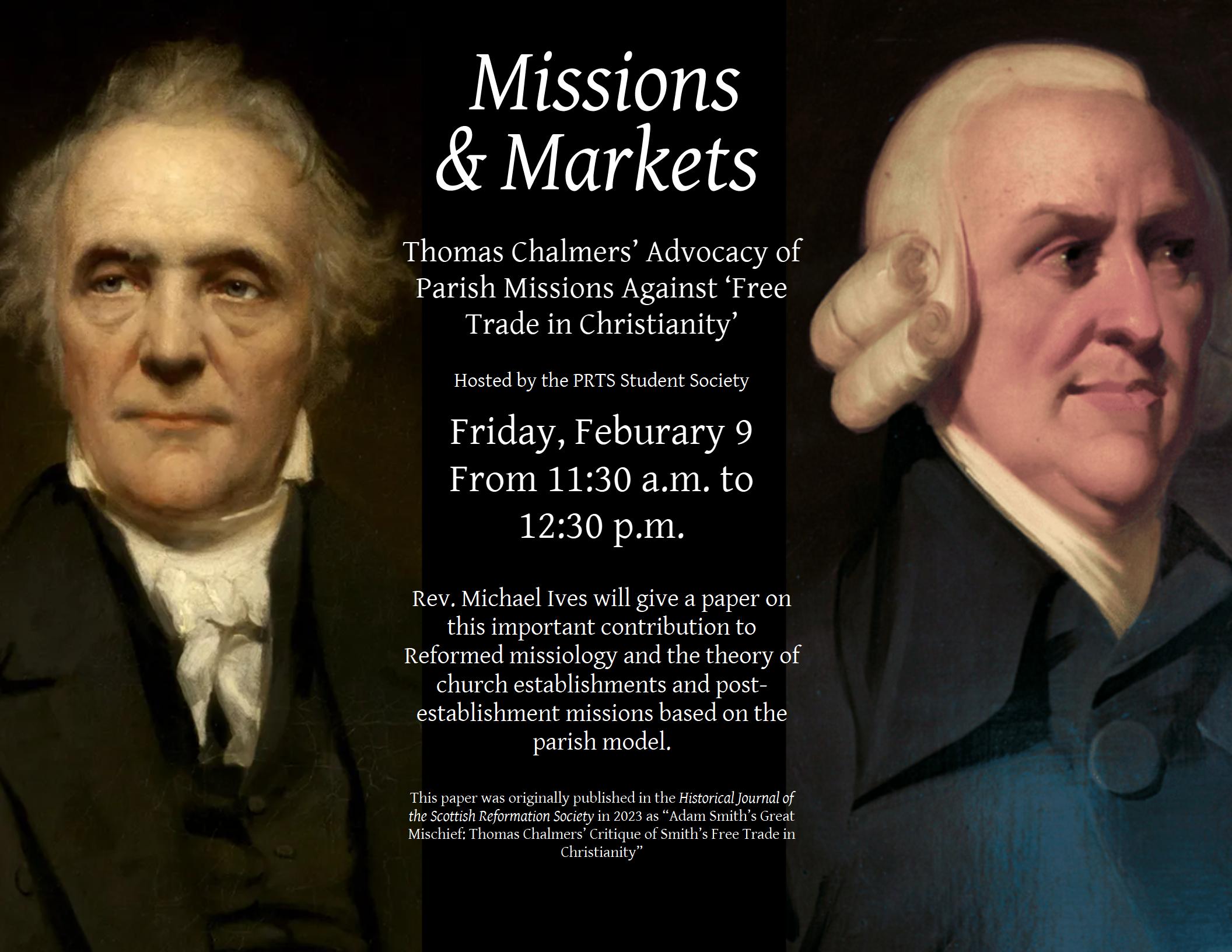
Apologies to everyone who tried to watch the livestream—technical issues. Here is the audio:
Posted in Commerce & Christianity, Contemporary Parochialism, Establishments, Gathered Church Ecclesiology, Locality & the Law of Residence, Missiology, Parish Theory & Practice, Patronage, Religious Marketplace, Thomas Chalmers on January 31, 2024| Leave a Comment »
Apologies to everyone who tried to watch the livestream—technical issues. Here is the audio:
Posted in Establishments, New England Puritanism, Puritans & Puritanism, Sabbatarianism & the Church Calendar, The Godly Prince on December 20, 2023| Leave a Comment »
Thomas Shepard (1605-1649), on civil magistrates promoting the true religion. “Thesis 20. And if superiors in families are to see their gates preserved unspotted from such provoking evils, can any think but that the same bond lies upon superiors in commonwealths, who are the fathers of those great families, whose subjects also are within their gates, and the power of their jurisdictions? The civil magistrate, though he hath no power to impose new laws upon the consciences of his subjects, yet he is bound to see that the laws of God be kept by all his subjects; provided always, that herein he walk according to the law and rule of God, viz., that, 1, ignorant consciences in clear and momentous matters be first instructed; 2, doubting consciences have sufficient means of being resolved; 3, bold and audacious consciences be first forewarned. Hence it is, that though he hath no power to make holy days, and to impose the observation of them upon the consciences of his subjects, (because these are his own laws,) yet he may and should see that the Sabbath day, (the Lord’s holy day,) that this be observed, because he doth but see to the execution of God’s commandment herein.”
Posted in Articles, Commerce & Christianity, Establishments, Thomas Chalmers, WPE Editor on November 2, 2023| Leave a Comment »
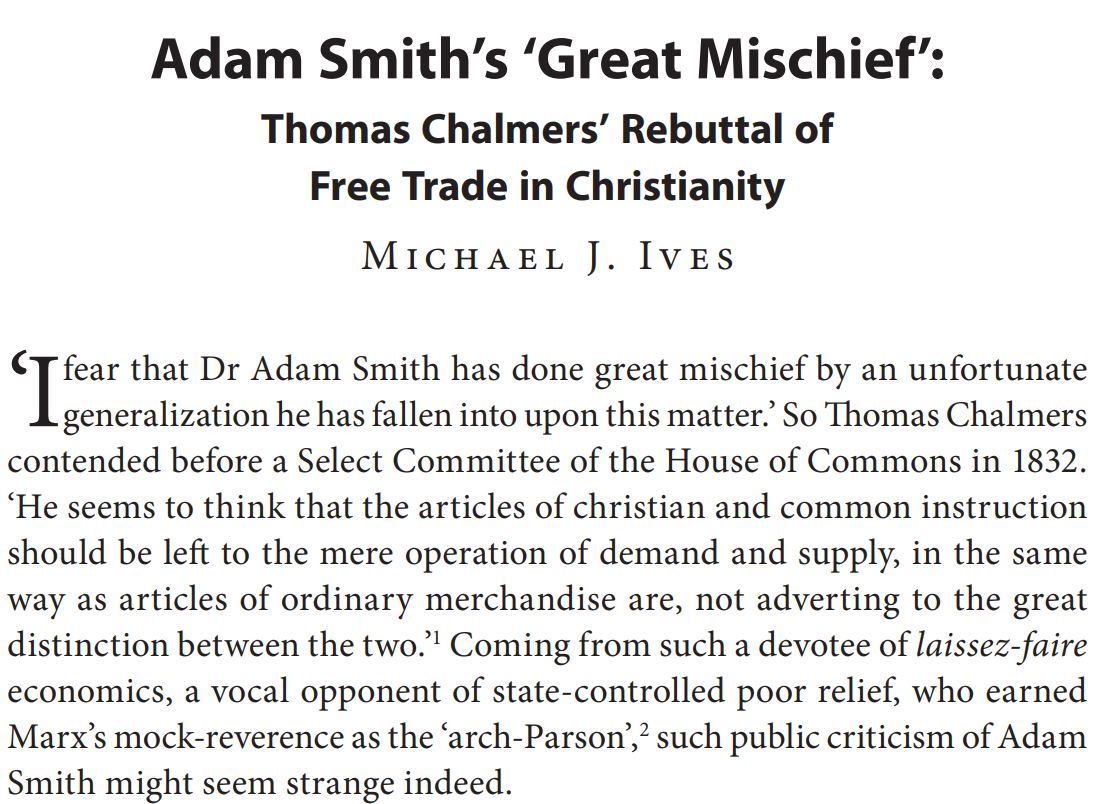
Just published another article on Thomas Chalmers. This is also a fantastic journal, and well worth the low cost to purchase. Get your copy here. For past articles I’ve written on Chalmers, visit the ‘About’ page and scroll to the bottom.
Posted in Catholicity, Church of Scotland, Connectionalism & Conciliarism, Ecclesiology, Establishments, Separatism & Schism, The Visible Church on August 30, 2023| Leave a Comment »
A tremendous, two-part treatment that anyone identifying with historic Presbyterian should read by my friend, Matthew Vogan.
* * * *
Whole doctrine catholicity | “Who is she that looketh forth as the morning, fair as the moon, clear as the sun, and terrible as an army with banners” (Song 6:10)?
Posted in Articles, Church of Scotland, Church Order & Discipline, Confessional Subscription, Establishments, Experimental Religion & the Cure of Souls, Free Church of Scotland, Free Offer of the Gospel, John Murray, Practice of Piety, Presbyterian Reformed Church, Psalmody, Puritans & Puritanism, Sabbatarianism & the Church Calendar, Sacraments, The Free Offer of the Gospel, The Godly Prince, The Lord's Supper, Vital Godliness, Worship, True & False on October 7, 2021| Leave a Comment »
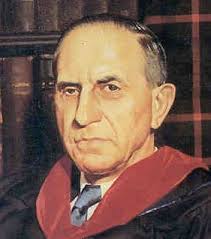
The following is a series of messages given to lay out the distinctives of the Presbyterian Reformed Church, a denomination organized through the instrumentality of Professor John Murray in 1965, committed to the principles of historic Scottish Presbyterianism in doctrine, worship, government, and discipline, as enshrined in the original Westminster Confession of Faith (1646).
For a historical sketch of our beginnings, see here.
(Note: The title “Our Testimony” is merely thematic, and does not refer to a supplementary ecclesiastical document besides the Westminster Standards as is done among Reformed Presbyterian brethren.)
Our Testimony, Part 1: Psalm Singing
Our Testimony, Part 2: Instruments in Worship
Our Testimony, Part 3: Presbyterianism
Our Testimony, Part 4: Holy Days, True & False
Our Testimony, Part 5: Confessionalism
Our Testimony, Part 6: Experimental Religion
Our Testimony, Part 7: The Free Offer of the Gospel
Our Testimony, Part 8: Religious Establishments #1
Our Testimony, Part 8: Religious Establishments #2
Our Testimony, Part 9: Head Coverings
Our Testimony, Part 10: Liberty of Conscience
Our Testimony, Part 11: Our Communion Practice
Our Testimony, Part 12: Frequency of Communion
Posted in Establishments, Gathered Church Ecclesiology, Missiology, Parish Theory & Practice, The Gospel & the Poor, Thomas Chalmers on August 18, 2021| Leave a Comment »

“Ministers are the fishers of men; and the effect of an endowment is to lengthen their line, and enable them to reach downward to the lowest gradations of the commonwealth. The voluntaries are a kind of fly-fishers—whose operations do not reach to the muddy bottoms, to those depths and those fastnesses of society, which to them are inaccessible. And a chapel of ease, give it any ecclesiastical organization you like, is just such a voluntary [entity]. Nominally, you may give it the title of an established church; but you will never give it the power or the properties of an established church without an endowment” (Works 18:101-102)
In this quote, Chalmers is contending within his historical situation for the full inclusion of “chapels of ease” (more or less preaching stations) within the established Church of Scotland. But what is crucial, he argues, is that they should be territorial, assigned to focus pastorally and evangelistically on one defined neighborhood, and endowed, so that they do not have to be beholden to the more privileged classes attending from beyond their ‘parish.’ Without these two pillars, the ability to minister to all, both rich and poor, becomes extremely difficult. In fact, it becomes impossible when contemplated as a system for the entire nation, which is what an establishment is built to guarantee. In the end, you are back to the religious marketplace, and those who lack “wealth and will” are left to sink to the bottom.
Posted in Culture, Establishments, Parish Theory & Practice, Public Health, Sacred & Secular, Social Byproduct, Social Issues, The Gospel & the Poor, The Sacred Ministry, Thomas Chalmers on April 11, 2021| Leave a Comment »

In the following quote, Chalmers explains how a territorial establishment, where parish missions bring the Gospel to every home and hearth, is a double blessing. Even if few souls are saved, the social and moral impact of the Gospel effort leavens the lump:
“And perhaps it will give in your eyes less of a Utopian, and more of an experimental character, to our anticipations of a result so general—if we ask you to consider the just observation of Mr. Wilberforce, on the effect of Christianity even beyond the circle of its own proper and genuine disciples. It elevates the general standard of morals, in every country or neighbourhood which it enters. Even though it should but spiritualize the few, it civilizes the many. Over and above its direct influence on those whom it converts, it has, through the medium of their example and their virtues, a reflex or secondary influence on the families of every little vicinity around them-insomuch that the sanctities and the extraordinary graces of a small number, with the influence of a purifying and preserving salt on the general mass, tell, by a certain overawing power, in restraining the profligacies, and so in raising the character for decency and morals of society at large. This will be remarkably seen in any parish that is under a reclaiming process from the out-fields of heathenism, if the experiment be but well and vigorously conducted. We do not say that the minister will Christianize all; or that he will introduce the worship of God, the voice of psalms, into every family. But the melody that is heard in the habitations of the righteous, will have a certain softening and subduing effect on the inmates of other habitations; and it will be found no romance, but in strict accordance with the realities of human nature, if-by means of his schools and of his other parochial institutes, and (of no small account either) if, by means of his own frequent and various intercourse with the people, and the dignifying effect upon all the householders of their personal acquaintance with the clergyman, and of the personal cognizance which he takes of them and of their families—he mollifies, and to a very great degree, the general aspect of that parochial community over which he presides ; and bequeaths to his successors a far blander and better generation, than he had to encounter himself at the outset of his great undertaking” (Works 14:334-335)
Posted in Chalmers Audio Library, Church of Scotland, Establishments, Gospel Proclamation, Locality & the Law of Residence, Missiology, Parish Theory & Practice, Patronage, The Gospel & the Poor, Thomas Chalmers on October 4, 2019| Leave a Comment »
 Should robust, confessional, reformed Christianity be the preserve only of white, middle and upper class folk? Chalmers didn’t think so, much less that the Gospel should be left to the demands of the religious marketplace. Another appeal for establishments, and especially aggressive, territorial missions.
Another addition to the Chalmers Audio Library. Sermon on Isa. 26:9, “For when thy judgments are in the earth, the inhabitants of the world will learn righteousness.” In this message on the occasion of the death of Princess Charlotte of Wales, Chalmers argues that such national calamities are God’s instruments to call the nation to learn righteousness. He takes the opportunity to rebuke the fashionable upper classes for whom religion is a mere occasional, token exercise, and makes a general appeal to support the spread of righteousness among the nation’s poor and neglected by way of an endowed, territorial system, worked by godly ministers.
Posted in Chalmers Audio Library, Establishments, The Romance of Locality, The Sacred Ministry, Thomas Chalmers, Two Kingdoms Theology, Uncategorized on September 30, 2019| Leave a Comment »
Another addition to the ‘Chalmers Audio Library.’ A fascinating defense of religious establishments, arguing for them on the ground that they serve as a great, national Home Mission. In my opinion, he counters some of the standard objections well.
 West Port Experiment