Feeds:
Posts
Comments

Archive for the ‘Eschatology’ Category

“But now, to apply all this to the subject under consideration—the earthly inheritance : If that inheritance was promised in a way which, from the very first, implied a resurrection from the dead, before it could be rightly enjoyed; and if all along, even when Canaan was possessed by the seed of Abraham, the men of faith still looked forward to another inheritance, when the curse should be utterly abolished, the blessing fully received, and death finally swallowed up in victory,—then a twofold boon must have been conveyed to Abraham and his seed, under the promise of the land of Canaan; one to be realized in the natural, and the other in the resurrection state, —a mingled and temporary good before, and a complete and permanent one after, the restitution of all things by the Messiah. So that, in regard to the ultimate designs of God, the land of Canaan would serve much the same purpose as the garden of Eden, with its tree of life and cherubim of glory—the same, and yet more; for it not only presented to the eye of faith a type, but also gave in its possession an earnest, of the inheritance of a paradisiacal world. The difference, however, is not essential, and only indicates an advance in God’s revelations and purposes of grace, making what was ultimately designed for the faithful more sure to them by an instalment, through a singular train of providential arrangements, in a present inheritance of good. They thus enjoyed a real and substantial pledge of the better things to come, which were to be fulfilled in the kingdom of God.”

Patrick Fairbairn, The Typology of Scripture

Read Full Post »

Patrick Fairbairn (1805–1874), Free Church of Scotland theologian and author of The Typology of Scripture, on his understanding of the papacy as the antichrist and “man of sin.”

* * * *

“On the whole, then, the conclusion which forces itself upon our minds from a full and impartial consideration of the apostolic testimony, is that the antichristian apostacy cannot be identified cither with the heathenism ofancient Rome, or with any conceivable form of infidelity or atheism yet to be developed. The conditions of the prophetical enigma are not satisfied by either of these views. So much for the negative side of the question. And in regard to the positive, if we may not say (as, indeed, we by no means think it can in truth be said) that in Romanism and the papacy the anticipated evil has found its only realization; yet we cannot for a moment doubt, that it is there we are to look for the most complete, systematic, and palpable embodiment of its grand characteristics. There, we perceive, as nowhere else, either to the same extent, or with the same firm determination of purpose, a mass of errors and abuses “grafted on the Christian faith, in opposition to, and in outrage of, its genius and its commands, and taking a bold possession of the Christian church.” We see “the doctrines of celibacy, and of a ritual abstinence from meats, against the whole spirit of the gospel, set up in the church by an authority claiming to have universal obedience; a man of sin exalting himself in the temple of God, and openly challenging rights of faith and honour due to God; advancing himself by signs and lying wonders, and turning his pretended miracles to the disproof and discredit of some of the chief doctrines or precepts of Christianity; and this system of ambition and falsehood succeeding, established with the deluded conviction of men still holding the profession of Christianity.” All this meets so remarkably the conditions of St Paul’s prophecy, and in its history and growth also from the apostolic age so strikingly accords with the warnings given of its gradual and stealthy approach, that, wherever else the antichrist may exist, they must be strangely biased, who do not discern its likeness in the Romish apostacy. We may the rather rest in the certainty of this conclusion, as it is matter of historical certainty, that ages before the Reformation, and, indeed, all through the long conflict that was ever renewing itself on the part of kings and men of faith against Rome, the Pope was often denounced as the antichrist, and man of sin. But it is one thing to find a great and palpable realization of the idea there, and another thing to hold, that it is the only realization to be found in the past or the future. And if Romanists have made void the testimony of Scripture in rejecting the one application, we fear Protestants have too often grievously narrowed it by
excluding every other. Of this, however, we shall have a fitter occasion to speak, when we have examined that remaining portion of New Testament Scripture, which treats of the same subject, and in a way peculiarly its own. We refer, of course, to the Apocalypse.”

(more…)

Read Full Post »

XX. Sixthly. We may reckon among the benefits of the New Testament the restoration of the Israelites, who were formerly rejected, and the bringing them back to the communion of God in Christ. Paul has unfolded this mystery to the Gentiles, Rom. 11:25–27: “For, I would not, brethren, that ye should be ignorant of this mystery (lest ye should be wise in your own conceits), that blindness in part is happened to Israel, until the fulness of the Gentiles be come in. And so all Israel shall be saved; at it is written, There shall come out of Sion the deliverer, and shall turn away ungodliness from Jacob. For this is my covenant unto them, when I shall take away their sins.”

XXI. On this place observe, 1st. That the apostle here explains some mystery; that is, a secret thing, not known but by revelation, and taken notice of by few, and happening beyond the expectation and judgment of reason; in fine, the whole method and manner of executing which, lies in a great measure concealed; see 1 Cor. 2:7, 15:51, and Eph. 3:3. 2dly. That it is the interest of the Gentiles to be acquainted with this mystery, to prevent their entertaining higher thoughts concerning themselves, and lower concerning the Israelites: we are therefore to take care to enquire diligently, and with attention, into what the prophets have foretold concerning this matter. 3dly. The apostle here speaks of the people of Israel, not figuratively but properly so called; who were at this time blind, obdurate, stupid, and hardened, of which ver. 7. Isaiah foretold this judgment of God against Israel at large, chap. 6:9, 10, compared with Acts 28:26, Isa. 29:10, 11. To this also seems applicable, that whirlwind of the Lord, that fury, and continuing whirlwind, which shall abide on the head of the wicked, of which Jer. 30:23. In short, this is that forlorn condition of the blinded nation of Jews, which taking its rise in the apostles’ time, continues to this our day. 4thly. That this blindness is in part happened to Israel. The whole nation, from its first origin even to the end of the world, is considered as one whole; a certain part of which are those, who either have, or now do, or hereafter shall live in the days of the wrath and indignation of God: blindness has seized that part only. 5thly. That blindness is to continue upon them no longer, than till the fulness of the Gentiles be come in; that is, till the Gospel is preached among all nations of the world whatever. Which, indeed, began to be done by the apostles and their fellow-labourers; but could not be done perfectly, both on account of the extent of the world, and the shortness of human life, and likewise because many nations (as all the American) were at that time unknown. This therefore still remains to be done successively; God, in his admirable providence, paving the way for his word. The offer of grace was first made to the Israelites. When they refused it, it was sent to the Gentiles; but when the fulness of them shall be brought in, it will be again given to the Israelites, “that the last may be first, and the first last,” Luke 13:30; see Luke 21:24. 6thly. That when the fulness of the Gentiles is brought in, all Israel shall be saved; that is, as our Dutch commentators well observe, not a few, but a very great number, and in a manner the whole Jewish nation, in a full body. Peter Martyr has judiciously explained the fulness of the Gentiles, and the whole body of Israel, in the following words: “But we are to understand a limited fulness, and a fixed or determined collection; which is therefore called fulness, because there will be an exact and a very great number of believers, so that the church shall be publicly owned, and had in great esteem among the Gentiles, just as all Israel is to be taken for a great number of Jews, among whom Christ should be publicly acknowledged; not that some, as well of the Gentiles as Jews, shall not be lost.”

(more…)

Read Full Post »
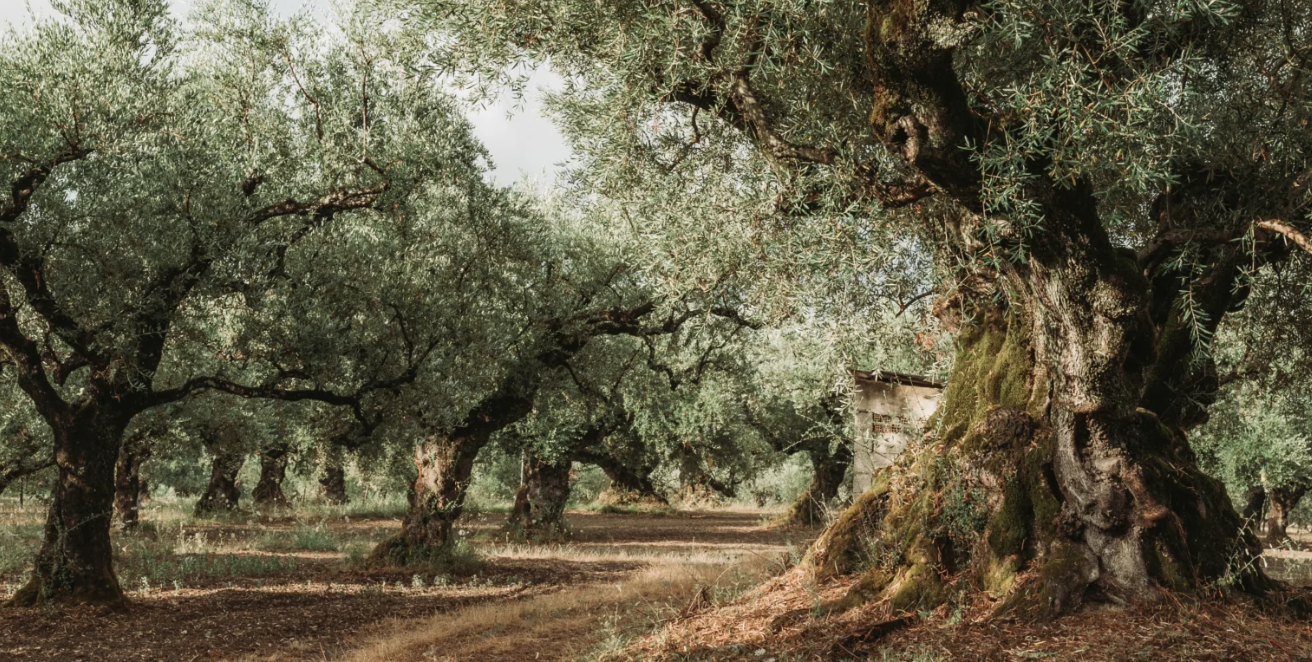
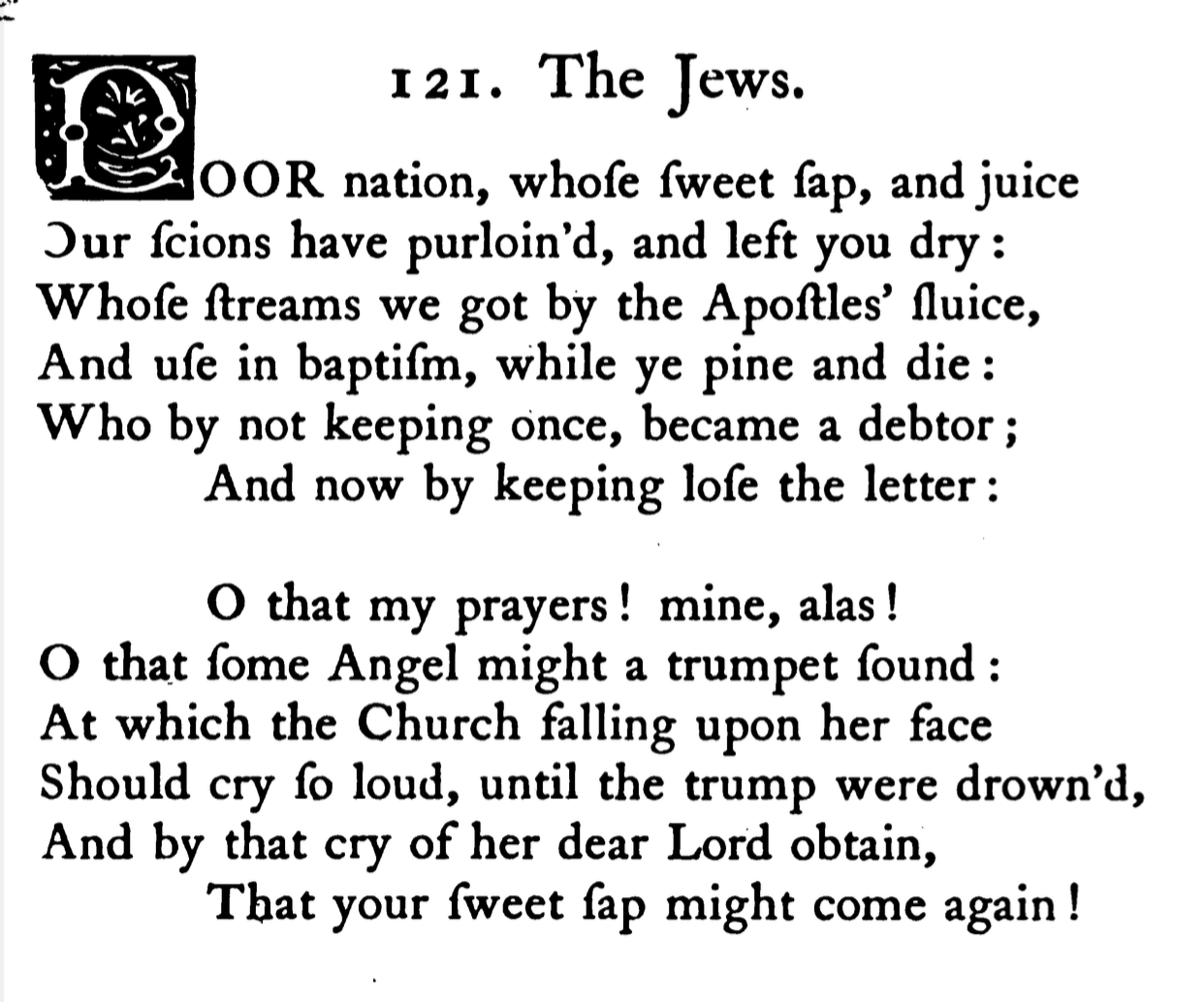
“For if thou wert cut out of the olive tree which is wild by nature, and wert graffed contrary to nature into a good olive tree: how much more shall these, which be the natural branches, be graffed into their own olive tree” (Romans 11:24). This poem of Herbert beautifully and tenderly expresses the right attitude of the believing Gentiles toward the disinherited Jews, with Pauline longings for their final restoration by repentance and faith in their own, rejected Messiah.

1. scion: a young shoot or twig of a plant, especially one cut for grafting or rooting. 2. purloin: to steal. 3. sluice: a sliding gate or other device for controlling the flow of water, especially one in a lock gate.

Read Full Post »

This message was delivered at the Presbytery Conference of the Presbyterian Reformed Church on June 16, 2022. The audio is available here. Special thanks to Susan Abel for her selfless efforts in transcription!

* * * * *

Isaiah 35:7-10, “And the parched ground shall become a pool, and the thirsty land springs of water: in the habitation of dragons, where each lay, shall be grass with reeds and rushes. And an highway shall be there, and a way, and it shall be called The way of holiness; the unclean shall not pass over it; but it shall be for those: the wayfaring men, though fools, shall not err therein. No lion shall be there, nor any ravenous beast shall go up thereon, it shall not be found there; but the redeemed shall walk there. And the ransomed of the LORD shall return, and come to Zion with songs and everlasting joy upon their heads: they shall obtain joy and gladness, and sorrow and sighing shall flee away.”

Revelation 21:1-3, “And I saw a new heaven and a new earth: for the first heaven and the first earth were passed away; and there was no more sea. And I John saw the holy city, new Jerusalem, coming down from God out of heaven, prepared as a bride adorned for her husband. And I heard a great voice out of heaven saying, Behold, the tabernacle of God is with men, and he will dwell with them, and they shall be his people, and God himself shall be with them, and be their God. Amen, this is the Word of the living God.”

Last month I had the personal privilege of going back to my old stomping grounds—at least, one of them— as a boy. I had not been to Homestead, Florida, just south of Miami, since I was about fourteen years old, not long after my father went to glory. It was a place, notwithstanding the bitterness of the memories of the loss of my father, [that] was overall a time of great delight: many good memories, especially on this particular street. And I am sure my children can tell you, that I would mention the many late nights when we would play a pick-up game of baseball, and take some charcoal and make some bases, and have an awful lot of fun. Well, as we drove up and came into the neighborhood, memories started flooding back—a lot of good memories. And finally I came with my wife to this home, and there it was, largely as I remembered it, although it had a new coat of paint. And much was the same, and much was so very sweet and so very special. I even got to meet the next-door neighbor whom I did remember as a boy (and I got to have a selfie with them!). So it was quite special.

(more…)

Read Full Post »

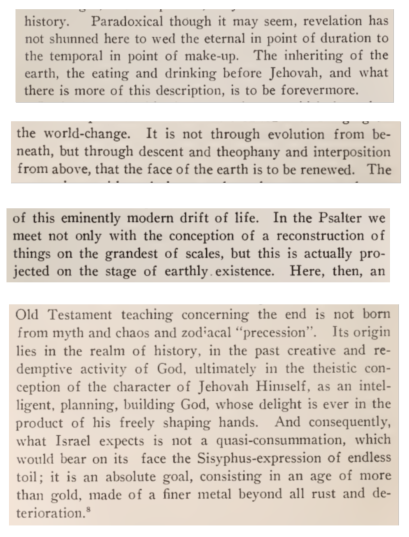
“Thus, then, it is that God is saving the world—the world, mind you, and not merely some individuals out of the world—by a process which involves not supplanting but reformation, re-creation. We look for new heavens and a new earth, it is true; but these new heavens and new earth are not another heaven and another earth, but the old heaven and old earth renewed; or, as the Scriptures phrase it, “regenerated.” For not the individual merely, but the fabric of the world itself, is to be regenerated in that “regeneration when the Son of man shall sit on the throne of his glory” (Matt. 19:28). During the process, there may be much that is discarded. But when the process is completed, then also shall be completed the task which the Son of Man has taken upon himself, and the “world” shall be saved—this wicked world of sinful men transformed into a world of righteousness.”

“Surely, we shall not wish to measure the saving work of God by what has been already accomplished in these unripe days in which our lot is cast. The sands of time have not yet run out. And before us stretch, not merely the reaches of the ages, but the infinitely resourceful reaches of the promise of God. Are not the saints to inherit the earth? Is not the re-created earth theirs? Are not the kingdoms of the world to become the kingdom of God? Is not the knowledge of the glory of God to cover the earth as the waters cover the sea? Shall not the day dawn when no man need say to his neighbor, “Know the Lord,” for all shall know him from the least unto the greatest?”

-Warfield, “God’s Immeasurable Love”

-Vos, “Eschatology of the Psalter”

Read Full Post »

XIV. The rest of God, from the work of the creation, was a type of a far more glorious rest of God from the work of the glorification of the whole universe. When God had created the first world, so as to be a commodious habitation for man during his probation, and an illustrious theatre of the perfections of the Creator; he took pleasure in this his work, and rested with delight. For he bestowed upon it all the perfection which was requisite to complete that state. But he had resolved, one day, to produce a far more perfect universe, and, by dissolving the elements by fire, to raise a new heaven and a new earth, as it were, out of the ashes of the old: which new world, being blessed with his immutable happiness, was to be a far more august habitation for his glorified creatures; in which, as in the last display of his perfections, he was for ever to rest with the greatest complacency. And besides, as God, according to his infinite wisdom, so wisely connects all his actions, that the preceding have a certain respect to the following; in like manner, since that rest of God after the creation was less complete than that other, when God shall have concluded the whole, and which is to be followed by no other labour or toil; it is proper to consider that first rest of God as a type, and a kind of prelude of that other, which is more perfect. In fine, because it tends to man’s greatest happiness, that the whole universe be thus glorified, and himself in the universe, that God may altogether rest in him, as having now obtained his last degree of perfection, he is said “to enter into the rest of God,” Heb. 4:10.

(more…)

Read Full Post »

God’s design was perfectly to restore all the ruins of the fall, so far as concerns the elect part of the world, by his Son; and therefore we read of the restitution of all things. Acts 3:21, “Whom the heaven must receive, until the times of the restitution of all things; and of the times of refreshing from the presence of the Lord Jesus.” Acts 3:19, “Repent ye therefore and be converted, that your sins may be blotted out, when the times of refreshing shall come from the presence of the Lord.”

Man’s soul was ruined by the fall; the image of God was defaced; man’s nature was corrupted, and he became dead in sin. The design of God was, to restore the soul of man to life and the divine image in conversion, to carry on the change in sanctification, and to perfect it in glory. Man’s body was ruined; by the fall it became subject to death. The design of God was, to restore it from this ruin, and not only to deliver it from death in the resurrection, but to deliver it from mortality itself, in making it like unto Christ’s glorious body. The world was ruined, as to man, as effectually as if it had been reduced to chaos again; all heaven and earth were overthrown. But the design of God was, to restore all, and as it were to create a new heaven and a new earth: Isa 65:17, “Behold, I create new heavens, and a new earth; and the former shall not be remembered, nor come into mind.” 2 Pet 3:13, “Nevertheless we, according to his promise, look for new heavens, and a new earth, wherein dwelleth righteousness.”

The work by which this was to be done, was begun immediately after the fall, and so is carried on till all is finished, when the whole world, heaven and earth, shall be restored. There shall be, as it were, new heavens, and a new earth, in a spiritual sense, at the end of the world. Thus it is represented, Rev 21:1, “And I saw a new heaven, and a new earth; for the first heaven and the first earth were passed away.”

[from A History of the Work of Redemption]

Read Full Post »

Geerhardus Vos, Reformed Dogmatics, vol. 5. “In Scripture symbolism the grave is the gateway to hell. Accordingly, Sheol in the one sense is the anteroom of Sheol in the other sense.”

Herman Bavinck, Reformed Dogmatics, vol. 4

Read Full Post »

Just finished recording the lengthy chapter “The Biblical Argument” in W. G. T. Shedd’s theological treatise, The Doctrine of Endless Punishment. Truly the definitive modern work on the subject. Listen to them here. Among other insightful and profound passages is the following on the apocalyptic, revelatory nature of death:

“. . . in Scripture death is represented as the deciding epoch in a man’s existence. It is the boundary between the two Biblical aeons, or worlds. Until man dies, he is in ‘this world’ (ho nun aion); after death, he is in ‘the future world’ (aion ho mellon). The common understanding of the teaching of Scripture is, that men are in ‘time,’ so long as they live, but when they die, they enter ‘eternity.’ ‘It is appointed unto men once to die, but after that judgment,’ Heb. 9:27. This teaches that prior to death man’s destiny is not decided, he being not yet sentenced; but after death his destiny is settled. When he dies, the ‘private judgment,’ that is, the immediate personal consciousness either of penitence or impenitence, occurs. Every human spirit, in that supreme moment when it ‘returns to God who gave it,’ knows by direct self-consciousness whether it is a child or an enemy of God, in temper and disposition; whether it is humble and contrite, or proud, hard, and impenitent; whether it welcomes or rejects the Divine mercy in Christ. The article of death is an event in human existence which strips off all disguises, and shows the person what he really is in moral character. He knows ‘as he is known,’ and in this flashing light passes a sentence upon himself that is accurate. This ‘private judgment’ at death, is reaffirmed in the ‘general judgment’ of the last day.”

Read Full Post »

Older Posts »