The following was an excellent article by Michael Foster on a wise and very pastoral approach to conspiracy theories and conspiratorialism. Shrewd. Especially appreciate the “80/20” guideline.
* * * *
From the time I was a kid, my mind ran toward the strange and the shadowy corners of the world. I ate up Arthur C. Clarke’s Mysterious World and Leonard Nimoy’s In Search Of. Later it was Unsolved Mysteries and Sightings. But it wasn’t just TV. Back when the library was the closest thing we had to the internet, I practically lived in it. I checked out any oddball book I could find. By twelve I had already plowed through Erich von Däniken, and a year later I grabbed Graham Hancock’s first book. Ancient aliens, lost civilizations, Bigfoot, alternate histories, you name it, I read it. Probably more than anyone else I knew.
By high school, I loved batting around theories about JFK, the moon landing, and Roswell. Stuff people talk about casually today in a post–Joe Rogan world, but back then you had to go hunting for it.
As Reformed people, we are deeply committed to the covenant. We have a solemn responsibility to our children—who after all are not ours, but the Lord’s. We as parents and as pastors have a sacred trust. As pastors, we require solemn vows of parents as they present their covenant children for holy baptism. As parents, we take those public vows in deep, humble gratitude for the manifold grace of God in ‘spreading His skirt over our little ones.’ With faith, we lay hold of the gracious promise, yet with a real trembling for the stewardship that is ours to raise them up in the “fear and admonition of the Lord.”
And yet, while our covenant-tradition is clothed with solemnity and gravitas, the lighter side of life shines through (or, it ought to!) as we endeavor to light the flame of faith in our children. There is a place for play; and, in fact, there is great promise in it. I’m increasingly convinced after twenty years of pastoring, twenty-five years of parenting, and now almost two years of grand-parenting, that one major ingredient of parenting and, yes, even pastoring, involves play. And I believe this is all the more vital in small, first- and second-generation Reformed and Presbyterian churches who lack the longevity of larger multi-generational churches. The margins are smaller and the risk of losing our children greater. Especially in our circles, the imperative to do all we lawfully can to create a home and church environment where our covenant children will naturally want to profess faith, commune, marry, bear children, and put down deep roots in our rootless world.
But whether your church is large or small and your subculture more fragile or more robust, these children are still ‘ours to lose.’ Yes, the Holy Spirit must regenerate. Enculturation is a barren womb without free and sovereign grace. But our responsibility, in giving and taking baptismal vows, is not just to catechize and keep good order in home and church. We may and must, if I may put it this way, “win” our children winsomely. And so I say, let us play.
Once again, good material from Timon Cline. The original address on which he comments is pretty interesting as well, though Timon rounds things off so as not to dismiss all legitimate interest by the commonwealth on the national birthrate.
“Is the decline of reading making American politics dumber?” The opening piece is so tragic; and it bodes very ill for America if things are not reversed. Christians, you who are “salt and light,” resist the great dumbing down! Take up and read!
I often listen to the Christian news podcast, The World and Everything in It. It’s basically a reformed-ish version of NPR, and produced by the same folks who publish World magazine. I highly commend it (my only quibble being the quasi-benediction at the end of each episode).
There was a really great segment this morning with their regular “Monday Moneybeat” with David Bahnsen. It was an excellent treatment of the masculine malaise of younger men in the U.S.A. and their economic underperformance. Perhaps the most impactful quote for me was “employable men are marryable and marryable men are employable.” Standing ovation! Listen to the episode here; the segment begins at 22:10, and the transcript is below.
* * * * *
MARY REICHARD, HOST: Coming up next on The World and Everything in It: The Monday Moneybeat.
NICK EICHER, HOST: It’s time now to talk business, markets and the economy with financial analyst and advisor David Bahnsen. David heads up the wealth management firm the Bahnsen Group, and he is here now. Good morning to you.
DAVID BAHNSEN: Good morning, Nick, good to be with you.
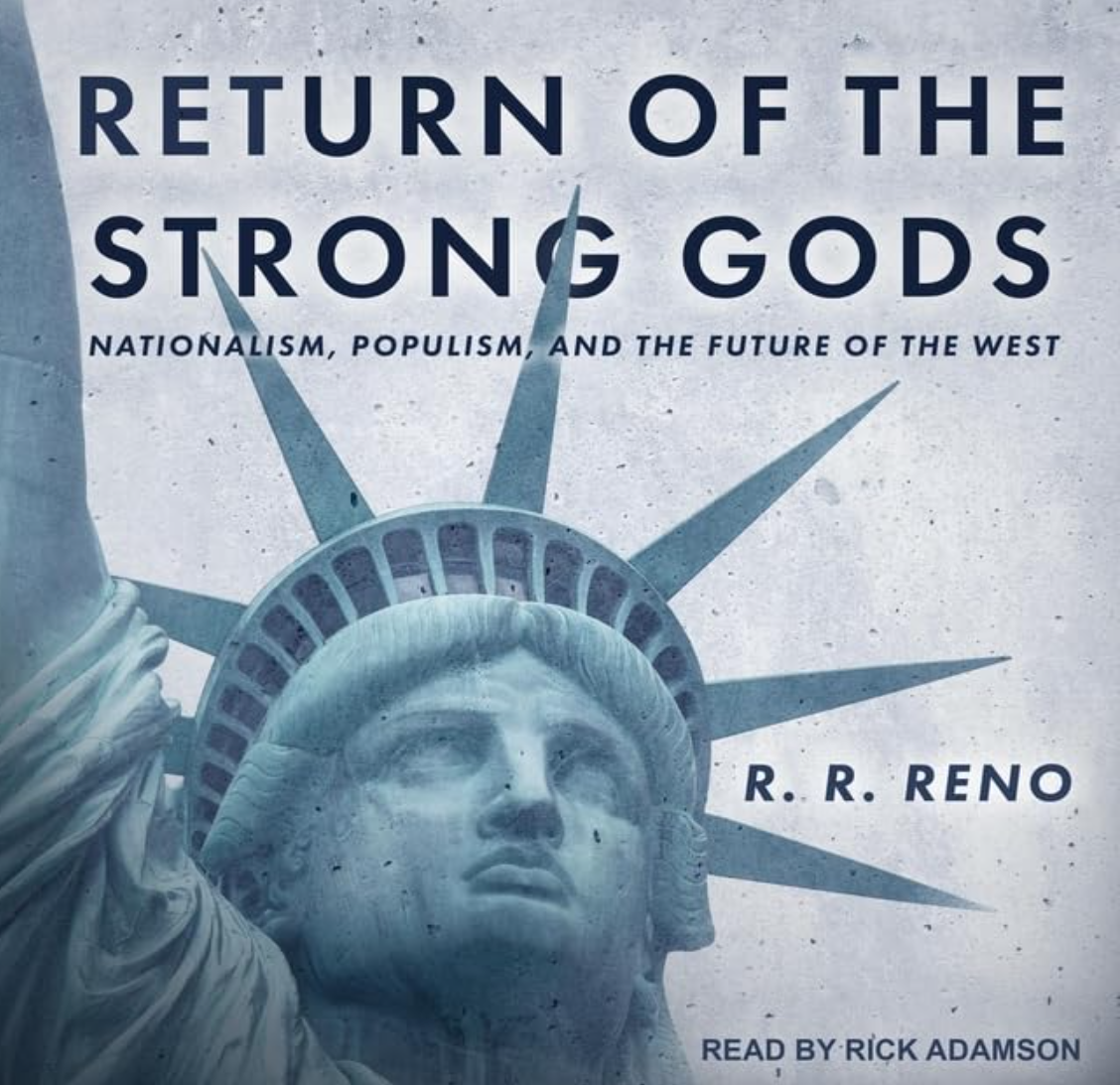
In the last few months, I finished a couple of really insightful non-fiction titles. The first was R. R. Reno’s The Return of the Strong Gods: Nationalism, Populism, and the Future of the West. This was the most helpful overview of what the “post-war consensus” (PWC) actually is and why it is on life support if not in its death pangs. Basically, the PWC was birthed in the aftermath of World War II and the horrors both on the battlefield and in the concentration camps. “Never again!” was the motto in Europe and the U.S., and the modus operandi of the elites was to tamp down on all discourse—religious, political, or social—that could elevate the blood pressure of the nations and so risk a reprise of the world wars. Liberalism in the broader sense of tolerance, acceptance, and openness, was the prevailing doctrine. But what it ended up doing was fueling the populisms and nationalisms we have witnessed in the last decade or so. In the end, we are humans who need “strong loves.” Something to be passionate about—and even die for!
Birth rates are plummeting in the United States and globally, forecasting a political and financial crisis. The most recent estimate predicts the average American woman will have 1.6 children in her lifetime, far below the rate of 2.1 required to maintain a steady population and even further below the 2.5 rate observed in the United States as recently as 1970.
Many cultural and technological factors have contributed to this dramatic decline, and public policies play a role in shaping people’s decisions about whether to have children and how many. Finding the right policy levers for influencing fertility rates, however, has proven very difficult.
I found this an able and persuasive rejoinder to Michael Spangler’s extreme kinism. Vogel is responding to a series of articles originally posted here. In my armchair studies of Christian nationalism, kinism, and the postwar consensus critique, there is quite a range of opinion: the good (or at least, acceptable), the bad, and the ugly. One thing is for sure: Spangler doesn’t fall within the first. Mark him, and avoid him.
A couple of good articles here and here, promoting biblical and natural-law views of women, motherhood, and childbearing contra feminism. I have tremendously little knowledge of Taylor Swift or her music; but the analysis from someone who does only confirms my suspicions and that Swift is a tragic symbol of feminism’s Faustian bargain.
On the other side of the gender coin is this article. I’ve never read this author before, but he definitely strikes a chord with me about a prescription for solid, biblical masculinity with a healthy, and distinctly Protestant embrace of church tradition:
This was very, very good. Especially in light of a resurgent antisemitism in the West, and even in the Church. Remember, Satan’s grand conspiracy is multi-front. And the Jews, while “enemies for our sakes,” are yet “beloved for the fathers’ sakes.”