Feeds:
Posts
Comments

Archive for the ‘Connectionalism & Conciliarism’ Category

“Christ is a drawing and an uniting Spirit; then all that are in Christ should be united. Certainly the divisions now in Britain cannot be of God. The wolf and the good Shepherd are contrary in this; the good Shepherd loves to have the flock gathered in one, and to save them, that they may find pasture, and the flock may be saved: the wolf scatters the flock; or if the wolf would have the flock gathered together, it is that they may be destroyed. Then it would be considered, if a bloody intention of war between two protestant kingdoms, for carnal ends, and upon forced and groundless jealousies, be from an uniting Spirit, and not rather from him, who was a murderer from the beginning.”

For a good, one-chapter introduction to the historic Scottish Presbyterian views of visible Church union or ‘catholicity,’ have a listen to “Church Unity & the Sin of Schism,” by John Macpherson, in his Doctrine of the Church in Scottish Theology.

* * * *

Whole doctrine catholicity | “Who is she that looketh forth as the morning, fair as the moon, clear as the sun, and terrible as an army with banners” (Song 6:10)?

Read Full Post »
Micro-presbyterians study hard to get things right. We dot our i’s and cross our t’s. And yet for all our learning, we can miss some pretty big things—in fact, some pretty big presbyterian things. Church-planting would definitely be one of them.

I speak from experience. For nearly the entirety of my 29-year Reformed career, I’ve been a ‘micro-presbyterian.’ I skipped the 1689 thing, past the (relatively) big-tent Reformed bodies, going straight into the Presbyterian Reformed Church, a very small psalm-singing body formed in 1965. I rather distaste the term ‘micro-presbyterian,’ especially with its connotations of over-scrupulosity and cantankerousness; and, the term may be a little dated. But in any case, God put me here, and I love my denomination. (And getting a gorgeous wife and elder’s daughter out of deal didn’t hurt either!).

I also think it has come a long way over the years. I feel that we have matured simultaneously, from a kind of cage-stage to something more balanced, stable, and seasoned. It has also helped, quite frankly, that we decided to join NAPARC some years back. Sure, it made us a pariah with many who might otherwise have sought us out. But often, those very types would never be happy in any case until they were safe in the embrace of an ecclesiastical micromanager or worshipping every Lord’s day in their own living-room.

I know we all have learned the hard way from many mistakes, missteps, and quite frankly, sins. “In many things, we offend all.” While we cannot deny the light that the Lord has graciously shown us, but embrace and follow on in it; while we cannot but press forward to the higher and better attainments of the First and Second Reformations and maintain them with diligence and zeal, we must also humbly acknowledge where we have mixed holy with unholy fire, and where we have in fact justified means by ends. Sometimes in our earnestness for truth we have cut corners; sometimes we’ve cut far more than just corners. But two wrongs do not make a right. And we may never “do evil that good may come.”

(more…)

Read Full Post »

The following is taken from J. C. Ryle’s exposition of John 3:22-36.

“On one account, this passage deserves the special attention of all devout readers of the Bible. It contains the last testimony of John the Baptist concerning our Lord Jesus Christ. That faithful man of God was the same at the end of his ministry that he was at the beginning. the same in his views of self–the same in his views of Christ. Happy is that church whose ministers are as steady, bold, and constant to one thing, as John the Baptist!

“We have, firstly, in these verses, a humbling example of the petty jealousies and party-spirit which may exist among professors of religion. We are told, that the disciples of John the Baptist were offended, because the ministry of Jesus began to attract more attention than that of their master. ‘They came unto John, and said unto him, Rabbi, he that was with you beyond Jordan, to whom you barest witness, behold the same baptizes, and all men come to him.’

“The spirit exhibited in this complaint, is unhappily too common in the Churches of Christ. The succession of these complainers has never failed. There are never lacking religions professors who care far more for the increase of their own party, than for the increase of true Christianity; and who cannot rejoice in the spread of religion, if it spreads anywhere except within their own denomination. There is a generation which can see no good being done, except in the ranks of its own congregations; and which seems ready to shut men out of heaven, if they will not enter therein under their banner.

“The true Christian must watch and pray against the spirit here manifested by John’s disciples. It is very insidious, very contagious, and very injurious to the cause of religion. Nothing so defiles Christianity and gives the enemies of truth such occasion to blaspheme, as jealousy and party-spirit among Christians. Wherever there is real grace, we should be ready and willing to acknowledge it, even though it may be outside our own pale. We should strive to say with the apostle, ‘If Christ be preached, I rejoice, yes! and will rejoice’ (Phil. 1:18.). If good is done, we ought to be thankful, though it even may not be done in what we think the best way. If souls are saved, we ought to be glad, whatever be the means that God may think fit to employ.”

Read Full Post »

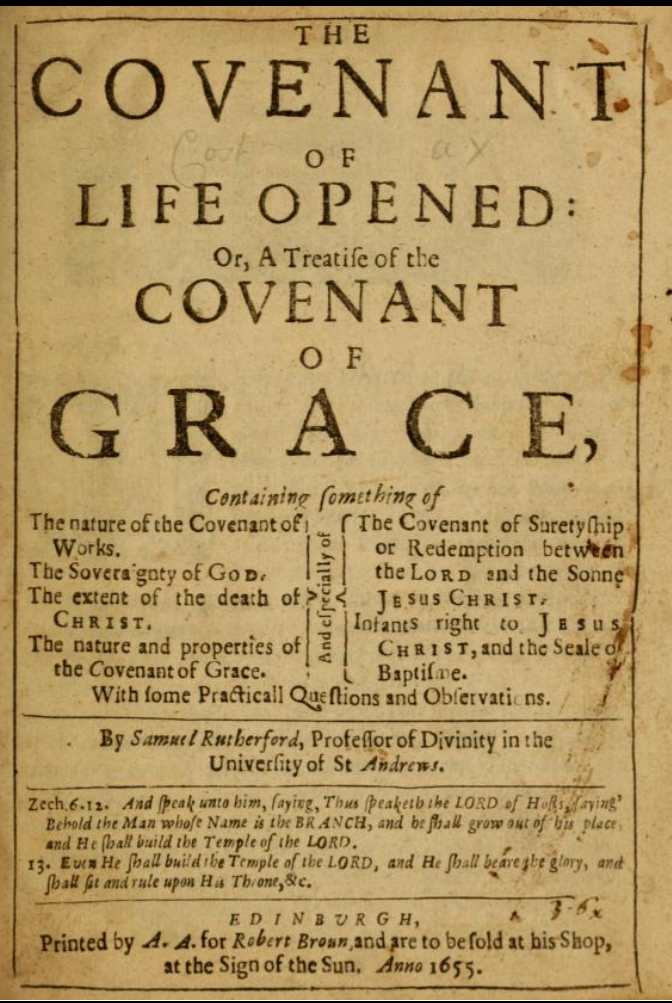
The following two quotes are taken from George Gillespie’s An Assertion of the Government of the Church of Scotland (1641). They seem to me to have a bearing on the question of the ‘indigenous principle’ that our denomination, the Presbyterian Reformed Church, has advocated since its inception in 1965. That is, presbyterian churches ought ideally to develop their own nationally autonomous bodies distinct from others outside their borders; or, trans-national denominations, especially when ‘centered’ in one particular nation, should be avoided or superseded as impractical, and liable to hierarchicalism or a kind of church-imperialism. These quotes in particular demonstrate that historic presbyterianism, while holding out a gradation of church courts, nevertheless accepts as valid smaller and even the smallest church units when circumstances on the ground prevent more.

“Add unto these a distinction betwixt a congregation lying alone in an island, province or nation, and a congregation bordering with sister churches. If either there be but one congregation in a kingdom or province, or if there be many far distant one from another, so that their pastors and elders cannot ordinarily meet together, then may a particular congregation do many things by itself alone, which it ought not to do where there are adjacent neighbouring congregations, together with which it may and should have a common presbytery” (43).

(more…)

Read Full Post »

A tremendous, two-part treatment that anyone identifying with historic Presbyterian should read by my friend, Matthew Vogan.

* * * *

Whole doctrine catholicity | “Who is she that looketh forth as the morning, fair as the moon, clear as the sun, and terrible as an army with banners” (Song 6:10)?

Read Full Post »

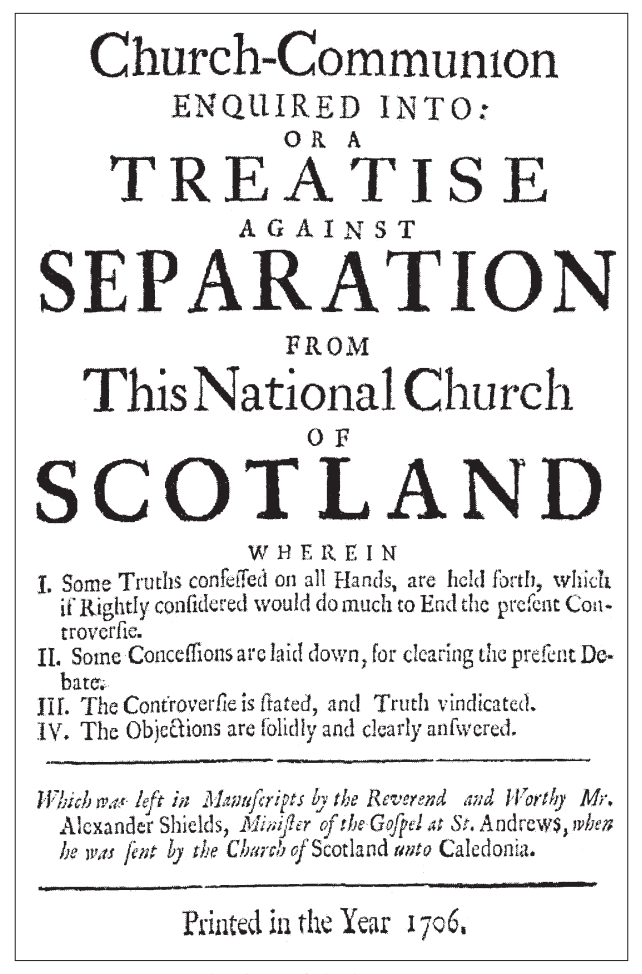
Just finished reading and recording Alexander Shield’s Church Communion Inquired Into (1706). Listen to it here, or read it below. This treatise is such a highwater-mark of classic Presbyterianism, with particular focus on the visible unity of the Church of Christ. It was his heartfelt, pastoral appeal to his brethren who refused to enter the Revolution Church of 1690 on account of its putative corruptions, urging them to reconsider their separation. It is not the easiest of reads, for sure, as it was written in the midst of controversy, among other things. But it is a definitive work on Presbyterian catholicity, right after James Durham’s On Scandal. Here is a very moving appeal from his conclusion:

“Keep your Zeal lively against all sin, but let it have two edges, to resent the Dishonour done to God, by Schism as well as defection; let it be Ballanced with Charity, and managed with Discretion. And we request you, that you study Uniformity in your Zeal, that you be not like Cake unturned, hot for some lesser Points in Religion, and cold for other Duties, but with a regular Proportion to their Concern in the Vitals of Religion. Let Religion be more in your Heart than Head, in Practice than in Controversie. Neglect not the Duties of your General Calling of Piety towards God, Sobriety in your selves, Righteousness and Mercy to Men, Brotherly Love, and Holy Christian Fellowship; And forget not the relative Duties of your particular Callings. Have a care of the Idleness of busy Bodies. 1 Thess. 4.11. But study to be quiet, and do your own business, and to work with your own hands. Beware of them that cause Divisions and Offenses, and avoid them. And look on them that blow the Bellows of Contention as no Friends to your or the Church’s Interest. Finally, study to be United one with another, and with your Pastors make Acquaintance, and entertain frequent and Friendly Converse with them, receive the Law at their Mouth, for they are the Messengers of the Lord of Hosts: Grieve them not by your Contempt, or continued Withdrawing, lest they be put to Complain of you to God, and it become Sin unto you.”

Here is a summary of the author by Matthew Vogan: “Alexander Shields (1660?–1700) is less well known than other field preachers such as Donald Cargill, Richard Cameron, and James Renwick. One of the last of the field preachers and a close associate of James Renwick, he was also a prisoner on the Bass Rock. He was a prolific writer and ably defended the Covenanter principles in the classic book A Hind Let Loose. After the Revolution of 1689, he was chaplain to the Cameronian regiment fighting against France in defence of Holland and the Protestant cause. In 1699, he was also among the first foreign missionaries of the Church of Scotland in the infamous Darien venture to what is now known as Panama. He died and was buried in Jamaica in 1700 at the age of forty. John Macleod well describes him as ‘one of the most striking figures of his epoch’. The life of this zealous young man is uniquely interesting and instructive.” Learn more about Shields and this treatise in Vogan’s two-part article, “Alexander Shields, the Revolution Settlement and the Unity of the Visible Church” (2013).

Whole doctrine catholicity | “Who is she that looketh forth as the morning, fair as the moon, clear as the sun, and terrible as an army with banners” (Song 6:10)?

Listen to other titles at WPE Audio

* * * *

Whole doctrine catholicity | “Who is she that looketh forth as the morning, fair as the moon, clear as the sun, and terrible as an army with banners” (Song 6:10)?

Read Full Post »
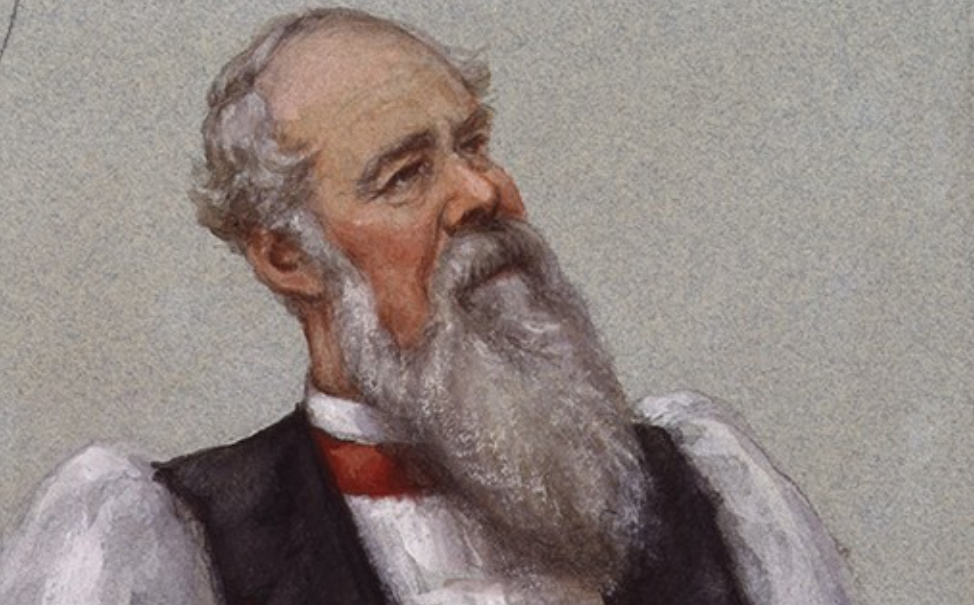
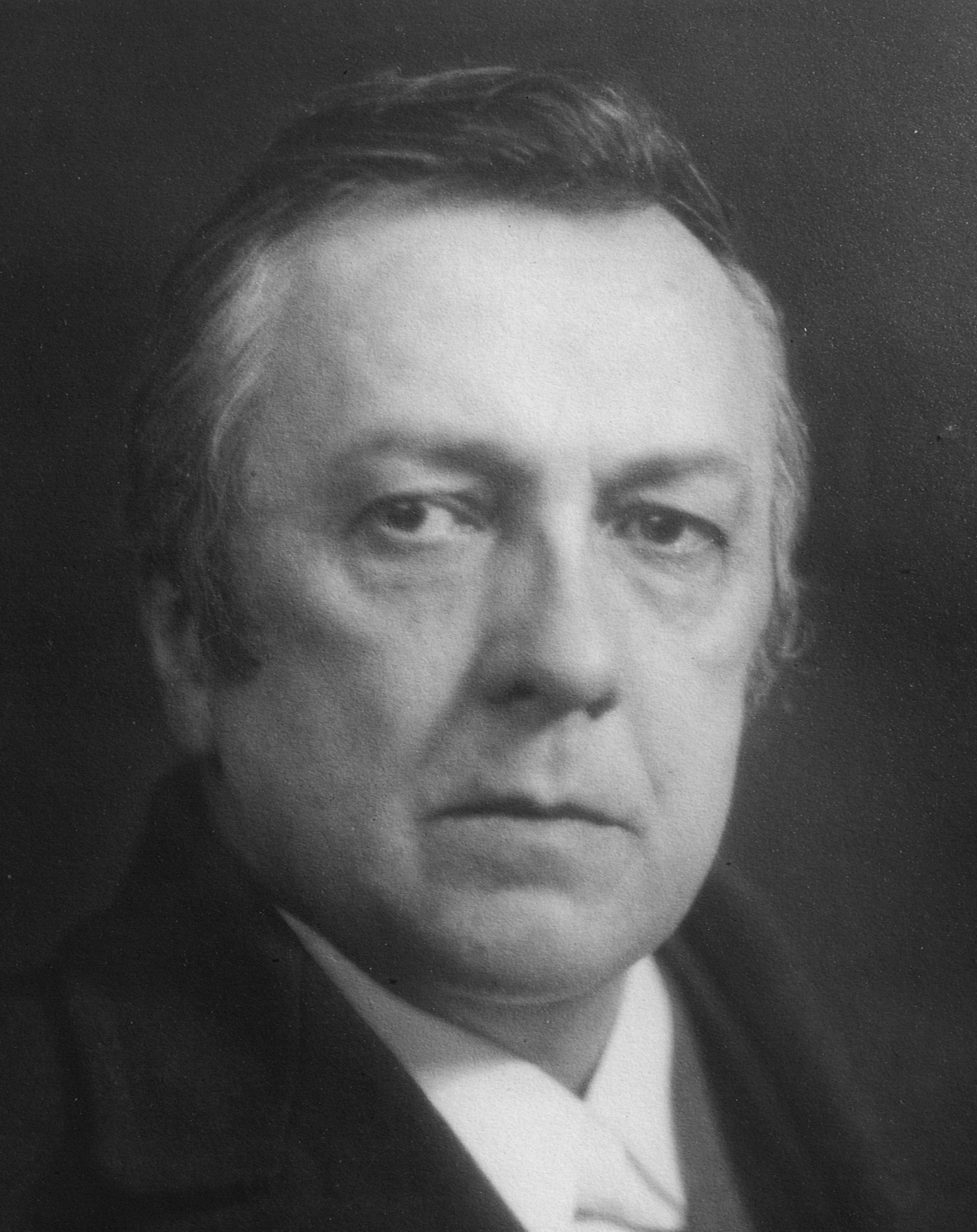
Just finished recording this masterful article by Principle John Macleod (1872-1948) of the Free Church of Scotland. While it is somewhat encumbered by historical details less familiar to the American reader, it is still a fresh, perceptive, and prophetic appeal for the old adherence to full, good faith subscription to the Confession of Faith. If you’re a historic Presbyterian belonging to or respectful of the old Church of Scotland and Free Church testimonies, you owe it to yourself. The PDF of the article is below; and here is a ‘handful of purpose’:

“The Churches of Scotland were unprepared for the day that had overtaken them. In their halting uncertainty they suffered a tendency that was inimical to their historical faith to effect a lodgment in their bosom. They lost sight of the essential simplicity of the Christian position- “Heaven’s easy artless unencumbered plan.” When John tells us that he wrote his Gospel that we might believe that Jesus is the Christ, the Son of God and that believing we might have life through His Name he thought the witness borne by his fellows and himself to be ground enough for the faith of Christians to build upon. Christian faith through the ages has responded to this claim. It was the claim not only of the Apostle but of the Holy Ghost who spoke in him. It is undoubtedly the mind of the Spirit that the evidence which He thus bore to the truth as it is in Jesus should suffice for the Church of God to the end of time and to the ends of the earth. What was thus in the Gospels claimed by the Apostles for the witness that they bore they claimed for their teaching in the Epistles. They spoke not in the words which man’s wisdom teaches but which the Holy Ghost teaches. They could say, ‘We are of God: he that knoweth God heareth us; he that is not of God heareth not us.’ Such claims were in full keeping with the promises given to them in the Upper Chamber. There has been from the beginning a Holy Catholic Church -define it how we may- to whose care and keeping the New Testament books were committed and from whose hands in successive generations her children have received them as being alike in their witness and in their teaching the crystallised and perpetuated ministry of the Apostles. As many as are willing to sit at their feet, as they thus continue to bear witness and to teach, will learn to treat the Old Testament. Scriptures as the Lord and His Apostles did. Here we have the common view of Holy Writ held throughout historical Christendom. On this view the whole structure of Christian Theology is built. To maintain the superstructure we must defend the substructure.”

Check out my growing audio library here.

* * * *

Whole doctrine catholicity | “Who is she that looketh forth as the morning, fair as the moon, clear as the sun, and terrible as an army with banners” (Song 6:10)?

Read Full Post »

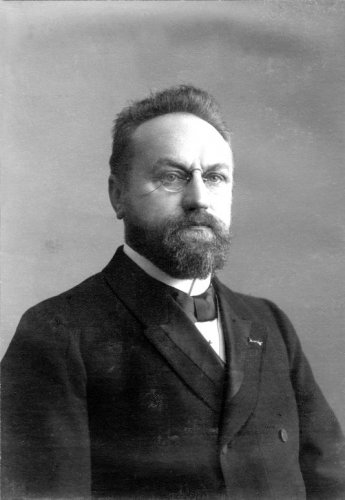
​”The rise of sectarianism that has accompanied the Protestant movement is a dark and negative phenomenon. It manifested itself already at the beginning of the Reformation, but it has never flourished as it has in our age. New church after new church is established. In England there are already more than two hundred sects. In America they are innumerable. The differences have become so many and so insignificant that one cannot keep track of them. There are even voices arguing for a new discipline in theology itself devoted to the comparative history of church confessions. What is even more serious is that this sectarianism leads to the erosion and disappearance of church consciousness. There is no longer an awareness of the difference between the church and a voluntary association. The sense that separation from the church is a sin has all but disappeared. One leaves a church or joins it rather casually. When something or other in a church no longer satisfies us, we look for another without any pangs of conscience. The decisive factor turns out to be our taste. Exercise of discipline thus becomes virtually impossible; it loses its very character. What preacher is left who dares, in good conscience, except perhaps in extremely rare instances, to use the form for excommunication? The worst result of all this is that by breaking the unity of doctrine and the church, Christians do violence to the communion of saints, deprive themselves of the Spirit’s gifts of grace, by which  other believers labor to build up the saints, shut themselves up in their own circle, promote spiritual pride, strengthen Rome, and give the world occasion for scorn and mockery.”

-Herman Bavinck, “The Catholicity of Christianity and the Church”

Read Full Post »

It is very common for professing Christians to draw a distinction between essentials and non-essentials in religion, and to infer that, if any fact or doctrine rightly belongs to the latter class, it must be a matter of very little import­ance, and may in practice be safely set at naught. The great bulk of men take their opinions on trust; they will not undergo the toil of thinking, searching, and reasoning about anything, and one of the most usual expedients adopted to save them the trouble of inquiry, and to turn aside the force of any disagreeable fact, is to meet it by saying, ”The matter is not essential to salvation; therefore we need give ourselves little concern on the subject.”

If the distinction here specified is safe, the inference drawn from it is certainly dangerous. To say that, because a fact of Divine revelation is not essential to salvation, it must of necessity be unimportant, and may or may not be received by us, is to assert a principle, the application of which would make havoc of our Christianity. For, what are the truths essential to salvation? Are they not these: That there is a God; that all men are sinners; that the Son of God died upon the cross to make atonement for the guilty; and that whosoever believes on the Lord Jesus Christ shall be saved? There is good reason for believing that not a few souls arc now in happiness, who in life knew little more than these—the first principles of the oracles of God—the very alphabet of the Christian system; and if so, no other Divine truths can be counted absolutely essential to salvation. But if all the other truths of revelation are unimportant, because they happen to be non-essentials, it follows that the Word of God itself is in the main unimportant; for by far the greatest portion of it is occupied with matters, the knowledge of which, in the case supposed, is not absolutely indispensable to the everlasting happiness of men. Nor does it alter the case, if we regard the number of fundamental truths to be much greater. Let a man once persuade himself that importance attaches only to what he is pleased to call essentials, what­ever their number, and he will, no doubt, shorten his creed and cut away the foundation of many controversies; but he will practically set aside all except a very small part of the Scriptures. If such a principle does not mutilate the Bible, it stigmatizes much of it as trivial. Revelation is all gold for preciousness and purity, but the very touch of such a principle would transmute the most of it into dross.

Read the entire treatise, Which is the Apostolic Church?, by Thomas Witherow, below. Or, listen to an audio version here.

Read Full Post »

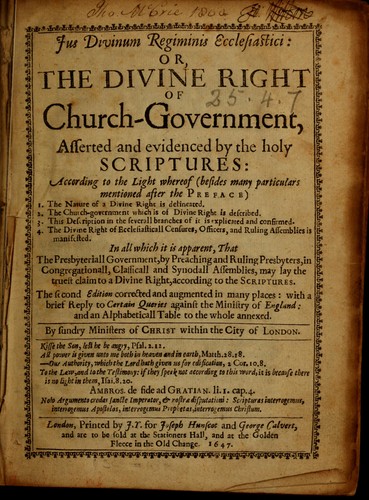
Listen to this classic work of Presbyterian church government written by London divines at the time of the Westminster Assembly. But fair warning: not for the faint of heart! But if you’re a thinker and would like to learn as you go, let me do the reading for you. [Project in progress.]

“Arguably the best biblical defenses of presbyterian ecclesiology and explanations of its polity were produced in the seventeenth century. Among these, none has a reputation better than an English work with the Latin title Jus Divinum Regiminis Ecclesiastici, with the English subtitle The Divine Right of Church Government. In three successive editions, two of which were penned during the time that the Westminster Assembly met, ‘sundry’ London ministers laid out their case. In the first part of the book they demonstrate that there is a government of the church established and revealed by God. In the second part of the book they describe that government, explain its benefits to God’s people, and further develop the biblical and theological justifications for presbyterianism.

Chris Coldwell’s new edition of this classic work will prove a most welcome addition to the Presbyterian minister’s or even church member’s bookshelf. The entire book was addressed to people who were not yet persuaded regarding the merits of presbyterian church government. It hardly needs to be said that such an audience has only expanded in the Christian world and that many people could benefit from understanding a principled form of church government rather than ones where leaders (or members) make it up as they go along. This critical edition is almost a third longer than earlier abridged versions. It offers David Noe’s translations of Latin material and a thoughtful introduction. The edition also evidences Coldwell’s careful editorial work and successful sleuthing, in some cases solving puzzles that have stumped historians for centuries. Editor, subscribers, and publisher are to be thanked for this invaluable scholarly contribution.” 

— Chad Van Dixhoorn, editor of The Minutes and Papers of the Westminster Assembly 1643–1652

Read Full Post »

« Newer Posts - Older Posts »