Feeds:
Posts
Comments

Archive for the ‘Communion of the Saints’ Category

“The PASTOR procureth the peace of the kirk by following after the things which make for peace; Rom .xiv.; for by the discipline and assemblies of the kirk he preserveth verity, without which there is either no unity, or such unity as is but a conspiracy, and resisteth heresy, the mother of the greatest divisions. So long as our assemblies had their liberty, there could arise no heresy among us; if it had broken out in a parish, a consistory or presbytery would have borne it down; or if it had proceeded further, then the synod, or if it had not been able, the national assembly, would have suppressed it. For the same reason the Kirk of France, which was nearest to ours, hath been free of heresy. In the low countries, if the kirks had enjoyed the liberty of their assemblies, which they wanted for a long time, Arminianism had neither troubled them nor their neighbours. He never can find in his heart to urge or enforce unprofitable and untimely ceremonies upon the kirk, if it were for no other cause but that they have been the apples of contention, and the cause of many schisms, and will choose rather, with Jonah, to redeem the quietness and safety of the kirk with the loss of himself, than for his own particular ends to raise the smallest tempest that may peril her peace; he carrieth himself no otherwise in his ministry than becometh the humble servant of the kirk, and feareth to be affected with Diotrephes’ ambitious humour of aspiring above his brethren, which is a special preservative of peace: he studieth to preserve holiness, without which there can be no sound nor wholesome peace; he is ever at war with that which is contrary to holiness, and sendeth away all scandalous livers with the workers of iniquity, that peace may be upon the Israel of God, Psal. xxv.”

David Calderwood, The Pastor & the Prelate (1628)

Read Full Post »

“In the second place, the principles laid down demonstrate the evil of schism, or of causeless separation in the Church. The visible Church of Christ was intended by Him to be catholic and one; and notwithstanding of the dissemination far and wide throughout the world of the separate societies of professing Christians, it would be one in reality, as comprehending all and uniting all, were it not for the sinful infirmities of its members. That can be no light offence which gives to the one kingdom of God in this world the appearance of a kingdom divided against itself, and liable to fall. It were impossible, indeed, to deny that there may be real and sufficient ground for separation from some particular local Church. That a particular Church may itself apostatize from the faith, or be guilty of imposing upon its members terms of communion, to comply with which would be sin, there cannot be a doubt; and in such a case separation becomes a duty to be discharged, and not an offence to be avoided. But in separating in such circumstances from the Church, the schism lies not with the parties who separate, but with the Church that compels and causes the separation. In thus going forth from it, we maintain, in fact, rather than infringe on the higher unity of the one Church of Christ. But for parties to separate wantonly, and on insufficient grounds, from the communion of the visible Church, is a grave and serious offence against the authority of Christ in His house. To go out from the communion of the visible Church, and to widen its breaches wilfully, and for trivial reasons, is to set ourselves against the desire and design of Christ that His kingdom in this world should be catholic and one. And when schism is aggravated by the permanent abandonment of a Church profession and Church state,—when causeless separation from any one Church of Christ is followed by the disavowal of all,—when the outward profession that makes a man a member of the visible Church is cast off, and all Christian fellowship is disowned, the guilt incurred is of a ruinous kind.” ” The visible Church,” says the Confession of Faith,” is the house and family of God, out of which there is no ordinary possibility of salvation” (emphasis mine).

James Bannerman, The Church of Christ

* * * *

Whole doctrine catholicity | “Who is she that looketh forth as the morning, fair as the moon, clear as the sun, and terrible as an army with banners” (Song 6:10)?

Read Full Post »

“Did believers in the Lord Jesus more frequently meet in council, in service, in communion, how soon and entirely would the coldness, the party spirit; the jealousies, the erroneous impressions vanish which now, alas! divide the body of Christ, all whose members are ‘members one of another.’ Knowing each other better, they would love each other more; and loving each other more, there would be more ready concession made to the freedom of judgment and the claims of conscience. The clergy of the various sections of the Christian Church stand too wide apart from each other simply because they do not know each other. And if the shepherds are thus sundered, it is no marvel that the sheep are divided! The Church of Christ is essentially one, why should she not be visibly one? Inseparable from Christ, why should we be separated from each other? With an essential unity of faith, why should we not all unite in excluding uncharitableness? Oh! If the Lord’s people—losing sight of every badge but Christian, and of every name but Christ—were to mingle more frequently, confidingly, and prayerfully together, how much more would they find of assimilation, of sympathy, and affection—how much less to sunder, separate, and censure, and how much more to admire, love, and imitate in each other than they had any conception of.”

–Octavius Winslow

Read Full Post »

“Therefore all the true Members [of the Church] should study Unity; This Truth of the Oneness of the Catholick Visible Church, being the Ground of all the Union and Communion in the Ordinances thereof. Cant. 6.9. My Dove, my Undefiled is but One, She is the only One of Her Mother. If the Church be One, Divisions and divided Communions in her must either inferr that this one Church is many, made up of Heterogeneous parts, or that the Church divided from is not apart of that one Church, and hath broken off from that which compacts the Body together.”

Alexander Shields (1661-1700)

* * * *

Whole doctrine catholicity | “Who is she that looketh forth as the morning, fair as the moon, clear as the sun, and terrible as an army with banners” (Song 6:10)?

Read Full Post »

Comedian John Mulaney once joked that one of Jesus’ greatest miracles was having twelve close friends in his thirties. Sadly, the modern decline of friendship is real, and anything but a punchline.

The Survey Center on American Life reports that that in 1990, almost 70% of men had five or more close friends. By 2021, just 40% reported having that many. And the number who said they had no close friends quintupled. Women haven’t fared well, either, though their friend groups haven’t shrunk as rapidly.  

Part of the challenge is that time together is the oxygen of friendship. Deprive it of that, and friendship tends to die or at least become more distant. And today, perhaps due to a faster pace of life and more “stuff” piled into our schedules, spending time with friends requires more effort and intentionality than in decades past. Research shows that Americans now spend half as much time with their friends (three hours a week) as they did just a decade ago.  

Read the rest of this article by John Mulaney at Breakpoint.

Read Full Post »

“Christ is a drawing and an uniting Spirit; then all that are in Christ should be united. Certainly the divisions now in Britain cannot be of God. The wolf and the good Shepherd are contrary in this; the good Shepherd loves to have the flock gathered in one, and to save them, that they may find pasture, and the flock may be saved: the wolf scatters the flock; or if the wolf would have the flock gathered together, it is that they may be destroyed. Then it would be considered, if a bloody intention of war between two protestant kingdoms, for carnal ends, and upon forced and groundless jealousies, be from an uniting Spirit, and not rather from him, who was a murderer from the beginning.”

For a good, one-chapter introduction to the historic Scottish Presbyterian views of visible Church union or ‘catholicity,’ have a listen to “Church Unity & the Sin of Schism,” by John Macpherson, in his Doctrine of the Church in Scottish Theology.

* * * *

Whole doctrine catholicity | “Who is she that looketh forth as the morning, fair as the moon, clear as the sun, and terrible as an army with banners” (Song 6:10)?

Read Full Post »

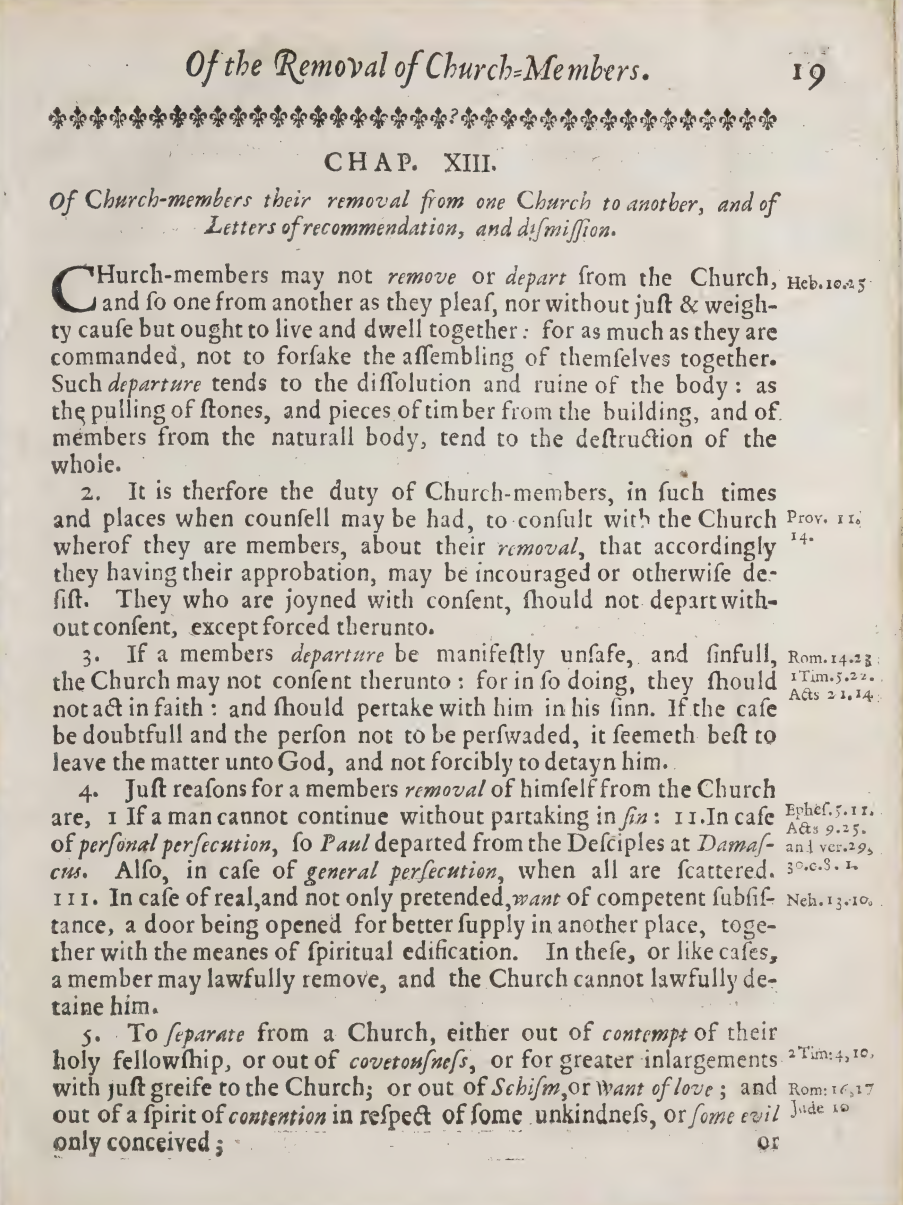
Though I am Presbyterian, I have for years deeply appreciated the great majority of what the New England fathers set forth here in their Cambridge Platform (1649) concerning why, how, and when church members may lawfully leave their local congregation to join another. Would to God we “eat this scroll,” internalizing its biblical principles. And so may we more and more in this individualistic and non-committal age live out the articles of our ancient creed, “I believe an holy catholic church” and “the communion of saints!”

* * * * * * * * *

CHAPTER XIII.

Of church members, their removal from one church to another, and of recommendation and dismission.

1. CHURCH members may not remove or depart from the church, and so one from another as they please, nor without just and weighty cause, but ought to live and dwell together; forasmuch as they are commanded, not to forsake the assembling of themselves together. Such departure tends to the dissolution and ruin of the body, as the pulling of stones and pieces of timber from the building, and of members from the natural body, tend to the destruction of the whole.

Heb. x. 25.

2. It is therefore the duty of church members, in such times and places where counsel may be had, to consult with the church whereof they are members about their removal, that accordingly they having their approbation, may be encouraged, or otherwise desist. They who are joined with consent, should not depart without consent, except forced thereunto.

Prov.xi. 16.

3. If a member’s departure be manifestly unsafe and sinful, the church may not consent thereunto; for in so doing, they should not act in faith, and should partake with him in his sin. If the case be doubtful, and the person not to be persuaded, it seemeth best to leave the matter unto God, and not forcibly to detain him.

Rom. xiv. 23. 1 Tim. v. 22. Acts, xxi. 14.

(more…)

Read Full Post »

Boston, The light of the Jews

“A Griegos y á bárbaros, á sabios y á no sabios soy deudor” (Rom. 1:14) —

Chalmers, Orator of the Species [Esp]

More quotes, sans image …

Communion of the Saints

“The speech of one hearty friend cannot but revive the spirits of another. Sympathy hath a strange force, as we see in the strings of an instrument, which being played upon, as they say, the strings of another instrument are also moved with it. After love hath once kindled love, then the heart, being melted, is fit to receive any impression. Unless both pieces of the iron be red hot, they will not join together. Two spirits warmed with the same heat will easily solder together.”

-Richard Sibbes

Faith & the Promise

“The faith of the promises is the door at which the accomplishment of the promises doth enter in: according to the word, Luke 1:45, Blessed are they that believe, for there shall be a performance of those things that are spoken of the Lord unto them. If we were more in waiting for the accomplishment of the promises, the vision should speak, and should not tarry: and no doubt, a mercy coming to us, as the fruit and performance of a promise, will make it an exceeding refreshful thing, when a Christian getteth leave to sing that song, which is in Isa 25:9, Lo, this is our God; we have waited for him, and he will come and save us. And when a mercy is the fruit and accomplishment of the promise, there is a beautiful lustre and dye upon that mercy, which no art could set on, but only the finger of the love of God.”

-Andrew Gray

Regeneration of Children

“The education of children should proceed on the principle that they are in an unregenerate state, until evidences of piety clearly appear, in which case they should be sedulously cherished and nurtured. . . . Although the grace of God may be communicated to a human soul, at any period of its existence, in this world, yet the fact manifestly is, that very few are renewed before the exercise of reason commences; and not many in early childhood.”

-Archibald Alexander, Thoughts on Religious Experience

Honesty in Confessional Subscription

“Honesty is as important in theology as in trade and commerce, in a religious denomination as in a political party. Denominational honesty consists, first, in a clear, unambiguous statement by a Church of its doctrinal belief, and, second, in an unequivocal and sincere adoption of it by its members. Both are requisite. If a particular denomination makes a loose statement of its belief, which is capable of being construed in more than one sense, it is so far dishonest. If the creed of the denomination is well drawn and plain, but the membership subscribe to it with mental reservation and uncertainty, the denomination is dishonest. Honesty and sincerity are founded in clear conviction, and clear conviction is founded in the knowledge and acknowledgement of the truth. Heresy is a sin, and is classed by St. Paul among’the works of the flesh,’ along with ‘adultery, idolatry, murder, envy and hatred,’ which exclude from the kingdom of God. (Gal. v. 19-21). But heresy is not so great a sin as dishonesty. There may be honest heresy, but not honest dishonesty. A heretic who acknowledges that he is such, is a better man than he who pretends to be orthodox while subscribing to a creed which he dislikes, and which he saps under pretence of improving it and adapting it to the times. The honest heretic leaves the Church with which he no longer agrees; but the insincere subscriber remains within it in order to carry out his plan of demoralization.”

– W. G. T. Shedd, Calvinism: Pure and Mixed, 152

Trials in the Womb of the Covenant of Redemption

“Whatever trials you have, whatever troubles you have, whatever difficulties you have, they come from the same covenant as Christ came for your salvation. They come from the same covenant as your regeneration came. They come from the same covenant as your hope of heaven comes. And they come with the same love, and they come for the same purpose, and that is that you might be to the glory of his grace throughout eternity.”

-Hugh M. Cartwright (1943-2011)

The Virgin Mary’s “Low Estate”

“​In the following words she teaches us how worthless she felt of herself and that she received by the heavenly grace that was lavished on her every sort of good merit that she had. She says, “For he has considered the humility of his handmaid. For behold from this time on all generations will call me blessed.” She demonstrates that in her own judgment she was indeed Christ’s humble handmaid, but with respect to heavenly grace she pronounces herself all at once lifted up and glorified to such a degree that rightly her preeminent blessedness would be marveled at by the voices of all nations.”

-Venerable Bede

The Right Veneration of the Virgin

But that she was eminently a saint; that her faith, and resignation, and absolute devotion to God, on the message of the angel, were most extraordinary and exemplary; that her relation to our common Saviour should render her name dear and venerable to us all; and that we should fulfil our part of her own prediction, that “henceforth all generations shall call me blessed,” [Luke 1:48]—all this is not only to be admitted, but remembered and regarded​. . .  Yet in counteracting this error, the veneration and affection due to her true character, has, I think, been sometimes refused, or impaired. Let us avoid both extremes. Let us worship God alone; but let us love and venerate all his saints, and the mother of our Lord among the chief.”

-Ashbel Green

A Penitent Marveling at Common Grace

“Her self-conceited heart is self-convict’d,
With barbed arrows of compunction prick’d;
Wonders how justice spares her vital breath,
How patient heav’n adjourns the day of wrath;
How pliant earth does not with open jaws
Devour her, Korah-like, for equal cause;
How yawning hell, that gapes for such a prey,
Is frustrate with a further hour’s delay.”

-Ralph Erskine

“Social” Christianity & the Individual

“Nevertheless, the attempts to apply Christianity socially have profoundly affected the meaning which the Christian faith has for the average man and ordinary churchgoer. The emphasis on the social has largely stifled the spiritual nature of the faith. It has obscured the revealed fact that the Christian message was primarily to and for individuals. . . For the business of the Church in its God-given mission is to the individual and through the individual to society. Moreover, the Christian revelation holds out no hope for society except in so far as the men and women who form it are Christian, which for the secular State is a futile and unattainable ideal. It is therefore all the more essential that the truth should be understood that a Christian society can only be fashioned out of and by Christian men and women. . .”

“Evangelical ministers, holding their high commission as ambassadors of Christ, must ever plead with men to be reconciled to God. When people are reconciled to God they are in fact at peace with one another. From this peace, conditioned by faith in Jesus Christ, can alone arise a state of mutual peace among peoples of nations and a fellowship in peace of the states constituted of these reconciled peoples. . .”

“To-day, therefore, as at all times, the primary privilege and service of this ministry must be the regeneration of men who will become creators of a better and more really Christian civilisation.”

-Donald Maclean (1869–1943), Principal of the Free Church of Scotland and co-founder of the Evangelical Quarterly. From “An Evangelical Ministry.”-

Read Full Post »