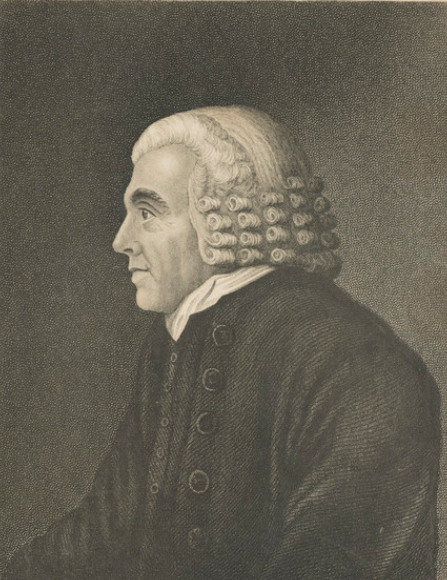
It is a joyful time when new members are added to a congregation, formally identifying themselves as believers in Jesus and committing to live as one of His disciples. All churches have some kind of admission process which allows them to decide whether somebody can be accepted as a new member. However, what criteria should a church use? Robert Baillie (1602–1662) served as a minister in Kilwinning, an army chaplain, and Professor of Divinity (later Principal) at Glasgow University. He was also one of the Scottish commissioners to the Westminster Assembly. In his writings he interacted with some who believed that people were obliged to provide evidence that they were truly regenerate before they could be accepted as church members. Robert Baillie argues in the following extract that this sets the bar for church membership too high. We cannot see into each other’s hearts, so how can we know whether someone is genuinely saved or not? Also, the Lord Himself has organised His church in the world in such a way that it will never be composed entirely of the truly regenerate. Baillie’s position strives for the highest standards for church members to live up to, while relieving us of the burden of deciding whether each individual church member is genuinely born again.
Below I’ve included a few striking passages, followed by the entire PDF. A few observations. First, I note that his letters definitely reflect his Secession outlook vis-a-vis certain corruptions of the Church of Scotland at the time. Second, baptized children may revoke their church standing by falling into heathenish “principles or practices.” Next, it would seem that Brown agrees with me (or better, I with him) that a working knowledge of the Shorter Catechism is more or less the cognitive requisite for an intelligent profession of faith. And while he counts as useful and warranted to utilize confessions and catechisms as a means to ascertaining an intelligent profession of faith, he has great misgivings against overloading the minds and consciences of applicants by the misuse of obliging them to public covenanting. He has said what I have long thought: to require taking vows to historically involved and obscure documents easily calls for implicit faith.
The following is an article written in 1919 by Dr. Benjamin B. Warfield. Prof. Warfield was an orthodox theological heavyweight who taught at Princeton Theological Seminary in the early 20th century, until the institution tragically succumbed to theological liberalism in the late 1920s. He here addresses the question of Paul’s words prohibiting women to speak in the assemblies of the church. A digitized version can be accessed here.
Came upon this choice piece from Boston’s Memoirs. A series of questions put to a prospective communicant. The first question I find rather insightful—I’ve long tended to think that a working understanding of the Shorter Catechism is basically the cognitive side of Presbyterian terms of communion. Without reaching that bar, the session ought to delay that applicant and give further instruction (L. Cat. 173). Also, there is explicit submission to church discipline.
I am aware that Boston arguably had some “independent” aspects to his presbyterianism, and perhaps this reflects too much a likeness to the old Congregational “church covenants?” But whatever the case, I find this explicit consent and covenanting commendable:
“And if the Session be satisfied in this also, the party is to be put explicitly to consent to the Covenant (whereof he desires the seal), to be the Lord’s, live under Him, and serve Him all the days of his life, by answering expressly the following (or the like) questions: 1. Do you believe the doctrine of the Shorter Catechism of this Church, so far as you understand the same, to be the true doctrine agreeable to the Holy Scriptures, and resolve through grace to live and die in the profession of the same? 2. Do you consent to take God in Christ to be your God, the Father to be your Father, the Son to be your Saviour, and the Holy Ghost to be your Sanctifier; and that, renouncing the devil, the world and the flesh, you be the Lord’s for ever? 3. Do you consent to receive Christ, as He is offered in the gospel, for your Prophet, Priest and King; giving up yourself to Him, to be led and guided by His Word and Spirit; looking for salvation only through the obedience and death of Jesus Christ, who was crucified without the gates of Jerusalem; promising in His strength to endeavour to lead a holy life, to forsake every known sin, and to comply with every known duty? 4. Lastly, do you promise to subject yourself to exhortation, admonition, and rebuke, and the discipline of the Church, in case (which God forbid !) you fall into any scandalous sin?”
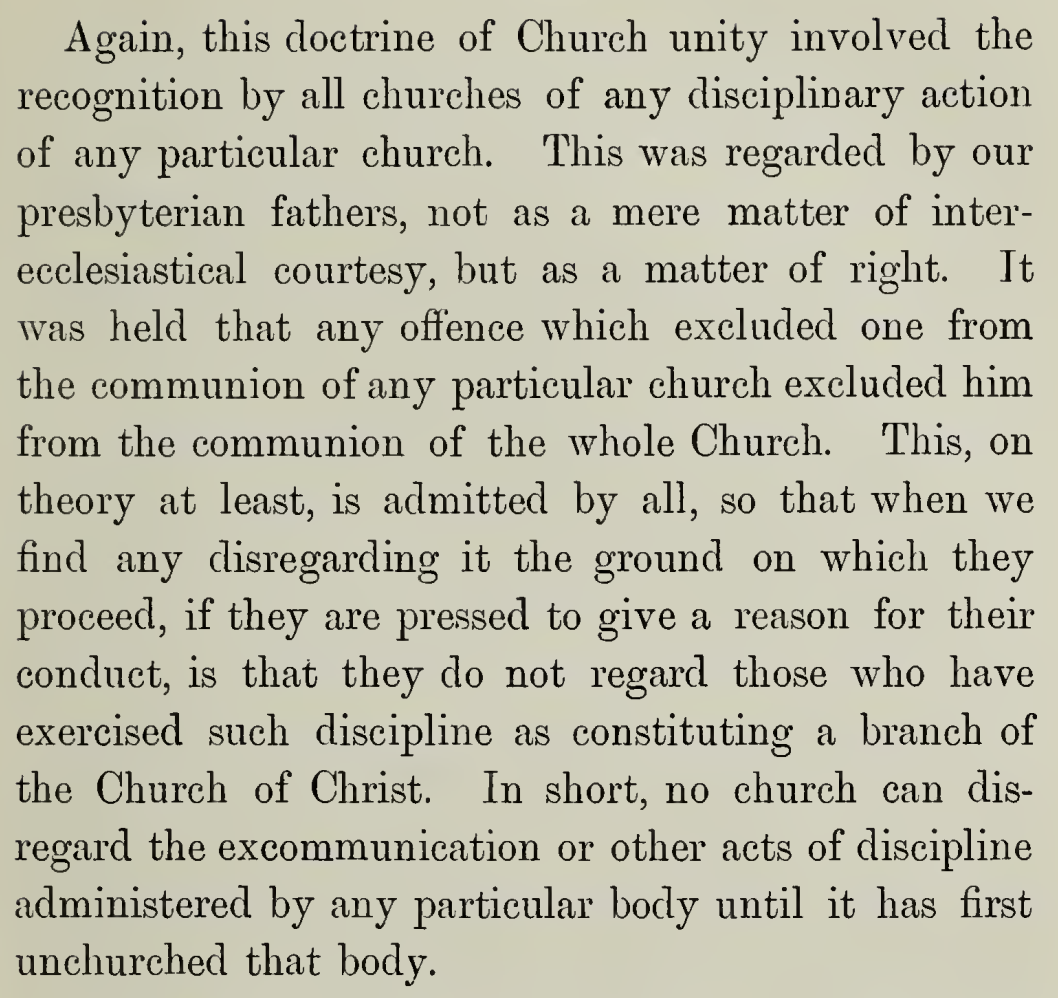
MacPherson explains the radically catholic ecclesiology of our Scottish Presbyterian forbears. Listen to an audio recording of the chapter where he treats this subject here.
Whole doctrine catholicity | “Who is she that looketh forth as the morning, fair as the moon, clear as the sun, and terrible as an army with banners” (Song 6:10)?
The following two quotes are taken from George Gillespie’s An Assertion of the Government of the Church of Scotland (1641). They seem to me to have a bearing on the question of the ‘indigenous principle’ that our denomination, the Presbyterian Reformed Church, has advocated since its inception in 1965. That is, presbyterian churches ought ideally to develop their own nationally autonomous bodies distinct from others outside their borders; or, trans-national denominations, especially when ‘centered’ in one particular nation, should be avoided or superseded as impractical, and liable to hierarchicalism or a kind of church-imperialism. These quotes in particular demonstrate that historic presbyterianism, while holding out a gradation of church courts, nevertheless accepts as valid smaller and even the smallest church units when circumstances on the ground prevent more.
“Add unto these a distinction betwixt a congregation lying alone in an island, province or nation, and a congregation bordering with sister churches. If either there be but one congregation in a kingdom or province, or if there be many far distant one from another, so that their pastors and elders cannot ordinarily meet together, then may a particular congregation do many things by itself alone, which it ought not to do where there are adjacent neighbouring congregations, together with which it may and should have a common presbytery” (43).
If you would truly profit by ordinances, after you have a fixed pastor, I think it is of moment to forget, as much as possible, the persons of men, and consider them as no more than instruments in the hand of God, for your daily instruction and comfort. The more you remember the appointment of God, and wait upon his ordinances, in the faith of his presence, and the expectation of his blessing, the more you are likely to receive both sensible and lasting benefit. I must therefore take the liberty to observe, that we have amongst us a set of wandering unsettled hearers, who run about from one congregation to another, and even from one profession to another, and are scarcely ever to be seen a whole day in one place. If they be but deliberating where to fix, we may fay of them, that they are ever learning, and never come to the knowledge of the truth. But the probability is, that they have itching and curious ears, and go about not to serve God but to hear men. If I am able at all to judge, either by reflection or observation, those are most likely to profit, who having deliberately made their choice, sit habitually and regularly under one minister. By this means they enter into his views; and as he will naturally endeavour, if any thing was wanting at one time, to complete his scheme by supplying it at another, they will thereby have a more comprehensive view of the whole counsel of God. At the fame time, not having the charm of novelty to enchant them, they will have nothing to do but to reap instruction. On the other hand, by hearing separate, detached, and independent discourses, men may please their fancy more, but they will improve their understanding less. It is also plain, that as every minister will endeavour, not only to follow an order in his discourses on one subject, but to have a respect to the connection, and relation of the subjects themselves, the more accurate and exact he is, in suiting one part to the, illustration of another, the less he will be understood by these desultory hearers, who take only a single branch, without being able to perceive its subserviency to the general design. I have many times known exceptions taken at ministers, for some parts of a discourse by such persons, when, if they had heard the whole upon the same or corresponding subjects, they would have perceived there was no place for their objections. The great purpose, my brethren, of a serious and judicious people, in attending on ordinances, should neither be to please themselves, nor to criticise their teachers; but to hear the word of God, that they may do it. On this account it is, that humble and regular Christians are getting real advantage to their souls, while some are only watching the opinions, or others only passing judgment on the ability, perhaps no more than the style and outward manner of the speaker.
Nathan Eshelman recently penned this very helpful review article of a newly published book on spiritual abuse in the church. This is a must read. While there are certainly autocratic bullies in the Church, there are also dangerous, manipulative abusers in the pew who–if not held to simple, biblical and presbyterian standards for conflict resolution–can create tremendous harm.
* * * *
If you stumbled into a rabbit hole you may find several things that intrigue you. There may be keys and playing cards or caterpillars—and maybe even a rabbit. But just because you find keys, playing cards, and caterpillars does not mean that you’ve entered the world of the Red Queen and the hookah-smoking caterpillar. Sometimes it takes more. Jefferson Airplane said it like this:
“One pill makes you larger And one pill makes you small And the ones that mother gives you Don’t do anything at all Go ask Alice When she’s ten feet tall…”
I am working on a writing project that has taken me into various books on church relationships and communication. In the midst of that project, a beloved former professor of mine and churchmen has resigned from the ministry, in part, because of what is currently being called “spiritual abuse.” The idea of spiritual abuse is everywhere right now.
Years back, Prof. John Murray’s letter to a friend on the question of ladies wearing head-coverings in public worship was very helpful to me. In particular, he helped me see that 1 Corinthians 11:6 in particular will make no sense at all on the thesis that Paul wanted women simply to wear long hair in church. But if the long-hair “covering” of v. 15 is all that Paul meant for women being “covered” in vv. 5-6, then what does verse 6 even mean?
To help make this as clear as possible for others, I decided to make a little chart here below. Also feel free to read a transcript of a sermon I gave on the subject here.
Este tratado de Thomas Doolittle, escrito por el pastor de la infancia del gran comentarista de la Biblia Matthew Henry, es una obra maestra muy olvidada sobre el tema de la naturaleza, la justificación y los métodos de la catequesis. Es una lectura obligada para cualquier pastor reformado.



 West Port Experiment