Feeds:
Posts
Comments

Archive for the ‘Church of Scotland’ Category

The following quote from the First Book of Discipline (1560) illustrates how perceptive the Reformers were in the machinations of Satan – and human vulnerability.  Time and again, he has sought to draw the Church aside to the extremes of hyper-visibility (idolatry) and hyper-invisibility (profanity):

As Satan hath never ceased from the beginning to draw mankind into one of two extremities, to wit, that men should either be so ravished with gazing upon the risible creatures, that forgetting the cause wherefore they are ordained, they attribute unto them a virtue and power which God hath not granted unto them; or else that men should so contemn and despise God’s blessed ordinances and holy institutions, as if that neither in the right use of them there were any profit, neither yet in their profanation there were any danger: as this way, we say, Satan hath blinded the most part of mankind from the beginning; so doubt we not, but that he will strive to continue in his malice even to the end.

The Reformers sought to hold to a biblical via media in these matters.  There is a Visible Church.  Knox wished to alter the Creed from “I believe an holy kirk” to “I see (video) an holy kirk.”  Thus, the Reformers weren’t hyper-invisibilists like so many Anabaptist radicals.  But on the other hand, they were not hyper-visibilists calling believers to walk by sight and not by faith. 

We absolutely must retain this vital balance in the present climate of evangelical low-churchism.  And let us also be aware of the law of extremes.  Like the pendulum, one overreaction begets its opposite.  I’m sure Rome could become appealing to mystified followers of an eccentric old man who has to revise his end-time decrees every few years.
Read Full Post »

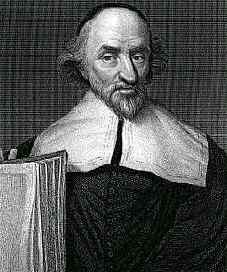
John Knox, the great Scottish Reformer, was definitely no adept in worldly-wisdom.  His positions were always unbending and uncompromising.  He despised subtlety, and spoke always with the greatest of candor.  He obviously had little interested in making friends and influencing people; that is, unless by influence one means shameless, hard-hitting argument!

When Queen Mary came to Scotland in 1561 to take the throne, she was of a mind to assert her royal prerogatives in everything – religion included.  An ardent Romanist from her youth, she decided to make a clear, bold statement at the outset.  She would have a mass celebrated in the chapel of the Holyrood house, something forbidden by the Protestant magistracy at the time.

Not surprisingly, Knox was outspoken against the celebration.  There could be no accommodation, no middle ground.  “One mass,” proclaimed Knox,  “was more fearful unto him than if ten thousand armed enemies were landed in any part of the realm, of purpose to suppress the whole religion.”

One mass, Master Knox?  One private mass, as a concession to the rightful heir of the throne?  And that one mass should be of more dire consequence than a foreign invasion?  Not only is this intolerant, but it’s unreasonable!  Don’t you realize that to get what you want, you’ve got to give?

Knox responds to the naysayers.  The mass issue is a non-negotiable, for “in our God there is strength to resist and confound multitudes, if we unfeignedly depend upon Him, of which we have had experience; but when we join hands with idolatry, it is no doubt but both God’s presence and defence will leave us; and what shall then become of us?”

What the calculators of this world can’t grasp is that he was more practical than them all!  His explanation here reveals the deepest sagacic insight.  Why?  Because, thought Knox, you must factor God into every equation.  Giving in to Queen Mary on one little point may have been expedient on the earthly plane in the short-run, but by doing so it would alienate the One whose favor is absolutely indispensable.  You don’t want to mess with the ‘wrong man’ (or woman, in Mary’s case), but it’s far worse to mess with the ‘wrong God!’

Knox had learned his other-worldly wisdom at the feet of Wisdom incarnate.  He, the Logos, the Light that lightens every man entering the world had said, “Whosoever shall seek to save his life shall lose it; and whosoever shall lose his life shall preserve it” (Lu. 17:33).  To make it in this world and in the next, you must think counter-culturally, counter-intuitively.  But be assured, this is the best way!

In deference to the One who “knows all things,” Knox shunned statescraft.  But in doing so, he became the true patron and friend of the nation.  If only we had eyes to see what Master Knox saw!  If we would close our eyes and heed true Wisdom, we would walk the safest and most expedient course.  And we would assign much less weight to earthly factors, which to the eye of the flesh loom so large.

Read Full Post »

The following extract comes from Thomas Chalmers: A Biographical Study, by James Dodds (1870).  In it, he recounts a lesser known story from the career of Thomas Chalmers.  While not an effort on par with his earlier St. John’s and his later West Port Experiments (he was teaching divinity at the University of Edinburgh at this time) the Water of Leith story nonetheless exhibits his ardent commitment to territorial or parochial urban mission.  Not to mention his readiness to roll up his sleeves!

* * * *

HALMERS, in 1833-4, was residing in Forres Street, Edinburgh, not far from the line of the Great North Road by Queensferry.  In his walks out to the country in that direction, he would often cross the lofty and spacious Dean Bridge, then newly erected,—the latest wonder in Edinburgh, —spanning the ravine through which, far below, foams the Water of Leith, turbid and brawling, and laden with pollution.  From this elevation he would look down upon the village of the Water of Leith, — almost sunk out of sight and sound of the world, though within a few hundred paces of the metropolis, — antiquated and decayed; cooped within steep narrow precipices; with tall gaunt chimneys, untenanted and crumbling granaries, rough dirty streets, miserable hovels into which ‘every element of heaven may enter;’ with scarce any sign of life or action, except two or three lounging figures, the noise and froth of mill-wheels, the grunting of pigs, and the squalling of children without childhood.  This abject and neglected place had made itself very notorious, in the late visitation of cholera, by its extreme ignorance and violence.  Yet in many ways it had a quaint, old-fashioned, half-savage charm.  To the antiquarian, this village was a curious relic of the past, lying close to, yet with a kind of repulsion hiding itself from, the encroaching pomp of the New Town of Edinburgh.  To the painter or poet it had strange bits of ancient masonwork; and it had frothing pools, and steep banks clustered all over with wild vegetation, and aspects of a rude primitive life. Chalmers was not insensible to the associations of the past; for, was he not born and brought up amongst the old decayed towns of the East of Fife?  He had also the artist’s eye for quaint and out-of-the-way nooks, either of nature or of human habitation.  But these lighter moods, though neither scorned nor abjured, were in his mind always subordinated to the sentiment of Christian benevolence.  Looking, then, from the height of the Dean Bridge, he might feel, ‘How antique!  how it carries one back to the time when Mary Stuart rode her palfrey across that now toppling old bridge in her excursions to the Highlands!’  Or, ‘ How quaint and picturesque these straggling houses, in the deep ravine, with the babbling brook running through the midst!’  But his uppermost feeling would be, ‘What a spot, as if scooped out by nature, and thrown aside by man, to plant a Territorial Church, with all its reclaiming and purifying influences!’

And in the Water of Leith he resolved to show to the world a new model of that Territorial system, which he had begun in St. John’s of Glasgow.

On a survey, it was found that the inhabitants were 1356 in number, but of these only 143 had sittings in any place of worship.  There was a meeting-house of some denomination in or near the village, but only five of the inhabitants had sittings; it was attended almost entirely by persons coming from a distance, outside the territory of the Water of Leith.  Chalmers, assisted by the liberal friends who never failed him, determined to raise here a territorial church, specially devoted to the inhabitants of the Water of Leith.  A missionary began his labours amongst them in 1833.  He visited from house to house, made the acquaintance of the people, was courteously received by them, conversed with them, visited the sick, was with them in the hour of affliction and death, was their daily counsellor and friend.  He invited them to come to meetings, where he addressed them—in fact, preached to them.  His audience became more and more numerous; he had to seek out places of meeting larger and larger; at last he resorted to an old maltgranary, where, with great packing, some 400 people could attend.  A church was then erected by subscription, which was opened in May 1836. The sittings were about 1000, and at a moderate charge, and offered in preference to the inhabitants.  Soon after the opening, about 700 of the sittings were taken, and almost entirely by inhabitants. It was a true territorial church.

Chalmers officiated at the opening, and dwelt paternally upon the effect of its territorial character.

‘Instead of leaving this church to fill as it may from all parts of the town, we first hold out the seats that we have to dispose of, at such prices as we can afford, to its own parish families. . . . Our fond wish for Edinburgh and its environs is that, district after district, new churches may arise, and old ones be thrown open to their own parish families, till not one house remains which has not within its walls some stated worshipper in one or other of our Christian assemblies; and not one individual can be pointed to, however humble and unknown, who has not some man of God for his personal acquaintance, some Christian minister for his counsellor and friend.’

This new and eminently successful model of Territorialism, coupled with his long teachings, the private exertions at the very same time of his old Glasgow friends, and also the religious darkness and fearful profligacy especially of the large towns, were at length stirring the Church of Scotland from its culpable neglect. . . 

Read Full Post »

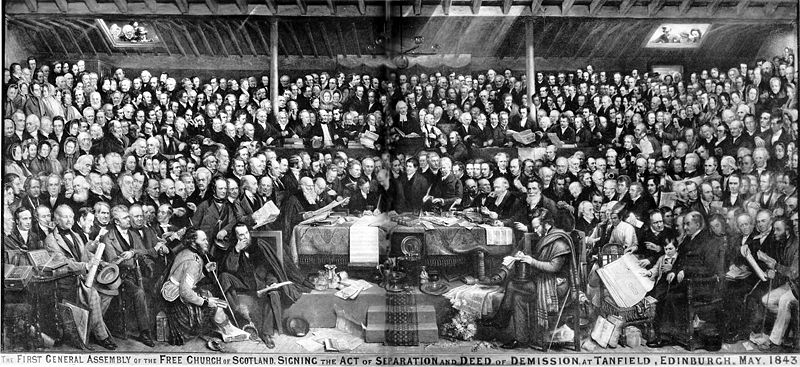
By the 1830s, the Church of Scotland was in the midst of a true evangelical revival.  Yet with the revival came conflict.  Increasingly, the State transgressed into the sphere of the established Church.  Its interference called into question the very spiritual independence of the institution that John Knox and others had helped consolidate under Christ’s ultimate authority. 

Thomas Chalmers, the premier Scottish preacher of the day, threw his full weight on the side of the evangelicals.  In temporal matters, the Church was to be subject to the State.  But not one inch of ground should be given on matters spiritual.  Christ is Head of the Church, and His law is higher than the law of the land.  His servants must at the end of the day obey God rather than man.

In Chalmers’ Memoirs, we read the following words about the dire consequences for compromise.  Speaking of the State’s intrusion in spiritual things, he writes, “Why, this would be lording it over us with a vengeance!  It would be making us swallow the whole principle; and the Church of Scotland, bereft of all moral weight, might henceforth be cast a useless and degraded thing into the bottom of the sea” (Memoirs 4:139).  In short, pragmatism leads to cultural irrelevance.

Though writing in a very different context, his words ring true today.  If the Church should indulge in pragmatism, then it not only breaks allegiance to Christ, but so debases itself as to be contemptible even to the wicked.   “If the salt loses its saltiness, how shall it be made flavorful?  Is it then good for nothing, but to be cast out and trampled under men’s feet.”

Read Full Post »

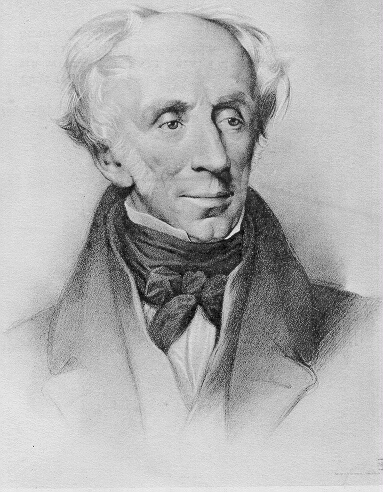
“The sounder part of the Scottish nation know what good their ancestors derived from their Church, and feel how deeply the living generation is indebted to it. . . . Visionary notions have in all ages been afloat upon the subject of best providing for the clergy; notions which have been sincerely entertained by good men, with a view to the improvement of that order, and eagerly caught at and dwelt upon by the designing, for its degradation and disparagement. Some are beguiled by what they call the Voluntary system, not seeing (what stares one in the face at the very threshold) that they who stand in most need of religious instruction are unconscious of the want, and therefore cannot reasonably be expected to make any sacrifices in order to supply it. Will the licentious, the sensual, and the depraved, take from the means of their gratifications and pursuits, to support a discipline that cannot advance without uprooting the trees that bear the fruit which they devour so greedily?  Will they pay the price of that seed whose harvest is to be reaped in an invisible world?  A Voluntary system for the religious exigencies of a people numerous and circumstanced as we are! Not more absurd would it be to expect that a knot of boys should draw upon the pittance of their pocket-money to build schools, or out of the abundance of their discretion be able to select fit masters to teach and keep them in order! Some, who clearly perceive the incompetence and folly of such a scheme for the agricultural part of the people, nevertheless think it feasible in large towns, where the rich might subscribe for the religious instruction of the poor. Alas! they know little of the thick darkness that spreads over the streets and alleys of our large towns. The parish of Lambeth, a few years since, contained not mora than one church, and three or four small proprietary chapels, while Dissenting chapels, of every denomination, were still more scantily found there; yet the inhabitants of the parish amounted at that time to upwards of 50,000. Were the parish church and the chapels of the Establishment existing there an impediment to the spread of the Gospel among that mass of people?  Who shall dare to say so?  But if any one, in the face of the fact which has just been stated, and in opposition to authentic reports to the same effect from various other quarters, should still contend that a Voluntary system is sufficient for the spread and maintenance of religion, we would ask, What kind of religion?  Wherein would it differ, among the many, from deplorable fanaticism?

“For the preservation of the Church Establishment, all men, whether they belong to it or not, could they perceive their own interest, would be strenuous; but how inadequate are its provisions for the needs of the country!  and how much is it to be regretted that, while its zealous friends yield to alarms on account of the hostility of Dissent, they should so much overrate the danger to be apprehended from that quarter, and almost overlook the fact that hundreds of thousands of our fellow-countrymen, though formally and nominally of the Church of England, never enter her places of worship, neither have they communication with her ministers!  This deplorable state of things was partly produced by a decay of zeal among the rich and influential, and partly by a want of due expansive power in the constitution of the Establishment as regulated by law.  Private benefactors in their efforts to build and endow churches have been frustrated, or too much impeded, by legal obstacles; these, where they are unreasonable or unfitted for the times, ought to be removed; and, keeping clear of intolerance and injustice, means should be taken to render the presence and powers of the Church commensurate with the wants of a shifting and still increasing population” (Poetical Works of William Wordsworth, 606, 607).

Read Full Post »

« Newer Posts