Feeds:
Posts
Comments

Archive for the ‘Church of Scotland’ Category

“And therefore I feared not to affirm, that of necessity it is, that such as hope for life everlasting avoid all superstition, vain religion, and idolatry. Vain religion and idolatry I call whatsoever is done in God’s service or honour, without the express commandment of his own Word.”

– John Knox (c. 1514-1572)


Read Full Post »

In the following quote from the great Scottish Reformer, John Knox, we see how vitally important the maintenance of the three marks of the Church are to its role, and for that matter to the witness of Christ in the world. The three marks constitute the ‘face’ of the Visible Church. That face of the Church, which identifies and distinguishes it among others, is the very face of Christ among men. So to the degree that the marks are compromised, the face of the Church and so of Christ are compromised. And where the marks are absent, the Visible Church is absent – and Christ walks not among such snuffed-out candlesticks.

* * * *

“The notes of the true Kirk are three: Word, sacraments and discipline: first, the true preaching of the Word of God in which God has revealed himself unto us; second, the right administration of the sacraments of Christ Jesus, which are annexed to the Word and promise of God to seal and confirm them in our hearts; last ecclesiastical discipline uprightly administered, as God’s Word prescribes, whereby vice is repressed and virtue nourished. In the observation of these notes the true face of Jesus Christ appears. We cannot make the face of Jesus Christ appear. Nevertheless, Jesus Christ himself, made known through Word and sacraments, is the true ordinance governing the life, form, and activity of the Church. We believe in Christ in the midst of those who meet in his name and by faith hear the voice of his Spirit speaking in and through the Scriptures and obey him. We see him in the Sacraments, and walk in holiness according to the leading of the Spirit of Jesus Christ. There the true Church manifests itself in the power of the presence of Christ the sole Head and Lord of the Church – there it steps forth before us, and distinguishes itself from any Church that usurps his authority.”

Read Full Post »

“In these circumstances do we know of no expedient by which this woful degeneracy can be arrested and recalled, but an actual search and entry upon the territory of wickedness. A mere signal of invitation is not enough. In reference to the great majority, and in reference to the most needful, this were as powerless as was the bidding to the marriage-feast of the parable. We must have recourse at last to the final expedient that was adopted on that occasion; or, in other words, go out to the streets and the highways, and, by every fair measure of moral, and personal, and friendly application, compel the multitude to come in. We must do with the near, what we are doing with the distant world. We do not expect to Christianize the latter, by messages of entreaty, from the regions of paganism. But we send our messages to them. Neither do we give a roving commission to the bearers, but assign to each of them their respective stations in that field, which is the world. And we most assuredly need not expect to Christianize any city of nominal Christendom, by waiting the demand of its various districts for religious instruction, and acting upon the demands as they arrive. There must just be as aggressive a movement in the one case as in the other. There is not the same physical distance, but there is nearly the same moral distance to be described with both ; and they who traverse this distance, though without one mile of locomotion to the place of their labour, do, in effect, maintain the character, and fulfil the duty of missionaries.”

-Thomas Chalmers, Works 14:84-85

Read Full Post »

Thomas Chalmers (1780-1847), ardent advocate of the parish in modern society, commended his Anglican contemporary, Charles Bridges (1794-1869), as a model of a man dedicated to the cure of souls.   “My excellent friend, the Rev. Charles Bridges, of Old Newton, Suffolk, finds, I am sure, most ample occupation among those six hundred people whom he may be said to have domesticated into one parochial family; and, were it not for his still more important services to the Christian church at large, would show, by his incessant labours, how possible it were to make out a most beneficial expenditure of all his strength and all his time amongst them” (Collected Works 18:62).   This quote certainly illustrates Chalmers’ high regard for evangelical Anglicanism, the better part of the established Kirk’s English counterpart.  But there’s something else here as well. 

Those of us today who read and appreciate Bridges’ great classic The Christian Ministry can easily fail to realize that he was not writing as a congregational, but as a parochial minister.  Chalmers refers to Bridges precisely for this reason.  This fact sheds light on Part V of Bridges’ work, “The Pastoral Work of the Christian Ministry.”  In that section, he treats the wide range of individual cases that the pastor must treat in his charge.  The first two classes are “The Infidel” and “The Ignorant and Careless.”  Not your typical church member – or your typical church attender!  But a percentage of the 600 souls under Bridges’ geographic charge.

Read Full Post »

The following passage is worth its weight in gold.  We would expect nothing less from Thomas Boston.

* * * *

In what sense Christ is Saviour of the world.  A saviour is a name of honour, and a name of business. It is an honourable thing to save and help the miserable; to be destined, appointed, and called to that employment: but the honourable post has business annexed to it; it will not do without activity, which success is expected to attend, as in the case of a teacher, physician, and the like. Now, one may be a saviour, even as a teacher or physician, of a society, two ways. (1.) In respect of office, as being called to and invested with the office of saving, teaching, or curing that society. And thus one is saviour, teacher, or physician of that society, before ever he save, teach, or cure any of them. In this respect one may be called an official saviour, teacher, or physician. (2.) In respect of the event and success, as actually and eventually saving, teaching, and healing. As the former ariseth from an appointment put upon such a one; this ariseth from the work he manageth in virtue of that appointment. In this respect one may be called an actual and eventual saviour. Thus it is said, Neb. ix. 27. ”  And, according to thy manifold mercies, thou gavest them saviours, who saved them out of the hands of their enemies. This premised, we say,

1. Our Lord Jesus is the actual and eventual Saviour of the elect only, in whose room and stead only he died upon the cross, according to the eternal compact passed between him and the Father, in the covenant of grace, otherwise called the covenant of redemption; for these are not two, but one and the same covenant. Thus the apostle calls him “the Saviour of the body,” Eph. v. 23. that is, of the elect, who make up the body whereof he was appointed the head from eternity, and in whose name he contracted with the Father in the eternal covenant. And he is their Saviour eventually, as actually saving them, Matth. i. 21.  “And she shall bring forth a son, and thou shalt call his name Jesus; for he shall save his people from their sins.”  None but these will ever truly employ him as a Saviour, or put their case in his hand : and there are none of them but will certainly employ him sooner or later, Acts xiii. 48. ” As many as were ordained to eternal life, believed.” John vi. 37.  “All that the Father giveth me, shall come to me; and him that cometh to me, I will in no wise cast out.”

2. Our Lord Jesus Christ is the official Saviour, not of the elect only, but of the world of mankind indefinitely; so our text calls him “Saviour of the world.” Agreeably to which, God in Christ is called “the Saviour of all men,” but with a speciality, “the Saviour of them that believe,” 1 Tim. iv. 10.  The matter lies here: like as a prince, out of regard to his subjects’ welfare, gives a commission to a qualified person to be physician to such a society, a regiment, or the like; and the prince’s commission constitutes him physician of that society ; so that though many of them should never employ him, but call other physicians, yet still there is a relation betwixt him and them ; he is their physician by office; any of them all may come to him if they will, and be healed: So God, looking on the ruined world of mankind, has constituted and appointed Jesus Christ his Son Saviour of the world: he has Heaven’s patent for this office; and wheresoever the gospel comes, this his patent is intimated. Hereby a relation is constituted betwixt him and the world of mankind; he is their Saviour, and they the objects of his administration: so that any of them all may come to him, without money or price, and be saved by him as their own Saviour appointed them by the Father.

Read Full Post »

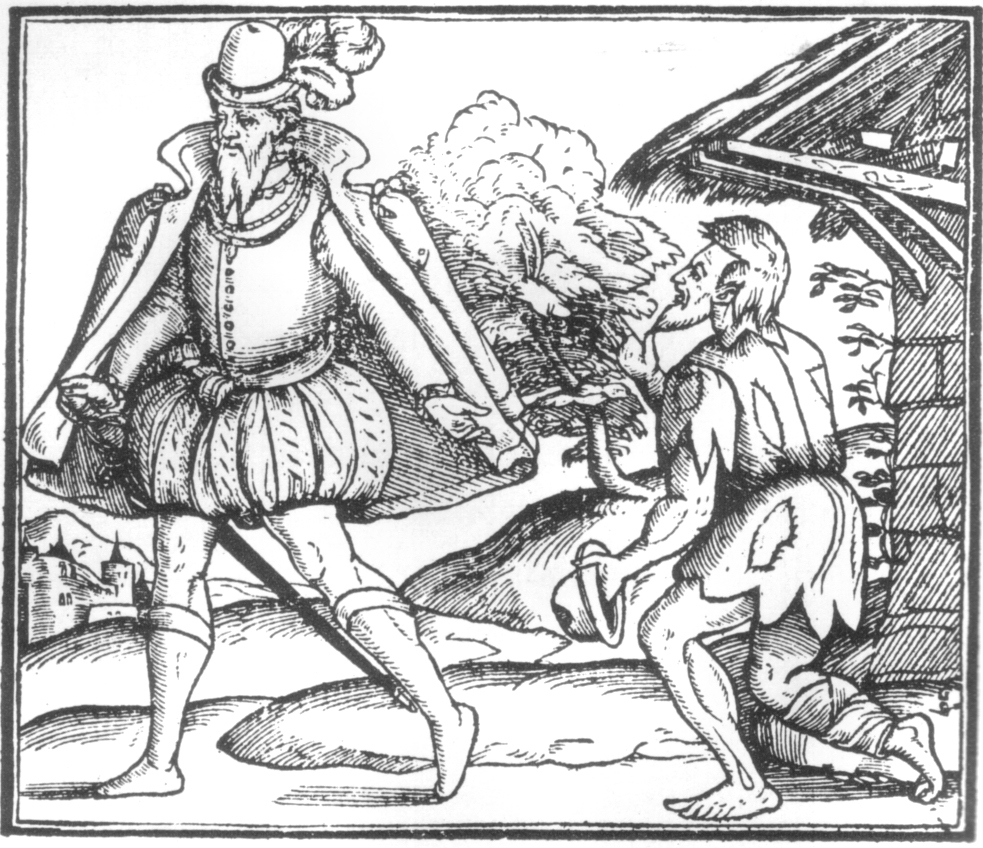
The following poem comes from a 19th century Edinburgh periodical, Tait’s Magazine.  It was written during the middle of a controversy over ‘seat rents,’ a traditional way used to finance the ministry and infrastructure of the church.  The author of the poem expresses the sentiments of churchmen like Thomas Chalmers who were mortified at the increasingly bald commercialism of the system, which effectively made church attendance for the poor cost-prohibitive.  The Presbyterian Church of Scotland had always been a church of the people, for the people.  And the poor, above all, ought to have the Gospel preached to them.  Has not God bypassed so many of the monied and of noble blood, in preference for the despised poor?

While the times and circumstances were considerably different from our own, one can certainly discern the thread of religion for profit.  And that evil is as old as the hills.  And is it not the case that the poor are largely left to shift for themselves when it comes to Reformed outreach and church planting (when done at all)?   How un-Presbyterian we Presbyterians can sometimes be!

* * *

THE POOR CHRISTIAN AND THE CHURCH

“How glorious Zion’s courts appear,”
The pious poor man cries:
“Stand back, you knave, you’re in arrears,”
The manager replies.

POOR CHRISTIAN.
“The genius of the Christian code
Is charity, humility;”
MANAGER, (In a rage.)
“I’ve let your pew to ladies, Sir,
Of high respectability.”

POOR CHRISTIAN.
“And am I then debarred the house
Where erst my father pray’d?
Excluded from the hallowed fane
Where my loved mother’s laid?”

MANAGER.
Their seat-rent, Sir, was never due;
The matter to enhance,
As duly as the term came round,
They paid it in advance.”

POOR CHRISTIAN.
“The temple of the living God
Should have an open door,
And Christ’s ambassadors should preach
The Gospel to the poor.”

MANAGER.
“We cannot, Sir, accommodate
The poor in their devotions;
Besides we cordially detest
Such antiquated notions.

“We build our fanes, we deck our pews
For men of wealth and station;
(Yet for a time the thing has proved
A losing speculation.)

“Then table down your cash anon
Ere you come here to pray;
Else you may wander where you will,
And worship where you may.”

POOR CHRISTIAN.
“Then I shall worship in that fane
By God to mankind given;
Whose lamps are the meridian sun,
And all the stars of heaven;

“Whose walls are the cerulean sky,
Whose floor the earth so fair,
Whose dome is vast immensity :—
All nature worships there.”

Read Full Post »

“Every man is justly held to be morally responsible, to a certain extent, for the state of his own parish. This is the glory of the Parochial System. Whilst it leaves any man to dissent from the Church, who chooses, it makes sure, if carried out properly, that every man in the land, in the mountain or valley, in the dense lane or stately square, has some one ‘to care for his soul.’  As the whole world is made up of families, and will never be full of peace until every man takes a Christian charge of his own, so this whole land consists of parishes, and will never be right until every minister does his utmost for carrying Christian instruction, by the aid of another, if not personally, to every family within his territory.  No other plan can make sure none are neglected.”

– James Begg (1808-1883)

Read Full Post »

“There is a deed or Grant of Christ made to Sinners, in the free Offer and Call of the Gospel . . . Tis true indeed, the eternal Destination, the Purchase and Application of Redemption is peculiar only to the Elect; but the Revelation, Gift and Offer is common to all hearers of the Gospel, insomuch as the great Mr Rutherford expresses it, the Reprobate have as fair a revealed Warrant to believe, as the Elect have.  Every man has an Offer of Christ brought to his Door who lives within the Compass of the joyful Sound, and this Offer comes as close to him, as if he were pointed out by Name.  So that none have reason to say, The Call and Offer is not to me, I am not warranted to embrace Christ . . . We have God’s commission to preach this Gospel, and to make offer of this Christ to every creature sprung of Adam, Mark xvi.15, and the event of the Publication of this Gospel among sinners follows in the next Words, He that believeth this Gospel shall be saved, he that believeth not shall be damned.”

Ebenezer Erskine (1680-1754)

Read Full Post »

The architects of the Reformed Churches in the 16th century were trans-generational thinkers. As those who rediscovered Covenant Theology, this should be expected. In reading the First Book of Discipline (1560), one will encounter explicit and repeated concern for future generations as justification for church policy decisions. For “the profite of the posterity to come.” Like good fathers, they wanted what was best for their bairns, and their bairns’ bairns as well!

Does this paternal, trans-generational concern shape the way we ‘do church’?  Is what we do in doctrine, worship, and government really in the best interests of the rising generations, or is it more candy to placate the over-indulged? Are we correcting and cultivating, or just coddling?

Read Full Post »

I’m certainly not well-versed in the current Reformed debates on the two kingdoms.  But what I have read in some quarters has given me the impression that the two kingdoms, church and state, ought to be as two ships passing in the night.  Each are on their own charted courses and should steer quite (quite!) clear of each other.

Now, this may be a position held in modern confessionally Reformed circles.  And it may have a pedigree going back to early 18th century American Presbyterianism.  But if my impression approximates to reality, then the position of some can hardly be advanced as classically reformed.  It may employ Melville’s famous terminology of the two kingdoms, but not the substance.

In my recent reading of the First and Second Books of Discipline (1560 and 1578 respectively) drafted by the architects of Presbyterianism, it is clear that the two kingdoms were to be distinct.  They ought not intrude on each other’s territory.  But note how they envisaged the ideal relationship, as recorded in the opening sections of the Second Book of Discipline:

10. The civil power should command the spiritual to exercise and do their office according to the word of God. The spiritual rulers should require the Christian magistrate to minister justice and punish vice, and to maintain the liberty and quietness of the kirk within their bounds.

11. The magistrate commands external things for external peace and quietness amongst the subjects; the minister handles external things only for conscience cause.

12. The magistrate handles external things only, and actions done before men; but the spiritual ruler judges both inward affections and external actions, in respect of conscience, by the word of God.

13. The civil magistrate craves and gets obedience by the sword and other external means, but the ministry by the spiritual sword and spiritual means.

14. The magistrate neither ought to preach, minister the sacraments, nor execute the censures of the kirk, nor yet prescribe any rule how it should be done, but command the ministers to observe the rule commanded in the word, and punish the transgressors by civil means. The ministers exercise not the civil jurisdiction, but teach the magistrate how it should be exercised according to the word.

15. The magistrate ought to assist, maintain, and fortify the jurisdiction of the kirk. The ministers should assist their princes in all things agreeable to the word, provided they neglect not their own charge by involving themselves in civil affairs.

Hardly did the Scottish Reformers admit the “Am I my brother’s keeper?” principle in their concept of the two kingdoms.  No, Cain ought not intermeddle in Abel’s affairs.  But neither should he ignore him as though he had relationship whatsoever.  The civil magistrate was to have a concern and exert his influence in the Kirk circa sacris.  So likewise the Kirk had a prophetic mantle to tell the civil magistrate how he ought to rule the people!

Read Full Post »

« Newer Posts - Older Posts »