Feeds:
Posts
Comments

Archive for the ‘Church of Scotland’ Category

A false dichotomy, if one is to take James Durham seriously:

“Never, never did men run to quench fire in a city, lest all should be destroyed, with more diligence than men ought to bestir themselves to quench this [sin of schism] in the church; never did mariners use more speed to stop a leak in a ship, lest all should be drowned, than ministers especially, and all Christian men should haste to stop this beginning of the breaking in of these waters of strife, lest thereby the whole church be overwhelmed. And if the many evils which follow thereupon, the many commands whereby union is pressed, yea, the many entreaties and obtestations whereby the Holy Ghost does so frequently urge this upon all, as a thing most acceptable to him and profitable to us; if, I say, these and many other such considerations have not weight to convince of the necessity of this duty to prevent or heal a breach [emphasis mine], we cannot tell what can prevail with men that profess reverence to the great and dreadful name of God, conscience of duty, and respect to the edification of the church and to their own peace at the appearance of the Lord in the great day, wherein the peace-makers shall be blessed, for they shall be called the children of God?”

Read more about the Scottish doctrine of visible church union and the sin of schism in MacPherson’s classic below. And an audio recording of that particular chapter can be accessed here.

Whole doctrine catholicity | “Who is she that looketh forth as the morning, fair as the moon, clear as the sun, and terrible as an army with banners” (Song 6:10)?

(more…)

Read Full Post »

It is said that John Knox prayed, “Give me Scotland, or I die.” In 1560, God gave him Scotland. The purpose of this submission is to examine what he and his colleagues did with her and initiate a discussion on what lessons we might learn for today.

To achieve our purpose, we shall first examine the mission strategy which Knox and his colleagues set out in The First Book of Discipline.

Second, we shall examine what the Reformers sought to do in the light of Presbyterian principles. Now, the object of our scrutiny is the Reformation in Scotland, and that, in fairness, requires a Scottish approach. We are not looking at Knox and company’s mission strategy for precedents which we might apply analogously to the pattern of English Common Law, but for principles which we might reapply in each situation while being informed by examples of previous applications.

Third, we shall describe how the principles and practices of the Scottish Reformation might be reapplied in mission situations today. As we have said, this is a discussion. This third section will not be a list of modern mission solutions but of resource maximizing suggestions. This will not require thinking outside of the box: our commitment to Scripture forbids that. This will involve rethinking our perception of the box’s dimensions and utilizing the extra space.

This article was written by the Rev. D. Douglas Gebbie and published by the Haddington House Journal in 2008. To read the rest, click here.

Read Full Post »

Listen to Thomas M’Crie’s The Life of Alexander Henderson.

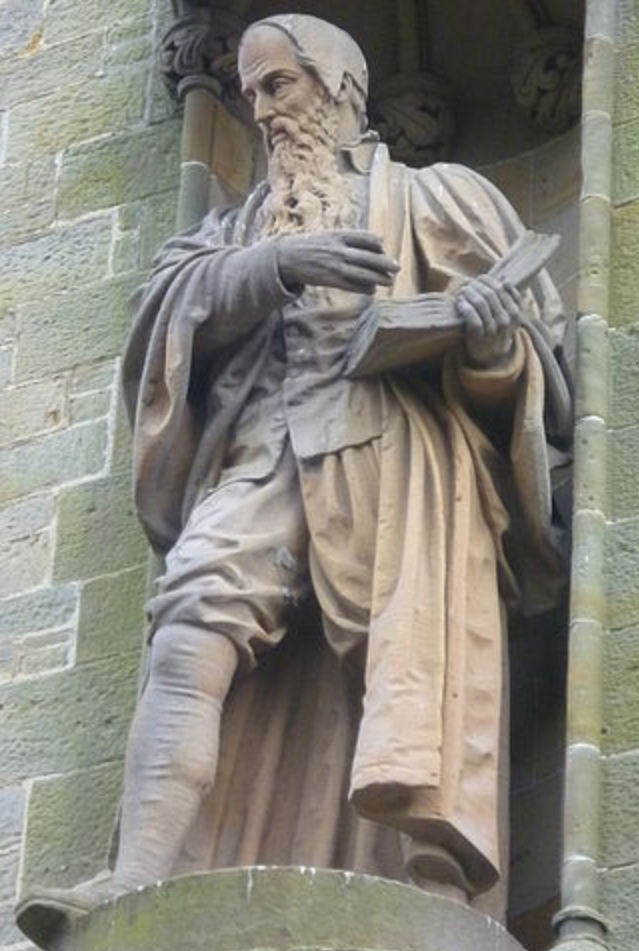
Robert Baillie, in a speech delivered before the General Assembly in 1647 upon the death of this great churchman, declared of his late friend, “That glorious soul of blessed memory, who now is crowned with the reward of all his labours for God and for us, I wish his remembrance may be fragrant among us, so long as free and pure Assemblies remain in this land, which we hope shall be to the coming of our Lord. You know he spent his strength, and wore out his days, he breathed out his life in the service of God and of his Church. This binds it on our back, as we would not prove ungrateful, to pay him his due. If the thoughts of others be conform to my inmost sense, in duty and reason, he ought to be accounted by us and posterity, the fairest ornament, after John Knox, of incomparable memory, that ever the Church of Scotland did enjoy.”

And check our our entire audio library here.

Read Full Post »

The following two quotes are taken from George Gillespie’s An Assertion of the Government of the Church of Scotland (1641). They seem to me to have a bearing on the question of the ‘indigenous principle’ that our denomination, the Presbyterian Reformed Church, has advocated since its inception in 1965. That is, presbyterian churches ought ideally to develop their own nationally autonomous bodies distinct from others outside their borders; or, trans-national denominations, especially when ‘centered’ in one particular nation, should be avoided or superseded as impractical, and liable to hierarchicalism or a kind of church-imperialism. These quotes in particular demonstrate that historic presbyterianism, while holding out a gradation of church courts, nevertheless accepts as valid smaller and even the smallest church units when circumstances on the ground prevent more.

“Add unto these a distinction betwixt a congregation lying alone in an island, province or nation, and a congregation bordering with sister churches. If either there be but one congregation in a kingdom or province, or if there be many far distant one from another, so that their pastors and elders cannot ordinarily meet together, then may a particular congregation do many things by itself alone, which it ought not to do where there are adjacent neighbouring congregations, together with which it may and should have a common presbytery” (43).

(more…)

Read Full Post »

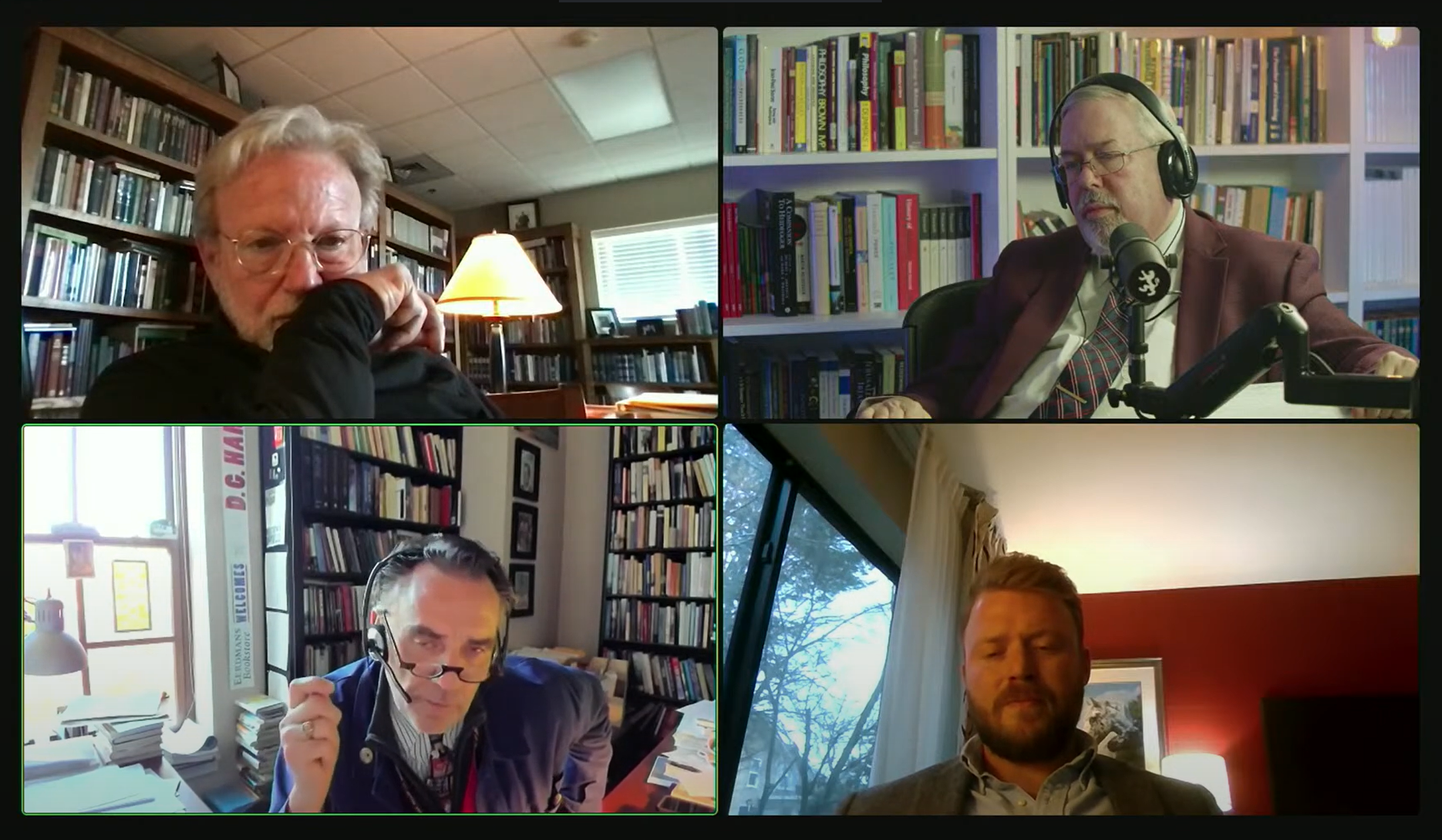
Establishments got some good press last week, at least on a respectable Reformed podcast. Kudos to Christ the Center for welcoming on Timon Cline to a panel discussion last Friday. While I’ve never heard of Timon before, I am sure going to read and listen to more of him. And I’m sure I’m not alone!

The panel discussion focused on Dr. Alan Strange’s newly published book, Empowered Witness: A Panel Discussion on Politics, Culture, and the Spiritual Mission of the Church. Giving feedback and critiques were D. G. Hart, Nick Wilborn, and Timon Cline. I’ve not read Strange’s book, so I’m only commenting on the video. The discussion up to Timon and related rejoinders was interesting enough. But Timon sure rocked the boat pretty hard when he brought up the obvious (at least from a historical Reformed perspective and not an American echo-chamber), that is, what about the spiritual nature in the church in light of the classic, confessionally Reformed and Presbyterian endorsements of religious establishments?

It’s clear that Dr. Strange was a bit flustered, though keeping a gracious demeanor. Sadly, though a respectable and accomplished Reformed scholar whom I otherwise appreciate, Strange’s response to Timon was more or less a rigmarole of informal fallacies and non-answers. Hart, however, just became flummoxed and unhinged. In contrast to Cline’s calm, measured demeanor, and even more importantly, to his much more careful, close, and logical reasoning (they guy’s a practicing lawyer, and it shines), Hart just full-on melted down, notwithstanding a clever little jab about Timon’s alleged tap-dancing like James Cagney. But even that was more amusing than apropos, as it only thinly veiled his chagrin. The young no-namer clearly bested his betters.

(more…)

Read Full Post »

Just completed recording Thomas Halyburton’s “A Christian’s Belief Under Troubles: Two Sermons After the Death of a Friend.” Access this three-part series and other titles here. View my full audio library here. (And please drop me a note if any link fails: michael at reformedparish dot com).

The following introduction is taken from the James Begg Society.

* * * *

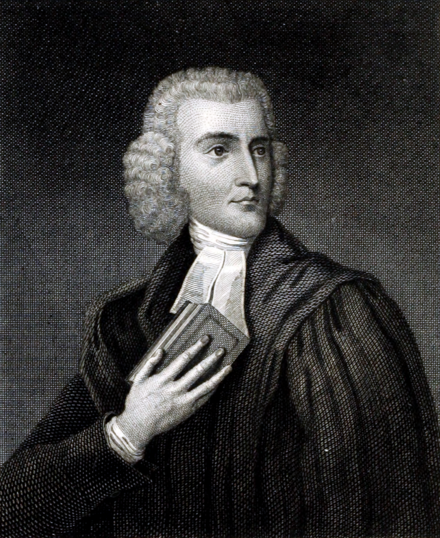
THOMAS Halyburton (1674-1712) was born into a family of Scottish Covenanters. His Father, Rev. George Halyburton, was a minister in the Reformed Church of Scotland until his ejection in 1662. Twenty years later George was denounced by the Privy Council of Scotland for holding “conventicles” (church services in the open air, unauthorised by the established church and outlawed by the government in those days). After his father’s death, young Thomas’s family (mother and sister) fled to Rotterdam in order to avoid the fierce persecution which was carried on against the Covenanters, where Thomas had his early education in the school of Erasmus. Following the Revolution, he returned to Scotland and continued his education.

After a period of inner struggle with the philosophy of Deism, God sovereignly and graciously enlighened Thomas’s soul, and gave him saving faith in the Lord Jesus Christ. He became committed to the same Reformed Christian religion as his father, and followed in his footsteps as a minister of the gospel. On completing theological training, Thomas was licenced to preach in the Church of Scotland by Queen Anne, and ordained to the ministry of the church in Ceres, Fife. The church was part of the presbytery of Kirkcaldy.

After faithfully pastoring the church in Ceres for ten years, Rev. Dr. Halyburton became Professor of Theology at St. Leonard’s College in St. Andrews.

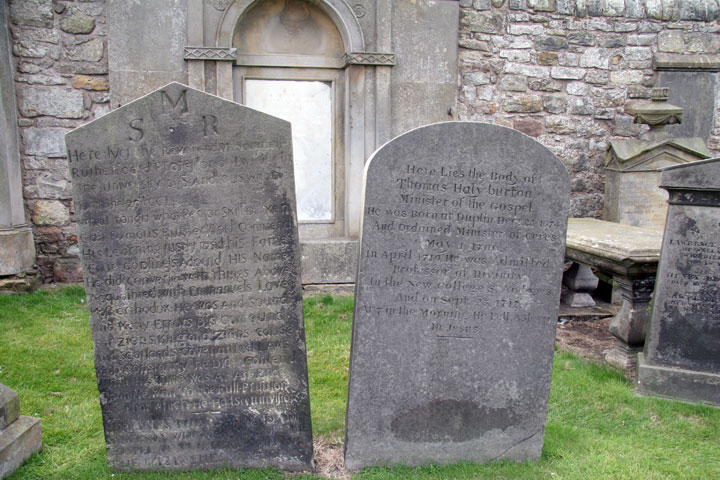
He died two years later at the age of 38, following an illness. At his request, his body was buried in St. Andrews next to his favourite Christian minister, Rev. Dr. Samuel Rutherford.

Thomas Halyburton’s theological and apologetic writings are marked by a distinctive thoroughness. The surviving scripts of his sermons show him to have been richly theological, deeply experimental (i.e. dealing with the experiences of the soul) and very practical — a master of the classic Puritan style of preaching.

* * * *

Have you been blessed by these recordings? Could you possibly help with a one-time gift, or perhaps a monthly recurring donation of $2, $3, or $5? Donations can be made here. Please earmark your contribution in the notes “WPE Audio,” as it will be processed through the Reformed Parish Mission. Donations will offset the monthly SermonAudio expenses; and any excess will go towards supporting my efforts to bring the Reformed faith to the working class, immigrant, and Hispanic populations here in the U.S.

Read Full Post »

A tremendous, two-part treatment that anyone identifying with historic Presbyterian should read by my friend, Matthew Vogan.

* * * *

Whole doctrine catholicity | “Who is she that looketh forth as the morning, fair as the moon, clear as the sun, and terrible as an army with banners” (Song 6:10)?

Read Full Post »

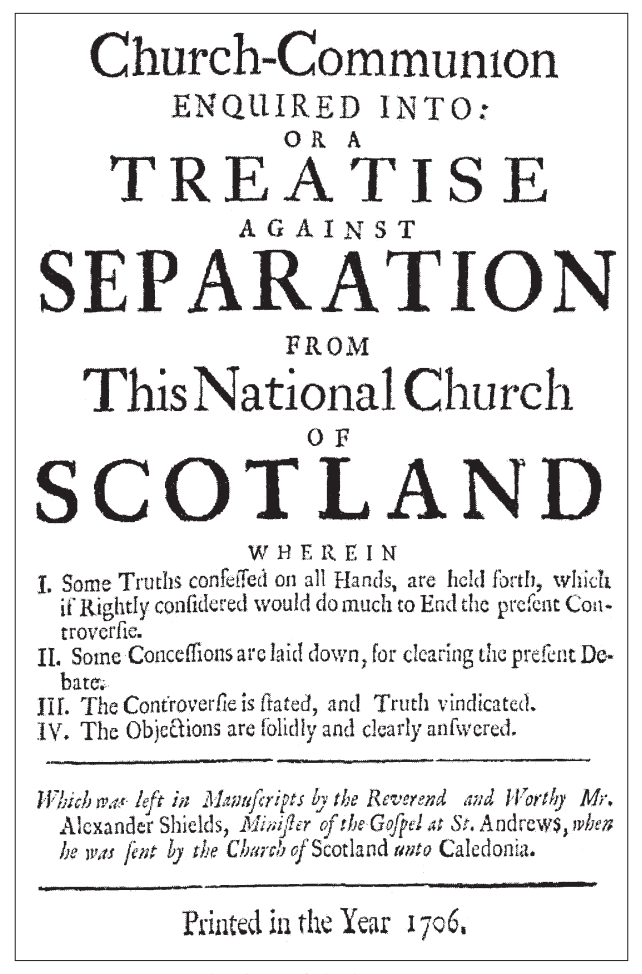
Just finished reading and recording Alexander Shield’s Church Communion Inquired Into (1706). Listen to it here, or read it below. This treatise is such a highwater-mark of classic Presbyterianism, with particular focus on the visible unity of the Church of Christ. It was his heartfelt, pastoral appeal to his brethren who refused to enter the Revolution Church of 1690 on account of its putative corruptions, urging them to reconsider their separation. It is not the easiest of reads, for sure, as it was written in the midst of controversy, among other things. But it is a definitive work on Presbyterian catholicity, right after James Durham’s On Scandal. Here is a very moving appeal from his conclusion:

“Keep your Zeal lively against all sin, but let it have two edges, to resent the Dishonour done to God, by Schism as well as defection; let it be Ballanced with Charity, and managed with Discretion. And we request you, that you study Uniformity in your Zeal, that you be not like Cake unturned, hot for some lesser Points in Religion, and cold for other Duties, but with a regular Proportion to their Concern in the Vitals of Religion. Let Religion be more in your Heart than Head, in Practice than in Controversie. Neglect not the Duties of your General Calling of Piety towards God, Sobriety in your selves, Righteousness and Mercy to Men, Brotherly Love, and Holy Christian Fellowship; And forget not the relative Duties of your particular Callings. Have a care of the Idleness of busy Bodies. 1 Thess. 4.11. But study to be quiet, and do your own business, and to work with your own hands. Beware of them that cause Divisions and Offenses, and avoid them. And look on them that blow the Bellows of Contention as no Friends to your or the Church’s Interest. Finally, study to be United one with another, and with your Pastors make Acquaintance, and entertain frequent and Friendly Converse with them, receive the Law at their Mouth, for they are the Messengers of the Lord of Hosts: Grieve them not by your Contempt, or continued Withdrawing, lest they be put to Complain of you to God, and it become Sin unto you.”

Here is a summary of the author by Matthew Vogan: “Alexander Shields (1660?–1700) is less well known than other field preachers such as Donald Cargill, Richard Cameron, and James Renwick. One of the last of the field preachers and a close associate of James Renwick, he was also a prisoner on the Bass Rock. He was a prolific writer and ably defended the Covenanter principles in the classic book A Hind Let Loose. After the Revolution of 1689, he was chaplain to the Cameronian regiment fighting against France in defence of Holland and the Protestant cause. In 1699, he was also among the first foreign missionaries of the Church of Scotland in the infamous Darien venture to what is now known as Panama. He died and was buried in Jamaica in 1700 at the age of forty. John Macleod well describes him as ‘one of the most striking figures of his epoch’. The life of this zealous young man is uniquely interesting and instructive.” Learn more about Shields and this treatise in Vogan’s two-part article, “Alexander Shields, the Revolution Settlement and the Unity of the Visible Church” (2013).

Whole doctrine catholicity | “Who is she that looketh forth as the morning, fair as the moon, clear as the sun, and terrible as an army with banners” (Song 6:10)?

Listen to other titles at WPE Audio

* * * *

Whole doctrine catholicity | “Who is she that looketh forth as the morning, fair as the moon, clear as the sun, and terrible as an army with banners” (Song 6:10)?

Read Full Post »

Have a listen to recorded sermons by the Second Reformation divine, the great architect of the Church of Scotland in that era, Alexander Henderson. More titles from this and other expanding shelves in my audio library here.

Principal John Macleod in his definitive work, Scottish Theology in Relation to Church History (1943), wrote the following:

“There are great times in which a crop of great men is raised up. In one sense all times are great by reason of the opportunities which they offer and the duties for which they call. Men in quiet times, however, live in an age that tells on the more stirring times ahead and their influence will contribute to the stir and bustle of those times when they come. The quiet times see the stream of life running a more smooth and less exciting course. They may be said to be the days of the average man or of the leading man that is distinctly small. The days of the Second Reformation were not of the tame an uneventful kind. They were days when things happened that are not forgotten and great men appeared on the field and had the chance to show their quality. The leader of the Church of Scotland in those days was not one of the creatures of the court exalted to dignified office above his brethren. There were such men with honours thrust upon them—yet not against their will—strutting their petty hour upon the stage. They were, however, but the puppets and tools of the royal policy. The leader who emerged when the call his work came was the minister of a quiet parish in Fife where he had almost as his next neighbor the Archbishop of St Andrews. The Archbishop was Spottiswoode, and the minister was Alexander Henderson.”

[Is a link broken? Please drop me a note! mjives dot refparish at gmail dot com]

Read Full Post »

Just finished recording this masterful article by Principle John Macleod (1872-1948) of the Free Church of Scotland. While it is somewhat encumbered by historical details less familiar to the American reader, it is still a fresh, perceptive, and prophetic appeal for the old adherence to full, good faith subscription to the Confession of Faith. If you’re a historic Presbyterian belonging to or respectful of the old Church of Scotland and Free Church testimonies, you owe it to yourself. The PDF of the article is below; and here is a ‘handful of purpose’:

“The Churches of Scotland were unprepared for the day that had overtaken them. In their halting uncertainty they suffered a tendency that was inimical to their historical faith to effect a lodgment in their bosom. They lost sight of the essential simplicity of the Christian position- “Heaven’s easy artless unencumbered plan.” When John tells us that he wrote his Gospel that we might believe that Jesus is the Christ, the Son of God and that believing we might have life through His Name he thought the witness borne by his fellows and himself to be ground enough for the faith of Christians to build upon. Christian faith through the ages has responded to this claim. It was the claim not only of the Apostle but of the Holy Ghost who spoke in him. It is undoubtedly the mind of the Spirit that the evidence which He thus bore to the truth as it is in Jesus should suffice for the Church of God to the end of time and to the ends of the earth. What was thus in the Gospels claimed by the Apostles for the witness that they bore they claimed for their teaching in the Epistles. They spoke not in the words which man’s wisdom teaches but which the Holy Ghost teaches. They could say, ‘We are of God: he that knoweth God heareth us; he that is not of God heareth not us.’ Such claims were in full keeping with the promises given to them in the Upper Chamber. There has been from the beginning a Holy Catholic Church -define it how we may- to whose care and keeping the New Testament books were committed and from whose hands in successive generations her children have received them as being alike in their witness and in their teaching the crystallised and perpetuated ministry of the Apostles. As many as are willing to sit at their feet, as they thus continue to bear witness and to teach, will learn to treat the Old Testament. Scriptures as the Lord and His Apostles did. Here we have the common view of Holy Writ held throughout historical Christendom. On this view the whole structure of Christian Theology is built. To maintain the superstructure we must defend the substructure.”

Check out my growing audio library here.

* * * *

Whole doctrine catholicity | “Who is she that looketh forth as the morning, fair as the moon, clear as the sun, and terrible as an army with banners” (Song 6:10)?

Read Full Post »

« Newer Posts - Older Posts »