Religious establishments are built upon the divine economy, both of nature and of grace:“They are the overflowings of the Nile which have given rise to the irrigations of an artificial husbandry in Egypt, for the distribution of its waters. And there is positively nothing in the doctrine of a sanctifying or fertilizing grace from heaven above, which should discharge us—but the contrary—from what may be termed the irrigations of a spiritual husbandry in the world beneath. It is not enough that there be a descent; there must be a distribution also, or ducts of conveyance, which, by places of worship and through parishes, might carry the blessings of this divine nourishment to all the houses and families of a land” (Thomas Chalmers, Works 17:190-91).
A really solid and balanced article by Zach Groff. Sadly necessary these days in some conservative Reformed circles.
Also, Groff mentions a sermon by Robert Murray M’Cheyne, “Our Duty to Israel.” I recorded that in audio not long ago: you can access that here. He also mentions M’Cheyne’s mentor, Thomas Chalmers. Here is a lecture of his on Romans 11, on Paul’s prophecy of the Jews’ future repentance and embrace of their rejected Messiah. And check out the entire WPE Audio library by clicking the tab at the top.
This was a really helpful biographical sketch of the great Presbyterian preacher of the Scottish Highlands, Lachlan Mackenzie (1754-1819). Below that are a collection of his sermons. Listen to some of his material I’ve recorded in audio here. And visit my entire audio library here.
Before reading of him in Principal John Macleod’s Scottish Theology in Relation to Church History, I had never heard of John Maclaurin. A contemporary of Jonathan Edwards and Thomas Boston, he stood within the old Evangelical wing of the Church of Scotland during the long, wintry reign of Moderatism. Impressed with the high praise for his sermon “Glorifying in the Cross of Christ,” I recorded it here. Here is a rich sample from Maclaurin as he waxes eloquent on the “fabric of nature” visibly responding to the horror of the death of the Prince of life:
“The frame of nature solemnized the death of its Author; heaven and earth were mourners; the sun was clad in black; and if the inhabitants of the earth were unmoved, the earth itself trembled under the awful load. There were few to pay the Jewish compliment of rending their garments; but the rocks were not so insensible, they rent their bowels. He had not a grave of his own; but other men’s graves opened to him. Death and the grave might be proud of such a tenant in their territories; but he came not there as a subject, but as an invader, a conqueror. It was then the king of terrors lost his sting; and on the third day the Prince of life triumphed over him, spoiling death and the grave. But this last particular belongs to Christ’s exaltation: the other instances show a part of the glory of his humiliation, but it is a small part of it.”
You can read more about Maclaurin in the PDF below, taken from Macleod’s work and the DSCH&T. And be sure to check out other audio titles from the Old Church of Scotland and the entire West Port Audio library.
“For the accomplishment of this, there must not only be a going forth on the vast and untrodden spaces that are without; there must be a filling up of the numerous and peopled vacancies that are within—a busy, internal locomotion, that might circulate, and disperse, and branch off to the right and to the left, among the many thousand families which are at hand: and thoroughly to pervade these families; to make good a lodgment in the midst of them, for the nearer or the more frequent ministrations of Christianity than before; to have gained welcome for the Gospel testimony into their houses, and, in return, to have drawn any of them forth to attendance on the place of Sabbath and of solemn services—this, also, is to act upon our text, this is to do the part, and to render one of the best achievements of a missionary.”
Came upon this choice piece from Boston’s Memoirs. A series of questions put to a prospective communicant. The first question I find rather insightful—I’ve long tended to think that a working understanding of the Shorter Catechism is basically the cognitive side of Presbyterian terms of communion. Without reaching that bar, the session ought to delay that applicant and give further instruction (L. Cat. 173). Also, there is explicit submission to church discipline.
I am aware that Boston arguably had some “independent” aspects to his presbyterianism, and perhaps this reflects too much a likeness to the old Congregational “church covenants?” But whatever the case, I find this explicit consent and covenanting commendable:
“And if the Session be satisfied in this also, the party is to be put explicitly to consent to the Covenant (whereof he desires the seal), to be the Lord’s, live under Him, and serve Him all the days of his life, by answering expressly the following (or the like) questions: 1. Do you believe the doctrine of the Shorter Catechism of this Church, so far as you understand the same, to be the true doctrine agreeable to the Holy Scriptures, and resolve through grace to live and die in the profession of the same? 2. Do you consent to take God in Christ to be your God, the Father to be your Father, the Son to be your Saviour, and the Holy Ghost to be your Sanctifier; and that, renouncing the devil, the world and the flesh, you be the Lord’s for ever? 3. Do you consent to receive Christ, as He is offered in the gospel, for your Prophet, Priest and King; giving up yourself to Him, to be led and guided by His Word and Spirit; looking for salvation only through the obedience and death of Jesus Christ, who was crucified without the gates of Jerusalem; promising in His strength to endeavour to lead a holy life, to forsake every known sin, and to comply with every known duty? 4. Lastly, do you promise to subject yourself to exhortation, admonition, and rebuke, and the discipline of the Church, in case (which God forbid !) you fall into any scandalous sin?”
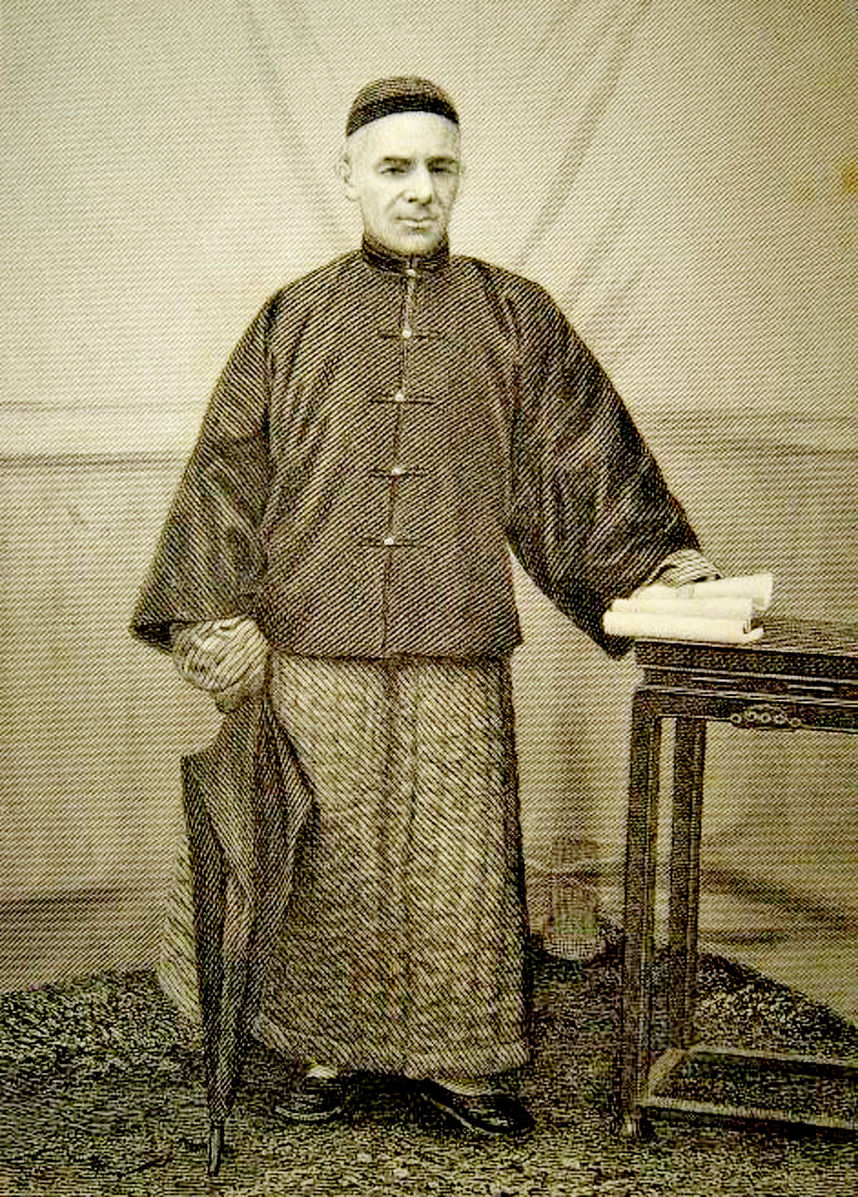
The following is a portion from William Chalmers Burns‘ sermon “I am Debtor,” from Romans 1:14. Burns was a good friend and ministerial colleague to Robert Murray M’Cheyne, and was a heroic Presbyterian missionary to China. Listen to the full audio recording here. And for more audio resources, click on the WPE Audio tab at the top.
* * * *
The apostle says something more than this, — “I am debtor both to the Greeks, and to the Barbarians; both to the wise, and the unwise.” The meaning of this seems to be, — if I were free to make a choice, I might choose the barbarian or I might choose the Greek, I might choose the wise or the unwise; but Paul says, I am debtor, and you know a debtor has no such thing as a choice to make to whom he will pay his debts. The debtor knows this, and the believer feels it just in the same way. “Whatever my calculations may be, or whatever I might myself desire, the question is not, what would I like, but what is my commission, — what are the objects of my embassy? It is not my choice that I have to do with, but God’s commission, — what instructions does it contain?”
We would fain impress this important, solemn truth upon God’s children. Believer, do you feel this? Do you know what it is to feel yourself a debtor to a lost world? Have you ever thought of what object Christ had in view when He brought you to Himself? what design He had in calling you? It was certainly, in the first instance, to save you from perdition, but that was not the only end. It is possible to think too much, or, at least, too exclusively, about your own case. In one sense you cannot do that; woe be to him who seeks to pull the mote out of a brother’s eye, when a beam is in his own. But yet a believer must remember that he is called to know Christ, not only to be safe himself, but also that he may be a witness for Christ in the world. Ah! think of this; don’t be selfish in the matter of salvation, and remember above all, that his is not a thing which you may or may not do, just as you like. Some people do much in this way, just because they have a liking to it, and because the employment suits their taste – and it is a happy thing to feel that; but there is a far more unchangeable foundation for a believer’s labour in the Lord’s vineyard than that. The man is no longer free to like, or not to like; he is a debtor now – a debtor to do it fully, and constantly, and unceasingly, and devotedly, whether he likes it or not. Think of it in this light, and then you will be going and hasting to tell your friends, and all whom you know, of these precious things of God. Oh, if this were fully felt, and felt universally , how many would be preaching whose mouths are dumb through sloth and idleness! There would be fewer preaching as a trade, and more preaching as debtors, forevery believer would then have a voice with which to sound the praises of the most high God.
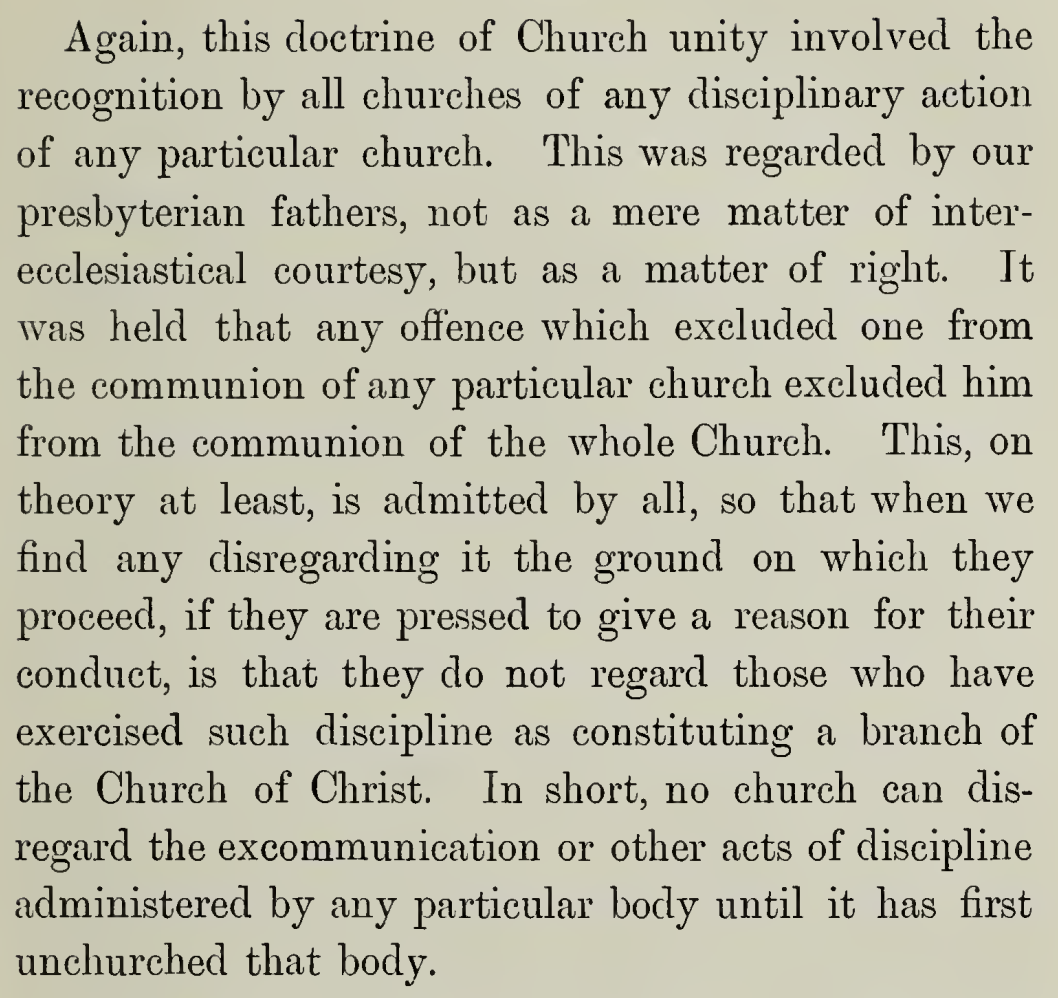
MacPherson explains the radically catholic ecclesiology of our Scottish Presbyterian forbears. Listen to an audio recording of the chapter where he treats this subject here.
Whole doctrine catholicity | “Who is she that looketh forth as the morning, fair as the moon, clear as the sun, and terrible as an army with banners” (Song 6:10)?
This author is evidently not orthodox, but some good history and analysis here nonetheless. Not sure what I think of his central thesis in the second, but certainly good grist for the mill.
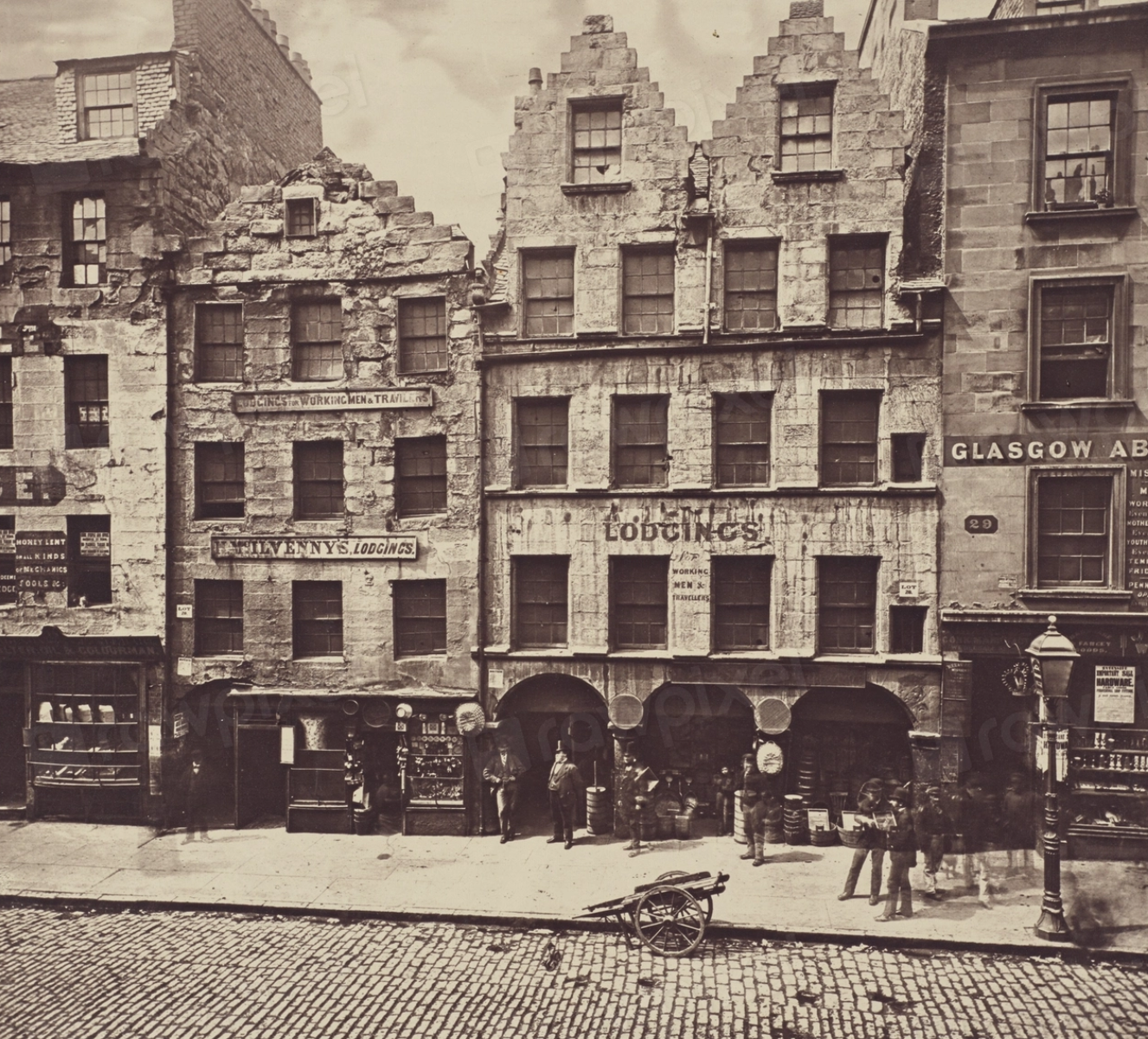
In this public lecture of the Scottish Reformation Society, I will be discussing Thomas Chalmers’ (1780-1847) defense of church establishments over against Adam Smith’s critique. Chalmers championed such an establishment as a “Great Home Mission.”‘ Yet is this a merely an academic question? Does Chalmers have something to offer is in modern, pluralistic America? You might be surprised. Join us Friday, October 18 at 2:30 p.m. Eastern-U.S. / 7:30 p.m. U.K. Watch throughFacebook Live. More information below:



 West Port Experiment