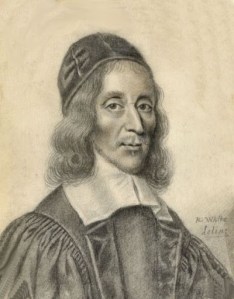
The following chapter entitled, “The Parson Catechizing,” is taken from George Herbert’s (1593-1633) classic of pastoral theology, A Priest to the Temple, or, The Country Parson his Character and Rule of Holy Life. Herbert, a celebrated English poet, was a minister in the Church of England. Though a conformist, his work surely merits serious attention by the heirs of nonconformity – a definitely pre-Baxter Baxterian. May the lost duty & art of pastoral catechizing be revived and stimulated by this rich contribution! [Recorded in audio here.]
* * * *
The Country Parson values catechizing highly: for there being three points of his duty; the one, to infuse a competent knowledge of salvation in every one of his flock; the other, to multiply, and build up this knowledge to a spiritual temple; the third, to inflame this knowledge, to press, and drive it to practice, turning it to reformation of life, by pithy and lively exhortations; catechizing is the first point, and but by catechizing, the other cannot be attained. Besides, whereas in sermons there is a kind of state, in catechizing there is an humbleness very suitable to Christian regeneration; which exceedingly delights him as by way of exercise upon himself, and by way of preaching to himself, for the advancing of his own mortification; for in preaching to others, he forgets not himself, but is first a sermon to himself, and then to others; growing with the growth of his parish.
He useth, and preferreth the ordinary church catechism, partly for obedience to authority, partly for uniformity sake, that the same common truths may be every where professed, especially since many remove from parish to parish, who like Christian soldiers are to give the word, and to satisfy the congregation by their catholic answers.
Below is a tremendous sermon Thomas Chalmers preached on the scourge of cholera in Britain in the year 1832. In it, we see God as the First Cause hearing and answering prayer either lower or higher up on the chain of secondary causes. Masterful. And also instructive as the world watches the vicious spread of Ebola. Listen to the sermon here. And access more titles I’ve recorded by Thomas Chalmers.
* * * *
ON THE CONSISTENCY BETWEEN THE EFFICACY OF PRAYER AND THE UNIFORMITY OF NATURE.
“Knowing this first, that there shall come in the last days scoffers, walking after their own lusts, and saying, Where is the promise of his coming ? for since the fathers fell asleep, all things continue as they were from the beginning of the creation” (2 Peter 3:3-4).
The infidelity spoken of in our text, had for its basis the stability of Nature, or rested on the imagination that her economy was perpetual and everlasting-and every day of Nature’s continuance added to the strength and inveteracy of this delusion. In proportion to the length of her past endurance, was there a firm confidence felt in her future perpetuity. The longer that Nature lasted, or the older she grew, her final dissolution was held to be all the more improbable-till nothing seemed so unlikely to the atheistical men of that period, as the intervention of a God with a system of visible things, which looked so unchanging and so indestructible. It was like the contest of experience and faith, in which the former grew every day stronger and stronger, and the latter weaker and weaker, till at length it waswholly extinguished ; and men in the spirit of defiance or ridicule, braved the announcement of a Judge who should appear at the end of the world, and mocked at the promise of His coming.
But there is another direction which infidelity often takes, beside the one specified in our text. It not only perverts to its own argument, what experience tells of the stability of Nature ; and so concludes that we have nothing to fear from the mandate of a God laying sudden arrest and termination on its processes. It also perverts what experience tells of the uniformity of Nature; and so concludes that we have nothing either to hope or to fear from the intervention of a God during the continuance or the currency of these processes. Beside making Nature independent of God for its duration, which they hold to be everlasting, they would also make Nature to be independent of God for its course, which they hold to be unalterable. They tell us of the rigid and undeviating constancy from which Nature is never known to fluctuate; and that in her immutable laws in the march and regularity of her orderly progressions, they can discover no trace whatever of any interposition by the finger of a Deity. It is not only that all things continue to be as they were from the beginning of creation-causes and effects following each other in wonted and invariable succession, and the same circumstances ever issuing in the same consequents as before. With such a system of things, there is no room in their creed or in their imagination for the actings of a God. To their eye Nature proceeds by the sure footsteps of a mute and unconscious materialism; nor can they recognise in its evolutions those characters of the spontaneous or the wilful, which bespeak a living God to have had any concern with it. He may have formed the mundane system at the first: He may have devised for matter its properties and its laws: but these properties, they tell us, never change; these laws never are relaxed or receded from. And so we may as well bid the storm itself cease from its violence, as supplicate the unseen Being whom we fancy to be sitting aloft and to direct the storm. This they hold to be a superstitious imagination, which all their experience of Nature and of Nature’s immutability forbids them to entertain. By the one infidelity, they have banished a God from the throne of judgment. By the other infidelity, they have banished a God from the throne of providence. By the first, they tell us that a God has nought to do with the consummation of Nature ; or rather, that Nature has no consummation. By the second, they tell us that a God has nought to do with the history of Nature. The first infidelity would expunge from our creed the doctrine of a coming judgment. The second would expunge from it the doctrine of a present and a special providence, and the doctrine of the efficacy of prayer.
I’m certainly not well-versed in the current Reformed debates on the two kingdoms. But what I have read in some quarters has given me the impression that the two kingdoms, church and state, ought to be as two ships passing in the night. Each are on their own charted courses and should steer quite (quite!) clear of each other.
Now, this may be a position held in modern confessionally Reformed circles. And it may have a pedigree going back to early 18th century American Presbyterianism. But if my impression approximates to reality, then the position of some can hardly be advanced as classically reformed. It may employ Melville’s famous terminology of the two kingdoms, but not the substance.
In my recent reading of the First and Second Books of Discipline (1560 and 1578 respectively) drafted by the architects of Presbyterianism, it is clear that the two kingdoms were to be distinct. They ought not intrude on each other’s territory. But note how they envisaged the ideal relationship, as recorded in the opening sections of the Second Book of Discipline:
10. The civil power should command the spiritual to exercise and do their office according to the word of God. The spiritual rulers should require the Christian magistrate to minister justice and punish vice, and to maintain the liberty and quietness of the kirk within their bounds.
11. The magistrate commands external things for external peace and quietness amongst the subjects; the minister handles external things only for conscience cause.
12. The magistrate handles external things only, and actions done before men; but the spiritual ruler judges both inward affections and external actions, in respect of conscience, by the word of God.
13. The civil magistrate craves and gets obedience by the sword and other external means, but the ministry by the spiritual sword and spiritual means.
14. The magistrate neither ought to preach, minister the sacraments, nor execute the censures of the kirk, nor yet prescribe any rule how it should be done, but command the ministers to observe the rule commanded in the word, and punish the transgressors by civil means. The ministers exercise not the civil jurisdiction, but teach the magistrate how it should be exercised according to the word.
15. The magistrate ought to assist, maintain, and fortify the jurisdiction of the kirk. The ministers should assist their princes in all things agreeable to the word, provided they neglect not their own charge by involving themselves in civil affairs.
Hardly did the Scottish Reformers admit the “Am I my brother’s keeper?” principle in their concept of the two kingdoms. No, Cain ought not intermeddle in Abel’s affairs. But neither should he ignore him as though he had relationship whatsoever. The civil magistrate was to have a concern and exert his influence in the Kirk circa sacris. So likewise the Kirk had a prophetic mantle to tell the civil magistrate how he ought to rule the people!
 I’m certainly not well-versed in the current Reformed debates on the two kingdoms. But what I have read in some quarters has given me the impression that the two kingdoms, church and state, ought to be as two ships passing in the night. Each are on their own charted courses and should steer quite (quite!) clear of each other.
 West Port Experiment