Feeds:
Posts
Comments

Archive for the ‘Audio Resources’ Category

Just finished recording this masterful article by Principle John Macleod (1872-1948) of the Free Church of Scotland. While it is somewhat encumbered by historical details less familiar to the American reader, it is still a fresh, perceptive, and prophetic appeal for the old adherence to full, good faith subscription to the Confession of Faith. If you’re a historic Presbyterian belonging to or respectful of the old Church of Scotland and Free Church testimonies, you owe it to yourself. The PDF of the article is below; and here is a ‘handful of purpose’:
“The Churches of Scotland were unprepared for the day that had overtaken them. In their halting uncertainty they suffered a tendency that was inimical to their historical faith to effect a lodgment in their bosom. They lost sight of the essential simplicity of the Christian position- “Heaven’s easy artless unencumbered plan.” When John tells us that he wrote his Gospel that we might believe that Jesus is the Christ, the Son of God and that believing we might have life through His Name he thought the witness borne by his fellows and himself to be ground enough for the faith of Christians to build upon. Christian faith through the ages has responded to this claim. It was the claim not only of the Apostle but of the Holy Ghost who spoke in him. It is undoubtedly the mind of the Spirit that the evidence which He thus bore to the truth as it is in Jesus should suffice for the Church of God to the end of time and to the ends of the earth. What was thus in the Gospels claimed by the Apostles for the witness that they bore they claimed for their teaching in the Epistles. They spoke not in the words which man’s wisdom teaches but which the Holy Ghost teaches. They could say, ‘We are of God: he that knoweth God heareth us; he that is not of God heareth not us.’ Such claims were in full keeping with the promises given to them in the Upper Chamber. There has been from the beginning a Holy Catholic Church -define it how we may- to whose care and keeping the New Testament books were committed and from whose hands in successive generations her children have received them as being alike in their witness and in their teaching the crystallised and perpetuated ministry of the Apostles. As many as are willing to sit at their feet, as they thus continue to bear witness and to teach, will learn to treat the Old Testament. Scriptures as the Lord and His Apostles did. Here we have the common view of Holy Writ held throughout historical Christendom. On this view the whole structure of Christian Theology is built. To maintain the superstructure we must defend the substructure.”

Check out my growing audio library here.

* * * *

Whole doctrine catholicity | “Who is she that looketh forth as the morning, fair as the moon, clear as the sun, and terrible as an army with banners” (Song 6:10)?
Read Full Post »

Read Full Post »

“Our Reformers were men of great wisdom, undaunted courage, irrepressible zeal and strong faith. They relied not on human expediency, vain traditions, or worldly wisdom, but on God’s promised blessing on His own means. They went direct to the Bible for all their plans, and the result was that every rag of rotten Popery, and every relic of the Amorite was purged away, and cast forth as things accursed into the region of eternal detestation, and the pure evangel set up instead. In the language of George Gillespie:

‘The Church of Scotland was blessed with a more glorious and perfect reformation than any of our neighbor Churches. The doctrine, discipline, regiment, and policy established here by ecclesiastical and civil laws, and sworn and subscribed unto by the king’s majesty and [the] several presbyteries and parish churches of the land, as it had the applause of foreign divines; so was it in all points agreeable unto the word; neither could the most rigid Aristarchus of these times challenge any irregularity of the same.'”

* * * *

These words are drawn from the opening of David Hay Fleming’s four-part series of articles in the Original Secession Magazine in 1878 entitled, “The Discipline of the Reformation.” I’ve just finished recording the fourth today. Listen to them here. The PDF is below. And check out more titles in my expanding amateur audio library.

I do not suggest that everything our fathers in the Reformation and Second Reformation did or said regarding discipline should be carried over in toto today. Nor do I think Fleming himself thought this. But before we too quickly dismiss what we may judge austere or harsh, let us consider that we are just as much creatures of our time as they were. And if we shouldn’t be slaves to their judgments, yet we still ought to honor father and mother. And listen to them in the first case!

[image source]

Read Full Post »

Just finished reading-recording this sermon by the founder of Connecticut, the Puritan Thomas Hooker, entitled, “The Danger of Desertion.” This was Hooker’s farewell sermon to his congregation in England before venturing across the Atlantic. It is one of the most impactful, profound, and weighty sermons I have read in some time. Please, please do yourself a favor and read it. If you are a sincere Christian not in a state of gross backsliding, it will hit you square in the eyes. And if you are, it just may jolt your out of your complacency!

Cling to God. Hard. Until your knuckles are white. And your nailbeds bleed. Do not let Him go! That’s the message. And more, it was a message to England, and so to any Christian nation that has had the privilege of the presence of God.

And here’s the same in PDF:

Read Full Post »

Ever read this classic of pastoral theology? Perhaps you should. But if you could use it in audio format, I’m making progress in recording it into mp3. Access it here (and more to follow).

Consider these contemporary endorsements from the Banner edition, then I challenge you not to ‘take up and read.’ Or, now listen, if you prefer!

“This book has been my companion for almost fifty years. First published in 1830, it is arguably more needed now than then. It is a classic, serving as a guide to all who are aware of the perils and privileges of pastoral ministry.” — Alistair Begg

“People ask me, “What’s the very best book for Ministers?” Overall for the ministry, and for passionate preaching, and how to preach to different kinds of people – there’s nothing like The Christian Ministry.” — Joel Beeke

For more titles, see my growing amateur audio library. [And if any links fail, kindly drop me a note: mjves dot refparish at gmail dot com. Thanks!]

Read Full Post »

Here is a truly momentous and historic sermon by John Cotton. Richly theological, eminently practical, and tenderly pastoral. On the occasion of the embarking of John Winthrop and company to the Massachusetts Bay in 1630.

The sermon is especially valuable for its contribution to a “theology of place” and the Christian ethics of travel, relocation, and lawful acquiring of land. Have a listen!

One precious gem: “Ruth dwelt well for outward respects while shee dwelt in Moab, but when shee cometh to dwell in Israel, shee is said to come under the wings of God: Ruth 2. 12 . When God wrappes us in with his Ordinances, and warmes us with the life and power of them as with wings, there is a land of promise.”

And check out my growing audio library, including the Puritan fathers of New England.

Read Full Post »

[video now posted here]

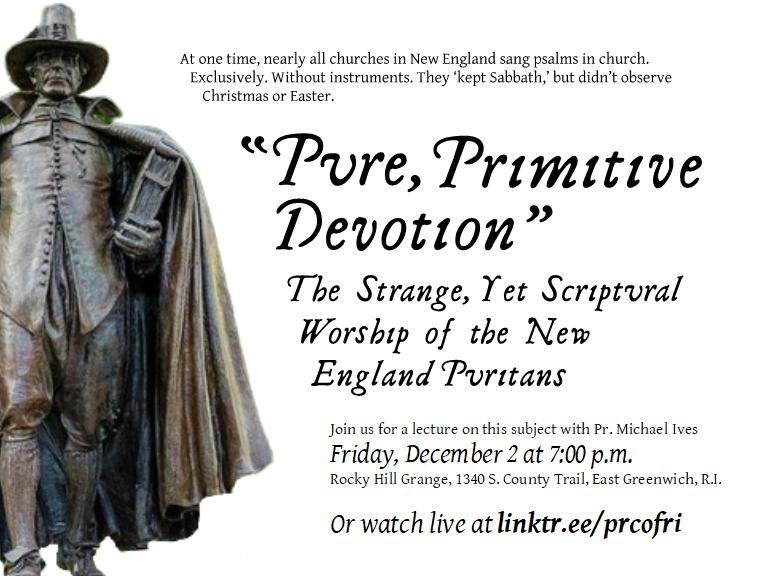
Watch by FacebookLive, or tune in at linktr.ee/prcofri

Read Full Post »

This message was delivered at the Presbytery Conference of the Presbyterian Reformed Church on June 16, 2022. The audio is available here. Special thanks to Susan Abel for her selfless efforts in transcription!

* * * * *

Isaiah 35:7-10, “And the parched ground shall become a pool, and the thirsty land springs of water: in the habitation of dragons, where each lay, shall be grass with reeds and rushes. And an highway shall be there, and a way, and it shall be called The way of holiness; the unclean shall not pass over it; but it shall be for those: the wayfaring men, though fools, shall not err therein. No lion shall be there, nor any ravenous beast shall go up thereon, it shall not be found there; but the redeemed shall walk there. And the ransomed of the LORD shall return, and come to Zion with songs and everlasting joy upon their heads: they shall obtain joy and gladness, and sorrow and sighing shall flee away.”

Revelation 21:1-3, “And I saw a new heaven and a new earth: for the first heaven and the first earth were passed away; and there was no more sea. And I John saw the holy city, new Jerusalem, coming down from God out of heaven, prepared as a bride adorned for her husband. And I heard a great voice out of heaven saying, Behold, the tabernacle of God is with men, and he will dwell with them, and they shall be his people, and God himself shall be with them, and be their God. Amen, this is the Word of the living God.”

Last month I had the personal privilege of going back to my old stomping grounds—at least, one of them— as a boy. I had not been to Homestead, Florida, just south of Miami, since I was about fourteen years old, not long after my father went to glory. It was a place, notwithstanding the bitterness of the memories of the loss of my father, [that] was overall a time of great delight: many good memories, especially on this particular street. And I am sure my children can tell you, that I would mention the many late nights when we would play a pick-up game of baseball, and take some charcoal and make some bases, and have an awful lot of fun. Well, as we drove up and came into the neighborhood, memories started flooding back—a lot of good memories. And finally I came with my wife to this home, and there it was, largely as I remembered it, although it had a new coat of paint. And much was the same, and much was so very sweet and so very special. I even got to meet the next-door neighbor whom I did remember as a boy (and I got to have a selfie with them!). So it was quite special.

(more…)

Read Full Post »

It is very common for professing Christians to draw a distinction between essentials and non-essentials in religion, and to infer that, if any fact or doctrine rightly belongs to the latter class, it must be a matter of very little import­ance, and may in practice be safely set at naught. The great bulk of men take their opinions on trust; they will not undergo the toil of thinking, searching, and reasoning about anything, and one of the most usual expedients adopted to save them the trouble of inquiry, and to turn aside the force of any disagreeable fact, is to meet it by saying, ”The matter is not essential to salvation; therefore we need give ourselves little concern on the subject.”

If the distinction here specified is safe, the inference drawn from it is certainly dangerous. To say that, because a fact of Divine revelation is not essential to salvation, it must of necessity be unimportant, and may or may not be received by us, is to assert a principle, the application of which would make havoc of our Christianity. For, what are the truths essential to salvation? Are they not these: That there is a God; that all men are sinners; that the Son of God died upon the cross to make atonement for the guilty; and that whosoever believes on the Lord Jesus Christ shall be saved? There is good reason for believing that not a few souls arc now in happiness, who in life knew little more than these—the first principles of the oracles of God—the very alphabet of the Christian system; and if so, no other Divine truths can be counted absolutely essential to salvation. But if all the other truths of revelation are unimportant, because they happen to be non-essentials, it follows that the Word of God itself is in the main unimportant; for by far the greatest portion of it is occupied with matters, the knowledge of which, in the case supposed, is not absolutely indispensable to the everlasting happiness of men. Nor does it alter the case, if we regard the number of fundamental truths to be much greater. Let a man once persuade himself that importance attaches only to what he is pleased to call essentials, what­ever their number, and he will, no doubt, shorten his creed and cut away the foundation of many controversies; but he will practically set aside all except a very small part of the Scriptures. If such a principle does not mutilate the Bible, it stigmatizes much of it as trivial. Revelation is all gold for preciousness and purity, but the very touch of such a principle would transmute the most of it into dross.

Read the entire treatise, Which is the Apostolic Church?, by Thomas Witherow, below. Or, listen to an audio version here.

Read Full Post »

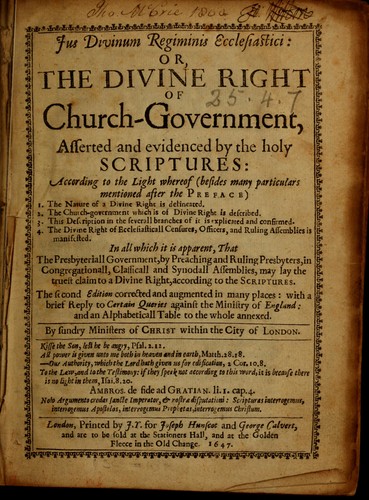
Listen to this classic work of Presbyterian church government written by London divines at the time of the Westminster Assembly. But fair warning: not for the faint of heart! But if you’re a thinker and would like to learn as you go, let me do the reading for you. [Project in progress.]

“Arguably the best biblical defenses of presbyterian ecclesiology and explanations of its polity were produced in the seventeenth century. Among these, none has a reputation better than an English work with the Latin title Jus Divinum Regiminis Ecclesiastici, with the English subtitle The Divine Right of Church Government. In three successive editions, two of which were penned during the time that the Westminster Assembly met, ‘sundry’ London ministers laid out their case. In the first part of the book they demonstrate that there is a government of the church established and revealed by God. In the second part of the book they describe that government, explain its benefits to God’s people, and further develop the biblical and theological justifications for presbyterianism.

Chris Coldwell’s new edition of this classic work will prove a most welcome addition to the Presbyterian minister’s or even church member’s bookshelf. The entire book was addressed to people who were not yet persuaded regarding the merits of presbyterian church government. It hardly needs to be said that such an audience has only expanded in the Christian world and that many people could benefit from understanding a principled form of church government rather than ones where leaders (or members) make it up as they go along. This critical edition is almost a third longer than earlier abridged versions. It offers David Noe’s translations of Latin material and a thoughtful introduction. The edition also evidences Coldwell’s careful editorial work and successful sleuthing, in some cases solving puzzles that have stumped historians for centuries. Editor, subscribers, and publisher are to be thanked for this invaluable scholarly contribution.” 

— Chad Van Dixhoorn, editor of The Minutes and Papers of the Westminster Assembly 1643–1652

Read Full Post »

« Newer Posts - Older Posts »