Feeds:
Posts
Comments

Archive for the ‘Audio Resources’ Category

As we turn in deep gratitude to the Most High for all His blessings towards us, let us remember especially the unique favor He has shown to our fathers and mothers of the faith who first came to these shores on a holy “errand into the wilderness.” In the words of the Mayflower Compact (1620), their cause was “undertaken for the Glory of God, and Advancement of the Christian Faith, and the Honour of our King and Country.”

Let me encourage you to listen to our Pilgrim and Puritan fathers. In addition to other amateur recordings, I’ve been steadily adding to this collection of sermons, treatises, and narratives from the pen of these giants of the faith, who helped found this “City on a Hill.” And if you’d like to hear an early account of the Pilgrim colony, check out Cotton Mather’s, “Magnalia Christi Americana 1.1: Discoveries of America.” Also, John Winthrop’s original sermon where he speaks of the “city on an hill,” is available under “A Modell of Christian Charity.”

And as we thank the Lord today, lest us with humility and earnestness implore Him to restore the former glory through national repentance. He did it before, and He can do it again! “Wilt thou not revive us again: that thy people may rejoice in thee” (Psalm 85:6)?

Visit the WPE Audio page for our full audio library.

Read Full Post »

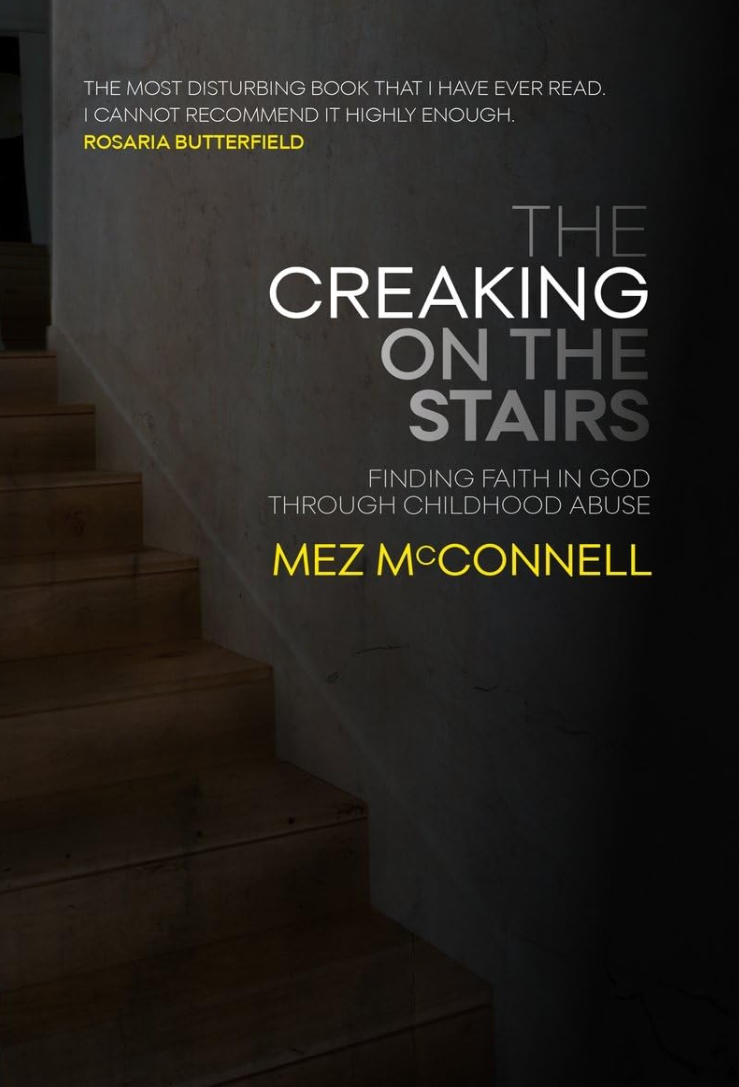
Just finished listening to this audiobook, The Creaking on the Stairs: Finding Faith in God Through Childhood Abuse. Very highly recommended. Rosaria Butterfield says in the forward, “The most disturbing book that I have ever read, and I cannot recommend it highly enough.” While I can’t say it is the most disturbing book I’ve ever read, the subject matter is beyond doubt extremely disturbing … and yet heavenly at the same time, which is why I heartily second Rosaria.

The author, Mez McConnell, was raised up in an extremely dysfunctional and highly abusive home. After coming of age, he fell into gross, reckless sin, became a criminal, and did hard time; but Christ had other plans. And so at the “time appointed,” Christ made a trophy of this sinner, plucking him as a brand from the burning and liberating his heart from anger, bitterness, and resentment.

The book is part narrative, part theology and spiritual reflection. It reminds me in many ways of Augustine’s great Confessions and Thomas Halyburton’s Memoirs, especially in its adult, post-conversion reflections on childhood, sin, and grace. (If you’ve never read those two classics, then tolle, lege! And for a taste, read Augustine’s thoughts on the ‘pear tree’ incident.) Further, Creaking is dramatic theodicy—if not directly inspired by the Book of Job, then at least resonating highly with it. If God is and is good, then why is there suffering?

This book is for those who have suffered abuse, Christian or not. It’s also for those who live with those who have or want to understand how better to love and support sufferers. Really, it’s for everyone. And I would be surprised if this doesn’t end up being something of a modern, Christian classic of autobiography, like Joni Eraekson Tada’s Joni and Rosaria Butterfield’s Secret Thoughts. Oh, and add those two to your list as well!

Read Full Post »

The following is a passage from David Calderwood’s The Pastor and the Prelate (1628), a short and very punchy treatise contrasting the godly Presbyterian pastor’s mentality over and against the worldly, time-serving prelate (bishop, etc.) of the episcopal Church under the Stuarts. In this chapter, he shows how the “pastor” far better serves the interests of the commonwealth and the good of the social fabric of society, while the “prelate” is a barnacle if not a blight upon the kingdom. One particular area is in their two very different approaches to education—or shall we say, Christian public education! I’m almost done audio-recording the book; present uploads here for your listening pleasure.

* * * *

The PASTOR would have learning to grow, and, considering that schools and colleges are both the seminary of the commonwealth and the Lebanon of God for building the temple desireth earnestly that there might be a school in every congregation, that the people might be more civil, and might more easily learn the grounds of religion; he would have the best engines chosen and provided to the students’ places in universities, the worthiest and best men to the places of teachers, who might faithfully keep the arts and sciences from corruption, and especially the truth of religion, as the holy fire that came down from heaven was kept by the Levites: he desireth the rewards of learning to be given to the worthiest, and, after they have received them, that they be faithful in their places, lest by loitering and laziness they become both unprofitable and unlearned.

The PRELATE is not so desirous of learning in himself as of ignorance in others, that he only may be eminent both in kirk and commonwealth, and all others may render him blind obedience and respect. He devoureth that himself which should entertain particular schools: he filleth the places of students without trial of their engines, to please his friends and suitors, contrary to the will of the masters and the acts of the foundations: he filleth the places of learning not with the most learned, but the wealthiest sort, who, for any vigilance of his, might both corrupt the human sciences and bring strange fire into the house ofGod. If a learned man happen to attain to one of their highest places, which they call the rewards of learning, incontinent, their learning beginneth to decay, and their former gifts to wither away. So that their great places and prelacies either find them or make them unlearned.

Read Full Post »

Some more personal reading recommendations. First, finished reading Luther in Love to the family in our Sabbath down time. We’ve read a number of his other books for younger readers—and the young at heart—all of them well-researched and well-written. I thought this one in particular really exhibited Bond’s literary excellence. Very easy to read. My only quibble is that the book’s title would lead you to think that its central theme is his relationship with his wife, Katharina von Bora. Their relationship is prominent, to be sure; but it’s really more a life of Luther. But if you really want to read some historical fiction featuring their Christian romance, I’d highly recommend, Kitty, My Rib, by E. Jane Mall.

Another book I read to the family was the non-fiction book by David Murray, Why Am I Feeling Like This? A Teen’s Guide to Freedom from Anxiety and Depression. This is the best thing I’ve come across from a Reformed perspective, addressed to adolescents. He covers the range of emotional pathologies, whether full-blown disorders or just the phases of that often tumultuous transition from childhood to adulthood. Very insightful, very appropriate, and very accessible. This is helpful also to share with others who are trying to help their teenagers weather their feelings biblically and wisely. You can read the introduction and the first chapter here, where he introduces “Circular Sarah.”

Finally, my last recommendation is a modern, secular classic, the sci-fi I, Robot by Isaac Asimov. Now, this genre is not my typical go-to, but my son put me on to it, and I was not at all disappointed. Originally published in 1950 and written about a futuristic world set in the 21st century, it is quite striking how very prescient Asimov was in terms robotics and artificial intelligence. The book is a catena of short stories featuring a handful of characters and their robotic counterparts who really prove to be a foil and a looking-glass for themselves as humans, in all their fancy, fury, and folly. I was quite surprised with how Asimov combined the technical, literary, and philosophical in a compelling way. Definitely both sides of the brain were working full power! And yet so tragic to consider that the celebrated author was a Russian Jew turned atheist. Man can imagine artificial intelligence and foreshadow it with elegance; and time has shown that he can bring it into being. Yet in his hubris he cannot and will not return to the Source. “Where is the wise? where is the scribe? where is the disputer of this world? hath not God made foolish the wisdom of this world?  For after that in the wisdom of God the world by wisdom knew not God, it pleased God by the foolishness of preaching to save them that believe” (1 Cor. 1:20-21). When one looks at the image above, what does he see but a dead idol, the stump of Dagon, the hollow shell of a man? Even so, the idol-maker is just “like unto them.”

And check out my growing library of devotional and theological resources from our rich and diverse Reformed heritage here.

Read Full Post »

I could use a tech-savvy helper for my Reformed Parish Mission work. I’m looking to create several videos of Spanish metrical psalms (Salterio de Ginebra) using slides such as these put to music sung by my family. Below are samples of both.

If you can help, drop me a note: michael@reformedparish.com, 515-783-5637.

Read Full Post »

Interested in auditing or participating in a Reformed ethics course, from a historic, Scottish Presbyterian perspective?

A few years back, our small denomination decided to start up an in-house ministerial training program, especially for practical reasons such as preventing more debt for our students and enabling them to remain at home, keep their secular employment, and preserve ties with our congregations.

A committee of presbytery is presently exploring whether we might make our seminary course offerings available at an undergraduate level—with corresponding adaptations of academic requirement—for the personal enrichment of folks in our own denomination, the training and continuing education of our church officers, and then more broadly in the communities where we serve and beyond. (And personally, I would also like to explore making such courses available in Spanish, with sufficient assistance.)

(more…)

Read Full Post »

“Let a man examine himself, and so let him eat of that bread and drink of that cup. For he that eateth and drinketh unworthily, eateth and drinketh damnation [judgment] to himself, not discerning the Lord’s body” (1 Cor. 11:27-28).

How should you prepare for the Lord’s Supper? A few thoughts for those who have come to appreciate the theology, practice, and piety of confessional Presbyterianism around the celebration Communion.

First, dedicate time ahead of time. You cannot put things off until Saturday night. Nor can you just let attendance at a midweek preparatory service ‘check the box.’ You need to begin to schedule in some meaningful time, in addition to your regular personal and family seasons of worship, to be one on one with God. Adjust your week’s schedule early, especially if you have more responsibilities surrounding the weekend, such as food preparation, etc. And husbands, be especially mindful of your wives. Help plan ahead and streamline things so that preparation doesn’t get eclipsed, helping the children step up–and even stepping up yourself!

(more…)

Read Full Post »

In the last few months, I finished a couple of really insightful non-fiction titles. The first was R. R. Reno’s The Return of the Strong Gods: Nationalism, Populism, and the Future of the West. This was the most helpful overview of what the “post-war consensus” (PWC) actually is and why it is on life support if not in its death pangs. Basically, the PWC was birthed in the aftermath of World War II and the horrors both on the battlefield and in the concentration camps. “Never again!” was the motto in Europe and the U.S., and the modus operandi of the elites was to tamp down on all discourse—religious, political, or social—that could elevate the blood pressure of the nations and so risk a reprise of the world wars. Liberalism in the broader sense of tolerance, acceptance, and openness, was the prevailing doctrine. But what it ended up doing was fueling the populisms and nationalisms we have witnessed in the last decade or so. In the end, we are humans who need “strong loves.” Something to be passionate about—and even die for!

(more…)

Read Full Post »

Listen to the last two sermons of Richard Sibbes here. Both of them are on the words of our Lord on the night of his betrayal, “Let not your hearts be troubled: ye believe in God, believe also in me” (John 14:1).

“Holy men, as they be ‘ trees of righteousness,’ Isa. Ixi. 3, and desire to be fruitful at all times, so most especially towards their end; having but a short time to live in the world, they be willing to leave the world with a good savour. So it was with Jacob. So with Moses, as appears in his excellent Song made before his death. You may see it in King Solomon and David before their deaths. But especially in our Saviour. The nearer to heaven, the more heavenly-minded. When grace and glory are ready to join, the one to be swallowed up of the other, then grace is most glorious. All the passages of Christ are comfortable; but none more comfortable than those sermons of his, that were delivered a little before his death. Of all words that come from loving men to those they love, such are most remarkable as be spoken when they be ready to die; because then men are most serious, they being about the most serious business. Then they be wisest, and best able to judge; for the consideration of their end makes them wise. And therefore, saith God, ‘ that my people were wise to consider their latter end!’ Deut. xxxii. 29. And, ‘ teach me to number my days, that I may apply my heart to wisdom,’ saith Moses, Ps. xc. 12. And indeed there is no wisdom to that; for it teacheth men to pass a right judgment upon all things in the world. They be no longer drunk with the prosperity of the world; they be no longer swayed with opinion, but they pass an estimation of things as they are.”

(more…)

Read Full Post »

Here is a sermon I recorded by John Owen on the ordination of a minister, late in his career. As always, Owen is exceptional. Here is a sample passage—so searching! See the rest of the WPE Audio library at the tab up top.

* * * * * *

“Another thing required hereunto, is experience of the power of the things we preach to others. I think truly, that no man preaches that sermon well to others, that doth not first preach it to his own heart. He who doth not feed on, and digest, and thrive by what he prepares for his people, he may give them poison as far as he knows; for, unless he finds the power of it in his own heart, he cannot have any ground of confidence, that it will have power in the hearts of others. It is an easier thing to bring our heads to preach, than our hearts to preach. To bring our heads to preach, is but to fill our minds and memories with some notions of truth of our own or other men, and speak them out to give satisfaction to ourselves and others: this is very easy. But to bring our hearts to preach, is to be transformed into the power of these truths ; or to find the power of them both before, in fashioning our minds and hearts. and in delivering of them, that we may have benefit; and to be acted with zeal for God, and compassion to the souls of men. A man may preach every day in the week, and not have his heart engaged once. This hath lost us powerful preaching in the world, and set up, instead of it, quaint orations; for such men never seek after experience in their own hearts : and so it is come to pass, that some men’s preaching, and some men’s not preaching, have lost us the power of what we call the ministry: that, though there be twenty or thirty thousand in orders, yet the nation perishes for want of knowledge, and is overwhelmed in all manner of sins, and not delivered from them unto this day.”

Read Full Post »

Older Posts »