A couple of helpful podcasts on issues being raised on the Christian far right. Definitely worth listening to.
Archive for January, 2026
Interracial marriage & Jewish conspiracies
Posted in Culture, Family & Family Issues, Israel; Calling of & Mission to the Jews, Natural Law on January 27, 2026| Leave a Comment »
Nicea today
Posted in Confessional Subscription, Connectionalism & Conciliarism, Constantine, Establishments, Patristics on January 27, 2026| Leave a Comment »
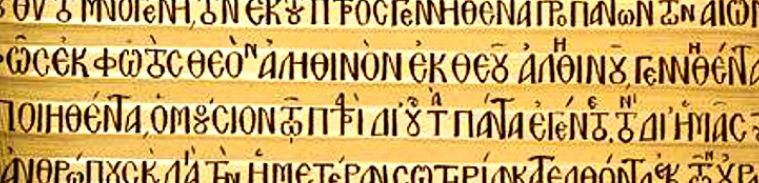
Since 2025 was the 1700th anniversary of the momentous Council of Nicea, a lot of material online has been produced. This short series by the White Horse Inn was exceptionally good. I would highly commend every intelligent Christian wanting to deepen his knowledge and appreciation of this tremendous formula of faith that has stood the test of time and has left its print upon Protestant confessions and catechisms, not to mention the preaching and piety of the reformed catholic Church.
Bursting the “poor narrow bounds of your time”
Posted in Christian Life & Experience, Church of Scotland, Experimental Religion & the Cure of Souls, Light of Eternity on January 27, 2026| Leave a Comment »

“Know ye not that your souls are created for eternity; that they will eternally survive all these present things? Now how do ye imagine they shall live after this life? Your thoughts and projects and designs are confined within the poor narrow bounds of your time. When you die, in that day your thoughts shall perish. All your imaginations and purposes and providences shall have an end then; they reach no farther than that time. And if you should wholly perish too, it were not so much matter. But for all your purposes and projects to come to an end, when you are but beginning to live, and enter eternity, that is lamentable indeed! Therefore I say, consider what ye are doing, weigh these in a balance,—eternal life and the present life; if there were no more difference but the continuance of the one, and the shortness of the other,—that the world’s standing is but as one day, one moment to eternity,—that ought to preponderate in your souls. Do we not here flee away as a shadow upon the mountains? Are we not as a vapour that ascends, and for a little time appears a solid body, and then presently vanisheth? Do we not come all into the stage of the world, as for an hour, to act our part and be gone; now then, what is this to endless eternity? When you have continued as long as since the world began, you are no nearer the end of it. Ought not that estate then to be most in your eyes, how to lay up a foundation for the time to come? But then, compare the misery and the vexation of this life with the glory and felicity of this eternal life. What are our days? But few and full of trouble. Or, if you will, take the most blessed estate you have seen and heard of in this world, of kings and rich men, and help all the defects of it by your imaginations; suppose unto yourselves the height and pitch of glory and abundance and power that is attainable on earth; and when your fancy hath busked up such a felicity, compare it with an eternal life: O how will that vanish out of your imaginations! If so be you know any thing of the life to come, you will even think that an odious comparison,—you will think all that earthly felicity but light as vanity, “every man at his best estate is altogether vanity.” Eternal life will weigh down eternally, 2 Cor. iv. 17, 18. O but it hath an exceeding weight in itself,—one moment of it, one hour’s possession and taste of it! but then what shall the endless endurance of it add to its weight?”
Hugh Binning, The Common Principles of the Christian Religion, Clearly Proved, and Singularly Improved; Or, A Practical Catechism.
Warfield’s “On the Emotional Life of our Lord”
Posted in Anthropology, Audio Resources, Christ Jesus, Christian Conduct, Christian Ethics, Christian Life & Experience, Conscience & Casuistry, Experimental Religion & the Cure of Souls, Mental Health on January 12, 2026| Leave a Comment »
B. B. Warfield’s “On the Emotional Life of our Lord” is simply a masterpiece of exegesis, theology, and psychology on the high mystery of the God-man’s emotions as the Gospels depict them. Especially profound are his insights on His holy anger and fear, where the “holy, harmless, undefiled” Savior gives full play to this side of His sanctified humanity without the slightest breach of God’s law. “Behold, and see if there be any sorrow like unto my sorrow!” And so we may appreciate all the more deeply the sympathy of our High Priest who can be “touched with the feeling of our infirmities, yet without sin.” This is an absolute must-read—I know of nothing else like it on the subject. You can read it below or listen to my recording here. Let me also suggest my recording of Richard Baxter’s “On the Government of the Passions;” and visit full WPE Audio library for more titles.
Rutherford on the Jews: “Let us pray our elder sister home to Christ”
Posted in Audio Resources, Church of Scotland, Israel; Calling of & Mission to the Jews, Samuel Rutherford on January 11, 2026| Leave a Comment »
A portion of Samuel Rutherford’s masterful Trial and Triumph of Faith, a series of sermons in which he treats the Lord’s dealings with the Syro-phoenician “dog” who yet “ate the crumbs falling from the childrens’ table.” Here we see him waxing eloquent on the high privileges of Israel “after the flesh,” and then plying the Gentile church not to be hard-hearted but to pray for the conversion of these “lost sheep of the house of Israel.” Listen to the full sermon here; and check out the entire WPE Audio library here.
* * * *
“OF ISRAEL.” It was then a privileged mercy, that Christ was sent to the Jews. (1.) The Jew is the elder brother, and the native heir of Christ. Christ is of their blood and house. (Rom. 1:2,3, and 9:3.) They were Christ’s first bride. Alas! they killed their husband. There is a born Jew in heaven, in soul and body: it is sweet to have any relation to Christ. (2.) The catholic covenant of grace made with the great sister, the Church Universal, was first laid down in pawn in their hand; they put their hand first to the contract, in subscribing the marriage contract, (Jer. chapters 2 and 3). Israel was holy to the Lord, and the first fruits of his increase. Oh, sweet! the fallen race of mankind was Christ’s corn-field, and his wheat. The Jews were the first sheaf of the field, (Deut. 7:6). They got Christ’s young love, and, (to speak so,) the first handsel of free grace in a church-way. (3.) Christ, in the Jewish flesh, (yet not excluding Ruth, Rahab, and other Gentiles of the blood-royal,) acted the whole gospel. A born Jew redeemed the lost world, offered a sacrifice to God for sinners: a born Jew is heir of all things, is exalted a prince to guide and rule all, and shall judge men and angels. (4.) The Lord Christ, in the flesh, was first offered to them; they had the first gospel-love, (Matt. 10:5,6; Acts 13:46). (5.) The oracles of God were committed to them, (Romans 3:1; 9:4); the testator Christ’s written will, was in their keeping. (6.) God was their first crowned King. He gave Ethiopia, and Egypt, and Zeba, a ransom for them, and was their lawgiver. (7.) Every male child among the Jews did bear somewhat of Christ in his flesh, (Col. 2:11) when all the world was without Christ. (8.) Their land was Christ’s by a special typical right. God saith of it, “It is my land.” Christ was their sovereign landlord, and they the great King’s freeholders. (9.) The Lord never dwelt in a house made with hands, in a temple, as amongst them, having special respect to the true Temple, Jesus Christ, (John 2:19).
USE 1. Let us pray our elder sister home to Christ. They said, “We have a little sister, and she hath no breasts; what shall we do for our sister in the day that she shall be spoken for?” (Cant. 8:8.) Now, we have a greater sister, what shall we, the Gentiles, do for her? There is a day when “ten men shall take hold, out of all nations, of the skirt of a Jew, saying, We will go with you; we have heard that God is with you” (Zech. 8:23.) . . .
USE 3. The Jews had the morning market of Christ, and they would not pay the rent of the vineyard to the Lord thereof. We have the afternoon of Christ; and know we what a mercy it is, that “our Beloved feedeth amongst the lilies, till the day break, and the shadows fly away;” and that “the voice of the turtle is heard in our land”? God, for our abuse of the gospel, hath sent among us the bloody pursuivants, and officers of his wrath, men skilful to destroy; God is now in three kingdoms, arresting the carcases of men. We are owing much to God; he will now have husbands and sons from us, and legs and arms of wounded and slain men from us, for that rent we owe to the Lord of the vineyard,—for our contempt of the gospel.
Sibbes on Shem’s hope & Japheth’s rejoicing
Posted in Israel; Calling of & Mission to the Jews, Old Testament Theology on January 9, 2026| Leave a Comment »

“Christ and his church, when they are at the lowest, are nearest rising. His enemies, at the highest, are nearest their downfall. The Jews are not yet come in under Christ’s banner; but God who has persuaded Japheth to come into the tents of Shem (Gen. 9:27) will persuade Shem to come into the tents of Japheth. The ‘fullness of the Gentiles’ has not yet come in (Rom. 11:25), but Christ, who has the uttermost parts of the earth given to him for his possession (Psa. 2:8) will gather all the sheep his Father has given him into one fold, that there may be one sheepfold and one shepherd (John 10:16). The faithful Jews rejoiced to think of the calling of the Gentiles and why should we not rejoice to think of the calling of the Jews?”
-Richard Sibbes
Have you toiled all night and taken nothing?
Posted in Free Offer of the Gospel, Gospel Proclamation, Missiology, The Free Offer of the Gospel, The Gospel, Thomas Boston on January 9, 2026| Leave a Comment »
You who are by office “fishers of men,” have you caught little, or even nothing? Lose not heart. Take it from good Master Boston:

“Surviving the Fringe: A Short Reflection on a Long Journey”
Posted in Contemporary Issues, Culture, Social Issues on January 4, 2026| Leave a Comment »
The following was an excellent article by Michael Foster on a wise and very pastoral approach to conspiracy theories and conspiratorialism. Shrewd. Especially appreciate the “80/20” guideline.
* * * *

From the time I was a kid, my mind ran toward the strange and the shadowy corners of the world. I ate up Arthur C. Clarke’s Mysterious World and Leonard Nimoy’s In Search Of. Later it was Unsolved Mysteries and Sightings. But it wasn’t just TV. Back when the library was the closest thing we had to the internet, I practically lived in it. I checked out any oddball book I could find. By twelve I had already plowed through Erich von Däniken, and a year later I grabbed Graham Hancock’s first book. Ancient aliens, lost civilizations, Bigfoot, alternate histories, you name it, I read it. Probably more than anyone else I knew.
By high school, I loved batting around theories about JFK, the moon landing, and Roswell. Stuff people talk about casually today in a post–Joe Rogan world, but back then you had to go hunting for it.
Wilhelmus à Brakel on the conversion of the Jews
Posted in Biblical Interpretation, Biblical Theology, Eschatology, Israel; Calling of & Mission to the Jews, Redemptive History on January 4, 2026| Leave a Comment »
“Question: Will the Jewish nation always be a rejected nation, or will the entire nation yet come to repentance, believing and confessing that the Messiah has already come, and that Jesus is the Christ?
“Answer: When speaking of the conversion of the Jews, we understand this to refer to the entire nation, and not only to Judah and Benjamin who had returned from Babylon and lived in Canaan until the destruction of Jerusalem. Rather, it also refers to the ten tribes. These tribes neither remained together nor are they hidden in an unknown corner of the world, as the Jews fabricate. Instead, they partially intermingled with the eastern nations, forsaking the Jewish religion. Another part, having dispersed themselves among the nations of the earth, continued to adhere to their religion; whereas a very large multitude also returned to Canaan and intermingled with the other Jews. Anna, the prophetess, the daughter of Phanuel from the tribe of Aser, served God at Jerusalem in the temple (Luke 2:36).
“Furthermore, very many from the tribes of Judah, Benjamin, and Levi did not return from Babylon. Among those who did return were also very many who again left their native land due to internal disturbances, and thus were dispersed throughout the entire world among various nations, still maintaining the Jewish religion. James wrote to the “twelve tribes which are scattered abroad” (James 1:1). The dispersed Jews came from all manner of nations to Jerusalem on the feast days for the purpose of worship, as is to be observed in (Acts 2:5-11). After the destruction of Jerusalem, the entire Jewish nation was dispersed and no longer has a specific residence. We are speaking here of this nation without distinction, and we believe that it will acknowledge that Jesus is the Christ—the Messiah who was promised in the Old Testament and anticipated by the fathers. This is the general sentiment of the theologians of all ages—even Lutheran and papist theologians. There are, however, also those who doubt this, and some deny it. In order to confirm this matter, we shall not now say all that can be said about it. Rather, we shall only 1 take two proofs from the New Testament and give them a place of prominence, since they are not subject to any evasive arguments of substance. After having given a clear exegesis of them, the few proofs we shall present from the Old Testament will give us more clarity and steadfastness in this matter.”
Read the rest below (pdf p. 519, doc. p. 510; source)
Heidegger, “On the Economy of the Covenant of Grace Under the Gospel”
Posted in Biblical Theology, Redemptive History, Reformed Orthodoxy, Revelation on January 4, 2026| Leave a Comment »
As I am about to teach a seminary course in NT Theology this coming semester in our presbytery’s theological training program, I found this chapter in Heidegger choice. Here is yet another example of how classic, orthodox Reformed theology definitely assigned a role for what later would be designated “Biblical Theology,” or as I far prefer to call it, Economic Theology. As God has “spoken at sundry times and divers manners unto the fathers by the prophets,” it is then fully appropriate to enquire how God has revealed Himself in the various economies of His one, unified, eternal plan.
 West Port Experiment