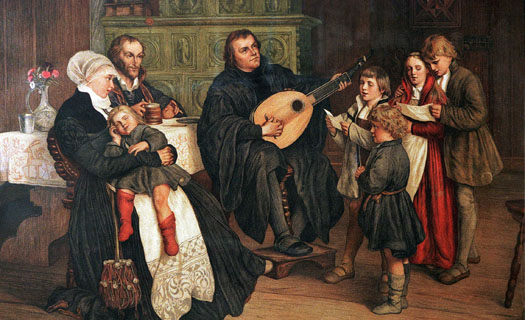
As Reformed people, we are deeply committed to the covenant. We have a solemn responsibility to our children—who after all are not ours, but the Lord’s. We as parents and as pastors have a sacred trust. As pastors, we require solemn vows of parents as they present their covenant children for holy baptism. As parents, we take those public vows in deep, humble gratitude for the manifold grace of God in ‘spreading His skirt over our little ones.’ With faith, we lay hold of the gracious promise, yet with a real trembling for the stewardship that is ours to raise them up in the “fear and admonition of the Lord.”
And yet, while our covenant-tradition is clothed with solemnity and gravitas, the lighter side of life shines through (or, it ought to!) as we endeavor to light the flame of faith in our children. There is a place for play; and, in fact, there is great promise in it. I’m increasingly convinced after twenty years of pastoring, twenty-five years of parenting, and now almost two years of grand-parenting, that one major ingredient of parenting and, yes, even pastoring, involves play. And I believe this is all the more vital in small, first- and second-generation Reformed and Presbyterian churches who lack the longevity of larger multi-generational churches. The margins are smaller and the risk of losing our children greater. Especially in our circles, the imperative to do all we lawfully can to create a home and church environment where our covenant children will naturally want to profess faith, commune, marry, bear children, and put down deep roots in our rootless world.
But whether your church is large or small and your subculture more fragile or more robust, these children are still ‘ours to lose.’ Yes, the Holy Spirit must regenerate. Enculturation is a barren womb without free and sovereign grace. But our responsibility, in giving and taking baptismal vows, is not just to catechize and keep good order in home and church. We may and must, if I may put it this way, “win” our children winsomely. And so I say, let us play.
But before we get too far, what are we really talking about? By “play,” I only mean any kind of lawful and moderate recreation. It can be physical play, like sports and other forms of outdoor recreation or the play of the mind and spirit, in music, games of strategy, or the reading of good literature. But whatever shape it takes, by “play” I also intend to mean that this recreation is not only done in solitude but is shared, and especially with those whom we love and who have been, as parents and pastors, entrusted to us to shape and mold for service in their generation. Of course, there is a place for individual recreation; but those who are “public persons,” as our Puritan forbears would put it, have others whom they will influence for good or ill.
Further, I would like to commend not so much playing, necessarily, as spending any kind of meaingful, quality time with our children. Sadly, the Industrial Revolution had deleterious effects on the earlier more agrarian cultures of our ancestors, when parents would co-labor side-by-side in their own little cottage industry. Much quality time was naturally enjoyed as mothers chatted with daughters at the loom and fathers with sons in fishing boats or in the fields. Those days are largely gone. Some Christians are re-thinking and innovating scenarios to recreate that old home-business model, but certainly there are limitations. We cannot un-modernize an entire world economy. So it seems that play takes on a unique imperative for 21st century Christians who take seriously their duty to children and others under their care.
Let’s start with some principles. Out of the gate, some play is bad. Some intrinsically so: “Neither be ye idolaters, as were some of them; as it is written, The people sat down to eat and drink, and rose up to play” (1 Cor. 10:7). There are also forms of lawful play that turn unlawful, when we should be at work or worship. What we are interested in is healthy play within the proper bounds of God’s law.
But make no mistake: play is good! God clearly made play. He made the oceans as a playground for the leviathan’s pleasure (Psa. 104:26). Then he harnesses the beast to amaze a curious world. “Wilt thou play with him as with a bird? or wilt thou bind him for thy maidens” (Job 41:5)? David was a skillful player of the harp, soothing the troubled mind of King Saul. The prophets, amid all their oracles of doom, portrayed the restoration of Israel and the glory of the Church in terms of wholesome mirth and merriment, onlooking elders smiling approvingly: “Thus saith the LORD of hosts; There shall yet old men and old women dwell in the streets of Jerusalem, and every man with his staff in his hand for very age. And the streets of the city shall be full of boys and girls playing in the streets thereof” (Zech 8:4-5).
For that matter, God made dance. David would brook no scorn from Michal for having danced before the Lord (2 Sam. 6:21). Yes, much dancing is sinful and sensual. But not all. Rabbi John Duncan, when he converted from atheism to belief in God, was so overcome with joy that he danced openly on a bridge. And while we need to be careful not to build too much on parables, let us not forget that our Lord Himself portrayed the very angels in heaven in rejoicing over one sinner that repents in terms of dancing to music: “Now his elder son was in the field: and as he came and drew nigh to the house, he heard musick and dancing” (Luke 15:25). I danced a lot with my children when they were young and have zero regrets. Our living room oft became a three-ring-circus, as their children-spent mother retreated to her room for an hour. Thankfully though, for my sake, there is no video evidence!
These are heavenly gifts, meant to be enjoyed. And lawful recreation is healing, even regenerative. “A merry heart doeth good like a medicine” (Prov. 17:22). Piety is not life-hating austerity. H. L. Mencken wrongly blackened our godly forbears, claiming that the essence of Puritanism was “the haunting fear that someone, somewhere, may be happy.” Not so, Mr. Mencken. Do not confuse piety and pietism. Pick up Leland Ryken’s Worldly Saints, and see for yourself. And inasmuch as recreation involves physical exercise, play is God’s gift for body and soul. Depression is bad. So get some sun, go for a swim, or grab a friend and go for a bike ride. Talk, reminisce, laugh. Repeat. And don’t forget to pray. But again, these things are not mutually exclusive.
Do this for you, in your God-ward stewardship of body and mind. And do it for those entrusted to your care; indeed, do it with them as much as you can. To our main point here, play is a gift especially useful to forge bonds, to create, sustain, and enliven relationships and shared identity. Yes, play is a team-builder. Team family and team church! Our children and indeed all God’s people need to belong, all the more in this fractured, individualistic, extremely mobile world. Let’s as Chalmers put it, “awaken an esprit de corps” among those under our influence. They were hard-wired to belong. Let’s give them the best family and church we can. Better the carrot than the stick. And better to use the stick when necessary, when felt love mollifies any momentary pain.
Finally, some examples. Winsome ones, from some of the men whom I shall unceremoniously bear-hug when I get to heaven. Luther, of course, was eminently playful. He often delighted to tease his wife and children with his rapier wit. He loved playing music and games with the family, sometimes also with visitors. The Doctor also loved to play chess—one wonders if he ever let his little Hans win?
One modern biographer wrote, “Luther advocated that adults use play and games to lure their children into voluntary patterns of learning and obedience.”
William Wilberforce, the great British evangelical MP and victorious champion in the abolition of the slave-trade, was well known for his love of story-telling, repartee, and healthy amusement. Above all, he cherished domestic happiness in the bosom of his large family. Once he broke off a letter to Hannah More, evangelical philanthropist, with the words, “I am irresistibly summoned to a contest at marbles, and in these days of the rights of man, as I would not furnish any valid ground for rebellion . . . I obeyed the call.” Another anecdote is particularly choice. One day, a respected visitor called at the Wilberforce home. The help opened the door, and to the bafflement of the visitor, a raucous noise from back in the hallway erupted, growing louder and louder, until a stampede of squealing, exhilarated children rushed past. Shortly behind the gaggle of children roared the William Wilberforce himself, giving hearty chase to his brood, oblivious to the bemused visitor as well as his wife who quietly sat nearby in a chair.
The great Scottish Presbyterian William Guthrie, author of the spiritual classic, The Christian’s Great Interest, was well-known for his playfulness as a pastor. He was clearly an enterprising evangelist, as John Howie relates in Scots Worthies:
He would frequently use innocent recreations, such as fishing, fowling, and playing on the ice, which contributed much to preserve a vigorous state of health; and while in frequent conversation with the neighbouring gentry, as these occasions gave him opportunity, he would bear in upon them reproofs and instructions, with an inoffensive familiarity. Mr Dunlop has observed of him “that he was animated by a flaming zeal for the glory of his blessed Master, and a tender compassion for the souls of men, and as it was the principal thing which made him desire life and health, that he might employ them in propagating the kingdom of God, and in turning transgressors from their ways, so the very hours of recreation were dedicated to this purpose; which was so endeared to him, that he knew how to make his diversions subservient to the nobler ends of his ministry. He made them the occasion of familiarising his people to him, and introducing himself to their affections; and, in the disguise of a sportsman, he gained some to a religious life, whom he could have little influence upon in a minister’s gown; of which there happened several memorable examples.”
Howie offers other noteworthy anecdotes in this vein, which you can read here. Some starch in the collar is good. As long as it doesn’t impede free movement in ice-hockey.
But by far, my favorite anecdote of the promise of play is that of one whose name is largely forgotten. It concerns the evangelical minister and missionary to pre-Protestant Highlands, Aeneas Sage (1694-1744). John Kennedy of Dingwall recounts the tale in his Days of the Fathers in Ross-Shire, no doubt with the same delight as I have had in telling and re-telling it ad nauseam, as my own family can attest:
Matters continued in this state [of barbarous heathenism in Sutherland] till the induction of Mr. Sage, nearly eighty years after. He was just the man for the work of breaking up the fallow ground of a field so wild, and a rich blessing rested on his labours. On the night of his first arrival at Lochcarron an attempt was made to burn the house in which he lodged, and for some time after his induction his life was in constant danger. But the esteem he could not win as a minister, he soon acquired for great physical strength. The first man in Lochcarron in those days was the champion at the athletic games. Conscious of his strength, and knowing that he would make himself respected by all if he could only lay big Rory on his back, who was acknowledged to be the strongest man in the district, the minister joined the people on the earliest opportunity at their games. Challenging the whole field, he competed for the prize in putting the stone, tossing the caber, and wrestling, and won an easy victory. His fame was established at once. The minister was now the champion of the district, and none was more ready to defer to him than he whom he had deprived of the laurel. Taking Rory aside to a confidential crack, he said to him, “Now, Rory, I am the minister, and you must be my elder, and we both must see to it that all the people attend church, observe the Sabbath, and conduct themselves properly.” Rory fell in with the proposal at once. On Sabbath, when the people would gather at their games in the forenoon, the minister and his elder would join them, and each taking a couple by the hand, they would drag them to the church, lock them in, and then return to catch some more. This was repeated till none were left on the field. Then, stationing the elder with his cudgel at the door, the minister would mount the pulpit and conduct the service. One of his earliest sermons was blessed to the conversion of his assistant, and a truly valuable coadjutor he found in big Rory thereafter. Mr. Lachlan thus describes the result of his ministry: —”Mr. Sage made the people very orthodox.” They “seem to have a strong attachment to religion.” “There is a great appearance of religion in Lochcarron; and as the fire of God’s Word is hereafter to try every man’s work, there is cause to hope that some of it will bear the trial.”
As one of my older, bookish colleagues once put it, “Well, if it didn’t really happen, it should have!”
Now, to be clear. Pray on. We must diligently cultivate personal piety and reverence, in God’s house especially, but also in our homes and our lives more broadly. Do take care not to forget yourself with excessive or carnal mirth, lest your dishonor God and degrade your place. But there is also a time and place to play. And if our priorities are right, then we can validate the real promise of such play. And have some good, clean fun ourselves along the way!
* * * *
This article first appeared in a somewhat shortened form in The Messenger, the denominational magazine of the Free Reformed Churches of North America.
 West Port Experiment
Leave a comment