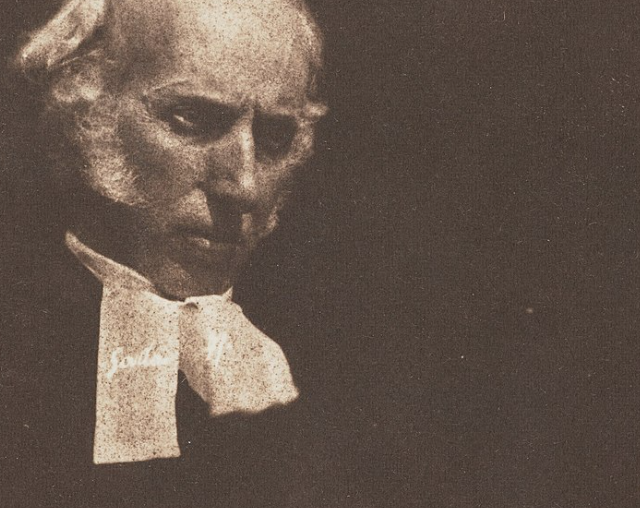
The following passage is taken from Free Church of Scotland minister Robert Gordon’s Christ as Made Known to the Ancient Church (1854), where he treats the command of God to build the tabernacle in the wilderness. “And let them make me a sanctuary; that I may dwell among them” (Ex. 25:8). Gordon sets forth rather poignantly the biblical doctrine as expressed in the Westminster Confession of Faith ch. 25, “On the Church.”
* * * * *
Though it was to the incarnation of Christ, therefore, that the passage before us does more immediately refer, as that which was prefigured by the tabernacle; yet the effect of his manifestation is, that God has always dwelt, and ever will dwell, among men, even in his Church, to whom Christ has promised that by his Spirit he will be with her always, even unto the end of the world. The Church, indeed, is represented as the tabernacle or dwelling, place of the Lord; for it is evidently of the Church at large, as well as of the place which God had chosen from among the tribes of Israel to put his name there, that he thus speaks: “The Lord hath chosen Zion; he hath desired it for his habitation. This is my rest for ever: here will I dwell; for I have desired it. I will abundantly bless her provision: I will satisfy her poor with bread. I will also clothe her priests with salvation: and her saints shall shout aloud for joy.” And again, “Look upon Zion, the city of our solemnities: thine eyes shall see Jerusalem a quiet habitation, a tabernacle that shall not be taken down; not one of the stakes thereof shall ever be removed, neither shall any of the cords thereof be broken. But there the glorious Lord will be unto us a place of broad rivers and streams.”
These, and many similar promises, do plainly declare that God will ever have a dwelling-place among men; and hitherto it has been so, inasmuch as God has never wanted a Church, even in the most corrupt and degenerate times, in the midst of which he has given tokens of the presence of his Spirit, giving efficacy to his own ordinances for converting, sanctifying, and saving sinners. In particular branches of that Church,—in communities, or portions of communities, where professedly his Word is believed and his ordinances administered, and where there are all the external arrangements which constitute the visible Church of Christ,—there may for a season be few or no indications of the divine presence,—no marks of spiritual life,—no instances of spiritual resurrection from the death of sin to the life of holiness. If there be not a general departure from sound doctrine, which does sometimes take place, there may be a cold and formal acknowledgment of it, which is unaccompanied with any quickening or life-giving power; and the other ordinances of the Gospel, though gone about with external decency and decorum, may be as wells without water, affording no nourishment to the feeble, and no refreshment to the weary. Such examples of the dereliction of the Spirit of God, in regard to certain portions of the visible Church, may occur, and have often occurred, but always, I may safely add, in consequence of such portions of the Church having first forsaken God, by giving way to a carnal and worldly spirit, till the truth itself was so disguised, at least, if not openly perverted, as to become palatable to the taste of ungodly men,—till the ordinances of the Gospel, the privileges of true Christians, were thrown open to the profanation of all who might find it for their worldly interest to seek them,—and till the whole system which Christ has established for the order and right government of his house was rendered subservient to the worldly policy of the day, becoming a mere political tool in the hands of any one who had ambition and skill enough to employ it for working out his worldly ends.
But though such has been the melancholy condition of many portions of the visible Church in succession; nay, though the time has been when, to appearance, the whole professedly Christian world exhibited one outwardly gorgeous tabernacle, but within a ghastly sepulchre, because devoid of the enlightening and life-giving glory which should have dwelt there; yet there ever has been, and there ever will be, a true Church on the earth,—a tabernacle in which God has dwelt, and will continue to dwell among men. But the lamentable declension which has from time to time taken place in various portions of the Church reads a very solemn lesson to every Christian community. Such an example of the judgment of God, in withdrawing or withholding his Spirit from one Church or professing community, is as if he were addressing, not that Church or community only, but every other, in the language of the passage before us, “Let them make me a sanctuary, that I may dwell among them.” He is as ready now to dwell by his Spirit in the midst of a Christian Church, to quicken them by his Word , and to refresh and invigorate them by all his ordinances, as he was of old to take up his abode among the people of Israel. But if the Church would expect his presence and blessing, she must be careful to improve her privileges,—in holding forth with all uncorruptness the doctrines of his Word,—maintaining the integrity of his ordinances,—and exercising in purity the discipline and government which he has established; and while she is thus faithful to Him, or if, after having been in a state of backsliding, she return to her fidelity and first love, then he will dwell in the midst of her, and he will vouchsafe proofs of his nearness and pledges of his favour, by sending her seasons of revival and refreshing from the presence of the Lord.
Whole doctrine catholicity | “Who is she that looketh forth as the morning, fair as the moon, clear as the sun, and terrible as an army with banners” (Song 6:10)?
 West Port Experiment
Leave a comment