The following is drawn from the First Book of Discipline (1560), adopted by the Church of Scotland during the Reformation period. Education is key!

* * * * *
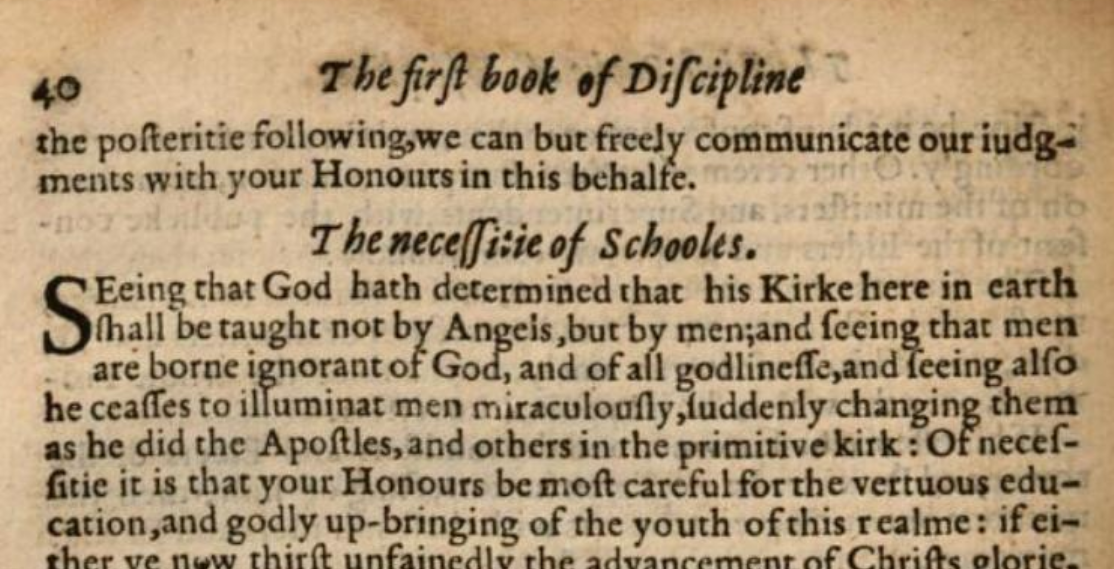
The Necessity of Schools
Seeing that God has determined that his church here in earth shall be taught not by angels but by men; and seeing that men are born ignorant of all godliness; and seeing, also, God now ceases to illuminate men miraculously, suddenly changing them, as that he did his apostles and others in the primitive church: of necessity it is that your honours be most careful for the virtuous education and godly upbringing of the youth of this realm, if either ye now thirst unfeignedly [for] the advancement of Christ’s glory, or yet desire the continuance of his benefits to the generation following. For as the youth must succeed to us, so we ought to be careful that they have the knowledge and erudition to profit and comfort that which ought to be most dear to us-to wit, the church and spouse of the Lord Jesus.
Of necessity therefore we judge it, that every several church have a schoolmaster appointed, such a one as is able, at least, to teach grammar and the Latin tongue, if the town is of any reputation. If it is upland, where the people convene to doctrine but once in the week, then must either the reader or the minister there appointed, take care over the children and youth of the parish, to instruct them in their first rudiments, and especially in the catechism,[10] as we have it now translated in the book of our common order, called the Order of Geneva. And further, we think it expedient that in every notable town, and especially in the town of the superintendent, [there] be erected a college, in which the arts, at least logic and rhetoric, together with the tongues, be read by sufficient masters, for whom honest stipends must be appointed; as also provision for those that are poor, and are not able by themselves, nor by their friends, to be sustained at letters, especially such as come from landward.
The fruit and commodity hereof shall suddenly appear. For, first, the youth and tender children shall be nourished and brought up in virtue, in presence of their friends; by whose good attendance many inconveniences may be avoided, in the which the youth commonly fall, either by too much liberty, which they have in strange and unknown places, while they cannot rule themselves; or else for lack of good attendance, and of such necessities as their tender age requires. Secondly, the exercise of the children in every church shall be great instruction to the aged.
Last, the great schools, called universities, shall be replenished with those that are apt to learning; for this must be carefully provided, that no father, of what estate or condition that ever he be, use his children at his own fantasy, especially in their youth; but all must be compelled to bring up their children in learning and virtue.
The rich and potent may not be permitted to suffer their children to spend their youth in vain idleness, as heretofore they have done. But they must be exhorted, and by the censure of the church compelled, to dedicate their sons, by good exercise, to the profit of the church and to the commonwealth; and that they must do of their own expenses, because they are able. The children of the poor must be supported and sustained on the charge of the church, till trial is taken whether the spirit of docility is found in them or not. If they are found apt to letters and learning, then may they (we mean neither the sons of the rich, nor yet the sons of the poor) not be permitted to reject learning; but must be charged to continue their study, so that the commonwealth may have some comfort by them. And for this purpose must discreet, learned, and grave men be appointed to visit all schools for the trial of their exercise, profit, and continuance: to wit, the ministers and elders, with the best learned in every town, shall every quarter take examination how the youth have profited.
A certain time must be appointed to reading, and to learning of the catechism; a certain time to the grammar, and to the Latin tongue; a certain time to the arts, philosophy, and to the tongues; and a certain [time] to that study in which they intend chiefly to travail for the profit of the commonwealth. Which time being expired, we mean in every course, the children must either proceed to further knowledge, or else they must be sent to some handicraft, or to some other profitable exercise; provided always, that first they have the form of knowledge of Christian religion: to wit, the knowledge of God’s law and commandments; the use and office of the same; the chief articles of our belief; the right form to pray unto God, the number use, and effect of the sacraments; the true knowledge of Christ Jesus, of his office and natures, and such other [points] as without the knowledge whereof, neither deserves [any] man to be named Christian, neither ought any to be admitted to the participation of the Lord’s Table. And therefore, these principles ought and must be learned in the youth.
The Times Appointed to Every Course
Two years we think more than sufficient to learn to read perfectly, to answer to the catechism, and to have some entry in the first rudiments of grammar; to the full accomplishment whereof (we mean of the grammar) we think another three or four years, at most, sufficient. To the arts-to wit, logic and rhetoric-and to the Greek tongue, four years; and the rest, till the age of twenty-four years, to be spent in that study wherein the learner would profit the church or commonwealth, be it in the laws, or physics or divinity. Which time to twenty-four years being spent in the schools, the learner must be removed to serve the church or commonwealth, unless he is found a necessary reader in the same college or university. If God shall move your hearts to establish and execute this order, and put these things in practice, your whole realm (we doubt not), within few years, shall serve itself of true preachers, and of other officers necessary for your commonwealth.
The Erection of Universities
The grammar schools and of the tongues being erected as we have said, next we think it necessary there be three universities in this whole realm, established in the towns accustomed: the first in Saint Andrews, the second in Glasgow, and the third in Aberdeen.
And in the first university and principal, which is Saint Andrews, there be three colleges. And in the first college, which is the entry of the university, there be four classes or seiges: the first, to the new supposts, shall be only dialectics; the next, only mathematics; the third, of physics only; the fourth of medicine. And in the second college, two classes or seiges: the first, in moral philosophy; the second in the laws. And in the third college, two classes or seiges: the first, in the tongues, to wit, Greek and Hebrew; the second, in divinity.
Of Readers, and of the Degrees, of Time, and Study
Item, In the first college, and in the first class, shall be a reader of dialectics, who shall accomplish his course thereof in one year. In the mathematics, which is the second class, shall be a reader who shall complete his course of arithmetic, geometry, cosmography, and astronomy, in one year. In the third class shall be a reader of natural philosophy, who shall complete his course in a year; and who, after these three years, by trial and examination, shall be found sufficiently instructed in these aforesaid sciences, shall be laureate and graduate in philosophy. In the fourth class shall be a reader of medicine, who shall complete his course in five years; after the study of the which time, being by examination found sufficient, they shall be graduate in medicine.
Item, In the second college, in the first class, one reader only in the ethics, economics, and politics, who shall complete his course in the space of one year. In the second class shall be two readers in the municipal and Roman laws, who shall complete their courses in four years; after the which time, being by examination found sufficient, they shall be graduate in the laws.
Item, In the third college, in the first class, a reader of the Hebrew, and another of the Greek tongue, who shall complete the grammars thereof in half a year, and the remnant of the year the reader of the Hebrew shall interpret a book of Moses, the prophets, or the psalms; so that his course and class shall continue one year. The reader of the Greek shall interpret some book of Plato, together with some place of the New Testament. And in the second class shall be two readers in divinity, the one in the New Testament, the other in the Old, who shall complete their course in five years; after which time, who shall be found by examination sufficient, shall be graduate in divinity.
Item, We think expedient that none be admitted unto the first college, and to be supposts of the university, unless he have from the master of the school, and the minister of the town where he was instructed in the tongues, a testimonial of his learning, docility, age, and parentage; and likewise trial to be taken by certain examiners, deputed by the rector and principals of the same, and, if he is found sufficiently instructed in dialectics, he shall incontinent [immediately], that same year, be promoted to the class of mathematics.
Item, That none be admitted to the class of the medicine but he that shall have his testimonial of his time well spent in dialectics, mathematics, and physics, and his docility in the last.
Item, that none be admitted unto the class of the laws, but he that shall have sufficient testimonials of his time well spent in dialectics, mathematics, physics, ethics, economics, and politics, and of his docility in the last.
Item, that none be admitted unto the class and seige of divines but he that shall have sufficient testimonials of his time well spent in dialectics, mathematics, physics, ethics, economics, moral philosophy, and the Hebrew tongue, and of his docility in the moral philosophy and the Hebrew tongue. But neither shall such as will apply them to hear the laws, be compelled to hear medicine; neither such as apply them to hear divinity be compelled to hear either medicine or yet the laws.
Item, in the second university, which is Glasgow, shall be two colleges only. In the first shall be a class of dialectics, another in mathematics, the third in physics, ordered in all sorts as Saint Andrews.
Item, In the second college, four classes; the first in moral philosophy, ethics, economics, and politics; the second of the municipal and Roman laws; the third of the Hebrew tongue; the fourth in divinity. Which shall be ordered in all sorts, conforming to it we have written in the order of the university of Saint Andrews.
The third university of Aberdeen shall be conformed to this university of Glasgow, in all sorts.
Item, We think needful, that there be chosen of the body of the university to every college a man of learning, discretion, and diligence, who shall receive the whole rents of the college, and distribute the same according to the erection of the college; and shall daily hearken the diet accounts; adjoining to him weekly one of the readers or regents, above whom he shall [take] attendance upon their diligence, as well in their reading as exercitation of the youth in the matter taught; upon the policy and upholding of the place; and for punishment of crimes, [he] shall hold a weekly convention with the whole members of the college. He shall be accountable yearly to the superintendent, rector, and rest of the principals convened, about the first of November. His election shall be in this sort: There shall be three of the most sufficient men of the university (not principals already) nominated by the members of the college whose principal is departed, sworn to follow their conscience, and publicly proponed through the whole university. After the which time eight days, the superintendent, by himself, or his special procurator, with the rector and rest of the principals, as a chapter convened, shall confirm one of the three they think most sufficient, being aforesworn to do the same with single eye, but [without] respect to feud or favour.
Item, in every college, we think needful at the least one steward, a cook, a gardener, [and] a porter, who shall be subject to [the] discipline of the principal, as the rest.
Item, that every university have a beadle subject to serve at all times throughout the whole university, as the rector and principals shall command.
Item, that every university have a rector chosen from year to year as shall follow. The principals, being convened with the whole regents chapterly, shall be sworn that every man in his room shall nominate such one as his conscience shall testify to be most sufficient to bear such charge and dignity; and three of them that shall be oftest nominated shall be put in edict publicly, fifteen days afore Michaelmas. And then shall on Michaelmas evening convene the whole principals, regents, and supposts that are graduate, or at the least studied their time in ethics, economics, and politics, and no others younger; and every nation,[12] first protesting in God’s presence to follow the sincere ditement and of their consciences, shall nominate one of the said three; and he that has most votes shall be confirmed by the superintendent and principal, and his duty with an exhortation proponed unto him: and this to be the 28 day of September; and thereafter oaths to be taken, hinc inde, of his just and godly government, and of the remnant’s lawful submission and obedience. He shall be propined to the university, at his entry, with a new garment, bearing Insignia Magistratus; and be held monthly to visit every college, and with his presence decore and examine the lections and exercitation thereof. His assessors shall be a lawyer and a theologian, with whose advice he shall decide all questions civil, betwixt the members of the university. If any without the university pursue a member thereof, or be pursued by a member of the same, he shall assist the provost and bailles in those cases, or other judges competent, to see justice is ministered. And likewise, if any of the university be criminally pursued, he shall assist the judges competent, and see that justice be ministered.
Item, We think it expedient that in every college in every university there be twenty-four bursars, divided equally in all the classes and seiges, as is above expressed: that is, in Saint Andrews, seventy-two bursars; in Glasgow, forty-eight bursars; in Aberdeen, forty-eight; to be sustained only in meat upon the charges of the college; and [to] be admitted at the examination of the ministry and chapter of principals in the university, as well in docility of the persons offered, as of the ability of their parents to sustain them themselves, and not to burden the commonwealth with them.
 West Port Experiment
Leave a comment