“It is no personal disparagement to the dissenting minister, when we simply say of him that he is less favourably placed. He may officiate through the week among his own hearers, who often lie scattered in isolated families over a wide extent of country, or through all the streets, and to the distant outskirts of a populous town. We have no doubt that he would greatly augment his influence, by assuming a local district in either of these two situations, and, in the way of Christian experiment, charging himself with the duty of religious attention to all the families within its limits whom he shall find willing to receive him. We should look for a far wider and more welcome respondency, and therefore a better result than is generally anticipated. But, in point of fact, this is seldom if ever done by dissenters. They are incredulous of its success—and are even themselves discouraged by a certain haunting sense of inferiority, which in as far as it is well founded, is itself a strong demonstration in favour of a religious establishment. They do apprehend a certain defect of reception and recognition among the families; and that, on the ground too, that they are not the regular or established functionaries of the land. They hang back under a sort of consciousness, that theirs is not so valid a right of entry as that of the parish minister. They cannot help the feeling of a certain defect in their warrant, in virtue of which they are not so authorized to go into every house, and there overture the services of Christianity. They themselves, in short, would have a greater sense of comfort and confidence in the prosecution of such a round, if translated into the place of regular clergymen, or similarly backed by the institutions of the land. For ourselves, we should like if our dissenting ministers could in the spirit of enlightened zeal, or of active religious philanthropy, overleap all these delicacies, and actually make the attempt of carrying their household ministrations into the bosom of every family that would open the door to them. The fact that this is so little done by them, is pregnant with inference. To our mind, it speaks powerfully for a religious establishment; that under the cover of its sanctions, there is on the one side, a greater boldness of access felt by its ministers; and, on the other side, a readier acquiescence by the people, in their offered services. The propriety of a universal movement among the houses of his allotted territory on any Christian errand, or with any Christian proposal, is far more promptly recognized by all, when performed by the parish clergyman, than would be a similar movement, if gratuitously attempted by a sectarian minister. And this would be the feeling not of the upper classes of society alone—but, in truth, the feeling even of workmen and cottagers. It is one of those aptitudes of our nature, of which it were most legitimate to avail ourselves—and which is turned to its best account by the device of an establishment. Without this machinery, the population will fall away in large masses, beyond the scope of any ecclesiastical cognizance. With it a wide door of access is opened to all the families. It is just the access which it is most desirable that a man of principle and prayer should be provided with that as it is a great, so also it may be an effectual door” (Thomas Chalmers, Collected Works 17:123-124).

Archive for March, 2025
Gathered-church minister: try the parish!
Posted in Gathered Church Ecclesiology, Parish in American Context, Parish Theory & Practice, Thomas Chalmers on March 24, 2025| Leave a Comment »
The Lord Christ, Steward of heaven
Posted in Christ & the Church, Church of Scotland, Covenant Theology, Mediator, Mediatorial Kingship, Samuel Rutherford, Thomas Boston on March 24, 2025| Leave a Comment »

The following are some passages from Scottish Presbyterian fathers on the Christological theme of our Lord’s mediatorial “stewardship.” Sublime:
“And if there be varieties of temperature of saints, some rough and stiff, some mild, some old men, and some babes, 1 John 2:13. And as there be some lambs, some fainting, weak and swooning tender things, that Christ feeds like kings’ sons, with wine of heaven: so there be others that are under the care of the steward Christ, who are heifers and young bullocks, like Ephraim not well broken yet, Jer.31:18, 19 and there be hoping and waiting saints, that must bear the yoke in their youth, Lam. 3:26, 27 and sundry kinds and sizes of children; every one must have their own portion and diet, 2 Tim.2:15; Mat. 24:45. One man’s meat is another’s poison, and yet they are both the sons of one Father.”
-Samuel Rutherford, Christ’s Dying and Drawing Sinners to Himself
“You have cause to hold up your heart in remembrance and hope of that fair long summer day, for in this night of your life, wherein you are in the body absent from the Lord, Christ’s fair moon-light in his word and sacraments, in prayer, feeling, and holy conference, hath shined upon you to let you see the way to the city. I confess our diet here is but sparing; we get but tastings of our Lord’s comforts; but the cause of that is not because our steward Jesus is a niggard, and narrow-hearted, but because our stomachs are weak, and we are narrow-hearted. But the great feast is coming, and the chambers of them made fair and wide to take in the great Lord Jesus . Come in, then, Lord Jesus to hungry souls gaping for thee!”
-Samuel Rutherford, Letters
(more…)Chrysostom, missionary to the Goths
Posted in Christendom, Establishments, Missiology, Patristics on March 24, 2025| Leave a Comment »
“Chrysostom soon gained by his eloquent sermons the admiration of the people, of the weak Emperor Arcadius, and, at first, even of his wife Eudoxia, with whom he afterwards waged a deadly war. He extended his pastoral care to the Goths who were becoming numerous in Constantinople, had a part of the Bible translated for them, often preached to them himself through an interpreter, and sent missionaries to the Gothic and Scythian tribes on the Danube. He continued to direct by correspondence those missionary operations even during his exile. For a short time he enjoyed the height of power and popularity” (Schaff, The Life and Work of St. John Chrysostom, Nicene and Post-Nicene Fathers 1.9).
“It was perceived by John [Chrysostom] that the Scythians were involved in the Arian net; he therefore devised counter contrivances and discovered a means of winning them over. Appointing presbyters and deacons and readers of the divine oracles who spoke the Scythian tongue, he assigned a church to them, and by their means won many from their error. He used frequently himself to visit it and preach there, using an interpreter who was skilled in both languages, and he got other good speakers to do the same. This was his constant practice in the city, and many of those who had been deceived he rescued by pointing out to them the truth of the apostolic preaching. On learning that some of the Nomads encamped along the Danube were thirsty for salvation, but had none to bring them the stream, John sought out men who were filled with a love of labor like that which had distinguished the apostles, and gave them charge of the work. I have myself seen a letter written by him to Leontius, bishop of Ancyra, in which he described the conversion of the Scythians, and begged that fit men for their instruction might be sent” (Theodoret, Historia Ecclesiastica 5.30–31).
(more…)Rethinking vocation in Christian education
Posted in Commerce & Christianity, Education on March 18, 2025| Leave a Comment »
A really good podcast episode from King’s Hall. They basically said what I had already been thinking (for what that’s worth!). In short, one size does not fit all educationally; and we really ought to rethink adding more vo-tech courses into the standard Christian school/homeschool curriculum.
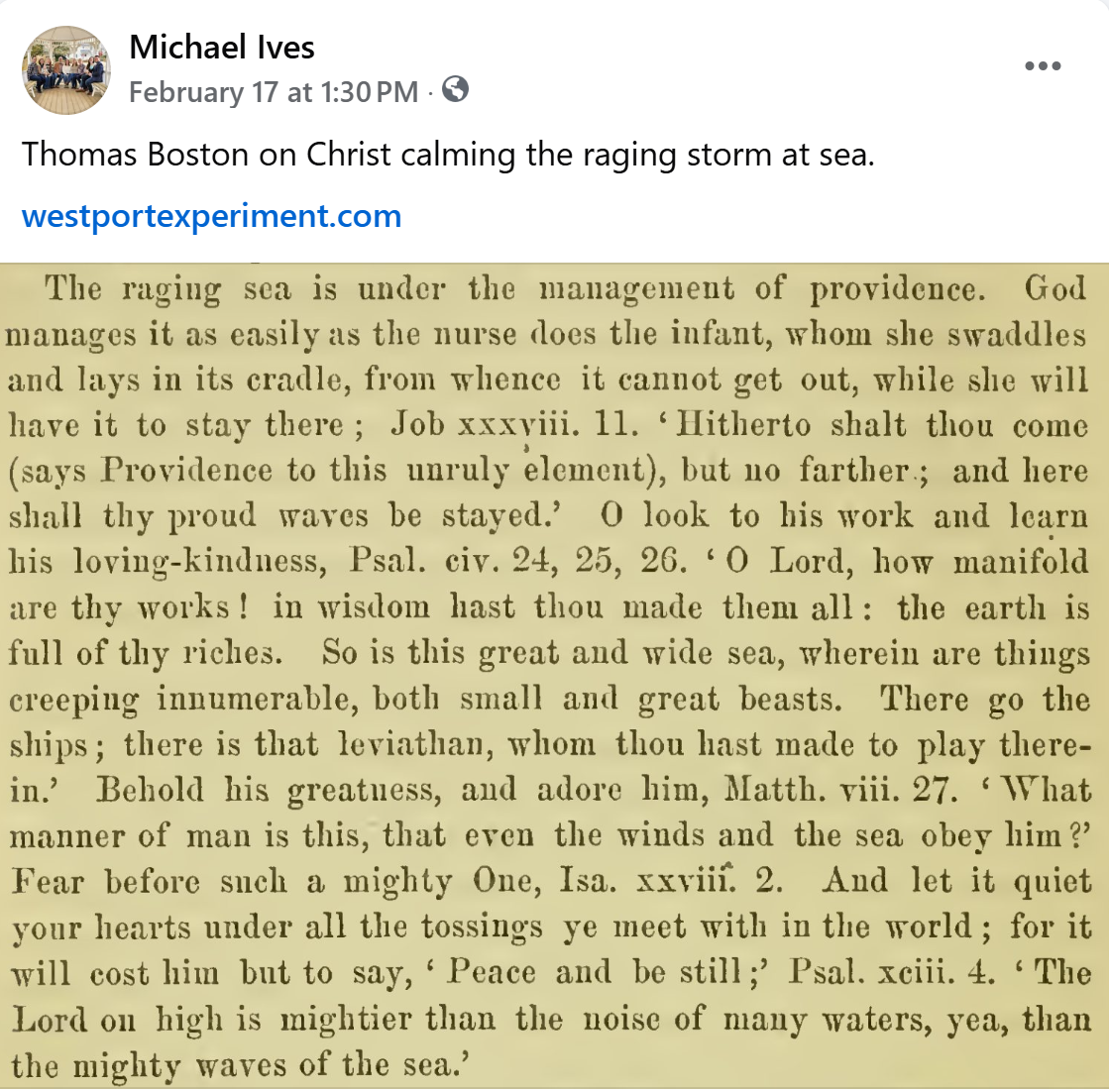
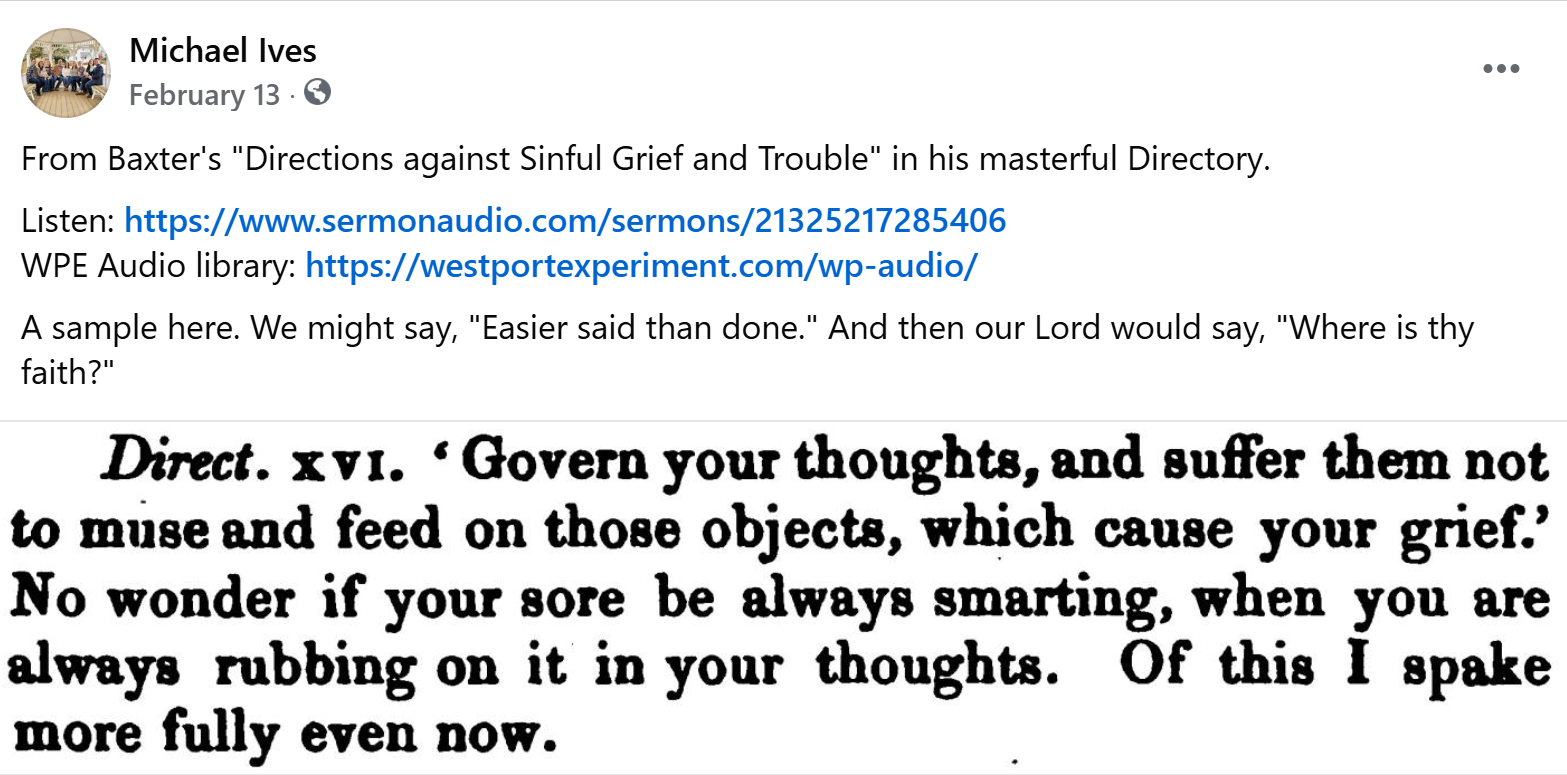
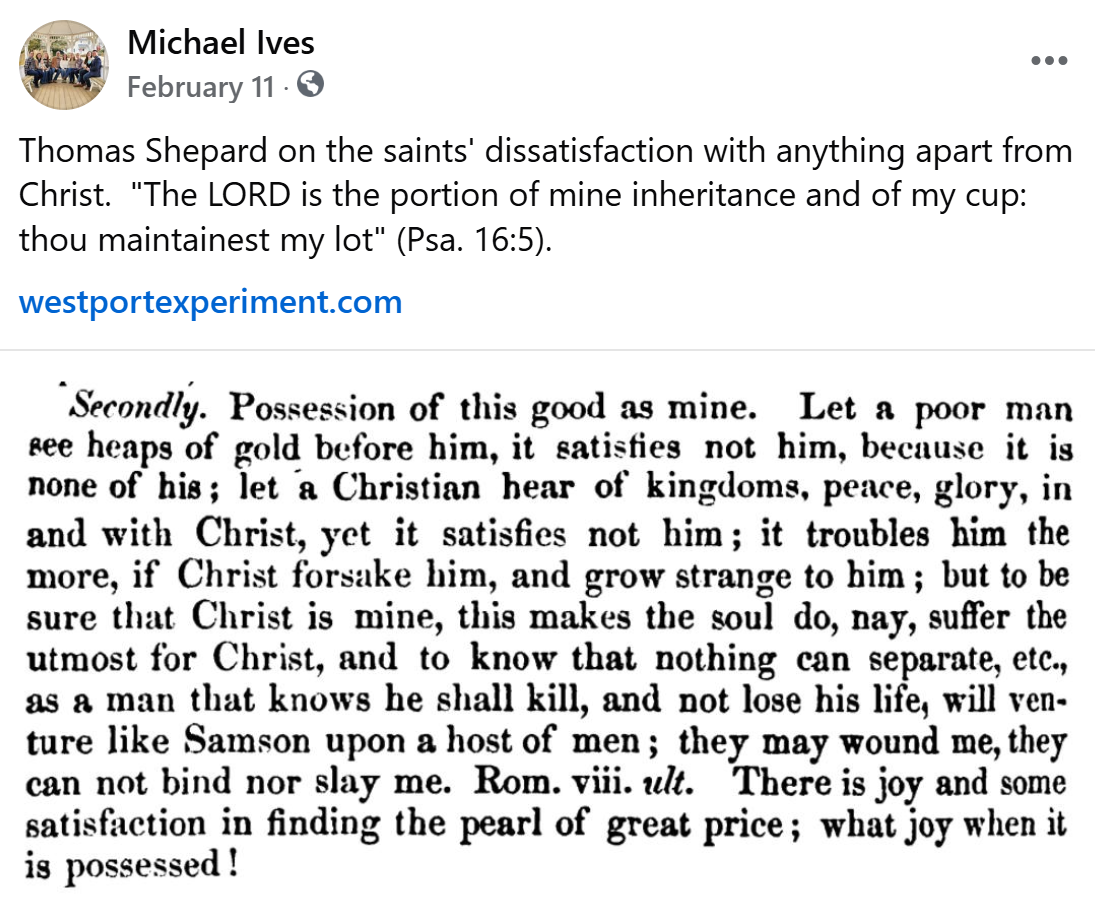
Vox patrum: Boston, Baxter, Shepard
Posted in New England Puritanism, Puritans & Puritanism, Vox Patrum on March 18, 2025| Leave a Comment »
Brakel: earnestly waiting on the means of grace
Posted in Christian Life & Experience, Experimental Religion & the Cure of Souls, Ordinary Means Ministry, Vox Patrum on March 18, 2025| Leave a Comment »
You who are unconverted, if you do not give heed, know that He will not always speak to you. He will remove either His Word, His Spirit, or you, and then it will be too late. “To-day if ye will hear His voice, harden not your heart” (Ps 95:7-8). You who are converted, know also that if you are not diligent in listening to Him, in continually beseeching Him, in expecting His answer, nor in following His counsel, He will remain silent, hide Himself more and more, and leave you in darkness. The more attentively and persistently you hear His instruction, however, the more He will reveal His secrets to you, and grant deeper insight into that which you may know already. His voice of instruction will be more enduring and efficacious within you. Therefore, “Hear attentively the noise of His voice, and the sound that goeth out of His mouth” (Job 37:2). The Lord Jesus says, “Hearken diligently unto Me, and eat ye that which is good, and let your soul delight itself in fatness” (Isa 55:2); “Blessed is the man that heareth me, watching daily at My gates, waiting at the posts of My doors. For whoso findeth Me findeth life, and shall obtain favour of the Lord” (Prov 8:34-35). All of you who are conscious of your blindness and are desirous for spiritual light, come to this Prophet who can and will instruct you, in order that by His instruction you may make progress.
National patrons of the national family
Posted in Establishments, Paternalism & Patriarchy, Patronage, The Civil Magistrate, Thomas Chalmers on March 11, 2025| Leave a Comment »
“We presume it to be agreed on both sides, that the outcast millions ought to be reclaimed from the ignorance and irreligion of heathenism. The only difference relates to the party at whose expense this great achievement ought to be perfected —whether by private Christians, under the impulse of a religious benevolence; or by an enlightened government under the impulse of a paternal regard for the highest weal of its subject population. We, the advocates of a National Establishment, hold it the duty and wisdom of every state, thus to undertake for the education of the great family under its charge, and to provide the requisite funds for the fulfilment of the enterprise—and this without prejudice, but the contrary, to the liberality of those individuals, who might choose of their own means to build more churches, and maintain more ministers—thus adding to the amount of Christian instruction in the land. Our antagonists on the other hand hold this to be only the fitting work of individuals, whether acting separately or in associated bodies—to be their concern, and theirs exclusively; and that the government of a country should have nothing to do with it” (Chalmers, Works 17:258-59).
All secrets will be disclosed
Posted in Holy Scripture on March 11, 2025| Leave a Comment »