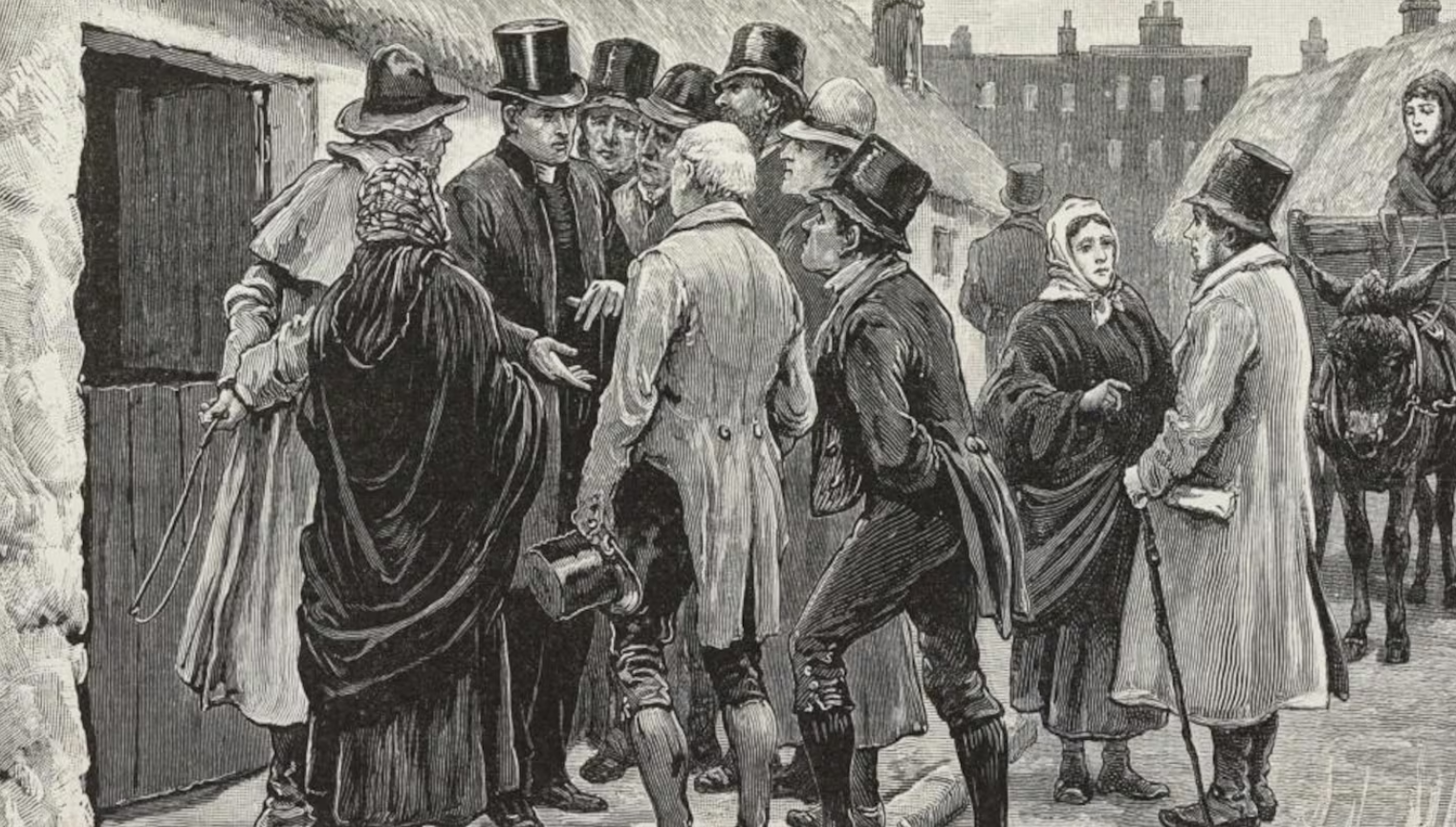
The following is a rather interesting piece in an old edition of the Bulwark Magazine. James Begg inquires with Dugald MacColl on the effect of his territorial mission with the Roman Catholic population in Glasgow.
See also this post on Thomas Chalmers’ outlook on Protestant parochial missions to Irish Roman Catholics.
“Yet I must say I liked the Irish part of my parishioners. They received me always with the utmost cordiality, and very often attended my household ministrations, although Catholics” (Works 16:243).
This and the following are selections from Thomas Chalmers on his attitude and outlook on reaching the poor Irish “papists” of his day, both domestically through aggressive, Protestant territorial missions, as well as on the Emerald Isle itself. Much here that is relevant, especially when so many Western nations have swarms of un-Christianized immigrants on our very doorstep.
* * * * *
Chalmers here refutes the notion that the Protestant establishment in Ireland ought to respect parochial bounds of Romanists. No! Parish lines are only relevant for the sake of the Gospel, and ought valiantly to be transgressed when the strong man’s house must be plundered: “We do not say that the maxim has been universally acted on, but it has been greatly too general, that to attempt the conversion of a Papist was to enter another man’s field; and that, in kind at least, if not in degree, there was somewhat of the same sort of irregularity or even of delinquency in this, as in making invasion on another man’s property. In virtue of this false principle, or false delicacy, the cause of truth suffered, even in the hands of conscientious ministers; and when to this we add the number of ministers corrupt, or incompetent, or utterly negligent of their charges, we need not wonder at the stationary Protestantism, or the yet almost entire and unbroken Popery of Ireland. We now inherit the consequences of the misgovernment and the profligacy of former generations. They may be traced to the want of principle and public virtue in the men of a bygone age. Those reckless statesmen who made the patronage of the Irish Church a mere instrument of subservience to the low game of politics—those regardless clergymen who held the parishes as sinecures, and lived in lordly indifference to the state and interests of the people—these are the parties who, even after making full allowance for the share which belongs to the demagogues and agitators of the day, are still the most deeply responsible for the miseries and the crimes of that unhappy land (Chalmers T 1838m; Works 17:304).
“Remember what all the manuals that teach effective work practices tell you to do? Do the difficult things first. Give them priority. My own experience, for what it is worth, is that disciplined, faithful attendance at corporate prayer times can slowly transform them into some of the best and most important meetings you attend. Apart from other considerations, the privilege of hearing the burdens on the hearts of Christian friends is a better way to get to know them than having coffee with them! In no other context in life will you hear the kind of speech that is expressed when believers share their needs and desires with God. The quickest way to get into the heart of a church is to gather with it when it turns to prayer.”
Comedian John Mulaney once joked that one of Jesus’ greatest miracles was having twelve close friends in his thirties. Sadly, the modern decline of friendship is real, and anything but a punchline.
The Survey Center on American Life reports that that in 1990, almost 70% of men had five or more close friends. By 2021, just 40% reported having that many. And the number who said they had no close friends quintupled. Women haven’t fared well, either, though their friend groups haven’t shrunk as rapidly.
Part of the challenge is that time together is the oxygen of friendship. Deprive it of that, and friendship tends to die or at least become more distant. And today, perhaps due to a faster pace of life and more “stuff” piled into our schedules, spending time with friends requires more effort and intentionality than in decades past. Research shows that Americans now spend half as much time with their friends (three hours a week) as they did just a decade ago.
I’ve recorded several chapters of Cotton Mather’s great Magnalia Christi Americana: Or, The Ecclesiastical History of New-England: from Its First Planting, in the Year 1620, Unto the Year of Our Lord 1698. Here are the opening words of the first chapter, “Discoveries of America.”
* * * * *
“It is the opinion of some, though ’tis but an opinion, and but of some learned men, that when the sacred oracles “of Heaven assure us, the things under the earth are some of those, whose knees are to bow in the name of Jesus, by those things are meant the inhabitants of America, who are Antipodes to those of the other hemisphere. I would not quote any words of Lactantius, though there are some to countenance this interpretation, because of their being so ungeographical: nor would I go to strengthen the interpretation by reciting the words of the Indians to the first white invaders of their territories, we hear you are come from under the world to take our world from us. But granting the uncertainty of such an exposition, I shall yet give the Church of God a certain account of those things, which in America have been believing and adoring the glorious name of Jesus; and of that country in America, where those things have been attended with circumstances most remarkable. I can contentedly allow that America (which, as the learned Nicholas Fuller observes, might more justly be called Columbina) was altogether unknown to the penmen of the Holy Scriptures, and in the ages when the Scriptures were penned. I can allow, that those parts of the earth, which do not include America, are, in the inspired writings of Luke and of Paul, stiled all the world. I can allow, that the opinion of Torniellus and of Pagius, about the apostles preaching the gospel in America, has been sufficiently refuted by Basnagius. But I am out of the reach of Pope Zachary’s excommunication. I can assert the existence of the American Antipodes: and I can report unto the European churches great occurrences among these Americans. Yet I will report every one of them with such a Christian and exact veracity, that no man shall have cause to use about any one of them the words which the great Austin (as great as he was) used about the existence of Antipodes; it is a fable, and nulla ratione credendum.
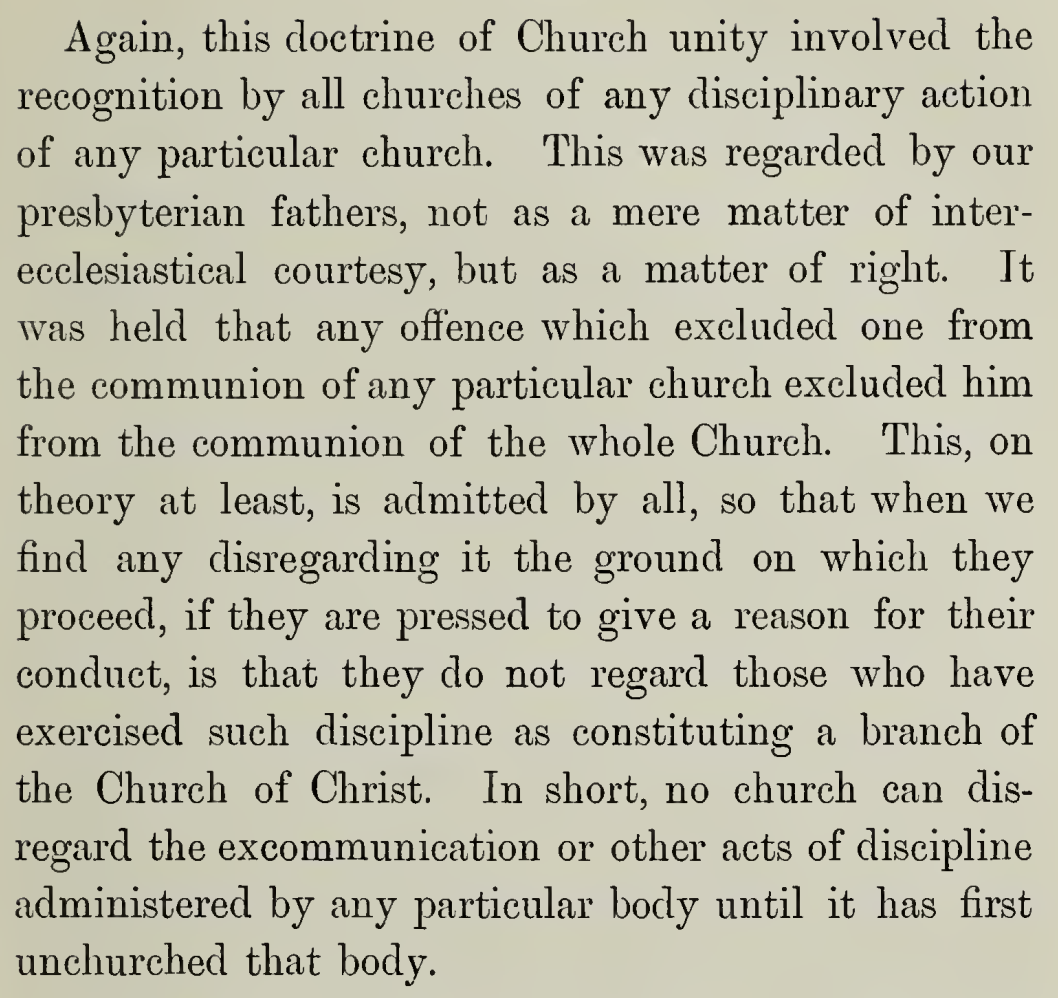
MacPherson explains the radically catholic ecclesiology of our Scottish Presbyterian forbears. Listen to an audio recording of the chapter where he treats this subject here.
Whole doctrine catholicity | “Who is she that looketh forth as the morning, fair as the moon, clear as the sun, and terrible as an army with banners” (Song 6:10)?
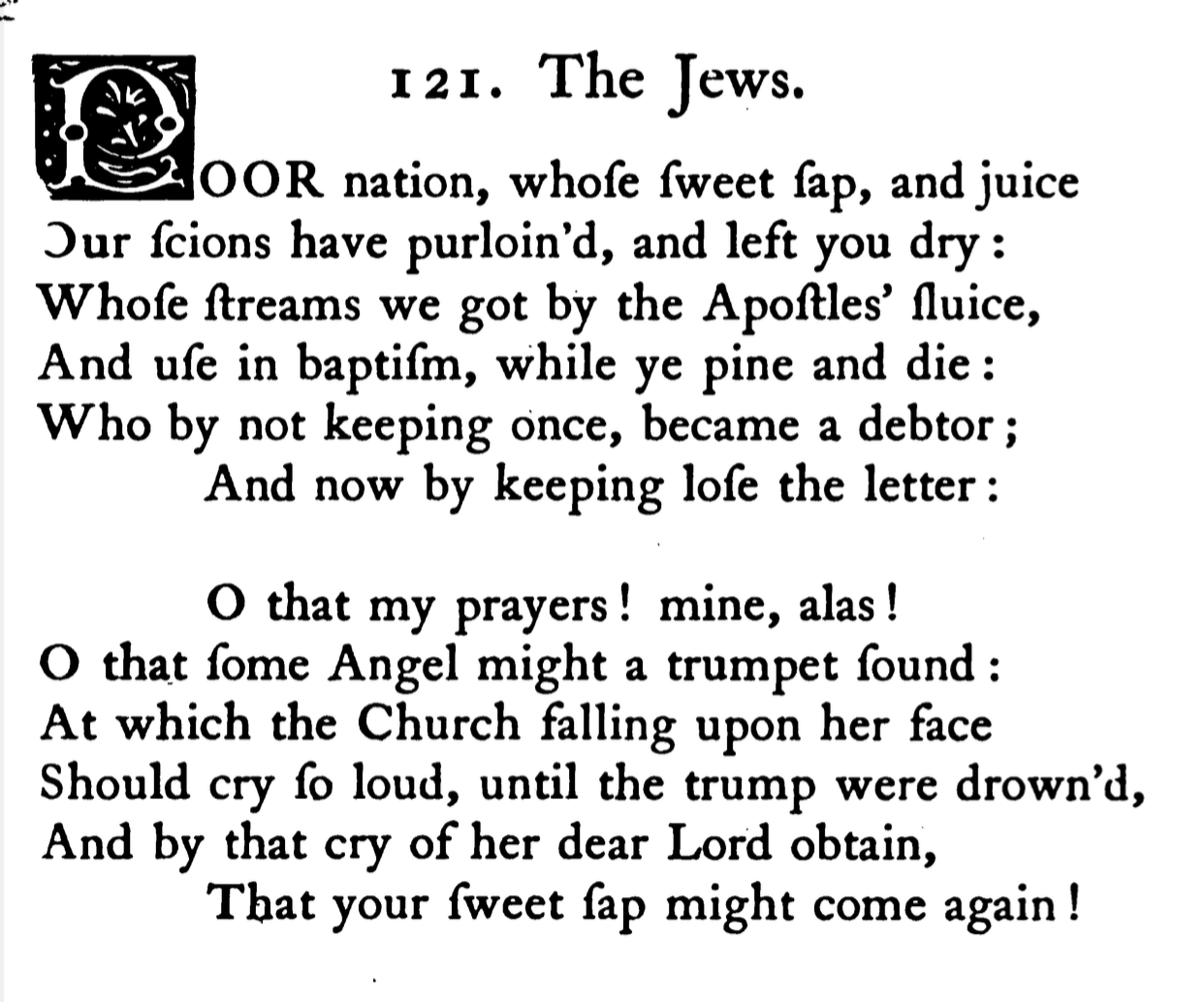
“For if thou wert cut out of the olive tree which is wild by nature, and wert graffed contrary to nature into a good olive tree: how much more shall these, which be the natural branches, be graffed into their own olive tree” (Romans 11:24). This poem of Herbert beautifully and tenderly expresses the right attitude of the believing Gentiles toward the disinherited Jews, with Pauline longings for their final restoration by repentance and faith in their own, rejected Messiah.
1. scion: a young shoot or twig of a plant, especially one cut for grafting or rooting. 2.purloin: to steal. 3. sluice:a sliding gate or other device for controlling the flow of water, especially one in a lock gate.
This was very, very good. Especially in light of a resurgent antisemitism in the West, and even in the Church. Remember, Satan’s grand conspiracy is multi-front. And the Jews, while “enemies for our sakes,” are yet “beloved for the fathers’ sakes.”
My role under presbytery is twofold. First is a conventional, pastoral one. I join my elders in pastoring our local congregation in S. Jersey, and I preach on average 1 out of every 2 of our Lord’s day services throughout the year. We are blessed with edifying pulpit supply for the balance of the pastoral ministry. The congregation is able to support me to a certain degree.
Second, I have what may be called a ‘home mission’ function. In 2023, presbytery formally approved my raising of funds for Reformed Parish Mission under the oversight and with accountability to our denominational missions committee. My presbytery also has committed to a measure of monetary support, but has limited means to do more. Together, those means are less than half of what my family and I require.
While not the ideal from a Presbyterian point of view (such missionaries would receive their full support from their own denomination), practical considerations lead me to raise funds for myself in a fashion similar to independent evangelicals. I am too convinced of the worthiness of the cause to allow it to wither for lack of funding; and so I have overcome my natural inhibitions and actively solicit funds for Reformed Parish Mission from friends, family, and churches within and beyond the Presbyterian Reformed Church.
Please pray for me. And if you could contribute—or even commit to monthly support—I would be in your debt. The Lord bless you and yours.

 West Port Experiment