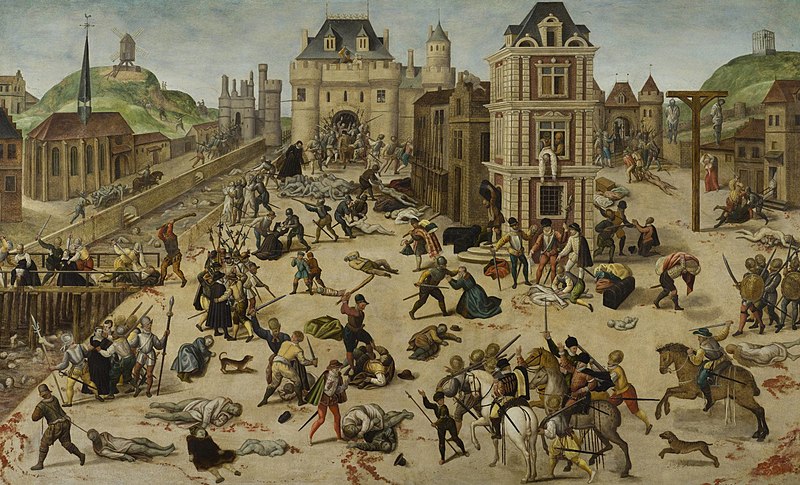
Why should we think about the St Bartholomew’s Day Massacre? What took place then was a long time ago, in a very different world. Most of society today will not have heard about [this] massacre. Of those that have, the majority will say that its significance is merely historical, and that today we are advancing in a new era that is leaving narrow-minded bigotry behind, and that focusing upon the evils of the past will simply perpetuate thoughtless sectarianism. Beside this, and much more significantly, there is the exhortation of Philippians 4:8: “whatsoever things are true, whatsoever things are honest, whatsoever things are just, whatsoever things are pure, whatsoever things are lovely, whatsoever things are of good report; if there be any virtue, and if there be any praise, think on these things.” The question that may therefore be legitimately asked, is, is it correct and is it helpful for us to focus upon this ugly and violent episode from the past?
In answer we must recognise that when scripture directs us to meditate and dwell on what is good, it does not forbid us from recognising and learning from what is not good. Rather, in scripture itself there are many horrific events, and we have a duty to notice and learn from them. It is very naïve to think that today’s world has progressed beyond such horrific violence. We must not turn away from the issues of our own day but be thoughtfully involved in addressing them, and there are important lessons to be learnt from this historic event.
Continue reading in the PDFs below. This article was written by the Rev. James MacInnes, of the Free Church of Scotland (Continuing) and published in the April-June and the July-September editions of the Bulwark, a publication of the Scottish Reformation Society.
 West Port Experiment
Leave a comment