I thought I might share what I’ve been reading recently. In addition to my devotional and theological recordings, here are some books I’ve finished in recent days of personal interest. In our extremely digital age, we need to stay reading. Let us read good books; and if we read books that are not explicitly Christian, let us do so critically with an eye to Scripture as our absolute authority.

First, Nancy R. Pearcey’s The Toxic War on Masculinity: How Christianity Reconciles the Sexes. In a similar fashion to Carl Trueman’s The Rise and Triumph of the Modern Self, Nancy Pearce frames her book of cultural commentary around a “how did we get here?” question. For Trueman, it was “how did we ever get to the place where a man thinks he is a woman?” For Pearcey, it is “how did masculinity ever become ‘toxic?'” She engages in a historical and sociological inquiry that is quite insightful, from a thoughtful, Christian perspective. I especially found her explanation of the shift of men from cottage-industry and family-integrated work patterns to working outside the home in factories, etc., at the Industrial Revolution, and its negative impact on father-son relationships and family life in general. For a kind of teaser, listen to this interview on Issues, etc.
The next one is H.G. Wells The War of the Worlds. I wasn’t drawn to it so much because of any particular love for science fiction, but because it was a classic and I had never read it. Of course, I had listened to Orson Wells’ dramatized and Americanized adaption of the same in the 1930s. While this original work by H.G. Wells did not explicitly challenge theism and Christianity, it certainly did so in the drift of the narrative. Religion proved wholly impotent and unmanly before the daunting invasion of the Martians. This sickening impotence was given shape in the sniveling curate (pastor). An instance of this may be seen when the protagonist and the curate are struggling for survival together amid the wreckage of a home next to a new crater with Martians ominously moving about:

That night, as we lurked in the scullery, balanced between our horror and the terrible fascination this peeping had, although I felt an urgent need of action I tried in vain to conceive some plan of escape; but afterwards, during the second day, I was able to consider our position with great clearness. The curate, I found, was quite incapable of discussion; this new and culminating atrocity had robbed him of all vestiges of reason or forethought. Practically he had already sunk to the level of an animal. But as the saying goes, I gripped myself with both hands. It grew upon my mind, once I could face the facts, that terrible as our position was, there was as yet no justification for absolute despair. Our chief chance lay in the possibility of the Martians making the pit nothing more than a temporary encampment.
One could say that it is precisely Wells’ secular, evolutionary worldview that even allows for the existence of Martians. Their emergence would suggest that the universe is much, much more random and inexplicable than it is in a God-structured and man-tailored one. Now while I tend to agree that real aliens would beg that question, and while I would much sooner (by far!) entertain the reality of demons masquerading as little green men to bait ‘sophisticated’ moderns, Wells’ grim tale does nothing to unsettle my Christianity—though I would give caution to any sensitive Christian reader always to take care with sci-fi. But I could see how the dread of more ‘sciencey’ star-gazing sinners might well be spiritual judgment upon them. “The wicked flee when none pursueth: but the righteous are bold as a lion.” And more, there will indeed be an epic invasion from beyond on the fearful Day of the Lord.
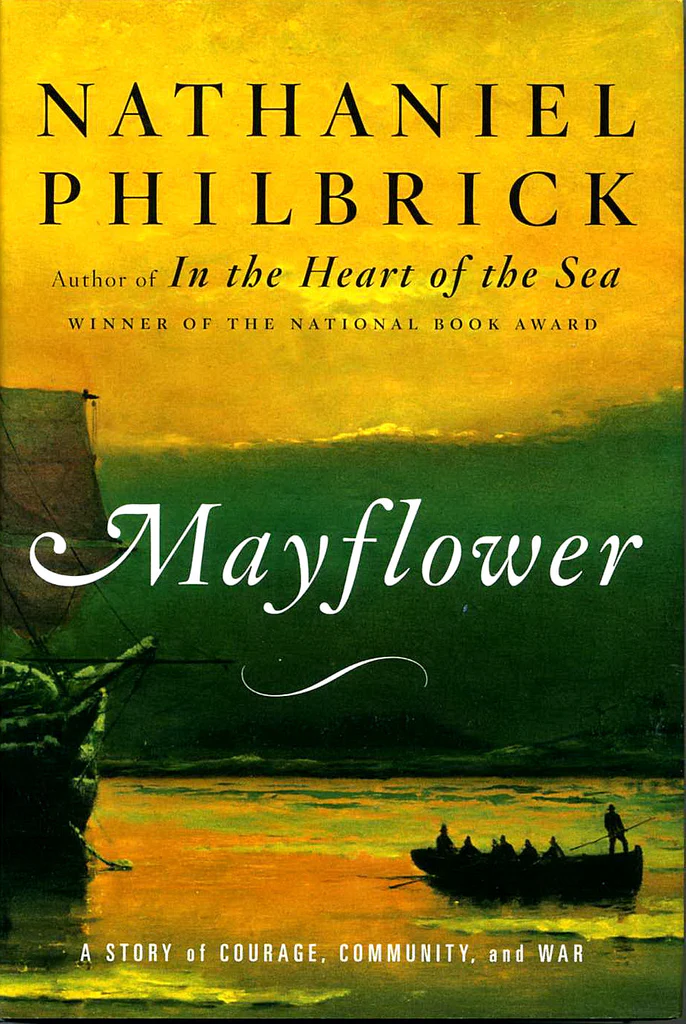
Finally, Nathan Philbrick’s Mayflower: A Story of Courage, Community, and War. This contemporary author really makes history fresh and engaging. And as a non-Christian scholar, he definitely approaches the New England colonial period with much more fairness and balance than the scorched-earth iconoclasts who view everything Christian in America through the lens of Western imperialism. In that respect, it is a breath of fresh air. He takes the reader through the end of King Philip’s War in the late 17th century. I also highly commend the audiobook, read by George Guidall. He really enhances the experience.
For some recorded primary sources from the New England Puritan era, including selections from Cotton Mather’s great Magnalia Christi Americana, click here.
 West Port Experiment
Leave a comment