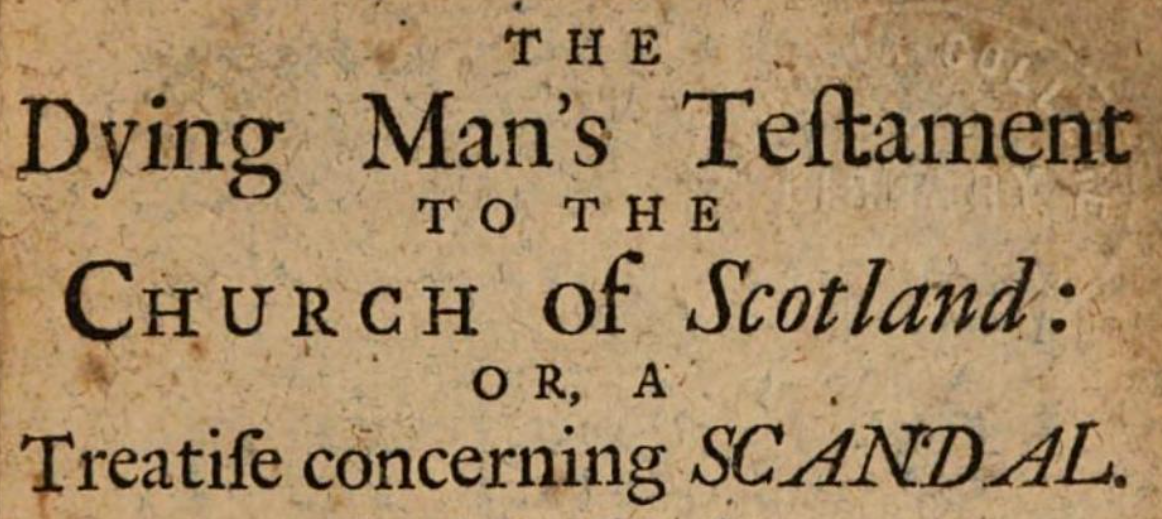
James Durham’s On Scandal is an enduring tribute of the Scottish Second Reformation to that ancient confession, “I believe an holy catholic Church.” There is nothing quite like it, in its thorough, thoughtful, pastoral handling of how to prevent and remedy divisions within the Church, both at the personal and congregational level, as well as organizationally in the broader Visible Church. The following chapter (4.7), “General Grounds leading to Unity,” lays out the path for visible, organizational unity. And it breathes of that simple, Christian yearning for the full answer to our Lord’s prayer, “That they all may be one; as thou, Father, art in me, and I in thee, that they also may be one in us: that the world may believe that thou hast sent me” (John 17:21).
Whole doctrine catholicity | “Who is she that looketh forth as the morning, fair as the moon, clear as the sun, and terrible as an army with banners” (Song 6:10)?
* * * *
But now, it may be of more difficulty to speak particularly to what indeed is duty at such a time when a Church lies under rents and divisions. For, though the general be granted, yet often it is difficult to take up the particular cure, and yet more difficult singly to follow the same. It is still more easy to prescribe rules to others than to follow them ourselves, especially in such a case when spirits are in the heat and fervour of contention, whereby they are somewhat drunken with affection to their own side and prejudice at the others, and distracted as it were with a sort of madness in pursuing their adversaries, as that great and meek Divine Melancthon did express it, so that it is hard to get affections that are in such a temper captivated to the obedience of light.
And though we will not take upon us to be particular and satisfying in this, wishing and hoping that it may be more effectually done by some other, yet, having come this length, we shall, in an abstracted manner, consider some things in reference thereunto and endeavour to hold forth what we conceive to be duty, especially to the Ministers of the Gospel who have interest in such a Church; as also what may be required of others who may possibly think themselves less concerned therein. We shall keep this order: we shall lay down some general grounds, which we suppose as granted; we shall premit some preparatory endeavours agreeable to the same; we shall speak negatively to what ought not to be done, or ought to be forborn; positively to the healing means called-for in reference to several sorts of division, with some questions incident thereupon; and lastly, we shall consider the grounds that press the serious and condescending application of these or other healing means in such a case.
The first general ground, which we take for granted, is this: that by way of precept there is an absolute necessity of uniting laid upon the Church, so that it falls not under debate whether a Church should continue divided or united, any more than it falls under debate whether there should be preaching, praying, keeping of the Sabbath, or any other commanded duty, seeing that union is both commanded as a duty and commended as eminently tending to the edification of the Church, and therefore is so frequently joined with edification. Nor is it to be asked by a Church what is to be done for the Church’s good in a divided way, thereby supposing a dispensation, as it were, to be given to division, and a forbearing of the use of means for attaining it; or rather supposing a stating or fixing of division, and yet notwithstanding thinking to carry on edification. It is true that where union cannot be attained among orthodox Ministers who agree in all main things (for of such only we speak), Ministers are to make the best use of the opportunities they have, and during that to seek the edification of the Church. Yet that men should by agreement state a division in the Church or dispense therewith, and prefer the continuing of division as fitter for edification than union, we suppose is altogether unwarrantable. First, because that is not the Lord’s Ordinance, and therefore cannot be gone about in faith, nor can the blessing be expected which the Lord commands to those that are in unity. Second, because Christ’s Church is but one Body, and this were deliberately to alter the nature thereof; and although those who deny this truth may admit of division, they cannot have union, that is proper Church-union, which is union in Government, Sacraments, and other Ordinances, because union or communion in these doth result from this principle. Yet it is impossible for those who maintain the principle of the unity of the Catholic visible Church to own a divided way of administrating Government or other Ordinances, but it will infer either that one party has no interest in the Church, or that one Church may be many; and so that the unity thereof in its visible state is to no purpose. This then we take for granted. And though possibly it be not in all cases attainable, because the fault may be upon one side who possibly will not act unitedly with others, yet is this still to be endeavoured, and every opportunity to be taken hold of for promoting the same.
The second ground which we suppose is this: that as union is ever a duty, so, we conceive, if men interested will do their duty, there can be no division among Orthodox Divines or Ministers, but it is possible also to compose it, and union is a thing attainable. We are not speaking of composing divisions that are stated upon fundamental things, nor are we speaking of removing all differences, as if all men were to be one in judgment in every point of truth; there may be difference where there is no division. Nor, when we speak of men doing their duty, do we mean a full up-coming of everything in knowledge and practice, and that in a sanctified manner, though that ought to be endeavoured. But it looks principally to the doing of duty in reference to this particular matter of attaining union, a great part whereof consists in outward obvious things, which do neither require simply sanctification in the person nor perfection in the degree, some of which we may afterward mention. So that the meaning is, if we consider union in itself, without respect to men’s corruptions (which will make the least thing impossible when they are in exercise), it is a thing possible, according to the acknowledged principles that sober, orthodox men usually walk by, as experience has often proven, and reason demonstrates in particulars afterward to be instanced. This consideration ought the more pressingly to stir up the endeavour of this duty, although oftentimes through men’s corruption it has been frustrated.
Thirdly, we premit that in endeavouring union and healing, men would not straiten it to a universal union in everything, in judgment and practice, but would resolve to have it with many things defective that need forbearance in persons who are united, which we may take up in these particulars. There may be difference of judgment in many things, I mean in such things that are consistent with the foundation and edification; and such forbearance would be resolved upon. To do otherwise were to think that either men had no reason at all, or that their understandings were perfect, or at least of equal reach. There may be dissatisfaction with many persons, whether Officers or Members; and to expect a Church free of unworthy Officers or Members, and to defer Church union thereupon, is to expect the barn-floor shall be without chaff, and to frustrate the many commands whereby this duty is pressed. For certainly our Lord Jesus gave this command to His disciples when Judas was amongst them, and Paul gave it and practised it when some preached out of envy, and when almost all sought their own things and not the things of Christ. And certainly, if people ought to carry even to corrupt Ministers who yet destroy not the foundation, as Ministers, in the duties that become them in communion with them while they continue such, then certainly Ministers ought to keep that communion with Ministers that becomes their relations, seeing they are still Ministers in that respect as well as in the other. And if this corruption will not warrant separation in other Ordinances, then neither will it warrant division in the ordinance of government.
It may also be consistent with many particular failings and defects in the exercise of government, as possibly the sparing of some corrupt Officers and Members; the censuring of some unjustly, or the admission of some that are unfit for the Ministry, and such like. These indeed are faults, but they are not such as make a Church to be no Church; and though these have sometimes been pretended to be the causes of schisms and divisions in the Church in practice, yet were they never defended to be just grounds of schisms and divisions, but were ever condemned by all Councils and Fathers, and cannot be in reason sustained. For there should be then no union expected here, except we supposed that men who have corruption could not fall in these faults. It is not unlikely that some of these were in the primitive Churches; somewhat is insinuated thereof in the Revelations to those Church officers, their tolerating of Jezebel and the Nicolaitans to seduce the people and to commit fornication; yet neither is separation or division called-for, or allowed either amongst Ministers or people. Sure there were such corrupt acts of all kinds amongst the Jewish Church-officers; yet it is clear that Nicodemus and Joseph of Arimathea continued to govern jointly, notwithstanding thereof, who yet cannot be counted accessory to any of their deeds. Because men in such cases have access, even when they are present, to discountenance such corrupt acts by not consenting thereto, and testifying against the same. They may by so doing stand in the way of many wicked acts, which by dividing they cannot do, which is sufficient for their exoneration both before God and men, as we see in the instances of Joseph and Nicodemus, who continued united in the government, kept the meetings even when sentences passed against those who acknowledged Christ, and orders for persecuting Him and them. Yet they are declared free because they dissented from and testified against the same. Their freedom and exoneration by virtue of their dissent being present is more solemnly recorded to their honour in the Gospel than if they had divided. And yet the unity of the Church now has the same ground, and no fewer motives to press it than it had then. It may stand with some defects in worship, manner of government, and rules that are necessary for good government in a Church. It is likely that many things of that kind were defective in the Church of Corinth, where the Sacrament was so disorderly administrated, confusion in many things of worship, and some things still to be set in order; yet does the Apostle nowhere press union more than in these Epistles. Neither can it be thought that perfection in all these is ever to be expected, or that union until such time is to be delayed. If there be defects of that kind, it is union and not division that is to be looked upon as the commended means for redressing the same.
If it be asked then, with what kind of defects or discontents may a union be made up, or what rules may be walked by therein, we offer these considerations or rules. First, what cannot warrant a breach where there is union cannot warrantably be the ground to keep up a division. There are many miscarriages or defects, which are really gross, and yet will not warrant a schism. The reason is that making up of a breach is no less a duty than preventing thereof; and if it began upon such a ground, then the continuing thereof upon the same ground is but continuing in the same sin, and it cannot be thought that any party by dividing upon an unjust ground can afterward be justified upon the same ground. It remains therefore that if the ground was not sufficient at first to warrant a separation or division, it cannot be sufficient afterward to continue the same.
Second, such defects as do not make communion in a Church and in its Ordinances sinful will not warrant a separation or division from the same. It is acknowledged by all that there is no separation from a true Church in such Ordinances, as men may without sin communicate into, although others may be guilty therein; as, suppose men to have access to government without such bonds and engagements, and such like, as may mar their freedom in following the light of the Word, in deciding whatever shall come before them, even though others should step over the same.
Third, men may keep communion with a Church when their calling leads them thereto upon the one side, and they have access to the discharge of the same upon the other. If some acts of a man’s station lead him to an united way of acting, as the duties of a fixed Minister do, then he is obliged to follow the duties of his calling whilst there is no physical or moral impediment barring him in the same, and others being defective in their duty will not absolve him from his, which he owes by virtue of his station.
Fourth, while the general rules tending to edification in the main are acknowledged, union is to be kept even though there be much failing in the application, because there are fit weapons to make use of, and who knows but single and zealous improving of them may help the application thereof. If there be a failing therein, it is the person’s deed that misapplies, and does not involve any other in that guilt, besides that by joint and united acting much of that misapplication may through God’s blessing be prevented.
Fifth, then there may and ought to be uniting when the evils that follow division or schism are greater and more hurtful to the Church than the evils that may be supposed to follow on union. I speak not of ills of sin, for the least of these are never to be chosen, but of evils and inconveniences that may indeed be hurtful to the Church in themselves, and sinful in respect of some persons, yet are not so to all. In such evils the lesser is to be chosen because uniting and acting jointly in a Church-way belongs to the policy and government of the Church, wherein Christian prudence is to have a main hand. So that when things cannot be done as men would simply, they are to do as they may comparatively, that is, to choose and make use of what may be most edifying and least hurtful to the Church’s edification, among all these means that seem probable and possible. So the conscience may have testimony in this, that the way that had fewest inconveniences and most advantages to edification was chosen, and though some inconveniences fall out afterward, yet the conscience may be quiet on this ground. Sometimes the Lord in His providence will order matters of government such that no side can be chosen without inconveniences.
If it be asked then, what way men may discern the side to be followed in such a case when inconveniences threaten on all hands, the answer is by observing which side has the most dangerous and destructive inconveniences, which inconveniences are most certain and inevitable, and which duty the command presses. Union has the advantage over division, because it is a commanded means tending to edification, which division is not. Division has no fewer inconveniences following it, nor less destructive to the Church, than union in the case supposed.
Schism is one of the greatest hurts that can come to an orthodox Church, next to heresy in doctrine, and therefore no particular evil can be weighed against it. The ills of division are most inevitable; the ills that follow union, through God’s blessing, may be prevented, but division itself is out of God’s way.
When men may unite without personal guilt or accession to the defects or guilt of others, there may and ought to be union, even though there be failings and defects of several kinds in a Church. Men are to reckon not for other men’s miscarriages, but their own, and no such Church-state is to be expected as is free of defects. It cannot warrant a man to abstain from his duty because others do not theirs while there is no sinful impediment lying in the way of his access thereto. Such impediments may include: if a person is put to condemn anything he thinks lawful in his own former practice or the practice of others, or in some point of Doctrine though extrinsic, if it is to him a point of truth; if he be put to approve the deed and practice of some others which he accounts sinful, or to affirm as truth something he accounts an error; or when some engagement is required for the future which restrains from any duty called for, or that may afterward be called for. These involve persons in the sin of what is past and make them accessory to inconveniences that may come, defiling their conscience. Such entanglements are to be forborn; but where no such thing exists, there may be access to union, even where there are many public defects.
For attaining union, there ought to be large mutual condescending, that is, both sides ought to stretch themselves not only to forbear what is sinful, nor only to condescend to what may be thought simply necessary, but condescending ought to be mutual and leveled according as expediency calls for, with respect to the edification of the Church. Many infirmities of others are to be forborne, and things otherwise unreasonable in respect of these men we deal with ought, for the Church’s peace, to make men cede. If there ought to be condescending for private peace, much more ought it be for Church peace and public edification.
In what may involve a man in sin, or in the approbation thereof in others, there is no condescending beyond the utmost border of duty. Condescension should be mutual, so one party does not expect full submission from the other, for that is dominion, not union. Even that party that seems most right in the matter, or to have authority on its side, ought yet to condescend, and in some things to be most condescending, because they are in some sort parents and strong; they ought therefore to bear and cover the infirmities of the weak, and to carry seriously toward others, whom they suppose to be in a distemper. Authority is given for edification, and it is not unsuitable for it to condescend to attain its end. Often the most tender and sincere, and those who were upon the right side, have been most condescending, and those who did the wrong were most averse from condescension. Those who condescended most in such things have been thought the greatest friends to the Church, even sometimes when their side was not as justifiable as the other.
From what is said, we may lay down negative conclusions concerning the upmaking of a breach among Godly and Orthodox men where a Church has harmony in the fundamental points, Faith, Worship, and Government, and where the thriving of the Gospel is mutually designed. Division ought not to be endeavoured to be removed in such a way as undoes or destroys either side, because that is not the good of the whole. Every part and side in such a case is a part of the body, although it may not be very considerable, and it is no wisdom to cut off a member of the body to cure a distemper when gentler means might recover it. That way of uniting is not to be admitted but shunned, which may incapacitate any Minister or member fit for edifying the Church from access thereto. Union should be essayed with all due respect from each to the other, without any note of disrespect. No simply authoritative mean is the fit and only way of healing a rent Church; the remedy must be extensive to both sides. Authority is often declined in such cases, and when declined, cannot effectuate the end; the remedy must suit the Church in its distemper, as a sick body is nourished with food suitable to its condition, sometimes pleasing the taste when more wholesome things are not admitted. Both judgments must be informed, and affections gained, by prudential and affectionate ways. Union is pressed more by persuasions, entreaties, reasons, and the ills that follow the want thereof than by authority, and must be persuaded rather than commanded. Among such persons, private and particular condescension is most becoming that respect which each ought to other.
Fifthly, We premit, That suppose sufficient condescension should fail upon one side, yet ought the other to condescend fully the length that is possible. Because Church-union amongst Church-men is no civil bargain to use prigging therein, but what is possible is duty out of obedience to God, who commandeth peace in other things (and so, much more in this) as far as is possible, or as in men lyes. And, because respect is to be had to the Churches good, whose advantage we should seek, even though others were defective; and often such condescending gaineth more for the advantage of the Church, and commendation of the party condescending, than if there had been more sticking, as we may see in that praiseworthy instance of Basilius his carriage, who stuck on nothing, but absolutely did lay by what was contended-for, without respect to his own right or injury, for the Churches good. And oftentimes it is one party waiting for the others condescension, or taking occasion from their tenaciousness to stick, that doth keep the distance at a height.
Oftentimes in such debates as are amongst orthodox Divines and Ministers, it seemeth they might be removed if one party should condescend according to the qualifications and cautions formerly laid down; yea, it seemeth it were safer for the Churches good in such a case, that either party should practically condescend to the way of the other, than that division should be keeped up upon such grounds. For, it is not supposed here, that there is any matter of faith in question amongst such, often there was full harmony in the Confessions of Faith, as in the instances cited. There is no question for Government simply, nor for Councils and Canons, these also were acknowledged; none did disclaim the general Councils, nor their acts. The question often is not amongst them, Whether others should be brought to their opinion or not, I mean as to the stick of the division; But often it is either upon some mistaken expression of another, or error in some lesser point of Truth; And, in such a case, it is that great Augustines word, Disputable errours, or uncertain faults, are not in their pursuit to be preferred to certain peace. Or, it is for some particular act of Government, or other miscarriages by misapplying of rules, or not walking according to them, or something of that kind, as was in contrary Ordinations of orthodox men, and such like: In which cases, we say, (and it will be found from History) That it had been ever better for the Church, that either side had practically condescended to suffer the other to rule and govern, and personally to have keeped themselves free from accession to their guilt, whether of crookedness, negligence, or the like, than to have raised or entertained divisions upon such accounts. For, often orthodox, and otherwise blameless men, have been made, by such divisions, factious and carnal in their carriage, and much unusefull; who otherwise, had they been free of that temptation, might have proved sober, and profitable; and, when the temptation was over, were found to be such.
We may observe, that though in the primitive times there were diverse schisms and divisions, concerning Synods and Government, yet we will find that these contests and divisions did flow from the matter and particular acts and actings thereof, and that there was hardly ever division tabled upon the formality of the constitution of a Council or Synod; nor yet, that much difference was put betwixt declining of their authority, and of the Acts or Censures past by them. Concerning which we may observe these generals.
If the matter was right and satisfying that was concluded by many Bishops and Church-men, there was an acquiescing in the authority thereof. If the matter were displeasing and hurtfull, of whatever form it was, and of whatever number, its authority was not much respected, because it consisted only in adding weight to these things, as we may see in the Arian Councils, which were often very numerous, and others also that were erroneous, and otherwise corrupt, although there was no formal declinatour of them, or protestation against them as null; though there were sometimes some dissentients in them, yet was not their authority any way confirmed by the forbearing of such Protestations or Declinatours. Sometimes we will find worthy men appearing before and answering unto most corruptly constituted Synods, as was in those same times, and although they were sentenced and deposed by them, yet did they never esteem these Sentences to have the more authority, as we may see in the case of Athanasius, Chrysostom, and many others. Sometimes they did protest against Synods as null, when they saw violence and iniquity prevail, as was done in the Council of Antioch, in the case of Eustachius; and was done in the second Council of Ephesus by Flavianus and Anatolius. Sometimes also upon seen hazard, and designs of professed corrupt enemies, Protestations were drawn in writ antecedently; as in that Protestation which the Reformers in Germany gave out against the Council of Trent, after its indiction; because there was no probable access for Truth to have liberty in speaking, and equity in judgment; And as Sleydan hath it set down, they alleaged Cyrillus for the first practiser of this, in the time that the Arians prevailed. This we may see is their practice when they have to do with professed enemies; not sticking on formalities, but on what was material. And again, amongst themselves, the Orthodox used not to stick upon the trying and scanning of the formality of any of these Councils (for certainly in such corruptions as were so universal, Synods corrupt for the plurality of them, might have been had with all the formalities and solemnities that could be required in the external constitution of any lawful Synod) but when they had occasion to meet, they went to the doing of what was for the present good of the Church, condemning the matter of such corrupt Synods; which they did account sufficient in such cases: And for difference amongst themselves, when they were of a right temper, they did also endeavour to redress such particulars as needed, and to restore persons unjustly sentenced, and the like; Whereby it appeareth that the matter both in things of general and particular concernment, did ever bear most sway.
Although such debates concerning Government seem most easie to be removed, yet often and almost ever, they have been most difficulty healed, and have been followed with greatest bitterness and contention in the Church; for, different Judgements simply, and also different Ceremonies, and different practices in other things, may consist without direct opposition or counteracting, and may either be the more easily born or removed: but when it comes to Government, whose Sentence shall stand, whose Ordination shall be acknowledged, who shall have place to decide such and such things, and the like, it is far otherwayes. Hence it came to pass that men could keep union and communion with others that differed from them in far greater points of Truth; but to persons that did not acknowledge their Authority, or did acknowledge those that did controvert with them thereanent, they could by no means so condescend: Because, in Government, mens own particular interest is more concerned than in points of Truth, and that inadvertently stealeth in upon men. Because, in Government the question is not only for what is past, but there is a fear of what may come: Hence men that have some testimony in themselves that they are not ambitious of Government, yet having taken up a prejudice against others, they are suspicious that if such had power, they would miscarry, not only in reference to them, but in reference to publick concernment; And therefore in removing such a division that is in point of Government, the great difficulty is not so much to heal and remove what is past, as to prevent the fear of what may come, if such continue to govern. And this maketh, that the result of such division is, That either they themselves, or such as they have confidence in particularly, may have the weight of government upon them, which may indeed be aimed at with some sincerity; because being someway alienated with prejudice, they do not think it fit for the good of the work, at least during that time, that any others should have such trust; and this made the heat of debates in the time of division, to break out mainly in the ordination of Bishops, and planting of Churches; because by that means their interest in the government was kept up, whereby there was after-access to the management of every other thing according as this succeeded.
 West Port Experiment
Leave a comment