Community is dead. R.I.P. This short article by Dr. Carl Trueman laments the evaporation of community–at least in the West–and of its historically Christian nexus, the Church. He then offers a strategic prescription in the rediscovery of hospitality, no doubt in the spirit of Rosaria Butterfield. I couldn’t agree more. If we are embodied souls living in real places with zip codes and GPS coordinates, we as Christians need to love our neighbors in very tangible ways for their salvation — and as a happy byproduct, recreate community.
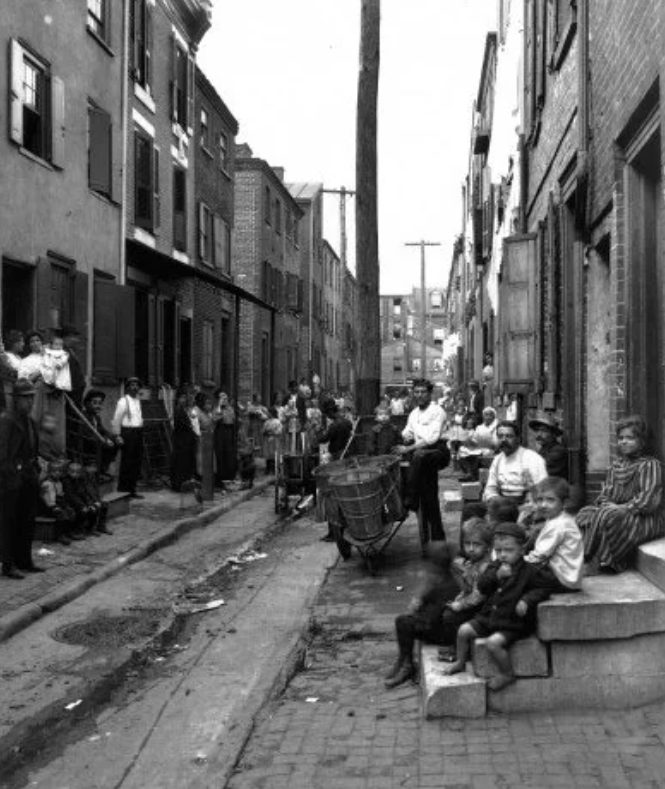
But I think this malady requires more than one prescription. Thomas Chalmers (1780-1847), the pioneer of the Free Church of Scotland in which Trueman spent many years, was even in his day deeply troubled at the disintegration of then-modern community. The Industrial Revolution had forced masses of country folk into the slums of Britain’s factory-choked cities. It grieved him to his core that these people were living in grinding poverty and were completely falling through the cracks of the Church of Scotland’s traditional spiritual care, forming a bloated underclass of unchurched “home heathen.” And the mechanized web of misery only strengthened its grip by the complete and utter absence of community. His assessment is surprisingly contemporary: “As the matter stands, juxtaposition forms no security whatever for acquaintanceship—insomuch that the members of distinct households might live for years under the same roof, unknowing and unknown to each other.”
What was to be done? Many voices called for state intervention, eventually leading Britain into the embrace of a bureaucratic welfare state. It seemed that to many, the old, tight-knit communities of the pre-industrial countryside were a thing of the past. With a sigh and a shrug, Britain moved on. But not Chalmers. Community, even in the grimiest, vilest dens of iniquity, could be re-formed. And how exactly? By the very antiquated ‘parish’ model of Britain’s Christian past.
Chalmers argued that the Church (two centuries ago!) should rediscover the parish idea. For him, it wasn’t an established church thing, necessarily; it was a Christian, stewardly, strategic thing. People still have bodies. They still live in places. The Church should not wait for them to come, much less form themselves into tight-knit Christian subcultures; the Church should adopt them, chalk out districts, and cultivate them evangelistically. They should seek them not only in the well-to-do neighborhoods, but courageously and lovingly pursue them into whatever dingy haunt they are pleased to call home. They should go there, befriend them, ingratiate themselves with them as they can, and introduce the “one thing needful.” They should not make ‘the world their parish,’ but take up a modest, defined neighborhood of souls, most of whom are probably pastorless and functionally neighborless. Let the leaven leaven the lump. And by the blessing of the Word and Spirit, as an individual here and a family there finds True Center, little nuclei of a shared few streets gravitate to each other in grace and rediscover–among many other things–the duty and opportunity of being a real neighbor. And that the “Gospel that comes with a house-key.”
Chalmers summarizes, “We know of no expedient better fitted to overcome this alienation, to annihilate this moral distance between our contiguous families, and more especially in the plebeian quarters of the town, than the re-establishment of this local, or strictly parochial system, in the midst of them.” A Gospel patron adopts a formless void of what he envisions can become a Christian vineyard. He labors to win them to himself “as a common centre,” that he may win them to Christ. Collaterally, “they would come to recognise and to feel the affinity of a certain mutual relationship to each other.” Prayerfully labor to create a “community of sentiment,” and what more is wanting for a community indeed?
I am rather confident that Chalmers would give a resounding ‘bravo’ to Trueman’s prescription. Indeed, every Christian can and should be a light in the darkness of their friends, coworkers, and next-door neighbors. We are community: let us recruit! And the tool of hospitality is a mighty engine to break down those barriers of secular, self-isolating individualism. But I think he would definitely want to give another prescription, ‘both-and.’ He’d especially urge church leaders to pioneer parish ministry beyond the church walls. Let pastors, elders, deacons (with their wives all three!) pioneer a parish ministry. Adopt-a-parish! There is more than enough territory to take, quite dispossessed of much real Christianity and void of any meaningful community.
Oh, and as Peter to Paul, just “don’t forget the poor!”
 West Port Experiment
Brilliant! Thank you for your insightful writing as always!! When are Chalmers and Guthrie having breakfast together? Any trips to Scotland planned?